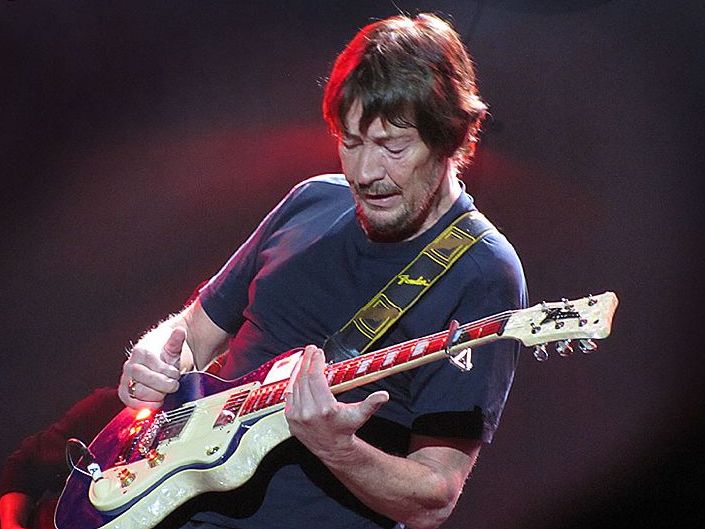
by Ben Hogwood, photo courtesy of Wikipedia (c) Dutch Simba
There was only one way Arcana could sign off for Christmas 2025 – with a tribute to the sadly departed and much-missed Chris Rea.
Before the inevitable finale, I wanted to share a couple of favourites from his considerable collection of excellent songs – this beauty from 1983:
The song Josephine has become something of a Balearic anthem, and is a sun-soaked beauty:
Speaking of sunshine, I had to include On The Beach, another dreamy song that proved versatile enough to be worked into a late 1990s trance hit:
And of course, finally, the ubiquitous Driving Home For Christmas, one of the staple Christmas songs with its wistfulness, charm…and patience!
With many thanks to all Arcana readers this year for your input and support, as well as gratitude for our fine writing contributions from John Earls and Richard Whitehouse. Arcana will return in the first full week of the New Year, but for now have a wonderful and peaceful Christmas, and all very best wishes for 2026 when it comes.
Ben Hogwood, editor, Arcana
Published post no.2,758 – Wednesday 24 December 2025
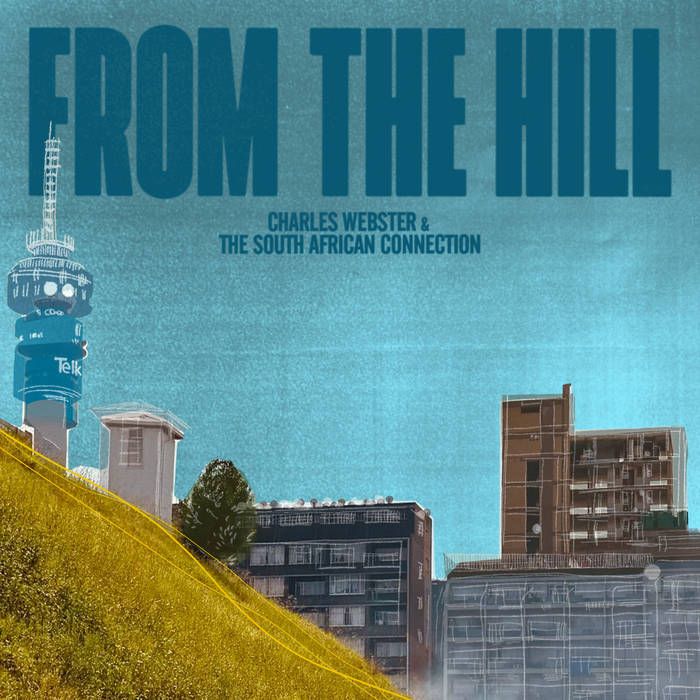
Charles Webster And The South African Connection’s new LP is a keenly anticipated set of work between the UK deep producer and the cream of the crop from South Africa. In a recent interview, Webster traces its roots:
“In 1997 when ‘Better Day’ by Presence came out, it was a hit on the radio in South Africa”…while “in England, it wasn’t on the radio at all”.
Webster boosted his profile in South Africa with a clutch of remixes, helping create a blueprint for a regional take on the deep, soulful house genre.
The press release documents the outcome of the project: “After the instant high of the project coming together so quickly and the collaborators all gelling effortlessly with Charles, Allan confesses that “there were moments where Charles was refining it, and I was thinking, how are we going to find this common thread between all these musical styles. Charles said don’t worry, this is what I do.”
What’s the music like?
Typically for Charles Webster, this is cool deep house music but with something extra. The Atmos Blaq collaboration Free is just that, an effortless piece of music with an airy trumpet break at its core, introducing The Artist, notable for Bokani Dyer’s vivid storytelling.
Many Blessings and the nippy A Journey channel the spirit of Matthew Herbert, while retaining Webster’s signature shuffle and liquid bass, while Film Me, From The Hill and Rain are classy downtempo numbers. The latter is especially evocative with its liquid guitar and sparkly vocal from Bokang Ramatlapeng.
Soweto Sunrise is a sultry beauty, but if anything Bakulindele is even better with its punchy organ riff and meditative vocal. Qiniseka, meanwhile, is magnificently brooding, and the rolling beats and cool keyboards of Part Two prove the ideal match.
Does it all work?
It does – the quality threshold is extremely high throughout!
Is it recommended?
Very much. Quality oozes from every pore of this record, which will up the winter temperature with its hot weather grooves and winsome, soulful vocals. Highly recommended!
Listen / Buy
Published post no.2,757 – Tuesday 23 December 2025
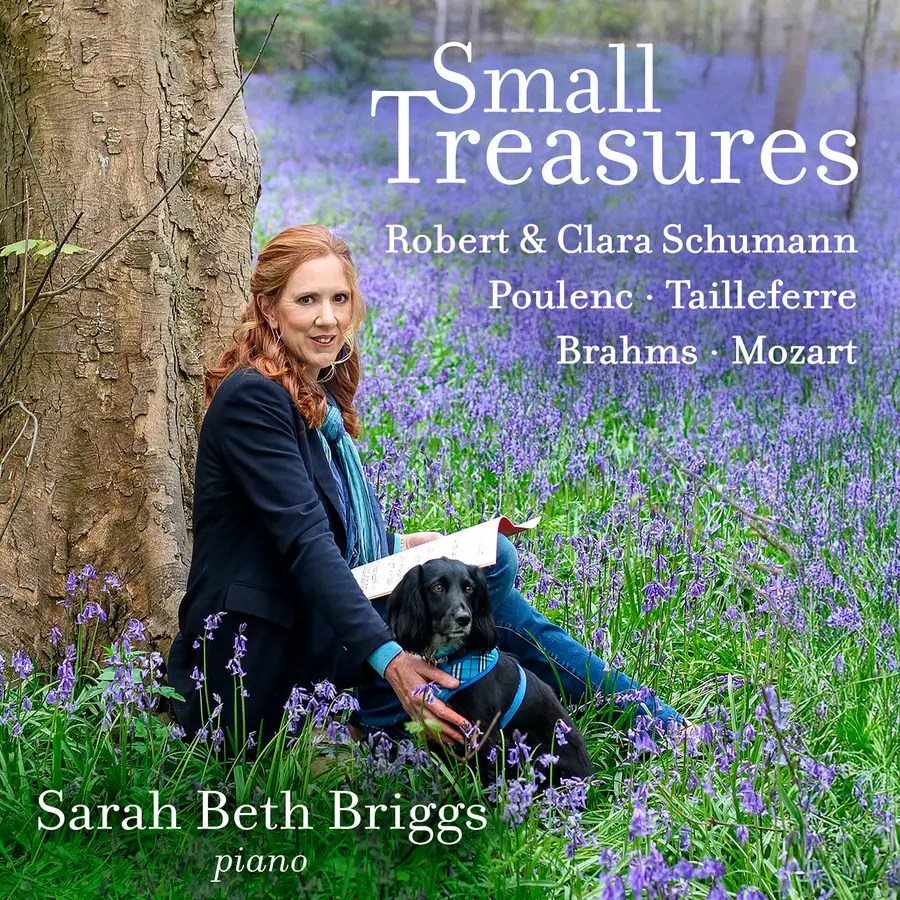
Small Treasures presents a typically inventive programme compiled by pianist Sarah Beth Briggs. In it she presents works by a trio of inseparable Romantic composers, with late-ish Robert Schumann, lesser-heard Clara Schumann and very late Brahms, his final compositions for solo piano.
Complementing these are thoughts from two members of Les Six, Germaine Tailleferre and Francis Poulenc – with the bonus of a cheeky encore from Mozart.
What’s the music like?
In a word, lovely. Briggs is a strong communicator, and finds the personal heart of Schumann’s Waldszenen – which is actually quite a Christmassy set of pieces. She particularly enjoys the intimacy of character pieces like Einsame Blumen (Lonely Flowers) and the delicate but rather haunting Vogel als Prophet(The Prophet Bird), beautifully played here.
A tender account of Robert’s Arabeske is a welcome bonus, an intimate counterpart to the more extrovert Impromptu of Clara. Written in c1844, the piece floats freely on the air in Briggs’s hands. By contrast the Larghetto, first of the Quatre Pièces Fugitives, inhabits a more confidential world, one furthered by a restless ‘un poco agitato’. The Andante espressivo, easily the most substantial of the four, is more serene, and it is tempting to draw a link between this and the mood of Robert’s Traumerei, from Kinderszenen. The Scherzo with which the quartet finishes is charmingly elusive, with clarity the watchword of this interpretation,
Poulenc’s Trois Novelettes are typically mischievous and elegant by turn, spicy harmonies and bittersweet melodies complementing each other, before Tailleferre’s Sicilienne, a charming triple-time excursion with a bittersweet edge.
The Brahms Op.119 pieces are serious but have plenty of air too, and the final majestic Rhapsody is grand but not over-imposing, Briggs resisting the temptation to go for volume over expression.
Does it all work?
It does – and the album is easy to listen to the whole way through, the lightness of the Mozart Eine Kleine Gigue complementing the Brahms at the end. Some of the classic recordings of the Brahms and Schumann pieces arguably find more angst, but these finely played accounts are a treat, especially in context.
Is it recommended?
It is. Rather than visit a playlist on your go-to streaming service, you can just put this album on to create a very satisfying recital. Small Treasures, indeed – as is Sarah’s dog, who joins her on the album artwork!
Listen / Buy
You can listen to Small Treasures on Tidal here, while you can explore purchase options on the Presto website
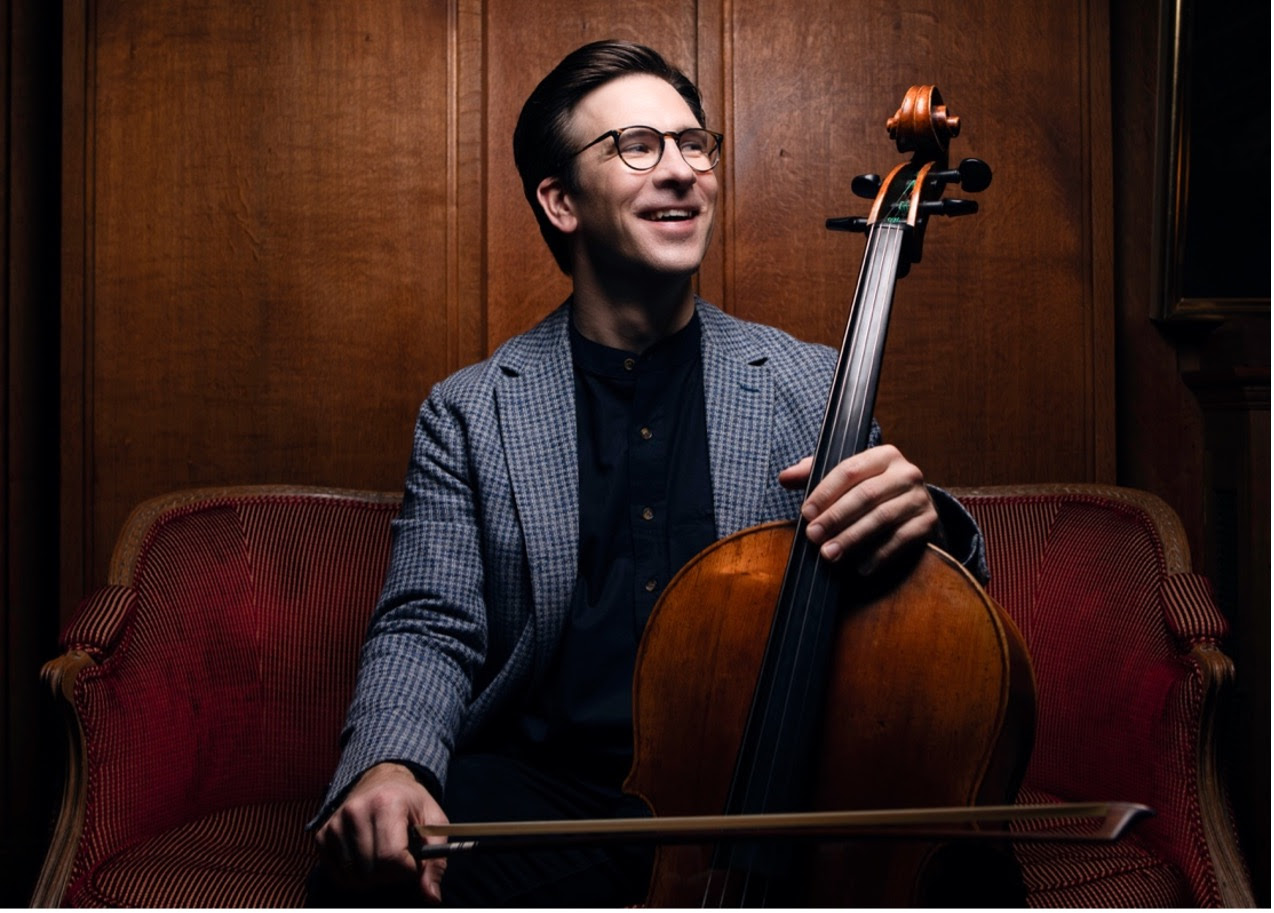
On 16 January 2026, Johnston will give the world premiere of Joseph Phibbs’ Cello Concerto at the Barbican with the BBC Symphony Orchestra conducted by Clemens Schuldt. In 2021,Johnston previously premiered Joseph Phibbs’ Cello Sonata, partly based on an Elizabethan pavane found in the archive of Hatfield House.
Phibbs (below) says about the work:
“This concerto is in five movements, the first and last scored for cello and strings only. The work opens softly with a short Invocation – a type of prayer – which leads without a break to an ebullient and at times abrasive Aubade, the cello moving from its lowest to highest range. The subdued central Elegy hones in on the celebrated lyrical qualities of the cello, before an agitated Notturno presents an unsettled, ever-shifting dialogue between the cello and orchestra, with a virtuoso cadenza featuring towards its close. A short Vocalise, adapted from a sonata Guy commissioned several years ago, ends the work on a note of resolution.
As one of the very finest cellists of his generation, I wanted to bring out Guy’s extraordinary expressive qualities as well as his dazzling technical prowess. The result was music which is often lyrical and emotionally direct sitting alongside that which is harder-edged, and at times frenetically virtuosic.”
This concerto appearance is part of a wider cello odyssey to record the major British cello repertoire. Following the digital release of the Bliss Cello Concerto with the RLPO on Onyx Classics in July 2025, Guy recorded Tavener’s The Protecting Veil with Britten Sinfonia in St Sophia’s Greek Orthodox Cathedral in October 2025 to be released on Signum in 2026. Early 2027 will see a physical release of the Britten Cello Symphony coupled with the earlier recording of the Bliss Cello Concerto with the RLPO on Onyx Classics. Also to be released in 2027 are recordings of Walton’s Cello Concerto and Barber’s Cello Concerto with the Bournemouth Symphony Orchestra.
The 2025-2026 season coincides with Johnston’s returns to the Royal Academy of Music as a Professor of Cello. This role will see him offer bespoke tuition to cello students throughout the year. Johnston started out as a professor at the Academy in 2011, later becoming visiting professor. The appointment follows Johnston’s recent relocation back to the UK following his tenure at the Eastman School of Music in Rochester, NY, from 2018 to 2024.
In my humble opinion, 2025 has been a brilliant year for new music. Over the course of the year I have listened to more than a hundred new albums and have been fortunate enough to review a good many of them for musicOMH (Suede, Kae Tempest, Gruff Rhys and Cate Le Bon being just four examples) and here as editor of Arcana.
Rather than restrict our thoughts to numbers or ratings, I wanted simply to present albums that Richard Whitehouse and I have reviewed here and have been returning to frequently. You’ll see the musical variety on show is as broad as this site would like it to be! So, in chronological order…
…try listening to C Duncan’s It’s Only A Love Song without being drawn into his weather-beaten world of romantic expression. This is another beautiful and personal album, Duncan’s voice and musical command only improving with time. Tunng’s return is a cause for celebration, and the band’s lates album Love You All Over Again is a typically winsome mix of quirky musical thoughts and unexpectedly concentrated emotions, all expressed through catchy melody.
At the start of last year, California was in the grip of terrible fire. The musical response was nothing short of extraordinary, not least from Leaving Records, whose massive compilation Staying not only kept a high musical bar of ambience – in spite of the terrors – but raised money for the area’s troubled residents.
Gavin Higgins continues to prove himself to be one of the most interesting voices in classical contemporary music these days. If you wanted a good place to start, think no further than his 2025 album The Fairie Bride, a Lyrita release including the Horn Concerto.
Moving sideways into the worlds of shoegaze and electronica, we have a series of rather wonderful releases that graced the headphones in 2025. Guitarist Andy Bell – prior to reclaiming his position in Oasis – released the excellent pinball wanderer album, a record that proved to be “equal parts Krautrock and Manchester”, while over at Castles In Space, Andrea Cichecki found “an inner serenity and brightness” on her album Drawn Into The Edge Effect, bringing positive energy to her ambient music. Speaking of ambience, Pye Corner Audio also found the sweet spot that blends relaxation and invigoration, with the heavenly Lake Deep Memory album.
Bureau B continued their streak of excellence with one of the year’s best compilations. Silberland Vol.3 celebrates the ambient side of Kosmische Musik with music of great colour and charm. Darker worlds were explored by the electronica of the remarkable Cosey Fanny Tutti, whose new chapter 2t2 proved a compelling and occasionally foreboding piece of work. Similarly well-established are the Matmos duo, and like Cosey their spirit for exploration goes undimmed. Metallic Human Nature only allows metallic objects in its discourse, but the imagination of the pair comes through in their use of creaking doors, pots and pans to make a surprisingly moving whole.
Baxter Dury has a sort of charm, though you wouldn’t want to get on his wrong side! Allbarone is his finest solo achievement to date, channelling his family influence but raging against city slickers and the like in a series of wickedly funny and extremely catchy songs, ably assisted by JGrrey.
More music of a rhythmic bent comes from Ten City, with their joyous celebration The Next Generation. There are several spiritual highs to be enjoyed within their house music, thanks to a set that frequently hits the highs.
With these albums suitably praised, who should take the album of the year? Well I’m going to give it to the record I’ve revisited most often…which is Andy Bell’s pinball wanderer. Listen to it a few times and you’ll see what I mean!
Published post no.2,754 – Saturday 20 December 2025



 Arcana.fm