John Beltran continues undimmed. The Michigan-born producer has been making albums since 1995, establishing himself as a leading exponent of ambient techno – but along the way showing us that he should not be restricted to that genre alone.
Serendipia finds him exploring his love of all things Balearic for the Oath label, and taking the opportunity to bring in references to Brazilian music and jazz.
What’sthemusiclike?
Music like this demands a cocktail and a large expanse of water. Serendipia will come as a lovely surprise to those who might have had John Beltran pinned down as a home studio producer, for it brings in a wide range of percussion, waves lapping at the shore in its beautifully realised down tempo treats.
Beltran creates a tropical infusion, with typically classy production but with a sultry atmosphere heightened by languid guitars and extra percussion. There are some lovely jazzy solos from guitar and keys, with the opening Taina an excellent example, but these are tasteful and never overdone.
Sa Coma Blue features a vocal cameo from regular collaborator John Arnold and sounds uncannily like the intro to Lady In Red – but styles it out with lazy guitar and hazy textures. It is typical of Beltran’s open air music, where widescreen textures put the listener in an exotic environment, while the close-up detail gives evidence of an expert technician.
Aşk Anları shows off those expansive sound pictures, while the more thoughtful tracks – such as La Hermosa Vista – bring the ideal blend of slow moving chord sequences and thrumming percussion loops.
Does it all work?
It does – effortlessly so. The combination of electronics, easy guitars and jazz-inflected solos is a winning one, especially with the rhythm section Beltran supplies.
Is it recommended?
Yes – an easy decision. An album to spend time with in the hot weather, for sure!
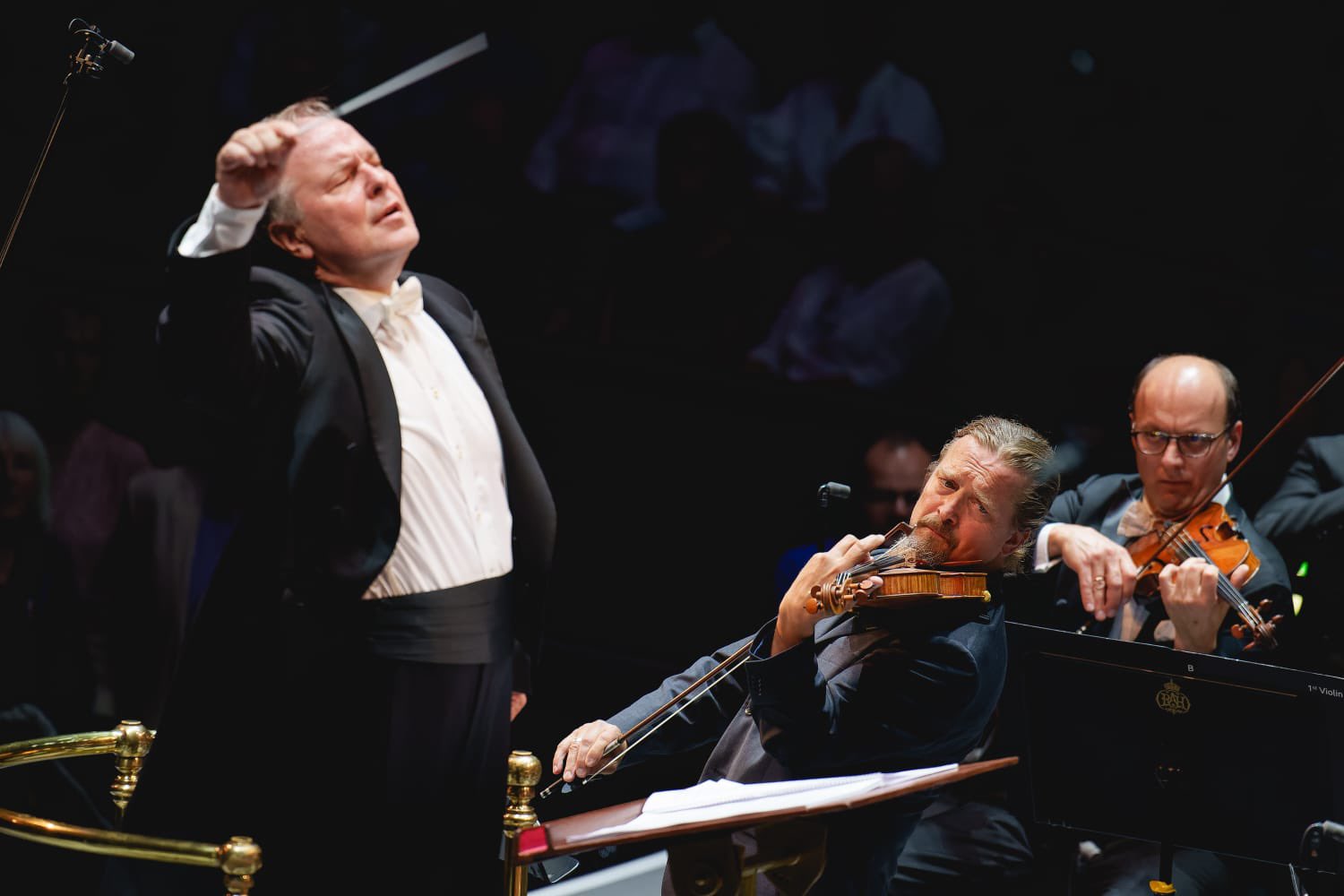
Prom 51 – Christian Tetzlaff (violin), BBC Symphony Orchestra / Sakari Oramo
Weir Begin Afresh (BBC commission, world premiere) (2022-3) Schumann Symphony no.1 in B flat major Op.38 ‘Spring’ (1841) Elgar Violin Concerto in B minor Op.61 (1907-10)
Royal Albert Hall, London Thursday 24 August 2023
by Ben Hogwood photos by Andy Paradise / BBC
The BBC Symphony Orchestra and their chief conductor Sakari Oramo have been on fine form this Proms season, and for their fourth outing together chose a concert whose first half celebrated the vibrancy of spring.
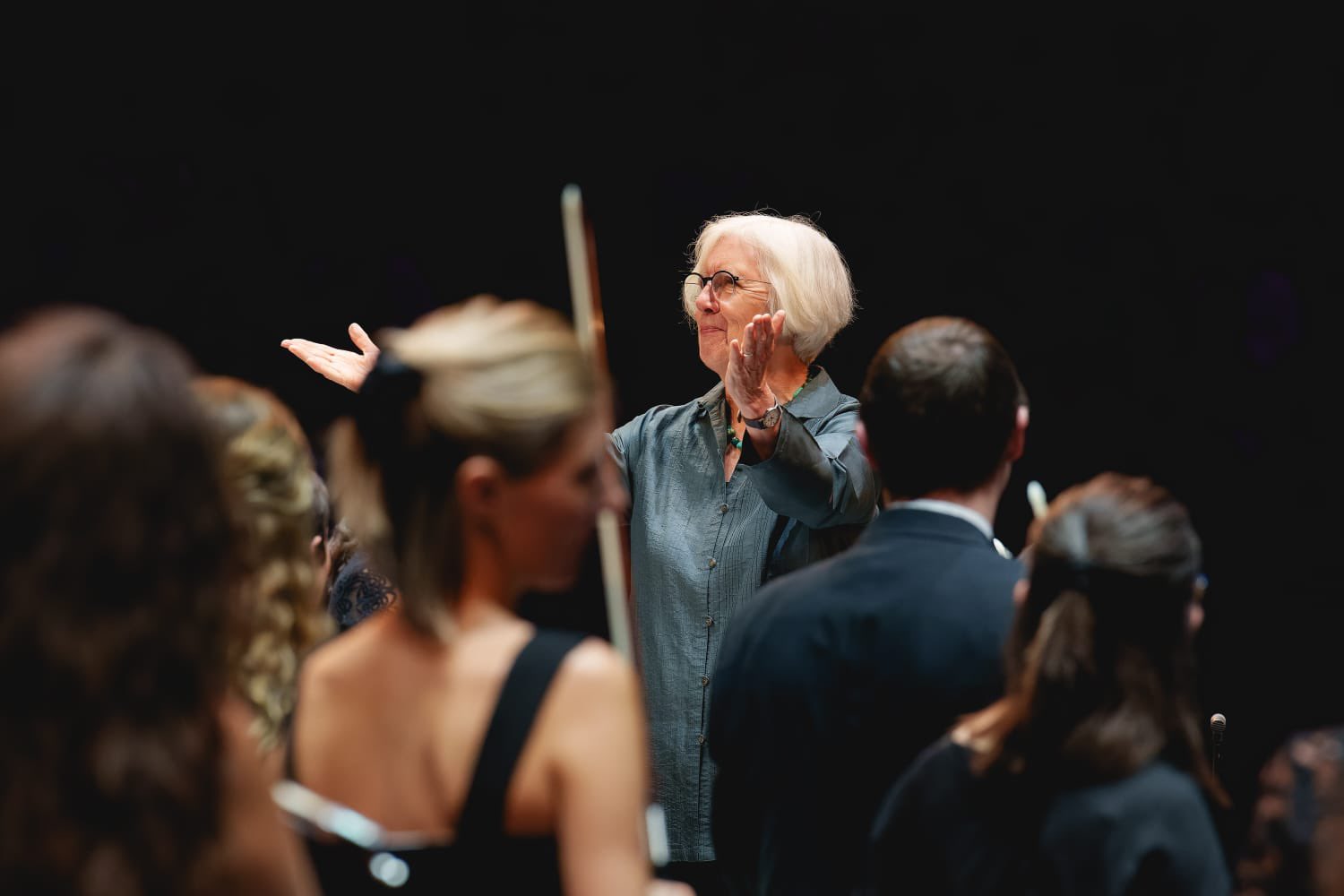
Judith Weir (below) has already written about green matter for orchestra, with her tone poem Forest premiered in 1995 and appearing at the Proms in 2019. Begin Afresh, its title inspired by Philip Larkin verse, takes a more forensic approach, looking at the wonder of trees in an urban setting. Effectively a musical diary, it begins in April, where we found orchestra leader Igor Yuzefovich teaming up with the woodwind section to lead an awakening from months of darkness. Fresh textures and opulent harmonies promised much, but October assumed a heavier tread, trees struggling to produce leaves with the onset of colder weather. Darker colours, including the sharper tone of the piano, came to the fore, but there was strong resolve reminiscent of Sibelius in the colours and phrasing, tonal but restless. True darkness set in among the lean lines of February, where roots fought against the frost, their sinewy profiles etched by the lower strings. Begin Afresh found its victory to be hard-won, but proved to be an attractive and pictorial piece deserving of more outings in the future.
Schumann’s Spring symphony, written in 1841 in the heady aftermath of his marriage to Clara, occupied an odd place in the program but benefited from a freshly minted performance. The initial fanfare set the tone for an interpretation of clarity and poise, the burbling woodwind on fine form. The ensuing Allegro molto vivace was bracing, and was complemented by a softly voiced second movement Larghetto. Here the softer shades were ideally weighted, the strings’ intimate thoughts conveyed with deep feeling. The Scherzo found the violins applying extra force, the theme balanced by two light-footed trio sections that danced happily. Oramo’s fluent reading of this wonderful symphony ended with a convincing last movement affirmation.
If spring was the main focus of the first half, Elgar’s Violin Concerto was ideally suited to late summer. There are many violin concertos in this year’s season – 13 at last count – and although this is the longest work by some distance, it did not tarry here. This was thanks in part to relatively quick tempo choices but mostly due to wholehearted investment from Oramo and soloist Christian Tetzlaff, who clearly loves the piece. From his first statement the violinist was in full, assertive control yet his most meaningful contributions were also the quietest, beckoning the audience in to Elgar’s most intimate thoughts and emotions.
The orchestral counterpoint was clearly and carefully managed by Oramo, himself a dignified Elgarian, with opportunity given for the strings to release ardent feelings in the climax points. The main themes were lovingly delivered, especially in the rapt slow movement Andante, the audience largely silent as the compelling dialogue took hold. While Tetzlaff took every opportunity for virtuoso display, reminding us that no less a violinist than Fritz Kreisler commissioned this work in 1904, none of the acrobatics were for personal gain. Instead they were at the service of Elgar’s expression, which made the final pages all the more telling. As the quiet music took hold a chill spread through the music, a sombre realisation that love – in this case – might not prevail. This realisation unwittingly found a parallel, a musical realisation of the temperatures dropping and the nights drawing in as they do in late August.
The concerto may have had an affirmative finish but these thoughts remained, reinforced by a tastefully restrained encore of the Andante from Bach’s Solo Violin Sonata no.2 in A minor BWV1003. As with the performance before, it was beautifully judged.
If you are a regular visitor to Bandcamp, you will know the musical riches and rewards that are available, both for streaming and for purchase.
The electronic band Broads – who are Norwich-based Mark Jennings and James Ferguson – have made a third set of B-sides and alternative versions available on the site for a ‘name your price’ fee.
Established listeners will know that theirs is an inventive, organic brand of electronica that responds really well to repeated listening – and so comes highly recommended from these parts. The cleverly titled B-roads Vol. III is available here:
It is relatively rare for electronic albums to be performed ‘as live’ – but that is what Saloli achieves with Canyon. Saloli – the Cherokee word for ‘squirrel’ – is the alias under which Portland pianist and instrumentalist Mary Sutton operates,
The whole album is performed on a Sequential Circuits MultiTrak synthesizer, routed through a delay pedal to add the spatial quality of ‘echoing off canyon walls’.
There is a concept powering Canyon, too, the album evoking ‘a day in the life of a bear in a canyon in the Smoky Mountains’. As the press release explains, ‘in Cherokee teachings, humans and animals are considered to have no essential difference – originally, all the creatures of the earth lived together in harmony.’ The album’s cover art is by Sutton’s father Jerry, its yellow lettering using Cherokee Syllabary and spelling ‘Yona’, which means ‘bear’.
What’sthemusiclike?
Strong in character. Saloli’s writing is very ‘in the moment’, creating portraits full of colour and musical content.
Waterfall shimmers and glistens in the light, the melodic patterns of the synthesizer sustained as they bounce around the sonic picture. At this point Saloli’s music resembles earlier Philip Glass, both in its melodic language and its pleasingly rough timbre. This is clearly music evoking the outside, and is all the better for its untampered state.
Lily Pad is much more fragile, the live setting capturing the surface tension of the water on which it sits, while Snake is more obviously right and left hand, as arpeggios in the left complement higher melodies in the right.
The sonic picture changes strikingly for Yona, the playful bear portrait, whose lack of reverberation makes this feel a close-up, indoor encounter. Panning out again we hear the softer Silhouette, whose vibrato casts a spell and draws parallels with Wendy Carlos.
Full Moon brings a pipe-organ sonority to Saloli’s music, wide-eyed and brightly lit, the echoes used again to playful effect. The slightly jaunty mood continues to the elusive Nighthawk, the left hand on the keyboard establishing a Habañera-type rhythm while trying to pin down an elusive right hand melody.
Saloli ends with the exhilarating Sunrise, its rippling arpeggios telling of the light forcing its way upwards out of the darkness and into the day. Its evocative growth from subtle flickers to stabs of daylight shows Sutton’s skill at painting pictures in sound.
Does it all work?
It does. The intimate portrait of the bear is slightly curious, given the animal’s size, but it is typical of the personality running through Sutton’s music. This is electronic music with a beating heart, for sure.
Is it recommended?
It is. Saloli has made an album of instrumental tone pictures with lasting character and quality.
Too High (arr. Rob Taggart) Visions (arr. Callum Au) Living for the City (arr. Jochen Neuffer) Golden Lady (arr. Neuffer ) All in Love is Fair (arr. Tommy Laurence) Superwoman (Where Were You When I Needed You) (Music of my Mind, arr. Neuffer) They Won’t Go When I Go (arr. Tim Davies)a Jesus Children of America (arr. Davies) He’s Misstra Know-It-Allb Creepin’ (Fulfillingness’ First Finale, arr. Taggart)c Something Out of Blue (Where I’m Coming From, arr. Davies)c Higher Ground (arr. Neuffer) Never Dreamed You’d Leave in Summer (Where I’m Coming From, arr. Davies)d Don’t You Worry ’bout a Thing (arr. Tom Richards)d Superstition (Talking Book) If It’s Magic (Songs in the Key of Life)
by Richard Whitehouse photos by Andy Paradise / BBC
From Nina Simone then Aretha Franklin to Stevie Wonder – these ‘tributes’ masterminded by Jules Buckley have become as much a Proms staple as were John Wilson’s stage-and-screen projects, with the 50th anniversary of Innervisions too notable an occasion to be passed over.
Now routinely hailed as one of the greatest albums, Innervisions was not always held in such esteem – being considered strong in atmosphere if short on hooks, which is rather to miss the point of its nine numbers merging into a seamless continuity broken only with the side-break of the LP. It duly elides between songs of love, self-awareness and social commentary with a mastery abetted by Wonder’s ingenuity as a musician and his skill as a producer; indeed, few albums, from what was to be the heyday for production, can rival its tangible space or depth.
Wonder’s distinctive if by no means inimitable voice makes his songs ideal for covering and, in Cory Henry, have a consummate keyboardist and eloquent singer able to encompass their conceptual and emotional range. Hence the dextrous organ intro’ then big-band stylings that underpinned the breezy ambivalence of Too High, or soulful communing of Visions with its textural enhancements from flute and electric guitar. It may have lacked the original’s urban ambience, but Living for the City emerged as an anthemic parable of racial injustice; then the amorous overtones of Golden Lady were enhanced by its shimmering slow shuffle.
An edgy vocal complemented the insistent groove of Higher Ground with its electronic and synthesized sounds which are no less intriguing today, while the Christian confessional that is Jesus Christ of America exuded piety but no undue emoting. The moodily reflective aura of All in Love is Fair benefitted from that deft backdrop of strings, as did the Latino-inflected jive of Don’t You Worry ’bout a Thing as here made for an irresistibly upbeat ending to the album itself. Typical of Wonder, though, that he should have concluded the original’s playing order with the snide political diatribe of He’s Misstra Know-It-All and which can still punch like a velveted fist when rendered, as here, with the allure of guest vocalist Lianne La Havas.
This begs the question as to whether such a classic album is best heard as an integral unity or interspersed, as was its second side, with other items – which latter course enabled a capacity house to sample each of those albums from Wonder’s ‘golden age’. Thus, the composite that is Superwoman (Where Were You When I Needed You), its interplay of easy grooves with fatalistic thoughts ably rendered by Henry, but the pensively resigned They Won’t Go When I Go felt coarsened and sentimentalized by histrionics from guest vocalist Laura Mvula. Not so the darkly insinuating Creepin’ with superb lead from backing vocalist Vula Malinga, who duetted with Henry on the burnished Something out of the Blue. A star of last year’s Aretha tribute, Sheléa handled the soaring pathos of Never Dreamed You’d Leave in Summer with aplomb, then all reassembled for a rousing send-off in the inevitable guise of Superstition.
It could have ended there, but Henry returned for a rendition of If It’s Magic in its original (and superior) version – confirmation that Stevie’s output will long remain a thing of Wonder.






 Arcana.fm