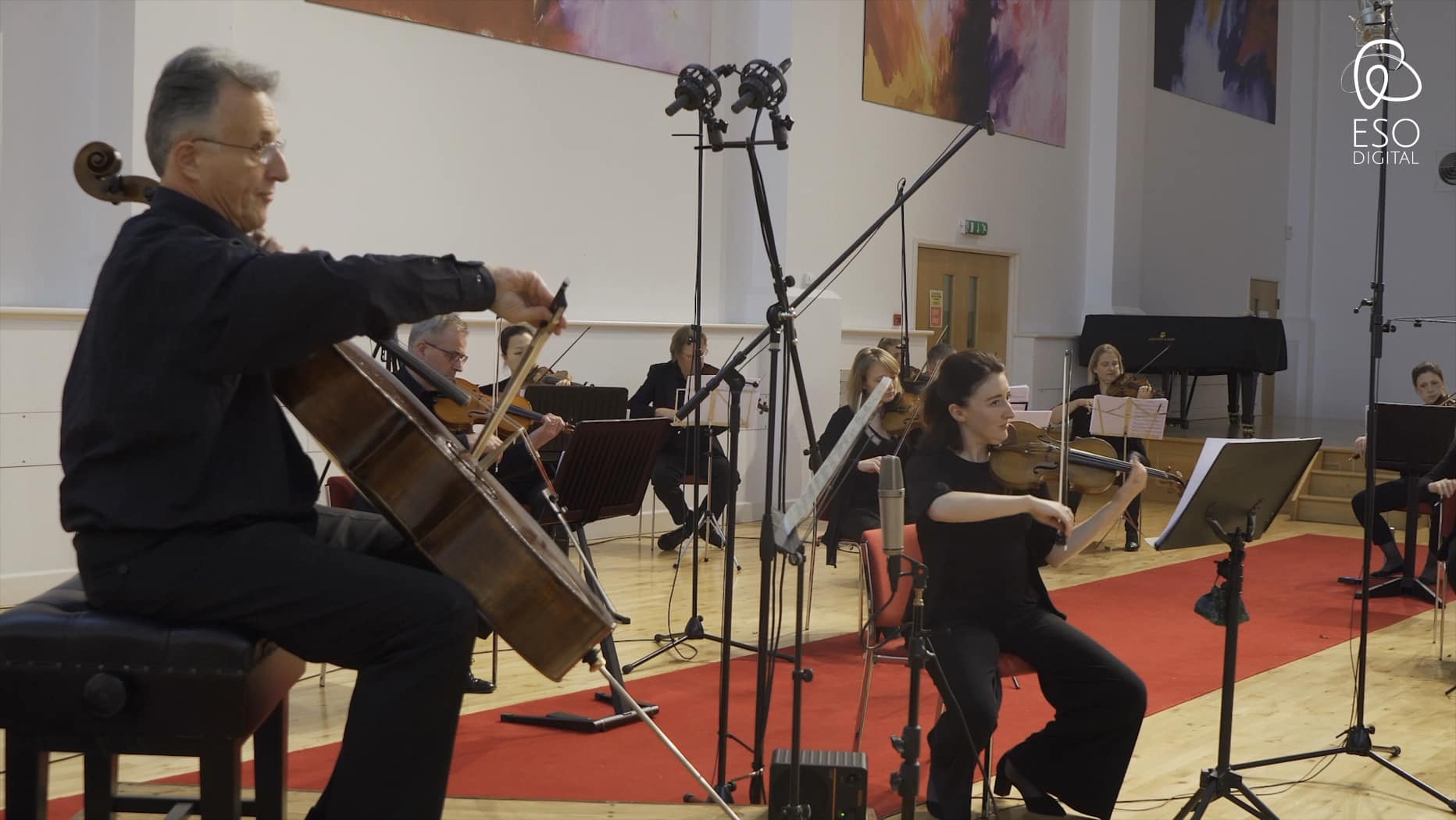
Online concert – Raphael Wallfisch, English Symphony Orchestra / Kenneth Woods: Elgar Reimagined

Elgar, arr. Fraser Miniatures for cello and strings: Chanson de Matin; Chanson de Nuit; The Wild Bears (Wand of Youth Suite No.2); Nimrod (Enigma Variations); Romance Op.62; Sospiri Op.70; Mazurka; Pleading; In Moonlight; Salut d’Amour; Adieu

Raphael Wallfisch (cello), English Symphony Orchestra / Kenneth Woods

Live performance at Guildhall, Worcester, 29 October 2021

by Richard Whitehouse

An afternoon concert at last year’s Elgar Festival, these Miniatures for cello and strings had been arranged by Donald Fraser for Raphael Wallfisch. Extending to an 11-movement suite, its viability in terms of smaller groupings was certainly demonstrated by this performance.

Chanson de Matin provided a mellifluous entrée, and if the cello’s assumption of the melodic line marginally obscured the strings’ contribution, that could not be said of Chanson de Nuit whose sombre inwardness was unerringly realized. Nor did The Wild Bears lose on impetus, and if the arrangement conjured Saint-Saëns, this only served to underline the importance of ‘Second Empire’ music on Elgar’s own thinking. Interesting, too, how the Romance brought soloist and strings into an even closer accord than the composer’s version with orchestra. The highlight, however, was Sospiri, for presenting one of Elgar’s finest inspirations in a striking new light. Salut d’Amour then conveyed the music’s essence without cloying, but the cello’s dominance in Nimrod detracted from its subtlety of orchestration as an ‘Enigma Variation’.

A wistful take on Adieu provided an affecting encore, but almost all these pieces would make a viable such item after the Cello Concerto or another British concertante work. What was a relaxed occasion does not imply any less commitment from Wallfisch and the English String Orchestra, heard to advantage with Kenneth Woods in the acoustic of Worcester’s Guildhall. The Miniatures sequence can be heard in full on Elgar Reimagined (Lyrita), but this selection offered an attractive contrast to those larger symphonic works heard elsewhere at the festival.

These works are available for viewing on the English Symphony Orchestra website, by way of a subscription or free trial. Further information on the Elgar Reimagined series can be found here. Meanwhile click on the names for more on Raphael Wallfisch, the English Symphony Orchestra and Kenneth Woods
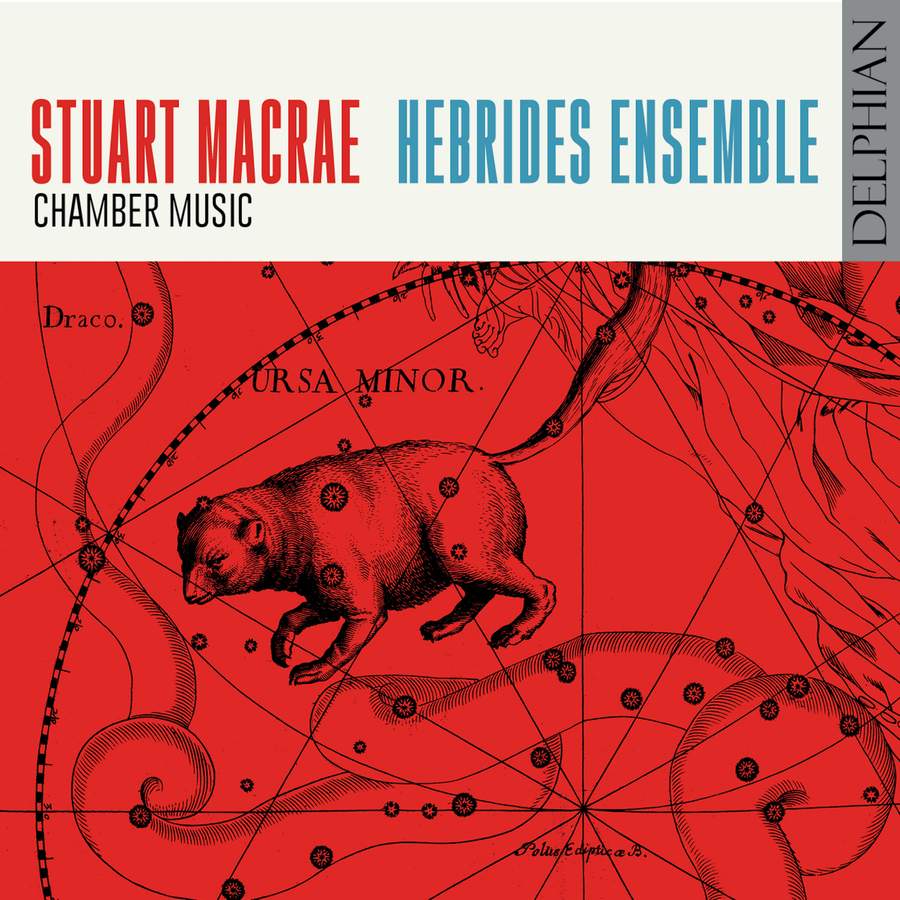
On record – Hebrides Ensemble – Ursa Minor: Chamber Music by Stuart MacRae (Delphian)

macrae

Joshua Ellicott (tenor), Marcus Farnsworth (baritone) / Hebrides Ensemble / William Conway (cello)

Stuart MacRae
I am Prometheus (2018); Dark Liquid (2020); Ixion (2013); cladonia bellidiflora (2014, rev. 2020); Tol-Pedn (1999); Lento in memoriam Peter Maxwell Davies (2016); Ursa Minor (2020); fthinoporinos (2001); Diversion (The room behind the room behind the room) (2020); Parable (2013)

Delphian DCD34258 [76’46”]

Producer / Engineer Paul Baxter

Recorded 12-14 August 2021, Queen’s Hall, Edinburgh

Written by Richard Whitehouse

What’s the story?

A timely follow-up to the NMC release of 15 years ago, this Delphian collection surveys over two decades of Stuart MacRae’s output – indicative of a personal and incrementally evolving idiom such as reaffirms his status among the leading European composers of his generation.

What’s the music like?

Most substantial is Ixion, the luckless figure from Greek mythology represented in a sequence of eight ‘moments’ where the motifs heard at the start variously combine and evolve without any underlying progress – as befits the motion of an endlessly rotating wheel. A fine addition to the repertoire for clarinet trio, as is cladonia bellidiflora for the even more restricted one of violin and cello as it gradually fuses these instruments into an inextricable, lichen-like entity. Inspired by a Cornish headland and alluding to Byrd, the early Tol-Pedn conjures a seascape the more potent for its eschewal of mere realism, whereas the recent Ursa Minor evokes that constellation in comparable terms of incrementally accruing change – amply reinforcing the consistency of MacRae’s musical idiom whatever those developments that have taken place.

A further side of MacRae’s creativity is here conveyed by the shorter pieces. Emerging out of lockdown, Dark Liquid reimagines the valedictory bagatelle associated with Silvestrov, while Diversion has a capricious or even insouciant playfulness. Lento in memoriam Peter Maxwell Davies evokes that composer’s lesser-known piano miniatures in poignantly restrained terms, while fthinoporinos (Greek for ‘autumnal’) is a transcription of the second movement from MacRae’s Violin Concerto (recorded on NMCD115) and an eloquent memorial to Xenakis.

Framing this collection are two vocal works. I am Prometheus uses the composer’s own text to evoke the Titan, neither Man nor God but invested with those attributes – whether good or bad – of both, while he endures a punishment meted out for what MacRae aptly describes as ‘‘his exceptionalism’’. Unfolding from the anger of captivity to the hopelessness of solitude, its musical trajectory is as arresting as it is inevitable – which might also be said of Parable. This stark setting of Wilfred Owen’s poem is appreciably different from that of Britten in the ‘Offertorium’ of his War Requiem, not least in the way the vocal part threads its way through an ensemble where the range of gestures affords a graphic evocation of the biblical story and its fateful ‘distortion’: one whose outcome can only be the collapse into mindless repetition.

Does it all work?

Yes, through MacRae’s imaginative response to the subject-matter at hand as well as an acute sense of timbre and texture in whatever context. It helps when the performances are so finely attuned, a reminder of the close working association between this composer and the Hebrides Ensemble. The contributions from Joshua Ellicott and Marcus Farnsworth are no less ‘inside’ their respective pieces, while the recording is fully up to Delphian’s customary high standard. Nor are the annotations by Tim Ruthford-Johnson found wanting in perceptiveness or insight.

Is it recommended?

Indeed, in the hope further releases of MacRae’s music from this source will be forthcoming. Maybe one or other of the operas that have dominated the composer’s output in recent years will become available on DVD? In the meantime, this Delphian portrait is required listening.

Listen

Buy

For more information on the disc you can visit the Delphian website – and to buy visit the Presto website To read more on the artists, click on the names of Joshua Ellicott, Marcus Farnsworth, Hebrides Ensemble and William Conway. Meanwhile a site dedicated to Stuart MacRae can be accessed here

In Appreciation – David Lloyd-Jones

by Ben Hogwood

This week we have learned the sad news of the death of conductor David Lloyd-Jones, at the age of 87. David was instrumental in founding Opera North in 1978, and there is a heartfelt tribute on their website in his honour.

While Lloyd-Jones was a highly respected opera conductor, I have chosen to focus on his many and pioneering recordings of English music by way of a tribute. These include extensive surveys of the orchestral music of Stanford (including a symphony cycle), Alwyn, Bliss, Rawsthorne and Arnold Bax, including another survey of his symphonies, and Holst – with an important disc of his orchestral music released in 1998. Here is just a hint of his discography for Naxos, with highlights from some very impressive recordings:

In Appreciation – Julee Cruise

by Ben Hogwood

Yesterday we learned the sad news of the death of Julee Cruise, at the age of 65.

Cruise will forever be associated with director David Lynch and the cult TV show Twin Peaks, which made its debut in 1990. Four years prior to that, when looking for a song for his equally influential film Blue Velvet, Lynch was looking for a song instead of his initial target, This Mortal Coil’s Song to the Siren. Composer Angelo Badalamenti stepped in, enlisting Cruise as the voice for his remarkable song Mysteries of Love, where the voice is supported by airy, padded synthesizers:

Four years later Badalamenti and Cruise collaborated again, this time on the theme for one of the most influential of all TV series. Twin Peaks‘ calling card was its remarkable music, and Falling embodied its glamour but also its darkness. Even now Badalamenti’s score is regarded as one of the most influential small screen soundtracks, its dark but luminous writing an utterly compelling blend – topped, of course, by the breathy control of Cruise, whose voice commands the work with remarkable subtlety.

You can listen to Falling below, but for a thorough appreciation of Cruise’s life and work I would direct you to an excellent obituary for The Guardian by Dorian Lynskey

In concert – Soloists, CBSO Chorus & CBSO / John Butt: Handel’s Messiah

John-Butt

Handel Messiah HWV56 (1741)

Mary Bevan (soprano), Reginald Mobley (countertenor), James Gilchrist (tenor), Christopher Purves (baritone), CBSO Chorus, City of Birmingham Symphony Orchestra / John Butt (harpsichord)

Symphony Hall, Birmingham
Wednesday 8 June 2022

Written by Richard Whitehouse

Unlikely as it might seem, the CBSO Chorus had never given Handel’s Messiah before this evening – the regular stream of performances by choral societies or the City of Birmingham Symphony Orchestra having other priorities putting paid to any such intention until tonight.

Not that Messiah has ever lacked for performances since its Dublin premiere in April 1742 – after which, it soon became recognized as, if not necessarily the finest of Handel’s numerous oratorios, then certainly the most representative; a template for the genre such as dominated music-making in Britain over the next 175 years. His text drawn freely from the Old and New Testaments, Charles Jennens relates Christ’s birth, death and resurrection then triumph of the Christian gospel in meaningful while not profound terms as were bound to strike a resonance.

Formerly the work falls into three parts of 16 scenes and 53 individual (not always separate) numbers, ranging from brief solo recitatives to lengthy arias and extended choruses in what became a blueprint for those oratorios as followed apace over the next decade. Although all four soloists share in relating aspects of the narrative, there is no division into specific roles as in Passion settings; itself a sure means of conveying a dramatic scenario without the need to endow musical content with an overly theatrical aspect as might have become distracting.

Tonight’s soloists evidently had no lack of familiarity with the work. For all their individual excellence, the deftness of Reginald Mobley’s lightly inflected alto, mellifluousness of James Gilchrist’s high tenor and elegance of Christopher Purves’s lyric baritone perhaps limited the emotional contrast possible between solo items. This was hardly the case with Mary Bevan (above), whose eloquent assumption of the soprano numbers, not least an I know that my Redeemer liveth as brought out the pathos of music that long ago seemed to have become its own stereotype.

Otherwise (not unreasonably) it was the choral items which really hit home. Enthused by the chance to sing this work the CBSO Chorus gave its collective all: whether in those energetic earlier choruses, fervent anticipation of Glory to God in the highest, contrapuntal vigour of Hallelujah or the majestic accumulation of Worthy is the Lamb, whose elaborate ‘Amen’ was powerfully rendered. Simon Halsey and Julian Wilkins (behind the organ manual) had evidently ensured that, for the CBSOC’s rare outing in this work, nothing was left to chance.

Not that the CBSO’s contribution was found at all wanting. Avoiding a temptation to try out one of the latter-day orchestrations, the string sections were modest (10.8.6.4.2) while almost always achieving a viable balance with the chorus. Bassoon, theorbo and organ constituted a discreet continuo, Matthew Hardy’s timpani underpinned the final choruses and Gwyn Owen was superb in the concertante role of The trumpet shall sound. Directing at the harpsichord, John Butt secured playing of incisiveness and depth with no recourse to specious authenticity. Given that the CBSO Chorus celebrate its half-century next year, it might have been thought advisable to schedule this performance during 2023. No matter – tonight proved a memorable occasion and it seems highly unlikely that a repeat account will have to wait another 49 years.

For more information on the CBSO’s 2021/22 season, visit their website, and for details on the newly announced 2022/23 season click here. Meanwhile for more information on the artists, click on the names to access the websites of John Butt, Mary Bevan, Reginald Mobley, James Gilchrist and Christopher Purves