If you’re reading this in the UK you will have noticed the sharpness in the air, an unmistakeable sign that summer is giving way to autumn.
At this time of year my musical thoughts often turn to late Elgar (above), and four works in particular that unwittingly depict the changing of the seasons with a striking clarity. Those four pieces are, in order of publication, the Violin Sonata in E minor Op.82, the String Quartet in E minor Op.83, the Piano Quintet in A minor Op.84 and the Cello Concerto in E minor Op.85.
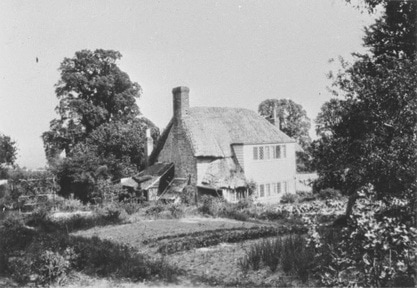
Each piece – in a minor key – was written at Brinkwells (above), a thatched cottage in Sussex where Elgar had spent the previous summer with wife Alice and daughter Carice. The Violin Sonata was completed in summer 1918:
Immediately after the composer began the String Quartet, finished just before Christmas 1918:
Spring 1919 saw the completion of the Piano Quintet…
…before the Cello Concerto, one of his crowning glories, was completed in time for an October 1919 premiere:
They are the last four major compositions completed by Elgar – and you can listen to complete recordings of each one on this Spotify playlist:
In three weeks’ time, the 21st Oxford Lieder Festival will be underway – and this is a short piece to show you why it’s worth going!
Arcana first attended this festival in 2018, and were really taken with its layout, friendly atmosphere, and intimate (or breathtaking!) venues. This is before we even get to the music, which is imaginatively chosen and programmed, and performed by some of the best singers and pianists available. Not only that, but festival director Sholto Kynoch and his team place the music in the context of interesting talks and features to place the songs in the context of the wider arts climate.
This year’s festival is Friendship In Song: An Intimate Art, and its aim is to ‘explore friendships between composers, poets and performers, recreate the intimate atmosphere of the salon, and generally enjoy a festive spirit of conviviality and shared experience. World-renowned artists mingle with the best of the new generation, and the great works of the song repertoire are complemented by new music and new discoveries’.
You are encouraged to head to the festival website to explore the concerts and artists, but Arcana would like to point you to a couple. On Saturday 15 October the songs of Richard Strauss come under the microscope. Until recently this aspect of the composer’s output was not greatly considered, lying in the shadow of his orchestral works and operas, but more recent explorations have shown just how inventive he could be as a songwriter.
Tuesday 18 October sees the beginning of a mini-series devoted to this year’s most prominent festival composer. Vaughan Williams: Perspectives will examine some of RVW’s most memorable songs and cycles, including Songs of Travel (William Thomas & Anna Tilbrook) and Four Last Songs (Ailish Tynan and Libby Burgess). As a considerable bonus Alessandro Fisher, William Vann & the Navarra Quartet will perform On Wenlock Edge together with a complementary work, Portraits of a Mind by British composer Ian Venables.
Sea beach with fisherman (The fisherman) by Caspar David Friedrich (1807)
Piano Sonata no.22 in F major Op.54 for piano (1804, Beethoven aged 33)
1 In tempo d’un menuetto 2 Allegretto – Più allegro
Dedication Count Ferdinand Waldstein Duration 12′
Listen
written by Ben Hogwood
Background and Critical Reception
Beethoven biographer Lewis Lockwood has an important observation, that ‘in other middle-period pairings, a long, powerful and brilliant work (in this case the Waldstein sonata) is succeeded by a short and quiet one, with Beethoven creating a double image and a deliberate contrast, a reminder of the balance between great and small, between seemingly opposed and adjacent modes of being that can compliment one another, as a rare flower grows by a large tree’.
Little needs to be said after that rather neat summing up – though it is as always worth hearing the thoughts of pianist Angela Hewitt. Writing booklet notes for her Hyperion recording, she notes the elegance of the opening before ‘all hell breaks loose’. For the second movement, she stresses the importance of observing the composer’s ‘dolce’ marking to avoid it sounding like a study.
Thoughts
As Angela Hewitt notes, it is a graceful and genial start to this piece, Beethoven enjoying a few sleights of hand with some chromatic inflections to the melody, before the cavalry rights roughshod over the tranquil mood. There is a perceptible glint in the composer’s eye while this happens, and you can sense the frowns the first audience may well have had! This means when the mood returns to tranquil the listener is no longer as trusting as to what might happen – and they are right to be wary, for Beethoven enjoys a few more outbursts and melodic quirks.
The second movement is fast and flowing, though there is a more romantic element to the twinkling right hand, and a good deal of expressive weight when the left hand goes towards the bottom end of the piano. Once again Beethoven enjoys journeying to far-flung keys, and the momentum never lets up right to the emphatic finish.
This is a curious piece, one that is indicative of Beethoven’s quest for the new, challenging existing notions of how a sonata should behave. It has elements of the Waldstein’s virtuosity and energy in the final movement, and has all the characteristics of a ‘prelude and fugue’ from the Baroque period. There is much to enjoy here!
Recordings used and Spotify links
Alfred Brendel (Philips) András Schiff (ECM) Angela Hewitt (Hyperion) Paul Badura-Skoda (Arcana) Stephen Kovacevich (EMI) Igor Levit (Sony Classical) Claudio Arrau (Philips) Daniel Barenboim (Deutsche Grammophon)
Once again a crowded field of some very fine versions, though those from András Schiff, Alfred Brendel and Stephen Kovacevich prove particularly enjoyable.
You can hear clips of Angela Hewitt’s recording at the Hyperion website
You can chart the Arcana Beethoven playlist as it grows, with one recommended version of each piece we listen to. Catch up here!
Also written in 1804 HummelRondo in E flat major Op.11
Tippett Quartet [John Mills, Jeremy Isaac (violins), Lydia Lowndes-Northcott (viola), Bozidar Vukotic (cello)]
VaughanWilliams String Quartet no.2 in A minor (1942-43) Holsted. Swanston Phantasy Quartet (1916) VaughanWilliams String Quartet no.1 in G minor (1909)
Somm Recordings SOMMCD 0656 Producer Siva Oke Engineer Adaq Khan Recorded 7-8 February 2022, St. Nicholas Parish Church, Thames Ditton
Reviewed by Ben Hogwood
What’s the story?
In case you have missed it, 2022 marks 150 years since the birth of Ralph Vaughan Williams. A great deal has been made of his symphonic and choral output, and rightly so, but an added benefit of such an anniversary is the chance to look at other relatively neglected corners of a composer’s work. Chamber music is one such area that is infrequently explored, and there are some fine works ready for reappraisal.
The two published string quartets sit as principal examples. The String Quartet no.1 in G minor was written in Paris, during a period of study with Ravel, and reflects new influences at work in 1909. A great deal of water had past under the bridge by the arrival of the String Quartet no.2 in A minor in 1942-43. Written for the composer’s friend Jean Stewart, who played viola in the Menges Quartet, it gives great deal of prominence to her instrument.
Complementing the quartets is the Phantasy Quartet by Gustav Holst, a close friend and confidante of Vaughan Williams for many years. Their mutual love of folksong is perhaps their strongest musical link, though as the quartet shows Holst had a different way of expressing his sources. Claiming the work was ‘insufficient’, the composer withdrew it some years after its first performance in 1917, though his daughter Imogen saw its worth and published a version for string orchestra. On this recording the Tippett Quartet use an edition made by Roderick Swanston.
What’s the music like?
The Vaughan Williams quartets are a complementary pairing, and although starting with the later work may seem a curious decision it makes good musical sense in the context of this recording.
As described above, the viola takes an assertive lead in the first movement of the String Quartet no.2, pushing the source material forward with silvery tones that nonetheless have a strong autumnal shade. The harmonic writing is shot through with an anxiety reminding us of this work’s position in the Second World War and its proximity to the Sixth Symphony, a powerful yet haunted work. The solemn second movement is deepened further by an almost complete lack of vibrato, while the viola takes charge again in the ghostly third movement, with the other instruments muted. The prayerful finale offers some solace, referring to the reverent calm of the recently completed Fifth Symphony, but the end is still shrouded in uncertainty.
The String Quartet no.1 is often talked about in the same breath as Ravel, but Debussy and Borodin are notable influences here. After a tautly argued first movement, the Scherzo is particularly successful, its motif recurring with just the right degree of playfulness. The third movement Romance is lovingly rendered, while the finale has a great deal of positive energy, Vaughan Williams showing great agility in his writing for four instruments that often sound like a small string orchestra.
Holst’s Phantasy Quartet is beautifully judged, celebrating its folk sources but also throwing context of light and shade that reflect another time of uncertainty during the First World War. The work has more than a little in common with the celebrated St Paul’s Suite for string orchestra, moving between energetic tunes and more thoughtful episodes, where a shadow passes over the face of the music.
Does it all work?
It does. These are fine performances from the Tippett Quartet, who understand the emotional and often anxious pull of the second quartet. Its urgency is compelling, and the harmonic tensions are finely judged here. Meanwhile the compositional promise of the first quartet is clearly shown, with its rich melodic content and the vigorous exchanges of the outer movements, which are extremely well played. The Holst is affectionately given, the quartet revelling in the folk melodies but also the composer’s imaginative harmonies. Swanston’s version works extremely well.
Is it recommended?
Enthusiastically. There are already some fine recordings of the Vaughan Williams string quartets, but the Tippett Quartet join the very best with performances of spirit and deep feeling. The Holst is the ideal complement, and with excellent booklet notes (Robert Matthew-Walker) and a cover picture to match (Simon Palmer) this is one of the finest releases so far in the Vaughan Williams 150 celebrations.
Listen
Buy
You can listen to clips from the recordings and explore purchase options at the Somm Recordings website
Diablo is an album for transportation. Not the car journey or train ride, though I can confirm it works on both – more the idea of transporting the listener straight into a hot, sweaty basement club somewhere, in the dead of night.
Gabe Gurnsey describes his new opus as being ‘formed out of a lot of trust and lust’, and credits his musical and physical other half, Tilly Morris, for her role in proceedings – not just as vocalist but as quality control and muse. Together they have made an album whose theme is release and escape, and to do it they use banks of keyboard sounds, vocal manipulation and a vocal hook or ten.
What’s the music like?
Hedonistic, in the best possible way. The twisting synth lines appear almost immediately on the horizon and stay for the duration, which is a good thing as they complement Morris’s voice perfectly. A fine first track, the single Push, sets out the stall, then the following Hey Diablo crackles with atmosphere.
With its vocals, Power Passion has an edge, leaning on 80s influences for its source material but also nailing a contemporary sound. The richly coloured Blessings struts forward confidently, while the synths on I Love A Sea On Fire bubble and weave, the deadpan vocal matched with liquid loops. Give Me is especially good, its vocal couplet beginning “Give me your oxygen”.
Special mention should be made of Morris, who proves the ideal foil to his electronics on this record. She brings something of the Eurythmics / Human League vibe to the table, but there is also a strong helping of Blancmange in the deadpan approach – which on repeated listening has a lot more depth than first meets the ear.
Does it all work?
Yes. There is a real frisson in a lot of these tracks, capturing the optimism and escapism we all feel on a good night in a club.
Is it recommended?
It is. Diablo is one of those albums looking backwards and forwards simultaneously, and Gurnsey’s awareness of both directions means that this new album works a treat.





 Arcana.fm