On Record – Dana Gavanski: When It Comes (Full Time Hobby)

written by Ben Hogwood

What’s the story?

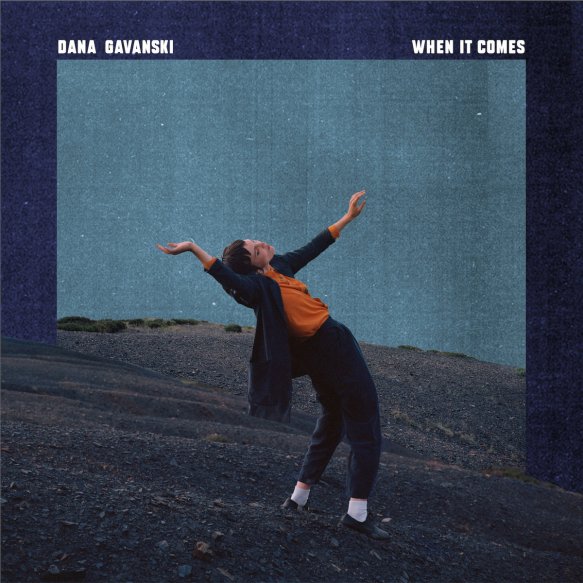
The story behind When It Comes is a powerful one. The second album from singer-songwriter Dana Gavanski, it celebrates the voice as an instrument, from the perspective of recovering lost vocal cords. She uses the album to bring her voice back to a musical way of thinking, a celebration of music itself.

The story explains the album’s precise but very natural vocal style, with strong communication the name of the game.

What’s the music like?

Bewitching. Gavanski has a lovely voice, bolstered by an accent that celebrates her heritage – Canadian raised and of Serbian descent, recording in the UK – as much as it celebrates her voice as an instrument. Gavanski’s partner James Howard deserves a great deal of credit for the instrumental support, and how he makes the voice the star of the show but creates a lovely tapestry behind it.

There is simplicity to this music, but welcome quirks too. I Kiss The Night, with its pure arpeggios, is the most obvious example, rooted in the ‘simple’ key of C major but actually revealing more layers with closer listening. The Reaper finds subtle humour in its straight faced delivery, with increasingly hypnotic offbeat vocals as it progresses. Gavanski’s vocal is beautifully weighted throughout both songs, as it is for Letting Go, an expressive admission that “I need your love” with hints of vulnerability around the edges in the oblique harmonies.

Bend Away & Fall has a different atmosphere entirely, powered by metallic harpsichord but with comforting sighs in the vocal line. It is a charming song. By contrast, Lisa – the most substantial song on the album – creates a portrait from the viewpoint of the sea, watching subjects pass by day after day. For the author it is about recognising what’s in front of her, in this case a richly coloured and textured seascape, brought to life in multicolour.

There are elements of Stereolab vocalist Laetitia Sadier in her delivery, also a little Jane Birkin and Cate Le Bon, but these should be used as guides rather than influences, as Gavanski’s style is very definitely her own. Knowing To Trust, the closing song, shows the voice at its purest and most romantic, bringing the listener in close with its often hushed delivery. “I know your face”, she coos at the end.

The instrumentation is often worth listening to on its own, responding to the voice with music of dexterity and colour. The Day Unfolds gets locked into a charming, hypnotic repetition, and the same fate befalls Indigo Highway, its gentle triple time oscillations complemented by Gavanski’s longer phrases.

Does it all work?

It does. There is both strength and vulnerability in Gavanski’s singing, and the album works its magic through this combination, with a rich mixture of styles and moods.

Is it recommended?

It is. When It Comes is often a memorising album. Dana Gavanski has created a rarefied atmosphere that offers us a route in to the very soul of her music. She is a profound singer and songwriter whose emotive music deserves to be heard far and wide.

Stream

Buy

Warp Records website

Online concert – English String Orchestra / Kenneth Woods: Elgar Festival Highlights 2 – Elgar’s Strings

elgar-festival-2

Truscott Elegy for Strings (1944)
Tippett Little Music for Strings (1946)
Elgar Serenade in E minor, Op. 20 (1892)
Chambers The Tall-Eared Fox and the Wild-Eyed Man (1994)

English String Orchestra / Kenneth Woods

Live performances at Guildhall, Worcester, Friday 29 October 2021

A further highlight from last year’s Elgar Festival, in the guise of an attractive miscellany that drew on the abundant body of music for strings, and which was persuasively rendered by the English String Orchestra that has been associated with this repertoire across several decades.

Interesting its principal conductor Kenneth Woods should have proposed a moratorium on the ESO’s performances of Elgar’s Serenade, as the three-year break evidently worked in favour of a piece here emerging as fresh and unjaded – whether in the capering motion of the initial Allegro as was ‘pleasurable’ indeed, the soulful intensity of a Larghetto centred on one of its composer’s most affecting melodies, or a final Allegretto which combines thematic elements with the deftest precision. 130 years on and this piece exhibits no signs of losing its appeal.

eso-woods

Sir Michael Tippett’s Little Music for Strings does seem to be gaining performances, which is only to the good of music as characteristic and accessible as this. Woods was rightly intent on imparting unity to the whole – tempering the rhetoric of the Prelude so it segued into the Fugue with its accumulation of textural weight and expressive intensity, before infusing the Air with a plaintiveness to which the vigorous Finale provided a natural foil. ESO performances in the presence of the composer need not detract from the excellence of its present-day incarnation.

The highlight, however, had come at the start with a revival of the Elegy by Harold Truscott. If the 22 piano sonatas are his greatest achievement, this is surely the piece to make his name more widely known – most likely his expression of acute regret over a failed relationship, and music that went unheard and unacknowledged in his lifetime. The ESO projected its questing tonal trajectory (redolent of later Nielsen) and plangent eloquence with unfailing conviction, so reinforcing its evident claim for a place near the heart of the repertoire for string orchestra.

A relative easing of emotional tension across this programme was made manifest by the final piece. Little known this side of the pond, Evan Chambers is widely respected as a composer and teacher – the present piece evincing his enthusiasm for Irish traditional music through its interplay of jigs which duly underpin the heady evocation that is The Tall-Eared Fox and the Wild-Eyed Man. That inspiration came from an encounter on the west coast of Wales serves to point up the playful irony of music such as strings and conductor alike attacked with relish.

An enjoyable piece, then, with which to round off a recital that was engaging and absorbing by turns. The ESO can be heard in further highlights from last year’s Elgar Festival towards the end of May – by which time, the 2022 edition will be only a few days away from starting.

This concert is available to view on the English Symphony Orchestra website from 29 April – 3 May

For further information on the 2022 Elgar Festival click here. For more on composer Harold Truscott click here, and for more on Evan Chambers click here. For more on the English String Orchestra, click here – and their conductor Kenneth Woods, click here

In concert – Mahan Esfahani, CBSO / Ludovic Morlot: A Journey Through Time

Mahan Esfahani (harpsichord), City of Birmingham Symphony Orchestra / Ludovic Morlot

Ravel Le Tombeau de Couperin (1914-17, orch. 1919)
Sørensen Sei Anime (2020) [CBSO Centenary Commission: UK premiere]
C.P.E. Bach Harpsichord Concerto in D major, H421 (c1745)
Stravinsky Pulcinella – Suite (1922)

Symphony Hall, Birmingham
Thursday 28 April 2022

Written by Richard Whitehouse

A concert with a difference this evening from the City of Birmingham Symphony Orchestra, featuring harpsichord concertos ‘ancient and modern’ alongside two staples of the chamber-orchestra repertoire from the early 20th century in a programme as balanced as it was equable.

His final major work for solo piano, Ravel’s Le Tombeau de Couperin (or at least four of its six movements) is more often heard in the orchestral transcription that accentuates its mood of searching pathos. Not least the Prélude, its liquid motion unerringly conveyed, or in the astringent humour of the Forlane. The Menuet featured a melting oboe contribution from Oliver Nordahl, then in the final Rigaudon Ludovic Morlot avoided an unduly rapid tempo – vividly characterizing the outer sections while drawing confessional intimacy from its trio.

Harpsichordists are infrequent visitors to orchestral concerts, so credit to Mahan Esfahani (above) for tackling two very different yet strikingly complementary works – including the first hearing in this country of another CBSO Centenary Commission. Inspired by matters mundane and metaphysical, the six short movements of Sei Anime have been likened by Bent Sørensen to a French Suite in its expressive contrasts. Unforced alternation of (relatively) slow and fast dances drew an always inquisitive response from the soloist, heard in the context of reduced yet diverse forces that included a range of percussion adeptly handled by Adrian Spillett and the ethereal tones of an accordion played by violinist Kirsty Lovie. By turns enchanting and disquieting, the piece raised many more questions than could be answered at a first hearing.

Esfahani was on familiar ground after the interval with a Harpsichord Concerto in D major by C.P.E. Bach (which this reviewer recalls last hearing at a 70th birthday concert by George Malcolm). If not among his more exploratory works in the medium, this certainly ranks among his most appealing – its three movements perfectly balanced as to form and content such that the lively interplay between soloist and strings in the initial Allegro is complemented with the urbanity and poise of its central Andante, the final Allegro maintaining a scintillating onward motion though to its close. Music such as this most engaging of present-day harpsichordists rendered with unceasing clarity and verve, not least in those cadenzas where the figured-bass writing brought an extemporization whose immediacy never drew attention from the music at hand.

Having proved the deftest of accompanists, Morlot presided over a sparkling account of the suite Stravinsky took from his ballet Pulcinella. Again, it was the lucidity of the woodwind that really came through – not least in the plaintive Serenata or the elegant Gavotta with its two graceful variations. Nor was there any lack of robustness in the opening Sinfonia or, thanks to trombonist Richard Watkin, deadpan humour in the Duetto. An eloquent take on the ensuing Menuetto prepared ideally for the Finale to bring about the uproarious close.
A rewarding concert which deserved a bigger attendance than it received. Those deterred by this ‘journey through time’ will no doubt feel on safer ground next Wednesday, when future chief conductor Kazuki Yamada directs a programme of Prokofiev, Bruch and Mendelssohn.

For more information on the CBSO’s 2021-22 season, click here

Meanwhile for more information on composer Bent Sørensen, click here – and for the artists, click on the names to access the websites of Mahan Esfahani and Ludovic Morlot

Third Coast Percussion to release ‘Perspectives’

The ever-inventive Third Coast Percussion have another album in the bag – and they are ready to share Perspectives with us in two weeks’ time.

Furthering the ensemble’s links with Cedille Records, the new album contains four new works, headed by a new four-movement Percussion Quartet from Danny Elfman. This substantial 20-minute work was written for Third Coast Percussion at the behest of Philip Glass, whose Metamorphosis no.1 is next up in an arrangement by the quartet themselves. Electronic composer Jlin has been commissioned to write a new piece, Perspective, a large-scale suite comprising seven contrasting viewpoints. Finally Rubix, a collaboration with flute duo Flutronix, signs off the album with its three sections, Go, Play and Still.

Have a listen to the latest edition of the Cedille podcast, where Third Coast Percussion’s Robert Dillon talks through the album and plays clips from it:

Arcana will cover the album in full next month…but before then you can read more about it and hear short clips on the Cedille website

On Record – Daniel Rossen: You Belong There (Warp Records)

daniel-rossen

written by Ben Hogwood

What’s the story?

To say You Belong There is an eagerly awaited album would be an understatement. Daniel Rossen, a key member of both Grizzly Bear and Department Of Eagles, made a strong impression with his Silent Hour/Golden Mile EP in 2012, and finally follows up that release with a fully-fledged long player for Warp.

What’s the music like?

Compelling. Perhaps inevitably Rossen brings elements of the two bands’ music to his writing, but there is plenty of room for exploration of his own. The songs on You Belong There live and breathe a heady air, with twists and turns in the music and narrative that keep the listener hooked.

‘The truth is always brighter than you say’, runs the repeated hook through Shadow In The Frame, a song where Rossen’s storytelling has the vivid references of a band like Fleet Foxes or Midlake. With carefully studied guitar work and sumptuous orchestration – never overdone – the song is a beauty, its coda especially moving.

On the title track percussion flits back and forth, the music panning out as the harmonies intensify, while Celia is a remarkable song, with a multi-layered choir of Rossens confessing that “I’m still staggering as you once did”. I’ll Wait For Your Visit goes further still, the singer in a lower range with long phrases above excitable piano and guitar.

Sometimes Rossen appears to be in the same room. Unpeopled Space begins with intimate phrases picked on the guitar before striding forward with a strong sense of purpose. Tangle, meanwhile, is out in the white water, a torrent of piano notes flowing around his vessel. The music is virtuosic but wholly relatable, especially at the song’s apex. However the best song – arguably – is Keeper And Kin, another gripping story told over descriptive guitars and percussion. After this, the final two songs form an effective coda.

Does it all work?

Yes. The blend of carefully studied guitar work and instinctive melodies is a strong one, each song a windswept beauty – and the virtuosity of Rossen should be commended, for over lockdown he learned a number of new instruments to add even more colours to his music. The songs blossom in his hands.

Is it recommended?

Without question. Fans of Grizzly Bear will find a great deal to enjoy here, as Rossen gives us the debut his initial promise suggested he would achieve.

Stream

Buy

To hear clips from You Belong There, and for purchase options, visit the Warp Records website