Switched On: Toby Wiltshire – Shunyata : Emptiness (Cue Dot Records)

toby-wiltshire

reviewed by Ben Hogwood

What’s the story?

The Cue Dot model deserves some examination, for this is no ordinary record label. It is a not-for-profit organisation, run by Paul Scott in Derbyshire, and is fronted by the flagship Cue Dot Series, now up to seven records strong. This is an opportunity for collaboration within electronic music, and the participating artists are given full control over the content and titles. The artwork, however, follows the same distinctive and particularly attractive circle pack design, best explained in the press release as ‘representing the infinite possibilities opened up through an electronic palette’.

The seventh in the series is given to Leeds-based composer Toby Wiltshire, who responds with an album using Buddhist imagery and concepts as its stimulation. Wiltshire’s free-standing style allows for slow, untethered musical movement, adding field recordings, modular synths and software to the equation. It is music for mindfulness, but with a license to develop along the way.

What’s the music like?

Wiltshire achieves a very appealing blend of stillness and activity in his work, which immediately carries the promise of outdoor activity. This in itself is stimulating, given the amount of time we have all spent indoors over the last 15 months, so the running water and soft, sleepy tones of Mist Clearing On The Mountain give the listener a chance to acclimatise to the new surroundings.

Wiltshire works and intertwines the seven recordings with the ease of a man who has been composing for 20 years, and he knows instinctively how to let the music breathe as much as it needs to. There are no explicit melodies but there are thoughts and moods that recur as each track proceeds, each keeping a firm grasp on tonality.

Running water and soft tones are also an appealing feature of Floating Consciousness, aptly named, with harmonics on the stringed instruments that give a glint to the edge of the overall sound. Karuna holds a beautiful poise, shifting slowly in the equivalent of a soft musical breeze, while Glimpse uses higher, quite shrill pitches but counters them with sounds in the middle distance. Orange Light is lovely, painting a series of closely matched, complementary musical colours like a Rothko painting.

One of the most restful scenes is found within Sakura, where bird-like noises call across the rippling texture. We could be in a vast cave, or out on the edge of a swamp in the rain – both examples of the pictures Wiltshire’s music forms in the listener’s mind. The Wave And The Water brings everything to rest at the end, with the gentle undulations implied by the title gradually evening out.

Does it all work?

It does – and if anything could be extended to an even longer piece of work. Yet Wiltshire leaves the listener wanting more, and as his work responds to repeated listening, it is easy to go round again immediately – a good state to be in. Talking of states, you will certainly end this album in a calmer condition then when you began it!

Is it recommended?

Very much so – and if like me you are using this as a point of entry to the Cue Dot series, it works as a starting point from which to enjoy the other six. There is much to admire about this label, and we will explore more in due course, but for now the wide open stage is Toby Wiltshire’s, and his music is very easy to experience and admire.

Stream and Buy
Switched On: Aria Rostami & Daniel Blomquist: Time Apart In The West (Intimate Inanimate)

aria-rostami-daniel-blomquist

reviewed by Ben Hogwood

What’s the story?

The partnership of Aria Rostami & Daniel Blomquist release their second album in five months, again recording in separate cities due to conditions imposed by the pandemic. Rostami currently resides on the East Coast in Brooklyn while Blomquist has remained in San Francisco, but the two have honed their recording process to an effective method of musical communication across the country.

For Time Apart In The West the compositions were written separately and then the ideas developed, with Blomquist sampling and altering Rostami’s composed and recorded contributions. Like a piece of chain mail, the music was passed back and forth until both were satisfied.

What’s the music like?

The titles are simple and indistinct, divided into 14 Months, but in spite of its minimal construction Time Apart In The West contains music of warmth and meaning. It contrasts nicely with the pair’s previous release Still, on Glacial Movements, which explored how time could change motion in cold weather.

The constructions on that release were much longer, clocking in around the ten minute mark, but some of the tracks here are short, descriptive sketches like Month 1 and Month 13, suggesting slightly more mechanical origins.

They are complemented by much more expansive scenes such as Month 2 or Month 10 which hang on the air beautifully, the latter like a white cloud on a hot summer’s day. This surely has its origins in the Californian heat haze, as Month 5 would seem to have, though the shimmering horizon here has a set of discords ensuring a level of tension remains throughout.

Does it all work?

It does – either on headphones as a calming soundtrack, or on a bigger system as an immersive experience. Both composers have a keen ear for texture, with the extended melodies and chord sequences easy to follow, and the ambient white noise offering extra depth. Often the slow speeds mean the music acts like a weather system, gradually evolving and unfolding.

Is it recommended?

Very much so. Time Apart In The West is the warmth to Still’s cold, and both make excellent companion pieces.

Stream

Buy

On paper – Kick It: A Social History of the Drum Kit by Matt Brennan

kick-it

Kick It: A Social History of the Drum Kit
by Matt Brennan
Oxford University Press 2020 (371 Pages, ISBN: #978-0-19-068387-0)

Reviewed by John Earls

Matt Brennan starts his magnificent social history of the drum kit by citing one of the many frequently made ‘jokes’ about drummers based on the stereotype of them being unintelligent (in fact all chapters start with ‘jokes’ concerning drummer stereotypes). He then demonstrates how the supposed stupidity of drummers is rooted in the history of racial stereotypes (primitive-savage drummer) and goes on to explain how the drum kit is “not only a product of musical ingenuity at the turn of the [twentieth] century, but also an outcome of massive historical changes in human migration, trade and engineering, beginning with the forced migration of the transatlantic slave trade”.

This is an ‘academic’ book (Brennan is Reader in Popular Music at the University of Glasgow) and the book is rigorous and detailed in its research and analysis. But it’s an incredibly rich story that Brennan makes sure never gets dry in the telling. It’s a riveting account of the importance of drums and drummers in music’s history (and future), deftly done through a largely chronological narrative cleverly structured in chapters focused on six ‘drummer’ themes: clever, noisy, studious, creative, working and indispensable.

We see the development of so-called ‘highbrow’ and ‘lowbrow’ music with drums and drummers confined to an inferior status both between and within musical genres, and are then taken on a journey through the development of jazz, rock, and hip hop that challenges and upends many perceptions and myths.

The book also covers the role of drums and percussion in classical music which has its own ‘highbrow’ and ‘lowbrow’ story. The French composer Hector Berlioz, for example, published a guide for composers that divided percussion into two categories: a first order of instruments with recognisable pitch (e.g. timpani, bells, glockenspiel) and a lower order of “noises designed for special effect” (e.g. bass drum, snare drum, cymbals) which, as Brennan points out, would form the core components of the drum kit.

Of course, composers would later write works for dedicated percussion ensembles including Edgard Varèse’s Ionisation, John Cage’s Quartet for Percussion, and Steve Reich’s milestone piece Drumming.

The role of jazz is central to this story, including the evolution of styles, development of equipment, and status of drummers. Gene Krupa, the ‘King of Swing’ and ‘World’s Highest Paid Drummer’ as a 1939 Slingerland catalogue has it, is identified as playing a key role in all these aspects.

Many jazz greats are also woven into the narrative, with Max Roach and Kenny Clarke rightfully explored.

The chapter on ‘Working Drummers’ is particularly good, capturing drumming as a “distinct form of musical labour” and showing not only how the economic and cultural value assigned to a drummer’s work has changed over time, but “how the seat behind the drum kit became a gendered workplace”. Brennan examines the tragic story of Karen Carpenter and suggests that it can be used as a kind of parable to illuminate a bigger picture of the sexist social conditions faced by women drummers. The same ‘social history’ approach helps explain why nineteenth-century American drum manufacturers tended to be overwhelmingly white.

The book is also good on the raw deal that drummers often get in respect of musical authorship using Clyde Stubblefield, who played in James Brown’s band, and his role in Funky Drummer as a case study.

Two ‘star’ drummers often perceived in the ‘wild animals of rock’ mythology are John Bonham (Led Zeppelin) and Keith Moon (The Who) and Brennan writes brilliantly about their styles and roles in their respective bands, but also movingly about issues concerning lack of self-esteem.

By contrast, the role of modest rock drummer is exemplified by Charlie Watts (The Rolling Stones) who whilst undoubtedly extremely knowledgeable and skilful at his craft is more interested in praising the artistry of others – “there are a million kids who can play like me”.

Brennan neatly challenges this in a nice piece about the Stones Sympathy for the Devil and its opening groove and shows how comments by Stones’ frontman Mick Jagger reveal how “Jagger’s ignorance comes across on several levels”. (By the way, Mike Edison’s Sympathy for the Drummer – Why Charlie Watts Matters is another excellent book, but it’s a rollicking read of a very different type).

The final chapter explores the relationship between drums, drummers, technology and the rise of the machines. It’s a fascinating take on the “back and forth influence between acoustic kit drummers and beatmakers” such as J Dilla. Incidentally, the relationship between drummers and technology is not just about electronic devices. One of the best examples explored earlier in the book is the ingenuity of drummers and equipment manufacturers in respect of the bass drum pedal.

This is a wonderful book and Brennan has done a great service to drummers and all lovers of music. As he says himself “we are all drummers now.”

John Earls is Director of Research at Unite the Union (and a former drummer). He tweets at @john_earls

For more information and to purchase, visit the Oxford University Press website

Switched On: Raxon: Sound Of Mind (Kompakt)

raxon

reviewed by Ben Hogwood

What’s the story?

The music of Ahmed Raxon has been a familiar feature on house and techno dancefloors for at least five years now, and he has previous with Kompakt as part of their Speicher series in 2019. The Egyptian DJ, now based in Barcelona, has label-hopped with a number of successful releases, but now turns to the longer playing format with his debut album.

What’s the music like?

Raxon’s versatility makes him the ideal producer for an electronic album. Sound Of Mind has plenty of variety, moving between slow and fast tempos, four to the floor and broken beat, but always with a surety of hand. The range of speeds and beats is impressively mastered, assembled in an order that makes the album more like a DJ set.

Raxon has a healthy penchant for music of the recent past, too, which helps him pull a couple of surprises out of the hat. Almost Human is one of these, a curveball with widescreen riffing and breaks that look more in the direction of Brighton than Barcelona. Flyby is an appealing slower jam with rich keyboards, while the sharp edges of El Multiverse are part of a really strong floor filler. Phantom Report has darkly coloured, solid beats – an examples of Raxon’s techno with depth – while Vice puts its bruising break beat to good use.

Does it all work?

It does. Raxon’s previous endeavours for a wide variety of labels helps enormously, as does his sense of structure – there are no fillers here, and a strong set of grooves in the locker.

Is it recommended?

Yes. An excellent debut long player from a producer whose versatility and confidence stand him good stead, Sound Of Mind is an album that avoids cliche and presents freshly made grooves with some style.

Stream

Buy

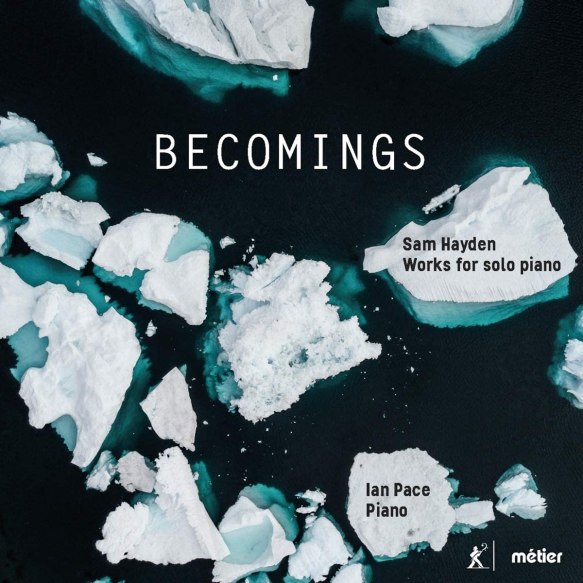
On record – Becomings: Sam Hayden Works for solo piano (Ian Pace) (Métier)

hayden-pace

Sam Hayden
Becomings (Das Werden) I-VII (2016-18)
Fragment (After Losses) (2003)
…still time… (1990)
Piano Moves (1990)

Ian Pace (piano)

Métier MSV28611 [two discs, 89’31”]

Producers / Engineers Will Goring, Sophie Nicole Ellison, Sam Hayden

Recorded August & September 2020 at City University, London

Written by Richard Whitehouse

What’s the story?

A major release of music from Sam Hayden (b1968), currently Professor of Composition at Trinity Laban Conservatoire of Music and Dance – the extent (thus far) of whose output for piano is featured here, and which makes for listening as engrossing as it can seem daunting.

What’s the music like?

It may be significant that, as if mindful of the reception that is nowadays accorded the more radical of today’s music, the composer’s own annotations seem intent on observing his music from the outside – as if to encourage objectivity on the part of those listening. This is by no means an unreasonable gambit for approaching his sometimes intricate, frequently oblique, and always provocative music which is made more so through the constant tension between the systematic and the spontaneous in his thinking. Not least with Becomings (Das Werden), whose notion – as has preoccupied philosophers from Heraclitus to Wittgenstein and beyond – of the state of ‘becoming’, as opposed to ‘being’, pervades the seven pieces at conceptual and semantic as well as musical levels; any tangible sense of finality remaining out of reach.

‘I’ functions as a prelude, but its textural dexterity and hectic passagework plunge straight in. ‘II’ takes this harmonic and polyphonic interplay much further as the intensifying waves of activity culminate in music of assaultive impact, whereas ‘III’ adopts a more improvisatory approach to formal elaboration. ‘IV’ assumes the guise of a central slow movement with its leisurely evolution and trill-permeated texture almost claustrophobic in its intricacy, while ‘V’ finds the superimposition of chromatic and spectral harmonic cycles at its most clearly defined. ‘VI’ unfolds as though a toccata of jagged expressive contrasts before it subsides into simmering anticipation, then ‘VII’ brings this sequence full-circle with its allusions to the opening piece as if a coda whose finality is pointedly offset by the desire to begin anew.

Of the other items, Fragment (After Losses) takes its material from an earlier orchestral piece as the basis for a short while eventful study in disjunct alternations of rhythm and timbre. As his earliest acknowledged work for solo piano, …still time… is audibly a statement of intent with its abrupt if methodical contrasts across the spectrum of pianistic facets; one whose debt to earlier composers (notably Stockhausen) is discharged via the constant pivoting between stasis and dynamism. Larger in overall conception, Piano Moves utilizes an amplified piano in music whose encroaching resonance and polyrhythmic intricacy gradually and inexorably saturate the sound-space; an extended ‘coda’ reducing previously dense textures to a hieratic succession of repeated chords such as sets the primary material at a vastly different remove.

Does it all work?

It does, not least through the unwavering focus of Ian Pace (who gave the complete premiere of Becomings two years back) in clarifying and articulating music whose complex textures never feel merely abstruse – thereby making for an experience seldom less than intelligible.

Is it recommended?

Indeed. These are fiercely committed readings, recorded with clarity and presence, making for a release worthy of attention from all adventurous and inquiring listeners for its dedicated and impressive music-making. Hayden’s chamber music (NMCD168) is also worth investigation.

Listen

Buy

You can discover more about this release at the Divine Arts website, where you can also purchase the recording. For the composer’s website, click here, and for more information on Ian Pace click here