Last week Arcana published an interview with Orpheus Chamber Orchestra violist Dov Scheindlin, in recognition of his time with the orchestra and their significant birthday. 50 years is a long time for a chamber orchestra, let alone a conductor-less one! Joining the celebrations, Deutsche Grammophon have released a 55-CD box set of all the orchestra’s recordings for the label.
Arcana have drawn on personal experience to select a playlist of recordings from the orchestra too, mostly from the DG archive. They range from a perky Haydn symphony to sparky Stravinsky pieces, from the wonderful open-air freshness of Grieg‘s Holberg Suite to the instinctive genius of Brad Mehldau‘s recently-released variations.
If I had to pick a favourite it would be a quite wonderful disc of Respighi orchestral works, crowned by an account of Trittico Botticelliano, a set of three orchestral responses to Botticelli pictures that is both colourful and intensely moving. Listen to the third picture, The Birth of Venus, and you will see what I mean:
Rossini Guillaume Tell – Overture (1829) Mozart Violin Concerto no.5 in A major K219 (1775) Berlioz Le carnaval romain, Op.9 (1844) Prokofiev Romeo and Juliet – Suite no.2 Op.64ter (1936)
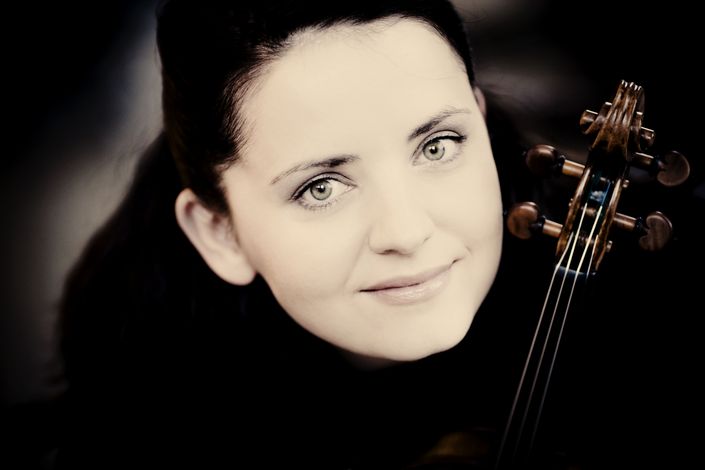
Baiba Skride (violin, below), City of Birmingham Symphony Orchestra / Andrew Gourlay (above)
Symphony Hall, Birmingham Wednesday 13 October 2021, 2pm
Written by Richard Whitehouse; Picture of Andrew Gourlay (c) Kaupo Kikkas, Baiba Skride (c) Marco Borggreve
This afternoon’s concert by the City of Birmingham Symphony Orchestra saw an unexpected but welcome return from Andrew Gourlay (replacing an indisposed François Leleux) for this diverse programme as worked much better as a concert than it might have appeared on paper.
Its fame as a novelty item in cartoons et al can easily obscure the innovative qualities of the Overture to William Tell, last and most ambitious of Rossini’s operas, in terms of its eliding between curtain-raiser and symphonic poem; which latter aspect Gourlay emphasized in this evocative but cohesive account – whether in the ruminative calm of its opening section with the CBSO cellos eloquently fronted by Eduardo Vassallo, a scrupulously controlled ‘storm’ episode, a not unduly mawkish ‘lullaby’ then a closing galop free from Hollywood overkill.
Mozart was barely out of his teens on writing his Fifth Violin Concerto, if not the finest then certainly the most eventful of his cycle through such as the soloist’s alluring first entry in the opening Allegro with music not directly related to either of the main themes and rendered by Baiba Skride with real finesse. Equally successful was her succinct yet ideally proportioned cadenza prior to its close; after which, the Adagio had elegance without excessive sweetness. In the final Rondeau, others may have made more of that contrast between graceful lyricism and the robust humour of its central section’s stylized Turkishness, but Skride brought these into complete accord and, with Gourlay securing limpid playing from a scaled-down CBSO, this was a persuasive performance of music whose felicities can easily be taken for granted.
Formerly ubiquitous as a concert-opener, Berlioz’s Roman Carnival – the inspired recycling of music from his opera Benvenuto Cellini – launched the second half to striking effect. If the soulful introduction took a little time to settle (doubtless occasioned by a soon extinguished onstage rebellion before Gourlay’s return), what ensued was not lacking rhythmic elan or that scintillating interplay of orchestral timbres as was Berlioz’s gift to the orchestra. Effecting a tangible crescendo into the blazing peroration, Gourlay undoubtedly saved the best until last.
Ad hoc selections from Prokofiev’s Romeo and Juliet rarely provide a satisfying second half, making one of three suites the composer extracted from his ballet the more viable option. Of these the Second Suite is the best overview, and this account quickly found its stride with a visceral take on the music which opens Act Three, the grinding progress of Montagues and Capulets proving no less forceful. Juliet as a young girl exuded the right insouciance and pathos, as did Friar Laurence that of earnest authority. The lithe Dance made a telling foil to Romeo and Juliet before parting, its fraught rapture potently conveyed here, then Dance of the girls with lilies made for an appealingly wistful entrée into Romeo at Juliet’s grave with its searing anguish that only gradually subsides into expectant calm towards the close.
Gourlay had previously directed a fine account of Rachmaninov’s Third Symphony with this orchestra and the Prokofiev confirmed his prowess in Russian music. The CBSO, meanwhile, returns next Wednesday for a varied American programme with the saxophonist Jess Gillam.
Further information on the CBSO’s current season can be found at the orchestra’swebsite. For more on Baiba Skride, clickhere – and for more information on Andrew Gourlay, head to the conductor’s website
Various venues in Oxford, Sunday 10 October. Artists as listed below
Written by Ben Hogwood from online streams
“There is no better way to get to know Stenhammar than the songs”, says pianist and scholar of the composer Martin Sturfält. With around half of the composer’s output delivered on this third day of the Oxford Lieder Festival, it was the ideal opportunity to get to know the Swedish composer, 150 years on from his birth. Arcana dipped its toe in four of the online events.
Celebrating Stenhammar, placed second in the substantial quintet of concerts, seemed the best place when approaching this series online. Taking the form of a seminar with musical examples, it doubled as the ideal introduction to the composer and an extremely useful and interesting top-up for those with working knowledge.
Beginning, naturally, with two songs, we were able to enjoy the clear voice of soprano Agnes Auer, giving with Sturfält a radiant account of I Skogen (In The Forest), which they countered with the distracted Adagio.
A panel of Sturfält, Daniel Grimley and Leah Broad then proceeded to give valuable historical context to Stenhammar’s work, brimming over with enthusiasm for the increased exposure his music has enjoyed of late. Broad explained the composer’s continued resolve to compose accessible tonal music in the wave of modernism sweeping Europe, renouncing Schoenberg and Strauss but striking out instead for a clarity of expression. This could be seen in helpful parallels drawn with Swedish art and politics of the time.
Auer illustrated why the fuss is justified, with a special account of Klockan (The Bell), one of Stenhammar’s finest songs stopping time as she sang. Later on Lutad Mot Gärdet (Leaning On The Fence) was a lovely illustration of how the composer’s relative simplicity could fuel profound feelings, especially through the clear tones of this singer.
In between Sturfält played the rather lovely Sensommarnätter (Late Summer Nights) Op.33. This suite captured both the clear light and furtive movements of nature at that time of year, but also found a metaphor for the late summer of life. Though written in 1914 the suite had been in Stenhammar’s mind for some time, and the performance here caught the essence of the five pieces, a tantalising combination of certainty amid darker thoughts and feelings.
Before this the day had begun with a broader celebration of Nordic song, in the company of young artists – soprano Siân Dicker, tenor Alessandro Fisher, mezzo Lotte Betts-Dean and pianist Keval Shah, who proved an excellent guide. As he said, nature provided the drama itself – and these examples, from contemporaries of Stenhammar, brought little-known names to the surface in illustration of the depth of songwriting talent in the Nordic countries in the 20th century.
Adolf Fredrik Lindblad’s Höstkvällen made a strong impact through Betts-Dean, as did Kuula’s slightly troubled Syystunnelma and a slightly playful Serenad from Erik Bergman. Here, Fisher and Shah portrayed the falling leaves with little flourishes. Betts-Dean also caught the unpredictable directions of Grieg‘s Autumn Songs. Definitely a song of two halves, it held the realisation that summer is over and winter is making a play for our affections. Meanwhile the remarkable Sibelius song Norden pushed Dicker’s voice to its limit, successfully, and she also shone in Merikanto and Madetoja.
The third concert, subtitled A Swedish Sensation, featured the Stenhammar String Quartet in a tense Elegy and brisk Intermezzo from Lodolezzi sjunger (Lodolezzi sings). Then they were joined by Lotte Betts-Dean for a fascinating set of five songs from Henri Marteau. The viola crept upwards before a portrayal of how the ‘quiet drops fall to earth from the clouds’ was brilliant in Thränentropfen, while the exultant In dem Garten meiner Seele found the ‘magic voice of a violin’ from first violinist Peter Olofsson at the end. Betts Dean set a very high standard, with wonderful tone and full voice in Sonnenlied, pushing to her upper range with impressive poise and power.
The quartet then proceeded to give a fluent account of their namesake’s String Quartet no.4, showing its ready inspiration in a first movement that delighted in a good many tunes, the instruments engaged in confident dialogue. The influence of Mendelssohn could be found in this busy activity, but the richly coloured Adagio made a more lasting mark, Olofsson’s passionate solo floating above the waves created by the other three instruments. There was a busy scherzo with a particularly bright fugal episode, high on energy, before touches of humour imbued the finale with positive spirits. Again, the dialogue between the four was intimate and entertaining.
The fourth concert, given in a starry Saint John the Evangelist church, included a complete performance of Stenhammar’s cycle Songs and Moods. The object of this concert was to show off Stenhammar’s talents to the full in the company of the best possible artists for the task. Agnes Auer returned, while Swedish soprano Camilla Tilling and baritone Jakob Högström gave fully idiomatic performances, all paired with festival director Sholto Kynoch, who had somehow found the time to rehearse the challenging piano parts!
The route to Stenhammar came by the way of Lindblad, Rangström, Nordqvist, Alfvén, Linde and Peterson-Berger, and was again illuminating in its selections. The darker shades of Ture Rangström’s Pan received a nice, airy delivery from Tilling, while Alfven’s Saa tag mit Hjerte was the most affecting song so far with its simple yet searching message and melody. Bo Linde’s Äppelträd och päronträd (The apple tree and the pear tree) sprang forward with renewed energy, while Peterson-Berger set a mood of longing with När jag för mig själv, and the poignant lyric “I think of a friend whom I will never find”.
After six very fine songs from Stenhammar himself – Ingalill Op.16/3 testing the upper range of Tilling and Fylgia Op.16/4 clinging urgently to its subject – we heard Högström in Songs and Moods Op.26. This fulsome baritone was beautifully projected, supported by a crystal clear piano part. There was a sharply rendered portrait of the butterfly orchid that stood out, then a staccato Miss Blonde & Miss Brunette which proved the most substantial song. Kynoch was certainly kept very busy! To the land of bliss was brilliantly judged, tripping along like a slightly tipsy dance, while Prins Aladdin af Lampan, with several twists and turns, wrought its way to a powerful climax.
Tilling returned for more of the composer’s single songs, with Vid fönstret Op.20 offering poignant words on ageing, then Månsken (Op. 20/4) a clear portrayal of the forest. For an encore, soprano and baritone linked in Swedish.
This was an absolutely fascinating day, too much to take in one sitting but consistently revealing when watched back on the different streaming sites. Great credit should go to the video production team, for the songs were expertly filmed, but also to the panelists and performers for clearly relishing their chance to show their respect for one of Sweden’s best-loved composers. This day will surely have won Wilhelm Stenhammar many new friends.
For further information on this year’s Oxford Lieder festival, you can visit the event’s website here
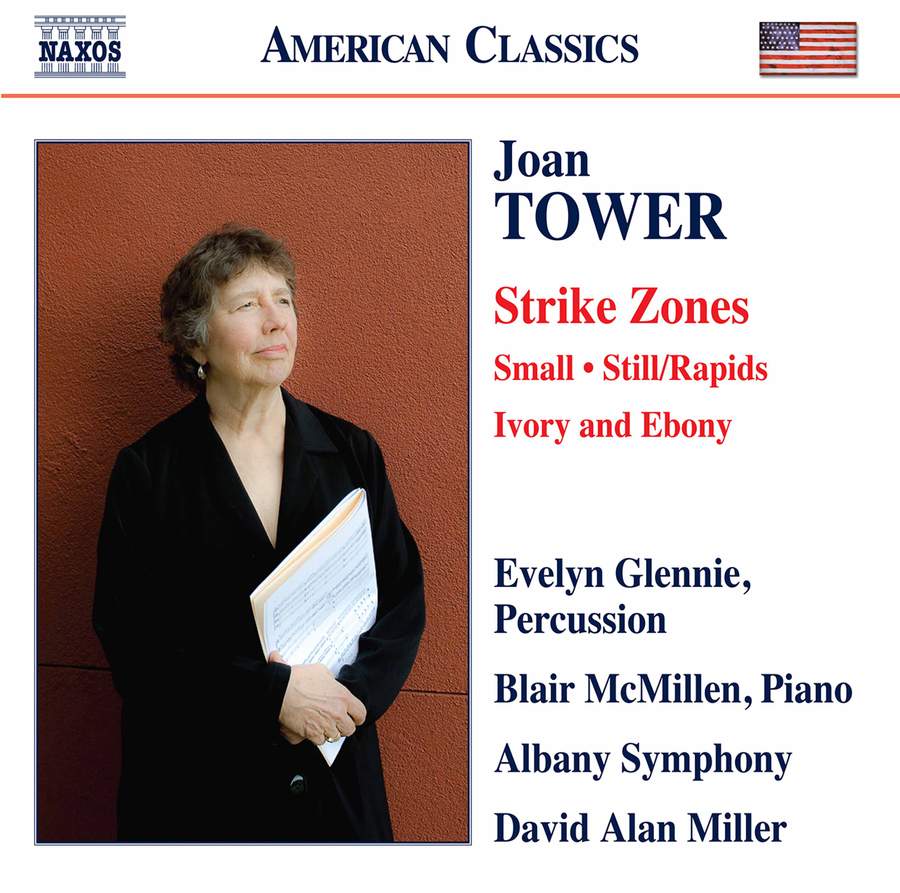
This year’s incarnation is ‘Celebrating Women In Music’, and there are two I would like to celebrate on this particular album, released by Naxos earlier this year. Percussionist Dame Evelyn Glennie will not need much introduction, for she is probably a familiar figure to you – but I would like to add to that the name of American composer Joan Tower.
Born in 1938, Tower has recently come to greater prominence thanks to the release of some excellent new recordings on the Naxos label. The latest is headed by Strike Zones, a concerto written for Glennie.
To quote from Tower’s program note: “Most percussion instruments are struck (hence the word ‘strike’ in the title) and I decided to have the percussion placed across the front of the stage with the soloist moving from one ‘zone’ to another – starting with the more fragile vibraphone and ending with a tour de force of drums. The other ‘zones’ include a marimba solo, a cymbal/hi-hat group, an ensemble of smaller/softer instruments (like the maraca, piccolo woodblock, castanet), a xylophone solo, and a trio with two other players placed in the hall echoing/‘reverberating’ the glockenspiel (with crotales) and the castanets (with more castanets)”
It is a piece of high drama, a composition with some compelling arguments and fascinating textures, best experienced on a big audio system or headphones.
Strike Zones is complemented by Still/Rapids, another substantial work for piano and orchestra. Rapids was a repeat commission from pianist Ursula Oppens, and is a fast-paced work – to which Tower has added the slow introduction Still. The two sections make a piece that proves every bit as dramatic as Strike Zones, with the unmistakable feeling of the American outdoors.
Meanwhile Small, also written for Dame Evelyn Glennie, is written for tiny percussion instruments – a rather lovely contrast to Strike Zones. Completing the album is Ivory and Ebony, which, as you might have guessed, is a piece for piano, commissioned by the San Antonio International Piano Competition.
I would urge you to have a listen, as Joan Tower’s music is both approachable and powerful. Hers is a distinctive musical voice well worth getting to know.
The new Chief Conductor of the Royal Liverpool Philharmonic Orchestra talks to Arcana about his appointment, the importance of an orchestra in its community and what he hopes to bring to the city of Liverpool.
interview by Ben Hogwood
It is a tall order indeed, following Vasily Petrenko onto the conductor’s rostrum at Philharmonic Hall, Liverpool. Domingo Hindoyan is the man chosen to fill the sizeable shoes of the Royal Liverpool Philharmonic Orchestra’s chief conductor, and he has joined Arcana to chat about the opportunities that lie ahead for him and for one of Britain’s finest orchestras.
He brings with him a positive energy, channelled through the most sonorous of voices. He could easily be mistaken for a baritone singer on this evidence alone, but his perspective as a conductor is brought immediately to the front. We begin by talking about one of his first appointments with the orchestra, his first Prom at the Royal Albert Hall in September this year. On the program were Dvořák’s Cello Concerto, with Sheku Kanneh-Mason as soloist, a new piece from Grace-Evangeline Mason (The Imagined Forest), Richard Strauss’ Don Juan and finally Hindemith’s Symphonic Metamorphosis of themes by Carl Maria von Weber.
The concert received extremely favourable reviews and was a great experience for the Venezuelan conductor himself. “It was a unique moment, a special moment in my career and in my musical life. It was my first concert as chief conductor, and the very special atmosphere of the Proms is unique around all the concert halls in the world.”
We talk about his decision to end with the Hindemith Symphonic Metamorphosis. “It is a great piece, and I had a lot of fun working on it, especially comparing it to what Weber wrote with the piano pieces. It is very, very clever, and shows perfectly all the facets of the orchestra, stressing a little bit on the brass section and the percussion. We have a fantastic set of bells, so we could use them in the second Turandot movement. We had a lot of fun. There was of course a link between all these pieces, with the 20th century composers, Strauss and Hindemith, but also an American connection between Hindemith and Dvořák. It is probably not obvious, but we’re talking about two composers who were influenced by the plantation music and by American music. Dvorak was the first one who really developed that to another level, and in the concerto, you don’t see as much as you can in the New World Symphony or the American string quartet, but you have in the second movement all the elements of American music. Hindemith was impressed later with some jazz moments we have in the second movement.”
He speaks very fondly of the Strauss, too. “Don Juan is a masterpiece, a showpiece for the orchestra. It’s a very difficult piece for orchestras, though today a little less as the technical level of the Royal Liverpool Philharmonic is very high. When you are technically free as the orchestra is, it is a piece that has thousands of colours, situations and emotions that we can explore. Every time I conduct it, I find new things you can do. That’s why it’s a masterpiece – all masterpieces have this characteristic.”
Hindoyan recalls his first visit to Liverpool. “It was not that long ago, in summer 2019. I conducted Beethoven’s Seventh Symphony, among other pieces of course. It’s not an easy piece to start a relationship with an orchestra, because every orchestra knows it very well, but I remember that immediately the chemistry was right. The energy was right too, so we could really rehearse in a natural way, as if we knew each other from a long time ago. The second time was also very special, because I could play some Latin American repertoire with a colleague of mine, Pacho Flores, a Venezuelan trumpet player. This was where I conducted Don Juan for the first time with the orchestra, and then I did Stravinsky’s The Firebird. Since the beginning the relationship has been very natural, with a great chemistry. So far it is going very well!”
On meeting an orchestra for the first time, how does a conductor gauge their strengths and common ground? “That’s a very interesting question, because that moment is probably the most important moment together with the concert. I was an orchestral musician, and if you ask a musician how it is when a conductor is with them for the first time, they will always tell you they know after one minute, as soon as they stand on the podium, they know if things will be OK or not. From the conductor’s point of view, it is also the same. From the first upbeat, and the first two or three minutes, you feel how it will go. You are not like a football trainer, where you are going to analyse the team against you with videos and so on. I don’t do this, and I have never met a colleague who does it. After five minutes you understand the strengths and the weaknesses, and then start working your way through with your ear and with your version of the music, the score you have in front of you. You try to achieve the sounds and version you want. Sometimes you don’t even need to talk, you can go with a gesture alone. It is a very interesting side of this job, the psychological contact with and between the musicians. It’s magic, and thanks to the scores and the genius of the composers!”
Domingo is conscious of the city’s fortunate position in having the Philharmonic Hall at their disposal, and when I suggest there is a buzz for classical music in the city, he agrees. “I also felt it! The city is lucky to have its own concert hall, and the orchestra is lucky to have a concert hall where many things happen, and where it is the cultural reference of the city. It is not only the concerts of the Philharmonic, but it is the pop concerts, the small ensembles, the music room – many, many activities. The daily life, after the pandemic, is that almost every day something is happening. These walls are used to beautiful vibrations of music, but one of the things that attracted me most to the orchestra was the community work they do, and how they want to expand to the community what’s happening in the concert hall. It is a symbiosis, from the stage to the community but also from the community to the stage. People get to know the faces of the musicians, the conductors, the guest conductors, and so the orchestra is the baby of the city.”
Hindoyan speaks from personal experience. “I am Venezuelan, and I grew up in Venezuela. I was part of El Sistema, a huge organisation of more than one million people. I studied violin and then conducting in Geneva. We had the idea with the Geneva Conservatory of founding an El Sistema project in Geneva. This year is ten years since we did it, and it’s working very well. It has brought music to some neighbourhoods that would not normally play music. There are two beautiful orchestras, one aged 10 to 16, for beginners – and it worked very well. This is motivation, and in that sense it feels like home to me, because it’s not exclusively about the orchestra. It is about everything, what’s happening with the choir, the kids, the young and contemporary music, pop music. I feel at home in that sense.”
Some adventurous concerts lie ahead for the Royal Liverpool Philharmonic Orchestra and their new conductor, including an interesting coupling of a new symphony – Roberto Sierra‘s Sixth Symphony – as a companion for Beethoven’s Ninth. “I first met Roberto when I had to do the European premiere of his Trumpet Concerto, and I enjoyed it enormously to analyse the score and see how talented, clean and transparently he can write his ideas. My heart was even more involved because I see he writes with elements of Latin American music, and I love it. When I first asked him, I said, “Roberto, I’m doing Beethoven’s Ninth in my first concert in Liverpool, and how many symphonies do you have?” “I have five”, he said. “That’s perfect – you should write the sixth and do as Beethoven did in his Sixth Symphony, a Pastoral” He didn’t name it as a Pastoral, but it is exactly that, a Caribbean Pastoral. It is all about the nature in the Caribbean area, and in Latin America. The first movement is about the cities, the urban craziness of Caracas or Mexico City. The second movement is the Caribbean nights, and then we have a scherzo with a shape of the perfect pastoral symphony. He took the example of Beethoven throughout!”
There is a reunion with Pacho Flores, the trumpeter giving the European premiere of the Concerto Venezolano by Paquito D’Rivera in November. “I think bringing some of the Caribbean to Liverpool in October is a very good idea. This is what I want to bring in general, to bring more of the Latin American repertoire to Liverpool. We have great composers in Argentina, Venezuela and Mexico, for instance. Many of them were students of Copland, and I really want to play them more here. In building a program I found it better to mix with other folkloric music. I decided to take the Bartók Concerto for Orchestra and couple them together. I think for the ear it is better, because you can compare, and you have some freshness. The Bartók Concerto, as we said with the Strauss, is a showpiece for the orchestra too.”
Are there plans afoot for new recordings with the orchestra? “We have some plans. My colleague Vasily has left a great legacy, he has been doing a fantastic job for 15 years. I will record my beloved pieces, those I feel comfortable with, and those I want to explore. I will introduce a lot of the Latin American repertoire and American repertoire that has not been played so often, without excluding anything of the traditional repertoire, that I love myself and I conduct very often too. It is a wide range of repertoire, and we have great plans.”
He reveals that he spoke briefly with Petrenko, his predecessor, before beginning the job. “We did have a short conversation, and we will have a longer one soon, but I am already on the job. Time for conductors is crazy! I had a nice message of welcome, and I was touched to see his last concert on demand. It was a difficult last year for him though because he couldn’t achieve his last season as he wanted. I could not do the transition as we wanted either, so our really first concert with full orchestra was last Sunday.”
Hindoyan is grateful to have a full programme stretching in front of him. “Of course. Every country had its own regulations. My first concert with an audience was last March, with a small audience for the Detroit Symphony. Then in April I had a bigger audience in Utah, but then in Europe we started with a small audience, and here in Liverpool last June I had a very warm audience for the last repertoire we did here. We did Ravel’s Le Tombeau de Couperin, BerliozSymphonie Fantastique and StravinskyOctet, and the trombone concerto by Dani Howard. We had the audience but now finally we have 80 people on stage, and the choir for the Beethoven in October. Finally, we can do music as we used to.”
There is a positive side to be found from the pandemic, however. “I always try! There were two positive things for me. First was the discovery of plenty of repertoire, which didn’t get played very often. Second, the exposure of the orchestras online, with recorded video, was very important, so that people had access to the concerts whenever they want. Social distancing was difficult, but on the other hand it has increased the attention of the players and the conductors. You have to make an extra effort to play together, which means when you start playing close again it is easier. It’s like going to the gym and you have to lift 30 kilos, but in fact you your goal was only 20, That is very light when you lift 30!”
One benefit of the online concerts is the chance for those further afield to see orchestras they would not normally see. “You can watch orchestras in Japan or South America, you can go on tour without travelling! Of course I believe there is nothing like live performance, the energy is never the same. When it is filmed you gain something, especially with opera, but in a symphonic concert there is nothing like the acoustic of the concert hall and the feeling of the sound coming to you directly.”
Domingo Hindoyan conducts the Royal Liverpool Philharmonic Orchestra in Roberto Sierra’s Symphony no.6 and Beethoven’s Ninth Symphony (the ‘Choral’) on Saturday 16 October in Liverpool’s Philharmonic Hall. For tickets, click here
For more information on the orchestra’s 2021-2022 season, including the concert with trumpeter Pacho Flores, head to the orchestra’s website here