Listening to Beethoven #139 – Romance no.2 in F major Op.50

Violin from Beethonven’s possession, one of four instruments Beethoven received as a gift from Prince Karl von Lichnowsky around 1800 (image from the Beethoven-Haus Bonn)

Romance no.2 in F major Op.50 for violin and orchestra (1798, Beethoven aged 27)

Dedication unknown
Duration 7’30”

Listen

Background and Critical Reception

After his early attempt at a concerto for violin and orchestra in 1792, Beethoven revisits the combination with two Romances – published in 1803 and 1805 as Op.40 and Op.50 respectively. The second is thought to predate the first, completed in 1798. Both Romances are thought to have been candidates for the slow movement of the early concerto, written as they are in suitable keys – but they stand alone as popular pieces.

Wolfram Steinbeck, writing for Universal’s Complete Beethoven Edition, observes that ‘Beethoven created a new genre with these two works, the violin romance, which found a number of successors in the 19th century (famous ones were composed by Berlioz, Dvořák and Bruch).’

Commentators observe that the focus is the singing tone of the violin, rather than athletic virtuosity. ‘These works by Beethoven were also to have been a stepping stone to his great Violin Concerto’, writes Steinbeck. ‘What appears there in broad strokes is tried out here on a much smaller canvas.’

Given the popularity of both Romances, there is a surprising dearth of writing from scholars of the composer.

Thoughts

The Romance no.2 is a sublime piece, and Beethoven fulfils his aims by really making the violin sing, The orchestral accompaniment is kept very much in the background but with the lovely ‘Viennese’ sound of a small orchestra.

As the piece progresses there is the opportunity for the violinist to show off, but lyricism is always the prime aim – and the tune itself is a keeper. Beethoven’s softer side is not always acknowledged, but it is to the fore throughout in this piece.

Recordings used and Spotify links

Anne-Sophie Mutter (violin), New York Philharmonic Orchestra / Kurt Masur (Deutsche Grammophon)

Thomas Zehetmair (violin), Orchestra of the Eighteenth Century / Frans Brüggen

Itzhak Perlman (violin), Berliner Philharmoniker / Daniel Barenboim

Arthur Grumiaux (violin), Royal Concertgebouw Orchestra / Sir Colin Davis

The creamy tone of Anne-Sophie Mutter may be a bit calorie-rich for some tastes, but it is an undeniably beautiful way to experience the Romance, nicely accompanied by the New York Philharmonic Orchestra and Kurt Masur. By contrast Thomas Zehetmair uses much less vibrato, playing with the Orchestra of the Eighteenth Century under Frans Brüggen in an account where less is most definitely more where emotion is concerned. Itzhak Perlman gives a special account with Daniel Barenboim and the Berliner Philharmoniker, while Arthur Grumiaux’s famous singing tone is ideal for these purposes.

You can chart the Arcana Beethoven playlist as it grows, with one recommended version of each piece we listen to. Catch up here!

Also written in 1798 Eybler Clarinet Concerto in B-flat major

Next up 7 Variations on ‘Kind, willst du ruhig schlafen’ WoO 75

Listening to Beethoven #138 – March in B flat major WoO 29 ‘Grenadiermarsch’ (piano version)

Austrian Infantry 1798 – 1805 (artist unknown)

March in B flat major WoO 29 ‘Grenadiermarsch’ for piano (1797-98, Beethoven aged 27)

Dedication unknown
Duration 1’30”

Listen

Background and Critical Reception

A piano reduction of the Grenadiermarsch, originally scored for wind sextet.

Beethoven was to write a good many marches, and this one must have meant something to him for it to be used in dual instrumentation.

Thoughts

After the wind sextet version, with its gritty sound and allusions to an accordion squeezebox, the piano sounds dry and rather foresquare as the march proceeds.

There are two versions – an original and a revision – but in all honesty there is very little to choose between the two!

Recordings used and Spotify links

Carl Petersson (Naxos)

Revised version

You can chart the Arcana Beethoven playlist as it grows, with one recommended version of each piece we listen to. Catch up here!

Also written in 1798 Wranitzky Grande Sinfonie caracteristique in C minor Op.31

Next up Romance no.2 in F major Op.50

Live review – Kile Smith, Gemma Whelan, English Symphony Orchestra / Kenneth Woods: The Art of Storytelling – The Bremen Town Musicians

eso-bremen-town

Kile Smith (music), Gemma Whelan (narrator), English Symphony Orchestra / Kenneth Woods

Wyastone Concert Hall, Monmouth
Recorded 30 July 2020, available online from Friday 16 April 2021

Written by Richard Whitehouse

The English Symphony Orchestra reaches the concluding instalment of its series for virtual storytelling with one of the most appealing fairy tales – The Bremen Town Musicians, here given in a discreetly updated version which preserves its salient narrative and robust charm.

Maybe through its specifically German setting, what is among the more life-enhancing tales by the Brothers Grimm has never enjoyed the popularity of various other such stories (those who remember an enticingly illustrated version published by Ladybird in the 1960s would no doubt disagree!). The more reason, then, why it should not find renewed currency today – not least with the assistance of this online rendering, which has been vividly and imaginatively illustrated by students from Chadsgrove School in the Worcestershire town of Bromsgrove.

The story is breezily and resourcefully told by Gemma Whelan, assuming a variety of accents and intonations to differentiate those characters – donkey, dog, cat and cockerel – who defy imminent demise to become travelling musicians on a journey to Bremen that (at least in this version) they never reach. Their travails and unlikely victory over a band of rural robbers is underpinned with a score by Kile Smith whose echoes of Stravinsky, Hindemith and lesser-known but worthwhile figures such as Walter Piston is effectively geared to events at hand

The ESO musicians play with style and assurance, while Kenneth Woods ensures poise and humour – not least in several meaningful ‘wrong entries’. The overall presentation is sure to win this story new friends and, as usual, a range of sundry material enhances the experience.

You can watch the concert on the English Symphony Orchestra website here

For more information on the English Symphony Orchestra you can visit their website here

For information about Auricolae, visit Kenneth Woods’ website here

Listening to Beethoven #137 – March in B flat major WoO 29 ‘Grenadiermarsch’

Austrian line infantry, the whitecoats, of the Napoleonic Wars 1805-1815 (artist unknown)

March in B flat major WoO 29 ‘Grenadiermarsch’ for wind sextet (1797-98, Beethoven aged 27)

Dedication unknown
Duration 1’30”

Listen

Background and Critical Reception

Beethoven has a surprisingly large arsenal of marches in his output – and this is the first we encounter. Little is known about the Grenadiermarsch, though its instrumentation for wind sextet means it could be played on the move.

Its nature suggests a military origin or use…but as Barry Cooper writes in the New Complete Beethoven Edition, ‘its original function is unclear’. The composer must have held it in high regard, as he also made a version for piano.

Thoughts

The wind sextet are ideally suited for this brief but perky march. When the wind ensemble hold the chords for longer they sound a bit like the squeeze box of an accordion – the sort of sound you might hear on a street corner.

Recordings used and Spotify links

Members of the Berliner Philharmoniker (Karl Leister, Peter Geisler (clarinets), Gerd Seifert, Manfred Klier (bassoons), Günter Piesk, Henning Trogmil (horns) (Deutsche Grammophon)

You can chart the Arcana Beethoven playlist as it grows, with one recommended version of each piece we listen to. Catch up here!

Also written in 1798 Wranitzky Grande Sinfonie caracteristique in C minor Op.31

Next up March for Wind Sextet in B-flat major (‘Grenadiermarsch’) – piano version

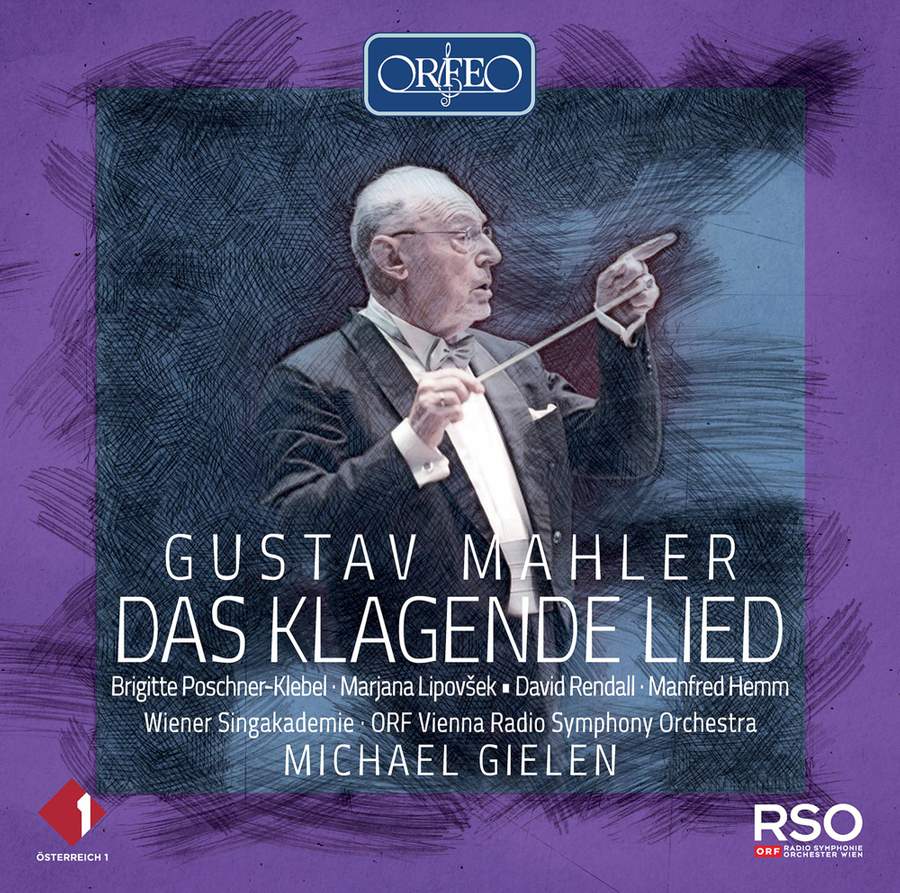
On record – Michael Gielen conducts Mahler: Das klagende Lied (Orfeo)

mahler-gielen

Brigitte Poschner-Klebel (soprano), Marjana Lipovšek (mezzo-soprano), David Rendall (tenor), Manfred Hemm (baritone), Wiener Singakademie, ORF Vienna Radio Symphony Orchestra / Michael Gielen

Mahler
Das klagende Lied (1878-80, rev. 1899)

Orfeo C210021 [62’10”] German text and English translation included. 

Remastering Erich Hofmann

Live performance at Konzerthaus, Vienna, 8 June 1990

Written by Richard Whitehouse

What’s the story?

Orfeo has put Michael Gielen admirers in its debt with this live performance of Das klagende Lied, a work which this conductor did not tackle with the SWR Symphony Orchestra and so could not be featured in the sixth volume devoted to Mahler of SWR Music’s Gielen Edition.

What’s the music like?

The almost total dearth of music composed prior to Das klagende Lied makes its appearance the more remarkable, Mahler drawing on a lineage from Schubert, via Schumann and Liszt, to Wagner in a dramatic cantata – to his own text – whose themes of fratricide and vengeance beyond the grave struck a resonance. Its failure to secure the Beethoven Prize in 1881 likely condemned Mahler to years in provincial opera houses; major revision leading to its premiere in 1901 and publication the following year – the first of its three parts having been jettisoned.

Yet it is Waldmärchen, broadcast on Czech radio in 1934 but otherwise unheard until 1970, that most clearly denotes the nature of Mahler’s achievement. The lengthy orchestral prelude resounds with horn-calls and images of nature, and if the initial stages of the narrative reflect the schematic confines of its ballad form, the depiction of the younger brother’s triumph then his death at the hands of the elder brother summons a response of starkest intensity; with that desolate closing section seldom (perhaps never?) equalled for its depiction of innocence lost.

The remaining parts are more concentrated in their unfolding, while no less focussed in their emotional acuity. Der Spielmann relates said minstrel’s unwitting discovery of the murder through a tense intermezzo that more nearly touches on Mahler’s future symphonic thinking, while Hochzeitstück affords the greatest emotional contrasts as it moves from evoking the wedding festivities, via the stealthy revelation of the elder brother’s guilt, to a violent climax then postlude that renders such events from a vantage no less tragic for its otherworldly calm.

At the time of the present performance, Das klagende Lied was only performable in a hybrid of the first part with the revised second and third parts. Publication of the original scores of these latter two in 1997 should have made for a straight choice between the 1880 original or the 1899 revision, but most subsequent hearings have still opted for the earlier compromise – regrettable, given Mahler amended the latter parts so these could be heard without reference to what had once gone before. Not that this should inhibit appreciation of what is heard here.

Does it all work?

It does, thanks to Gielen’s intent in endowing those narrative and – latent – symphonic facets of this score with an unforced equilibrium. Of the vocalists only the soprano’s rather fluttery tone affords reservations, the Wiener Singakademie despatches Mahler’s resourceful choral writing with relish, and the Vienna Radio Symphony Orchestra sounds fully attuned to an orchestration whose keen originality doubtless unnerved his elders at its time of completion. Immediate yet sympathetically balanced sound faithfully conveys the ambience of the Konzerthaus acoustic.

Is it recommended?

Very much so. Those wanting the piece as Mahler conceived it should acquire Kent Nagano’s account (Erato), or head to Pierre Boulez’s remake (DG) for the two-part revision. Otherwise, Gielen’s amalgam could well be considered the first choice for this so often astounding work.

Listen & Buy

You can get more information on the disc at the Orfeo website, or purchase from Presto