On record – Christopher Ward conducts Rott: Orchestral Works Vol.2 (Capriccio)

rott-ward-2

Gürzenich Orchester Köln / Christopher Ward

Rott
Symphony (no.1) in E major (1878-80)
Symphony for Strings (1874-5)
Symphonic movement in E major (1878)

Capriccio C5414 [77’02”]

Producers Thomas Bössl, Johannes Kernmayer
Engineer Sebastian Nattkemper

Recorded 27, 28 & 31 January 2020 at Studio Stolberger Strasse, Cologne

Written by Richard Whitehouse

What’s the story?

Capriccio releases its second volume devoted to orchestral music by the Viennese composer Hans Rott (1858-84), including a further recorded outing for the Symphony that was destined to remain his only fully realized mature work and on which his posthumous reputation rests.

What’s the music like?

Much is well known about the circumstances of Rott’s only completed symphony – namely its failure to secure a performance in his lifetime, being lauded by his younger contemporary Mahler (who alluded to it in at least four of his own symphonies) and its premiere 105 years after his death. That other composers in and around Vienna studied the score – elements are audible in Bruckner’s Seventh of 1883, even Franz Schmidt’s First of 1899 – is testament to its formal and expressive acuity in attempting to define a symphonic concept for the future.

Rott had produced a preliminary version of the opening movement which, recorded here for the first time, features the same themes in a relatively stolid entity that became more fluid in revision. The trumpet melody proves totemic for the whole work, as does Rott’s pervasive use of triangle as an ambient rather than merely textural device. Its preludial nature is reinforced by the emotional raptness of the adagio, twice building to intense climaxes that are eloquently rendered here, while leaving no doubt as to the composer’s harmonic and polyphonic mastery.

The highlight, though, is surely the scherzo – its elaborate design exuding rhythmic flair and a contrapuntal dexterity to the fore in this performance, with a frisson of excitement when the music threatens to career out of control in the closing pages. The finale’s ambition might not quite be equalled by its execution, but it does not prevent this heady amalgam of ruminative introduction that leads to a majestic prelude and fugue, then on to a fervent peroration, from aspiring to a transcendence it very nearly grasps. What might Rott have achieved forthwith?

By contrast, the Symphony for Strings is very much the product of a gifted student happy to emulate the string serenades of now little-heard minor masters such as Volkmann and Fuchs. That said, its trenchant opening Allegro then elegant slow movement are ably conceived in their writing for solo and ensemble strings, and if what follows equivocates between scherzo and finale (a fourth movement being summarily abandoned), it rounds off in lively fashion a piece that gives notice of Rott’s proficiency if little indication of a trailblazer in the making.

Does it all work?

Yes, inasmuch the Symphony requires a considerable level of intervention by the conductor to make it cohere as an integral entity. This it duly receives from Christopher Ward – cannily underlining thematic continuity across the whole, so that Rott is vindicated in what can seem reckless attempts to secure cohesion in the face of some disjunctive episodes. The Symphony for Strings presents few problems, with Ward bringing out various textural and phrasal points of interest. In both pieces, the Cologne Gürzenich musicians play to their collective strengths.

Is it recommended?

Indeed, those new to the Symphony should make it their choice of eight recordings. Vivid if rather airless sound, and detailed notes by Christian Heindl. Until more emerges of a putative ‘Second Symphony’, these discs would seem to be the last word on Rott’s orchestral output.

Listen & Buy


You can get more information on the disc at the Capriccio website, or purchase from Presto. Meanwhile for more information on Hans Rott, you can head to a dedicated website

Switched On – Thomas Fehlmann – Böser Herbst (Kompakt)

KOM432_Sleeve_3mmSpine_MPO_p.indd

reviewed by Ben Hogwood

What’s the story?

In which Thomas Fehlmann goes back in time once more, drawing on late 1920s Berlin for inspiration – specifically a documentary made by Matthias Luthardt, Herbst 1929, Schatten Über Babylon. This work, as Fehlmann’s press release describes, offers historical insight to the third season of the television series Babylon Berlin.

What it also does is give Fehlmann ample opportunity to prove his versatility as an electronic music artist, and he flexes his creative muscles by using archive sounds from the late 1920s. These fit snugly with his own loops, moods and structures.

What’s the music like?

Intensely calming. On headphones the full perspective of Fehlmann’s working is revealed, while even on a primitive sound system his exquisite harmonic shading goes a long way. Often the ideas are very simple, using the briefest of melodic loops or becoming preoccupied with a single chord or micro-progression.

These are spun into a substantial whole, so that on tracks such as VulkanKarnickel or Umarmt the listener is immersed in a warm bath of ambience. This is both soothing and stimulating, for while Böser Herbst could be used as a relaxation aid it is also a source of positive energy, the elements swirling into a meaningful whole.

Occasionally Fehlmann flexes his muscles a little more, hinting at the psychedelia of The Orb when the workings become mechanised. This happens on Abgestellt and Auf Die Spitze, but serves to heighten the ambient cloak elsewhere.

Does it all work?

Yes, providing you have the right listening environment. A quiet room or a headphone session at either end of the day will set the mood perfectly so that Fehlmann’s workings can be fully appreciated.

Time will often appear to stand still, especially when the likes of Mit Ausblick or .
Überschneidungen are casting spells with their consonant harmonies and thick, woolly ambience, but this has always been part of Fehlmann’s charm, and is precisely why he remains a master of ambient electronic music.

Is it recommended?

It is, for all the reasons outlined above – and because in these stressful times, Böser Herbst offers an all-too rare opportunity for escapism. Put simply, it’s good for the head!

Stream

Buy

On record – Simon Bainbridge: Chamber Music (Kreutzer Quartet, Linda Merrick) (Toccata Classics)

TOCC_0573

Simon Bainbridge
String Quartet no.1 (1972)
String Quartet no.2 (2014-16)
Clarinet Quintet (1993)
Cheltenham Fragments (2004)

Linda Merrick (clarinet), Kreutzer Quartet [Peter Sheppard Skaerved, Mihailo Trandafilovski (violins), Clifton Harrison (viola), Neil Heyde (cello)

Toccata Classics TOCC0573 [56’14”]

Producer Peter Sheppard Skaerved
Engineer Jonathan Haskell

Recorded 5 July, 30 October 2019, 3 March 2020 at St. Michael’s, Highgate, London

Written by Richard Whitehouse

What’s the story?

Toccata Classics issues only the third release to be devoted to the music of Simon Banbridge (1952-2021), whose recent and untimely death at the age of 68 has made this an unintended if pertinent memorial to one of the more underestimated British composers of his generation.

What’s the music like?

Bainbridge’s two string quartets effectively frame his output. Commissioned by André Previn for the South Bank Summer Music, the First Quartet finds a composer barely into his twenties taking on board then recent innovations emanating from Eastern Europe (notably the Second Quartet by Ligeti) and fashioning these into a tense single movement whose juxtaposition of timbre and texture are integrated so that the music feels inevitable in its unfolding. What was heard ‘in passing’ proves to have had a decisive implication when encountered in retrospect.

By the time of his Clarinet Quintet, Bainbridge was creating music as distinctive in idiom as it was virtuosic in its technical demands. Analogies with the ‘classic’ works for this medium by Mozart, Brahms and Reger may be elusive, but the piece likewise evinces an introspection (whether – or not – ‘autumnal’) that offsets an inner world teeming with formal subtleties and expressive nuances. Once again, it is the slightest gestures and pithiest motifs which prove to be crucial in the elaboration of what is one of the composer’s most seamless overall concepts.

In contrast, Cheltenham Fragments proceeds as a sequence of ideas such as takes in various combinations of the ensemble as it assembles a design certain to be perceived differently by each listener, if not the element of high-flown lyricism which comes momentarily to the fore.

Moving to the Second Quartet is to find Bainbridge engaged in a distillation of compositional practice, underpinned by the direct influence of visual art – namely Ethopian-born American artist Julie Mehretu, images of whose canvasses were projected to the rear of the ensemble at the first performance. Not that a visual component should be necessary for appreciating what, unlike the preceding pieces, is music whose rapidity of gesture is abetted by that of tempo in this audibly fast-moving work – any passing sense of slowness occasioned by context rather than actuality. Moments of intense eloquence do emerge over the course of these 21 minutes, their short-lived repose acting as points of orientation during what is otherwise a propulsive journey toward a conclusion which, if it indeed brings oblivion, does so with exquisite poise.

Does it all work?

It does, not least through the commitment of the Kreutzer Quartet and, in the Clarinet Quintet, Linda Merrick in teasing out cohesion and imagination from music that possesses both these qualities in abundance, but which might easily be overlooked given its underlying reticence or unwillingness to ‘force the issue’. Along with its contribution to Toccata’s disc of Jeremy Dale Roberts (TOCC0487), this finds the Kreuzer at its considerable best – aided by commendably natural sound and thoughtful annotations by Peter Shepperd Skaerved and David Wordsworth.

Is it recommended?

Indeed, and listeners are encouraged to investigate two NMC releases devoted to Bainbridge – one with his breakthrough work, the Viola Concerto (NMCD126), the other his Grawemeyer Award-winning song-cycle Ad ora incerta (NMCD059). More recordings will surely follow.

Listen

Buy

You can discover more about this release at the Toccata Classics website, where you can also purchase the recording.

Listening to Beethoven #136 – Piano Sonata no.8 in C minor Op.13 ‘Pathétique’

Northern Sea in the Moonlight by Caspar David Friedrich (1823-24)

Piano Sonata no.8 in C major Op.13 ‘Pathétique’ for piano (1798, Beethoven aged 27)

1 Grave – Allegro di molto e con brio
2 Adagio cantabile
3 Rondo: Allegro

Dedication Prince Karl von Lichnowsky
Duration 20′

Listen

Background and Critical Reception

With the Pathétique sonata we arrive at the first true Beethoven heavyweight. The origin of the title – seemingly Beethoven’s own – is unclear. ‘What exactly did he mean by Pathétique?’, speculates Angela Hewitt. ‘The word comes from the Greek ‘pathos’, meaning suffering, experience, emotion. But as William Behrend says in his book on the Beethoven sonatas first published in 1923, ‘it should be understood in an aesthetic sense, as the expression of exalted passion’.

In Beethoven: Anguish and Triumph, Jan Swafford is left in no doubt about the importance of the work. ‘As a revelation of individual character and emotion, it was a kind of democratic revolution in music. And as such, the kind of expression exemplified in the Pathétique became a founding element of the Romantic voice in music.’

The Pathétique returns to C minor, scene of previous fiery triumphs such as the Piano Trio Op.1/3. Here, Beethoven writes a solemn introduction (marked as Grave), which leads to a stormy Allegro. For Daniel Heartz, ‘With its many melodic sighs and ‘speaking’ rhetoric, the Grave takes on the character of an operatic scena presaging the anguished aria to follow’.

The second movement is one of Beethoven’s most treasured slow movements, ‘simple yet profoundly moving’, and it is followed by, as Hewitt says, a ‘wistful, somewhat haunting’ finale.

Lewis Lockwood writes of how ‘the unleashed power of its first movement amazed contemporaries, even those who were becoming aware of Beethoven’s C-minor mood. The strong rhetoric of the Grave introduction dramatically prepared the way for the intense Allegro first movement, which whipped up a storm of excitement not previously heard in his – or anyone else’s – piano sonatas’.

Jan Swafford goes further. ‘From its glowering opening chords, the Pathétique paints pathos like no work before: naked and personal. Here Beethoven found a kind of music that seems not like a depiction of sorrow but sorrow itself. It is the voice that is new in this sonata, the emotional immediacy. The Pathétique did not initiate so much as confirm that Beethoven was bringing to music a new immediacy and subjectivity’. For him, ‘the Pathétique… would endure as the first fully formed avatar of the tension and dynamism Beethoven found in C minor’.

Thoughts

This work is a true landmark in Beethoven’s writing so far. While we have shared his pain in the C minor works – the Cantata on the Death of Joseph II and the Piano Trio Op.1/3 especially – nothing has approached the depth of emotion found here. The Grave is stripped to the bone, pouring its heart out in the spirit of a tragic introduction to a Baroque opera. The Allegro that follows is a whirlwind, and again the piano sounds skeletal in its execution.

The slow movement offers a calm repose, and it is Beethoven’s deepest to date, profound in the extreme and beautifully shaded. No wonder it appears on so many ‘classical contemplation’ playlists and compilations, for time really does seem to stop here. Spotify figures show just how popular it really is.

Beethoven’s return to C minor for the third movement deepens the frown again, though there is a little more light and shade now. Still, the structure is tight, the mood resolute and often stern, and the tension does not let up even through to the last chord. The Pathétique is a deeply serious work from beginning to end, giving us some of Beethoven’s most intensely beautiful music to date.

Recordings used and Spotify links

Emil Gilels (Deutsche Grammophon)
Alfred Brendel (Philips)
András Schiff (ECM)
Angela Hewitt (Hyperion)
Paul Badura-Skoda (Arcana)
Stephen Kovacevich (EMI)
Igor Levit (Sony Classical)

While revelling in the drama, Angela Hewitt highlights a problem for pianists that Beethoven ‘never indicated that the repeat of the exposition should return only to the Allegro section…perhaps he meant us to return to the very beginning and play the Grave once more?’ This is what she chooses to do in her own deeply felt recording.

Emil Gilels reaches profound depths in his reading, especially the majestic first movement, which moves from intense soul-searching to ivory-rattling drama. András Schiff is a compelling guide to the Pathétique, the sharper tone of his piano heightening the drama – as it does with the fortepiano of Paul Badura-Skoda.

You can hear clips of Hewitt’s recording at the Hyperion website

You can chart the Arcana Beethoven playlist as it grows, with one recommended version of each piece we listen to. Catch up here!

Also written in 1798 Haydn Die Schöpfung (The Creation)

Next up March for Wind Sextet in B-flat major(‘Grenadiermarsch’)

Live review – Thomas Kraines, Henry Goodman, English Symphony Orchestra / Kenneth Woods: The Art of Storytelling – Hansel and Gretel

eso-hansel

Thomas Kraines (music), Henry Goodman (narrator), Members of the English Symphony Orchestra / Kenneth Woods

Wyastone Concert Hall, Monmouth
Recorded 20 July 2020, available online from Friday 9 April 2021

Written by Richard Whitehouse

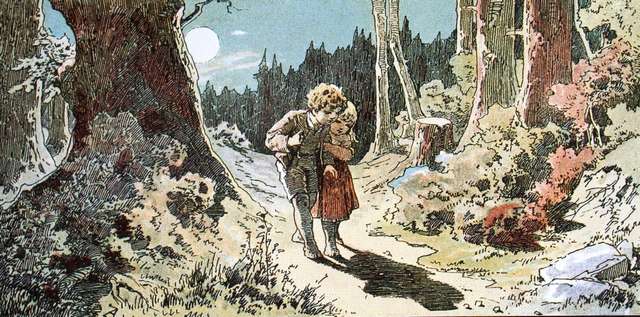
The English Symphony Orchestra reaches the penultimate instalment of its series for virtual storytelling with one of the most enduring among fairy tales – Hansel and Gretel, here given in the more abrasive version such as leaves little or no room for sentimental embellishments.

Although it has always been a parable for the playing-off of good against evil, the intensified recent concern about the exploitation of children has given this story a more ominous undertow. Little of that was emphasized here, yet the scenario remains one where the brutal corrupting of innocence is foremost; whether in the guise of the stepmother, rendered here in scarifying Irish, or that of the witch whose tendency to caricature is judged to a nicety. That neither children nor woodcutter exudes much in the way of persona may itself be significant.

As will have been realized, Henry Goodman is an animated and appealing narrator as he leads the listener through a story where incident likely counts for more than the ultimate destination. The score itself shows Thomas Kraines’s knack for moving across genres and styles with real sureness of touch, alighting on elements of German romanticism and expressionism to inflect those highpoints of the narrative. That the theme for the stepmother and the witch is a 12-note row brings a fresh perspective to a conceit whose lineage stretches back over nearly a century.

As in previous instalments the ESO musicians play with skill and sensitivity, Kenneth Woods ensuring clarity and balance even in the densest textures. The presentation is sure to provoke children of all ages and, as usual, a range of sundry material enhances the overall experience.

You can watch the concert on the English Symphony Orchestra website here

For more information on the English Symphony Orchestra you can visit their website here

For information about Auricolae, visit Kenneth Woods’ website here