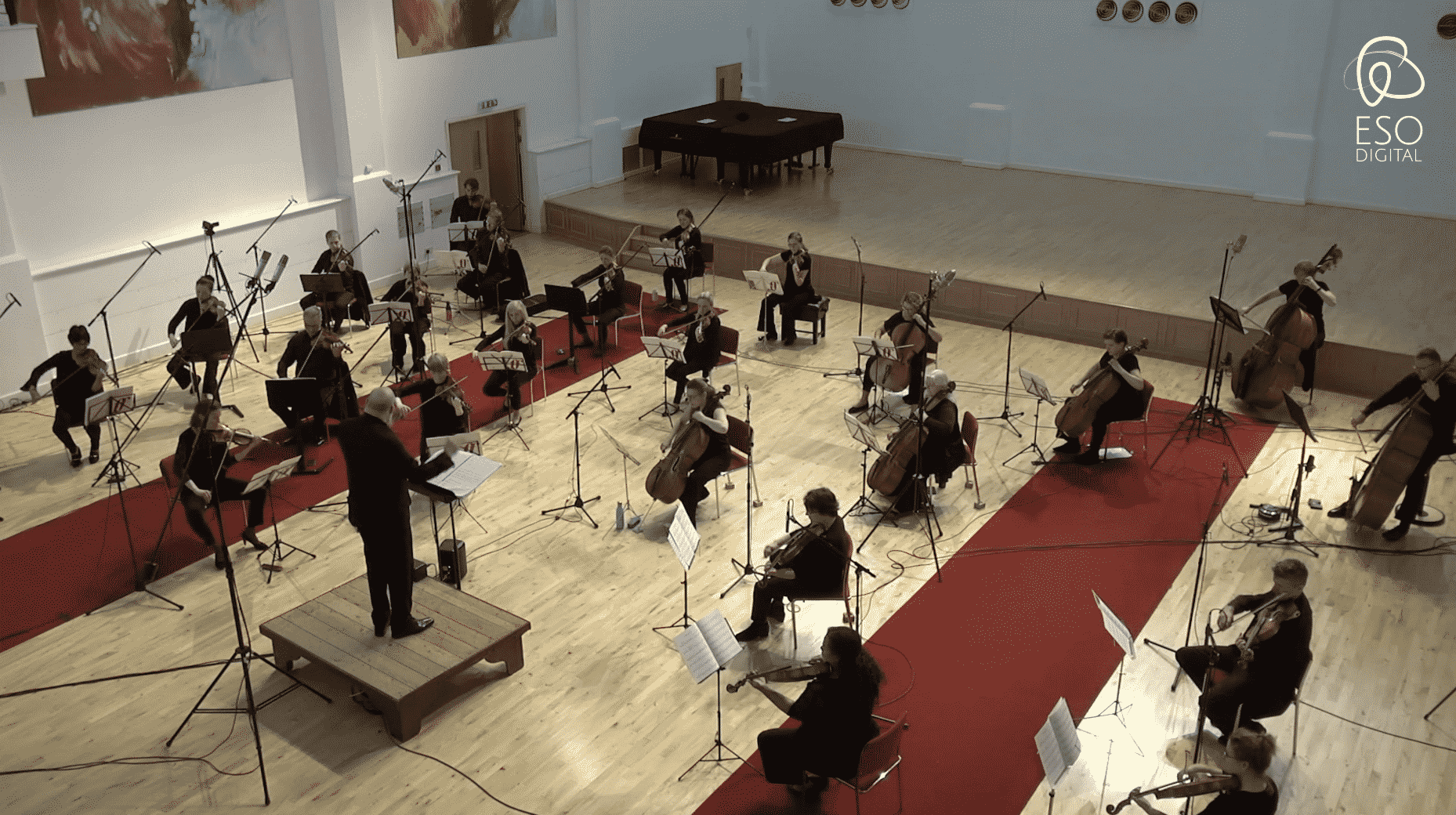
In concert – Members of Birmingham Contemporary Music Group: Huang Ruo: A Dust in Time

dust-in-time

Members of Birmingham Contemporary Music Group [Kate Suthers (violin), Colette Overdijk (violin), Adam Römer (viola), Ulrich Heinen (cello)]

Huang Ruo A Dust In Time (2020)

St Paul’s Church, Hockley, Birmingham
Tuesday 18 May

Written by Richard Whitehouse

The coronavirus pandemic and its attendant lockdowns has put paid to many events, not least a performance of A Dust in Time by Huang Ruo planned by Birmingham Contemporary Music Group for December, after a memorable online account three months earlier. Fortunately, it was possible to reschedule this to coincide with the further lifting of restrictions – enabling a socially distanced audience to hear what, when that created as the consequence of these past   18 months can be assessed more objectively, will come to be regarded as a defining artwork.

Born in southern China and now resident in the United States, Huang has emerged among the more striking composers of his generation (recordings of four Chamber Concertos and three of his ‘Drama Theatre’ pieces are well worth investigating on Naxos). Stylistically his music ranges across Eastern and Western, traditional and original sources – the resulting synthesis notable for its keen integration. An approach evident in this work, contrast between whose underlying concept and formal procedures are outweighed by its overall expressive impact.

Drawing inspiration from the circular concept of the mandala central to Hindu and Buddhist cultures (not least that of Tibet), while unfolding along the lines of a passacaglia which has long been a favoured formal model in European music, A Dust in Time patently evokes issues of transience and becoming over the course of an inevitable yet inexorable progress. Starting and ending on unaccompanied cello, it draws in viola, second then first violins as harmonic and rhythmic movement increase towards the sustained convergence of sound and emotion.

In its shortest incarnation (as previously performed by groups such as the ASKO-Schönberg Quartet) the piece ends here, but this evening it gradually effected a falling-off of tension on the way back to its beginning – deft usage of the Golden Section bringing it full circle at just under an hour’s length. In the earlier stages, listeners may have been reminded of the opening ‘Elegy’ from Shostakovich’s 15th Quartet with its oblique allusion to Russian Orthodox chant and comparable ‘otherness’, but the continuation and outcome could hardly be more different.

The performance, by a quartet from BCMG, was no less impressive than that given online by these same musicians – not least in its immaculate tonal blending and sense of venturing forth on a shared trajectory toward a common goal. Ensemble faltered passingly in the later stages, but never enough to undermine the intense focus and concentration which was brought to the music-making. Certainly, those present were held in thrall through to the transfigured closing bars – heard to advantage in the resonant while never cloying ambience of St Paul’s Church.

Huang has spoken of an extended version in which the piece can be looped round to twice its current length and played by a larger body of strings as an installation, though it is debatable whether music of this intensity would translate into a relatively passive listening experience. Hopefully, tonight’s account will be made available commercially – making possible a larger audience for a work which, together with the Donmar Warehouse’s production Blindness last year, is the surest statement of defiance and transcendence in the face of unforeseen tragedy.

Last year’s BCMG online performance of A Dust in Time can be seen here:

For further information about Huang Ruo you can visit his website here, while more information on the activities of the Birmingham Contemporary Music Group can be found at their website
Listening to Beethoven #151 – Piano Concerto no.1 in C major Op.15

piano-concerto-1
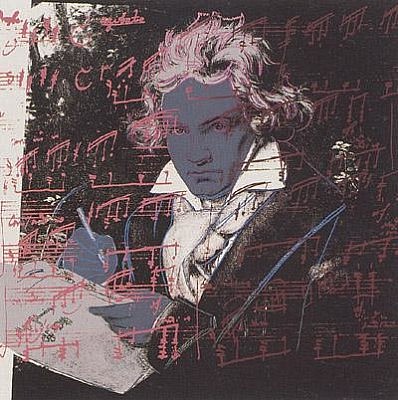
Beethoven (1987) by Andy Warhol – screenprint on Lenox Museum Board

Piano Concerto no.1 in C major Op.15 for piano and orchestra (1795-1800, Beethoven aged 29)

Dedication Princess Babette Odescalchi (a former pupil)
Duration 35′

Listen

Background and Critical Reception

Beethoven tried his hand at a piano concerto back in 1784 at the age of 13, and although it was another 17 years before his next attempt was published, the musical form was never far from his mind. As Barry Cooper reports in his booklet note for Hyperion’s new recordings with soloist Stephen Hough, ‘By 1795, Beethoven felt ready to launch a public career as a pianist-composer. He began composing his Piano Concerto no.1, making numerous sketches and rough drafts’.

A prototype seems to have been performed at the Burgtheater in Vienna on 29 March 1795, with the finale composed in a hurry, but the work was revised in 1800 and written out afresh. This final version was published in March 1801, with the original lost. Cooper writes that ‘around this time, Beethoven began including pedal marks in his own piano works, and this concerto was his first work (along with the Quintet for piano and wind Op.16) to be published with them’.

Daniel Heartz notes that the work ‘calls for the full orchestra of Mozart’s largest piano concertos’ – and goes on to draw parallels with Mozart in Beethoven’s structuring of the first movement and the relationship between the piano and the orchestra. Cooper finds that ‘in all of Beethoven’s piano concertos, the first movement is the most complex, written in a blend of Baroque ritornello form and the more modern sonata form.’ The suggestion is that a great deal of time has been spent on it, as well as the traditional cadenza near the end of the movement. While this section would normally be improvised by the soloist, Beethoven wrote out three possibilities – one in 1808 and two more in 1809.

Heartz describes the theme of the finale as ‘sharply etched in emphatic rhythms, with many repeated tones, lending it a popular or folklike character, like a country dance. For him the third theme has a ‘Slavic twang’.

The reaction to the concerto is not well-documented, but it appeared in an 1801 concert in Vienna which included the first performance of the Septet and the Symphony no.1, also in C major.

Thoughts

Beethoven’s official entry into the concerto arena has a real sense of occasion in its opening minutes. The orchestra play for a good three minutes before we hear the piano, which would surely have heightened the audience expectation back in 1801. It is an elegant theme that gains stature and power, complemented by a flowing second tune.

When the piano has arrived Beethoven enjoys its qualities in dialogue with the orchestra, as well as showing it off. There are some surprisingly quiet, touching moments where the ear is pulled in – just as there are the more obvious opportunities for display.

The first movement is a long one but sustains the drama through to the cadenza, the soloist given plenty of time to display their wares. It may even be too long in comparison to the rest of the work, for it is almost half the duration.

For the slow movement Beethoven chooses A flat major, the same key which held our rapt attention for the second movement of the Pathétique sonata. Here the effect is similar if not quite as concentrated, yet there are tender asides both for the soloist and the orchestra and some lovely prompting from the woodwind, clarinet in particular. The piano tells its story in expressive tones.

The best tune, however, is held over for the finale. It is a catchy number with its roots in the dance, as Daniel Heartz notes, and because of the finale’s ‘Rondo’ structure (A-B-A-C-A-B-A) and its status as the ‘A’ theme, we hear it several times – and it is undoubtedly the tune the audience walk away humming!

Spotify playlist and Recordings used

Wilhelm Kempff, Berliner Philharmoniker / Ferdinand Leitner (Deutsche Grammophon)
Robert Levin, Orchestre Révolutionnaire et Romantique / Sir John Eliot Gardiner (Arkiv)
Mitsuko Uchida, Bavarian Radio Symphony Orchestra / Kurt Sanderling (Philips)
Rudolf Serkin, Bavarian Radio Symphony Orchestra / Rafael Kubelik (Orfeo)
Claudio Arrau, Royal Concertgebouw Orchestra / Bernard Haitink (Philips)
Martha Argerich, Philharmonia Orchestra / Giuseppe Sinopoli (Deutsche Grammophon)
Ronald Brautigam, Die Kölner Akademie / Michael Alexander Willens (BIS)
Stephen Hough, Finnish Radio Symphony Orchestra / Hannu Lintu (Hyperion)

With so many recordings of the concerto it is only possible to offer a few pointers rather than declare a definitive version, but each of the above recordings have helped form an impression of the piece. Wilhelm Kempff and Ferdinand Leitner give a joyful account from 1960 which has held up extremely well, as do Rudolf Serkin and Rafael Kubelik from 1977. Serkin uses the biggest cadenza in the first movement, heightening dramatic impact even if it feels a bit unbalanced. Claudio Arrau’s musicianship is first class, with an especially beautiful delivery of the third movement theme. Robert Levin and John Eliot Gardiner create a special atmosphere in the hushed slow movement. Like Levin, Ronald Brautigam performs on a fortepiano, though his instrument has a coarser sound, lean and to the point. Despite the excitement of his reading the notes are a bit clumped in the finale.

To listen to clips from Stephen Hough’s new recording on Hyperion, head to their website

You can chart the Arcana Beethoven playlist as it grows, with one recommended version of each piece we listen to. Catch up here!

Also written in 1800 Boieldieu Harp Concerto in C major

Next up Horn Sonata in F major Op.17

In concert – Michael Collins & Michael McHale: Widor, Bax, Muczynski & Horovitz @ Wigmore Hall

collins-mchale

Michael Collins (clarinet), Michael McHale (piano)

Widor Introduction et Rondo Op.72 (1898)
Bax Clarinet Sonata in D major (1934)
Muczynski Time Pieces Op.43 (1984)
Horovitz Sonatina (1981)

Wigmore Hall, London
Monday 17 May (review of the online broadcast)

Written by Ben Hogwood

What a joy to see audiences back in Wigmore Hall on a Monday lunchtime, as the venue took its first available opportunity of 2021. The gathering was for an enterprising program of 20th century works for clarinet and piano from Michael Collins and Michael McHale, pleasingly off the beaten track in its selection and proving highly accessible.

Viewed online in this case, the excitement was palpable – from Andrew McGregor’s introduction for the live broadcast on BBC Radio 3 to the performers’ demeanour as they began. The clarinetist successfully overcame an instrument malfunction, too, which caused him to repeat the first few minutes of the Bax sonata.

Collins and McHale began with Widor, however, a competition piece written for students of the Paris Conservatoire in 1898. Both performers settled immediately, Collins with a beautifully floated introduction and McHale with sensitive pedaling, the pianist then echoing the excitable flourishes from of clarinet when the Rondo itself arrived. This work occupies a happy place in Widor’s output, and was a joyful overture here.

The mood deepened for the Clarinet Sonata in D major of Sir Arnold Bax from 1934. First performed by Frederick Thurston, it is an unusually structured work, but the two movements sit together nicely. It was during the beautifully floated opening that Collins had to change his clarinet, but the advantage of this was that we were able to marvel at his control for a second time, supported by rippling figures from McHale. The first movement unfolded as though in one long phrase, revealing the influence of Wagner but establishing Bax’s own melodic grace too. The second movement had impressive urgency, with chromatic surges from the piano and impressive breath control from Collins. A typically deep second theme was matched by a lovely, poised closing section.

The Polish-American composer Robert Muczynski has an intriguing works list including many pieces for woodwind, and the Time Pieces of 1984 are among his most-performed. Each of the four movements looks to bring out different qualities of the clarinet and Collins was fully alive to their possibilities. The busy first piece was enjoyable, clarinet and piano ducking and diving in their interplay, while time became suspended in the outer sections of the second piece, lost in thought. The third explored the timbres of the solo clarinet, wonderfully nuanced by Collins, while the spicy dialogue of the fourth was laden with syncopation and brilliantly played.

The Sonatina for clarinet and piano from Joseph Horovitz dates from 1981, when it was first performed by Gervase de Peyer and Gwenneth Pryor in the Wigmore Hall itself. Like Muczynski, Horovitz is at home writing for wind and brass. Working within a compressed structure, the Sonatina was packed with incident and melody. A perky first movement unfolded with easy, winsome phrases, while the second was more introspective and took time for soul searching. Not so the finale, whose offbeat japes were carefree and witty in this performance, instinctively played.

It was over all too soon – but we were treated to an encore, Collins every bit as enthused as the audience. The warm-hearted Summer, from Paul Reade’s suite Victorian Kitchen Garden, was the ideal choice.

This concert is available to play for 30 days using the YouTube embedded link above.

Live review – English Symphony Orchestra / Kenneth Woods: Elgar Reimagined Part 2

ElgarStringQuartet-Screenshot

English Symphony Orchestra / Kenneth Woods

Elgar, arr. David Matthews String Quartet in E minor Op.83 (1918)

Wyastone Concert Hall, Monmouth
Recorded September 22 2020 for online broadcast from Friday 14 May 2021

Written by Richard Whitehouse

Following its programme of miniatures – original and arrangements – for cello and strings in March, this latest online concert by the English Symphony Orchestra returned to Elgar for a reading of his String Quartet arranged by David Matthews for a full complement of strings.

This was the second in a triptych of chamber works composed in rural seclusion at Brinkwells in Sussex, Elgar having escaped the wartime disillusion of London for what was to be his last sustained period of creativity. Less introspective than the Violin Sonata that preceded it while less emotionally charged than the Piano Quintet that came after, the String Quartet is the most finely proportioned of the three – unfolding as a sustained sweep whose subtle transformation of thematic elements across and between its three movements make it among the finest of his later compositions. Heard in this guise, it follows on from the Serenade then Introduction and Allegro as the hitherto missing large-scale work for string orchestra of Elgar’s high maturity – which should hopefully commend it to an audience beyond that of the composer’s devotees.

Matthews has numerous arrangements to his credit (not least Schumann’s Piano Concerto as recast for marimba), and he has been mindful to balance the soloistic and ensemble potential of this music, so the result is neither straightforward transcription nor radical re-conception. The opening Allegro moderato discreetly emphasises an autumnal musing that sets the tone for much of what follows; even finer is the second movement – marked Piacevole – whose equability yields a main theme suffused with intensity, the extent of which is only revealed towards the close. If the emotional acuity of the final Allegro is marginally diffused when rendered for larger forces, there is no lack of rhythmic definition as the music proceeds to a coda whose terse decisiveness is far removed from the opulence of just a few years before.

Its idiomatic nature was enhanced by the ESO’s attentive playing under Kenneth Woods, a natural follow-on to their take on the Piano Quintet in Donald Fraser’s arrangement (Avie). Heard together, these two parts of Elgar Reimagined should make for a desirable recording.

You can watch the concert on the English Symphony Orchestra website here

For more information on the English Symphony Orchestra you can visit their website here

Let’s Dance – DJ Kicks mixed by Special Request (!K7)

special-request-dj-kicks

reviewed by Ben Hogwood

What’s the story?

The DJ Kicks story continues apace, and continues to choose imaginatively, with no sign of the quality dipping. Stepping up for this release is Paul Woolford, donning his Special Request moniker. As a listener he saw the DJ Kicks series ‘as a benchmark of quality and a time-stamped gateway into an artist’s state of mind’, going on to say that ‘for this volume, I wanted to focus on lush melodics. I kept that as a constant thread throughout, choosing only records I cherish…it’s not a ‘current snapshot’ by any means, more a chronicle of some of my all-time favourites.’

What’s the music like?

Given Woolford’s history and pedigree, the idea of sharing in his favourite music is too good to resist – and so it proves. It is no surprise to report a varied set of house and break beat, moving from classic disco-house to full blooded drum and bass, by way of variations in between. The mix is pleasingly rough around the edges in its blending of music, giving it a more authentic feel.

Woolford takes us straight to the heart of the dancefloor with Alicia MyersRight Here Right Now, remixed by John Morales, a very cool cut of swooning vocal house, and he backs this up with instrumentals from Harvey and Morgan Geist, complete with trumpet solo. Being such a prolific writer and producer, Woolford can’t resist adding some varied examples of his own canon, so we get KissFM NY87 Mastermix and Vellichor trading riffs and busy percussion while pushing the mix forwards.

Woolford then gives us sun-soaked techno from As One, Virgo (the brilliant synth-heavy R U Hot Enough?) and Ace Mo, complementing them with diverse beats from Krystal Klear, Speedy J, LS1 Housing Authority and μ-Ziq. Bleeps and blips, warm keyboard pads, dynamic percussive runs – all are found in a thrilling sequence of dance music, the direct style of Woolford’s own productions embodied in the music he chooses.

Two of his own remixes form highlights of the later section of the mix, FC Kahuna’s cool Hayling and μ-Ziq’s Twangle Frent, underpinned by a massive, sonorous bass sound. Now the pace is frenetic, with flurries of drums from Galaxian and Four Horsemen Of The Apocalypse cutting to a widescreen breakdown powering the Tim Reaper mix of another Special Request production, Pull Up. The two collaborate on another stormer, Elysian Fields, before a final Woolford collaboration wraps up the mix, the shimmering 96 Back co-write Petrichor.

Does it all work?

Very much so. Woolford is well-versed in pleasing his crowd, so the notion of a CD-length DJ Kicks mix comes easily to him. The only difficulty, you sense, was choosing what to leave out of the mix! In 25 tracks we get an excellent history lesson with no preaching, a view behind Woolford’s own creative process.

Is it recommended?

Highly. Special Request is an inspired, stellar addition to the DJ Kicks series, which just keeps on getting better. As a celebration of dance music’s primal power to move, you couldn’t ask for more.

Stream

Buy