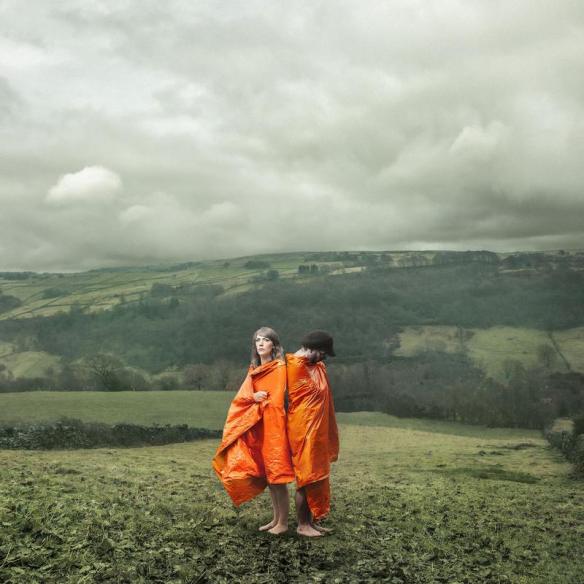
On Record – Cobalt Chapel: Orange Synthetic (Klove Recordings)

reviewed by Ben Hogwood

What’s the story?

Cobalt Chapel, the duo of Cecilia Gage and Jarrod Gosling, release a second album of pop roots in psychedelia and folk music, focusing in on their home county.

It is, as they say, ‘music grounded in the Yorkshire earth; its people, the surrounding nature, landscape and its mythology, from the distant past to modern life’.

What’s the music like?

Both protagonists of Cobalt Chapel have varied backgrounds – Gosling as a one-time member of I Monster and Gage through her work with Maps and Matt Berry. Orange Synthetic celebrates these diversities, and its music proves to be unpredictable and inventive if occasionally loose in structure.

The duo start out with what sounds like a leftfield pop album, but gradually more psychedelic, woozy layers are revealed, along with an underlying haunting quality. Our Angel Polygon is responsible for the latter feeling. A striking track with slightly sinister lyrics and a melody from folklore, it was inspired by RAF Fylingdales, the distinctive early warning centre on the East coast of Yorkshire. Its enormous domes, like oversized golf balls, are evoked here in a song of windswept mystery.

In Company, the first song of the album, is a dark fairy tale seen through the eyes of writer Angela Carter. It comes in an exquisitely scored chamber-pop setting, with Gage’s deadpan vocal both affecting and unsettling.

Meanwhile the rolling beat of It’s The End, The End carries a bleak, apocalyptic message, while the haunting folksong of E.B. is head as though in a weird apparition.

At times the album is downbeat in its message but the elements of fantasy and mystery are key, as are the elements of late 1960s psychedelia in the production. These give an essential colour to the music.

Does it all work?

Largely. The musical freedom Cobalt Chapel allow themselves is refreshing, and it allows them to construct unusual and evocative songs, which translate themselves into striking pictures for the mind’s eye. The bleakness of the Yorkshire moors is successfully evoked but so is the wonder of those open spaces.

Is it recommended?

It is, but with the caveat that Orange Synthetic is a dark album for a dark time of the year. It is beautifully made and executed, and offers some haunting visions. Fans of Broadcast and Stereolab will undoubtedly find something to enjoy here.

Stream

Buy

You can buy the album from the Norman Records website

Listening to Beethoven #109 – “Ah! Perfido”, Op.65

Portrait of Josepha Duschek in 1796

“Ah, perfido!”, Op.65 for soprano and orchestra (1796, Beethoven aged 25)

1. Scena: Ah! perfido, spergiuro
2. Aria: Per pietà, non dirmi addio

Dedication Josepha Duschek
Text Pietro Metastasio / Anonymous
Duration 14′

Listen

Background and Critical Reception

Beethoven wrote Ah! Perfido as a two-part concert scene and aria, with the Czech soprano Josepha Duschek in mind. He met the singer and her husband on his visit to Prague in 1796, but in the end had to entrust the debut on 21 November to Countess Josephine Clary, because of a clash of engagements. Despite its relatively early genesis the work was not published until 1807, and it appeared on the programme of Beethoven’s famous Akademie concert in 1808.

Many commentators see the roots in Ah! Perfido from Mozart’s writing for voice and orchestra. Writing in The Beethoven Companion, Leslie Orrey sees a clear prototype for the work in Mozart’s Bella mia fiamma, K528 – itself a scene and an aria written for Duschek. Daniel Heartz, in his comprehensive appraisal of early Beethoven, is not so sure.

He writes in typically revealing detail. “Since the text is pathetic, his (Beethoven’s) choice of E flat is appropriate, and so is the form, that of the two-tempo rondo, still the height of fashion in 1796 and just the sort of piece a professional like La Duschek would want to sing. Its languid first part, Adagio in 3/4 time, has a theme that returns after contrast, while the second part, Allegro assai in common time, has a gavotte-like theme that also returns after contrast. The faster transition between the two parts, which appears later, is unusual. It has been claimed that Beethoven modelled Op.65 on Mozart’s Bella mia fiamma. Yet there is little in common between them aside from the form, which Mozart treats more freely still.” 

Thoughts

Beethoven puts our emotions through the wringer with this dramatic scene. The orchestra’s brisk introduction sets the picture for our soloist, who is given some powerful and declamatory high notes. Seen live, the effect is arresting, the dialogue with the orchestra like a recitative from a Handel opera, with comments made in quick bursts.

Yet with the solo aria the mood changes markedly. A slow introduction from the orchestra leads to a beautiful melody from the soloist, which requires great control but fully conveys the emotion of the unknown author. Beethoven provides subtle orchestral complements from clarinet and woodwind, and in the middle of the aria we pull back to just the singer and soft pizzicato, a moving moment indeed. Our protagonist is resigned to a troubled end, with fresh drama through a burst from tremolo strings and another heartfelt plea. Finally the slow music returns, rather beautifully.

Recordings used

Elisabeth Schwarzkopf (soprano), Philharmonia Orchestra / Herbert von Karajan (EMI)

Janice Watson (soprano), English Chamber Orchestra / Matthew Best (Hyperion)

Chen Reiss (soprano), Academy of Ancient Music / Richard Egarr (Onyx)

Charlotte Margiono (soprano), Orchestre Révolutionnaire et Romantique / John Eliot Gardiner

Camilla Tilling (soprano), Gabrieli Players / Paul McCreesh (Archiv)

In her interview with Arcana, Chen Reiss talked about approaching Ah! Perfido from two different historical directions. Elisabeth Schwarzkopf brings the romantic drama in a commanding performance, singing with fulsome tone and vibrato. Herbert von Karajan’s sleek orchestral accompaniment makes the piece sound around 70 years younger.

By complete contrast, the leaner tones of the Academy of Ancient Music under Richard Egarr have the excitement of the new, as the strings burst from the blocks. Reiss’s voice is clear and urgent, the words still fresh off the page. Hers is a dramatic account indeed, and Egarr ensures the detail from the orchestra is beautifully shaded.

A mention, too, for Charlotte Margiono, whose clear singing matches John Eliot Gardiner’s detailed account – and for Camilla Tilling, who makes an excellent partnership with Paul McCreesh and the Gabrieli Players. Not quite as dramatic as Reiss and the AAM though!

Spotify links

This playlist collects most of the available versions mentioned above:


You can chart the Arcana Beethoven playlist as it grows, with one recommended version of each piece we listen to. Catch up here!

Also written in 1792 Cimarosa – Gli Orazi e i Curiazi

Next up 6 German Dances for violin and piano

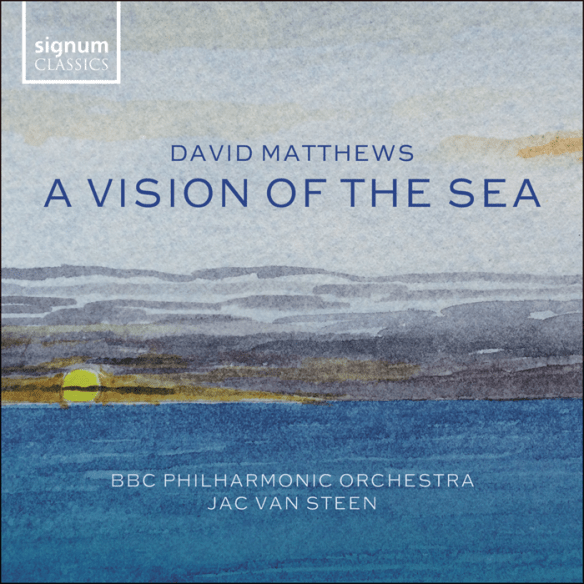
On record: BBC Philharmonic Orchestra / Jac van Steen – David Matthews: A Vision of the Sea (Signum Classics)

BBC Philharmonic Orchestra / Jac van Steen

David Matthews
Toward Sunrise Op.117 (2012)
Symphony no.8 Op.131 (2014)
Sinfonietta Op.67 (1995)
A Vision of the Sea Op.125 (2015)

Signum Classics SIGCD647 [67’42”]
Producer Michael George
Engineer Stephen Rinker

Recorded 7 November & 6 December 2017, BBC Studios, Mediacity, Salford, UK

Reviewed by Ben Hogwood

What’s the story?

This album is billed as an approachable route in to the music of David Matthews, one of the most prominent living British symphonic composers. Matthews has nine symphonies under his belt already, and we hear the Eighth as part of this programme, but he has a wealth of orchestral music alongside, from which Jac van Steen and the BBC Philharmonic Orchestra draw three works.

What’s the music like?

Matthews’ Symphony no.8 forms the centrepiece of the program, a substantial three-movement work completed in 2014. Its taut musical arguments suggest the influence of Sibelius, the harmonic language appears to build on late Vaughan Williams, and there are references to Debussy and Stravinsky in the orchestral colours used by the composer.

Yet this is by no means a derivative work. Matthews writes in the booklet note that he no longer feels the need to defend writing tonal music, and this argument gets the strongest possible endorsement from the music itself. From the opening chord, rich in woodwind, the musical exchanges are compelling, the harmonies often bewitching, and the form instinctive, written as it is by a hand of symphonic experience.

Too many newer symphonies are let down by their faster music, but not in this case. The first movement unfolds with powerful statements from brass and strings, their energetic arguments punctuated by rolling timpani. The bracing energy is complemented by a reflective Adagio, whose soft chords achieve contemplation in the context of a surrounding, uneasy mood. The music builds, reaching an impressive apex with full-bodied string sound before returning to its original state.

Matthews finishes with an uplifting set of four dances, inspired in part by vapour trails on the Kent coast. The bright colours and persuasive triple time rhythms add a lightness of touch to the full orchestra passages, resembling the profile of the second movement Sibelius’ Fifth Symphony…in a good way! The lightness of touch Matthews achieves at the final resolution is both unexpected and charming.

After the Eighth Symphony we hear the Sinfonietta from nearly 20 years earlier. A tightly compressed piece, its leaner textures generate a good deal of tension, as does the jousting between instrumental sections of the orchestra. The piece is in effect a short concerto for orchestra, culminating with thunderous timpani and short but probing melodies. It is convincing in its outcome, but less accessible with its more oblique melodies.

The accompanying pieces show Matthews’ ability to paint pictures with an orchestra. His tone poem Toward Sunrise begins the album. It is a response to the sun’s ability to make its own music through magnetic loops coiling away from its outer atmosphere, captured in sound by students at Sheffield University. Matthews takes two notes heard in that recording and transfers the motif to the depths of the lower strings, conveying the passing shadows of the night from which the sun will emerge. As the sunrise itself begins the orchestra tingle with anticipation, a volley of timpani rings out and the first rays poke through as the piece ends. It is the ideal piece with which to start.

The hiss of waves on the beach is immediately audible in A Vision of the Sea, a four-part tone poem completed in 2013. British composers have long written effective pictures of the sea, notably Vaughan Williams, Britten and Bridge, and Matthews can be added to that list. His first-hand account of English Channel vistas, punctuated by herring gulls, gets into the minds’ eye of the listener, painted with the help of ghostly piano and an expert use of the percussion section. The vision ends with another sunrise, and the crash of the waves on the shore.

Does it all work?

It does. The program is ideally judged, each work succeeding on its own terms but working as part of the bigger whole. The clinching factor is these authoritative performances from the BBC Philharmonic Orchestra, who have a very strong relationship with Matthews’ music. They appreciate his credentials as a fine symphonist, and his ability to create pictures in an instant.

Is it recommended?

Yes, with great enthusiasm. So many works premiered in this century are not followed up with second performances or recordings, which can be frustrating for concert goers, so it is wholly satisfying to see Signum and the BBC Philharmonic investing so much in this release. Their efforts are handsomely rewarded.

For further information on this release, visit the Signum Classics website.

Perfect Songs – Patrick Watson: Into Giants

by Steven Johnson

Over the last twenty years Canadian singer Patrick Watson has made a name for himself as a writer of keenly felt and sensitively delivered songs. His eight albums to date have all contained episodes to savour and, while he may have sung on higher profile songs along the way, it’s hard not to see Into Giants as arguably his finest moment. A lot of his songs might have a melancholic, introspective feel but Into Giants, taken from his 2012 Adventures In Your Own Backyard album, is in many ways the exact opposite.

Why is it a perfect song?

In short, it has all necessary elements in place and is over-brimming with positive qualities. There’s just so much to love about it.

The heart-warming storyline relayed throughout the song might have been enough on its own but the clever, subtly considered musical arrangements further elevate and enrich its message. Essentially, it tells the story of two people embarking on a journey through life, their relationship evolving and blossoming as they proceed. If you’re worried that sounds a little too saccharine, set any concerns aside – the song generates so much goodwill that you’ll soon find yourself rooting for the contented pair.

It’s not just Watson that sings on Into Giants – he duets with Swedish singer Erika Angell. Together they make sure we’re swept along in the narrative. “Started as lovers, don’t know where it’s gonna end” they repeat over the course over the four minutes. As a refrain it might leave the ending to the story tantalisingly open but there’s no doubting that, right now, things are looking up.

The video directed by Brigitte Henry brings the song even further to life (and is essential viewing in itself). It begins in a way that will be familiar to most these days, with Watson and Angell singing to each other remotely, connected only via the screens of their computers. Soon, they’re united in real life however, dressed up and theatrically tap dancing their way through a colourful set. They sing of how they “grew so tall our heads hit ceilings” and “turned into a crowd of smiles, jumping over all the bad times” and it’s hard not to submit to it in full. There are so many lovely details – from the way Watson wears his hat early on to how they’re showered in confetti towards the end (the allusion to a wedding is apt given the feeling of windswept romance the song portrays). The behind the scenes video provides some nice additional footage (and shows just how much work went into its creation).

There’s much in the way of ornate, decorative instrumentation across the song but when the celebratory trumpets kick in late on it feels especially exultant. Soon after, we’re transported through a door into a venue where a gig is taking place and the pair resume their original positions on stage to deliver their final, moving lines. The central yet understated percussion that runs through the song signs off for one last time. It caps a life affirming and joyous few minutes that never gets old, very much a perfect song.

Perfect Songs is a new occasional series from Arcana. If you have any suggestions for the series, or would like to contribute to it, get in touch – editor@arcana.fm


Listening to Beethoven #108 – 12 Variations on ‘Ein Mädchen oder Weibchen’ Op.66

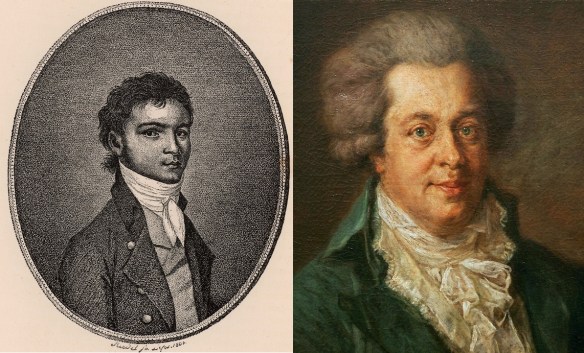
Ludwig van Beethoven and Wolfgang Amadeus Mozart (right, in a portrait by Johann Georg Edlinger)

12 Variations on ‘Ein Mädchen oder Weibchen’ from Mozart’s Die Zauberflöte Op.66 for piano and cello (1796, Beethoven aged 26)

Dedication thought to be Friedrich Wilhelm II, King of Prussia
Duration 10′

Listen

What’s the theme like?

The theme is Papageno’s aria, from Mozart’s opera Die Zauberflöte (The Magic Flute), where he expresses his desire for a wife over a glass of wine:

Background and Critical Reception

Beethoven’s flurry of activity writing for the piano and cello in 1796 yielded four works. Alongside the two groundbreaking sonatas published as Op.5 came two sets of unpublished variations, seemingly inspired by the same dedicatee and performers. The first set had fun with music by Handel, yet – as the excellent Beethoven’s Cello book reveals – this one has slightly more serious origins.

‘In all likelihood Beethoven finished these variations after his return to Vienna’, says the book. They were not published until 1819, when they were assigned the opus number 66 – overlooked when the Fifth Symphony was published ten years earlier. The book suggests Beethoven encountered The Magic Flute in Berlin, thanks to Frederick William II’s promotion. The roots of the piece, however, appear to lie in Beethoven’s competitive edge. They may have been designed in response to Abbé Gelinek, a pupil of Beethoven’s teacher Albrechtsberger and a popular piano teacher in Vienna.

Gelinek had already completed a set of ‘frivolous piano variations’ on Ein Mädchen oder Weibchen three years earlier. ‘Beethoven seems to have taken his lead from Gelinek’s six variations by producing twelve’, says the book, ‘starting in the same manner so he could eventually ‘out-compose’ his rival’. Gelinek’s is entertaining and pleasing, but not musically adventurous; Beethoven’s more assertively tests the limits of the theme and probes the possibilities for constructing a little musical drama around it. A contemporary review questioned Beethoven’s potential as a composer, for he was guilty of unusual tonal movements and ‘harmonic harshness’.

Thoughts

Beethoven has a lot of fun here. A perky introduction of the theme sees piano and cello in level partnership, with straightforward musical punctuation. Then, as the variations proceed, both instruments really start to express themselves. The piano offers a nicely weighted variation before the cello shows off its prowess in the higher register. This is Steven Isserlis’ ‘nightmarish’ second variation, the most difficult – and it’s easy to see why, with a high register and some very tricky jumps.

Once that’s over there is a lot for the cello to enjoy in rich, expressive exchanges with the piano, Beethoven’s bubbling stream of ideas showing no sign of letting up. Some are quickfire and virtuosic, others slow and profound, showing off the expressive tone of the cellist. There are also a couple of brisk marches, the second with block chords from the piano. As often seems to be the case with these pieces, the minor-key variation (the tenth) proves pivotal, a plaintive start growing into a substantial and emotional duet with unusual, questioning harmonies. Coming out of this, the two instruments have renewed energy and finish with a flourish.

Recordings used and Spotify links

Adrian Brendel (cello), Alfred Brendel (piano) (Decca)
Mischa Maisky (cello), Martha Argerich (piano) (Deutsche Grammophon)
Miklós Perényi (cello), András Schiff (piano) (ECM)
Steven Isserlis (cello), Robert Levin (fortepiano) (Hyperion)
Nicolas Altstaedt (cello), Alexandre Lonquich (piano) (Alpha)

The Spotify playlist below includes all but one of the versions listed above – with the opportunity to hear a clip from Steven Isserlis and Robert Levin’s version on the Hyperion website

Again it is Robert Levin and Steven Isserlis who get the measure of the piece, from its light hearted moments to the deep and questioning minor key variation.

Also written in 1796 Haydn Saper vorrei se m’ami, Hob.XXVa:2

Next up Ah! Perfido Op.65