Listening to Beethoven #107 – 12 Variations on ‘See The Conquering Hero Comes’ from Handel’s Judas Maccabaeus WoO 45

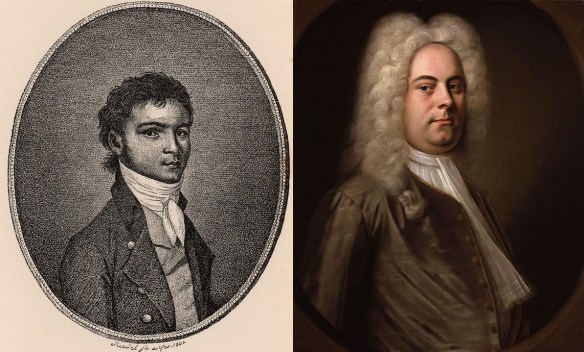
Ludwig van Beethoven and George Frideric Handel (right)

12 Variations on ‘See The Conquering Hero Comes’ from Handel’s Judas Maccabaeus WoO45 for piano and cello (1796, Beethoven aged 26)

Dedication thought to be Friedrich Wilhelm II, King of Prussia
Duration 12′

Listen

What’s the theme like?

Handel’s theme is a chorus from his oratorio Judas Maccabaeus. It is a popular tune which has been turned into a popular Christian hymn, Thine be the glory.

Background and Critical Reception

Soon after the success of his two Op.5 sonatas for piano and cello, Beethoven wrote a couple of sets of variations for the same instrumental combination. The dedicatee appears once again to have been Friedrich Wilhelm II, King of Prussia, with the cello-playing Duport brothers seemingly closely involved.

As Arcana discovered in a previous article, Beethoven’s love of the music of Handel ran deep. Later in his life he was to acquire Samuel Arnold’s first collected edition of Handel’s music (1787-97). Beethoven’s Cello – an excellent and compelling study of his music for the instrument by Marc D. Moskovitz and R. Larry Todd – has an engaging account of the work’s genesis.

It seems likely Beethoven attended a concert of Handel’s oratorio Judas Maccabaeus in Vienna in April 1794, but that his decision to use the ‘conquering hero’ theme came later. There are accounts of a concert in Berlin in 1796, when he improvised on the theme and, as Beethoven’s Cello recounts, ‘his listeners were so moved that they crowded around him and wept’. The decision to include cello ‘is not clear, but perhaps Duport played some role’, says the book.

There are twelve variations, beginning with keyboard-led music but gradually giving greater prominence to the cello. The seventh variation features a challenging display of tumbling triplets in the cello, noted by Moskovitz and Todd as having an affinity with Duport’s sixth etude. This variation is described by Steven Isserlis as the ‘one hideously difficult’ variation of the twelve.

Thoughts

Beethoven’s inspiration flows freely in this immediately likable work. The theme is memorable, one of Handel’s best tunes, and its triumphal air makes an early impact. The two instruments have an enjoyable and lightly spiced interplay, briefly turning baleful in the fourth, minor key variation but resuming its infectious optimism immediately afterwards.

The seventh variation is indeed a nasty one for the cellist, with skittish figures dancing all over the place, but then it’s the pianist’s turn, with a thundering statement. The two resume their ‘dance’, with a triumphant tenth variation – more bravura from the piano – and a substantial coda, with some slower thoughts, which leads to a subtly joyful finish.

Recordings used and Spotify links

Adrian Brendel (cello), Alfred Brendel (piano) (Decca)
Mischa Maisky (cello), Martha Argerich (piano) (Deutsche Grammophon)
Miklós Perényi (cello), András Schiff (piano) (ECM)
Steven Isserlis (cello), Robert Levin (fortepiano) (Hyperion)
Nicolas Altstaedt (cello), Alexandre Lonquich (piano) (Alpha)

The Spotify playlist below includes all but one of the versions listed above – with the opportunity to hear a clip from Steven Isserlis and Robert Levin’s version on the Hyperion website

There are some starry accounts of these variations, from father and son pairing Alfred and Adrian Brendel, from Martha Argerich and Mischa Maisky, and András Schiff with Miklós Perényi to name just three excellent versions. However it may not surprise you to learn that Steven Isserlis and Robert Levin pip them at the post with a thoroughly enjoyable account, recreating something of the air in the concert hall after Beethoven’s instinctive improvising in Berlin. Also highly commended is a new version from Alexander Lonquich and Nicolas Altstaedt.

Also written in 1796 Haydn Guarda qui, che lo vedrai Hob.XXVa:1

Next up 12 Variations on ‘Ein Mädchen oder Weibchen’ Op.66

Live review – April Fredrick, Zoë Beyers, English Symphony Orchestra / Kenneth Woods: Inspired by Mahler

April Fredrick (soprano, above), Zoë Beyers (violin), English Symphony Orchestra / Kenneth Woods

Mahler (arr. Stein) Das irdische Leben (1892/1900)
Weinberg Concertino for Violin and Strings, Op. 42 (1948)
Schulhoff Suite for Chamber Orchestra, Op. 37 (1921)
Ullmann (arr. Woods) Chamber Symphony op 46a (1943/1999)

Wyastone Concert Hall, Monmouth
Recorded in 2020 for online broadcast, Wednesday 27 January 2021

Written by Richard Whitehouse

The Holocaust Memorial Day is a timely opportunity to hear music anticipatory of, inspired by or stemming from events that have defaced human history on all too many occasions, and which provided the basis for this latest online concert from the English Symphony Orchestra.

The underlying tone for this programme was set by Mahler, with one of his settings of texts from the folk collection Des knaben Wunderhorn. In pivoting between the child’s supplication and his mother’s entreaties, over the fateful strains of a ceaseless ‘treadmill’ accompaniment, The Earthly Life is one of the composer’s most evocative songs – not least its portrayal of the child’s existence running out as though this were grains of sand. April Fredrick accordingly invested the vocal part with just the right combination of ominous dread and lingering pathos.

ESO leader Zoë Beyers then took centre-stage for Weinberg‘s Violin Concertino, the product of late-1940s Soviet culture when accessibility was not just desired but prescribed. Modest in expressive scope next to those chamber works that preceded it, this work is highly appealing – not least in the deftness and subtlety with which the composer unfolds his ideas across an ingratiating Allegretto, ruminative Adagio (whose cadenza-like introduction brings the most arresting music in the whole work), then a final Allegro whose thematic interplay is nothing if not resourceful. Beyers rendered it with unfailing eloquence, making it clear just why this attractive piece – which had to wait almost half a century for a first public hearing – should now have established itself among the most often performed of Weinberg’s orchestral works.

In telling contrast, Erwin Schulhoff’s Suite for Chamber Orchestra was a pert reminder of the composer’s usage of jazz as part of a lifelong and tragically curtailed stylistic odyssey. While the faster numbers recall the wit of Poulenc’s earlier chamber music and irony of Stravinsky’s suites for theatre orchestra, the Valse Boston (its soulful violin solos hauntingly rendered by David Juritz) and Tango admit of a searching introspection to the fore in those works from Schulhoff’s last years. Qualities which are pointedly side-lined by the uproarious final Jazz.

The final work provided the culmination in every respect. Written during internment at the transit camp of Terezin (aka Theresienstadt), the Third String Quartet is Viktor Ullmann’s likely instrumental masterpiece – in terms both of its formal unity and expressive diversity – and whose transcription onto the larger canvas has been persuasively achieved by Kenneth Woods. Chamber Symphony makes a not inappropriate title, this single span drawing the contrasted movements into a seamless and finely-balanced whole – the initial theme acting as a soulful refrain between the angular scherzo with its waltz-like undertow then, after the terse development, a fugal Largo whose accrued intensity carries over into the final Rondo with its striving towards a fervent restatement of the ultimately transfigured ‘motto’ theme’.

An imposing work, given a committed reading by this orchestra under its arranger in what was an appropriate tribute for the day. The ESO’s online series is scheduled to continue on the 26th of February, with a portrait concert of the American composer Steven R. Gerber.

You can watch the concert on the English Symphony Orchestra website from 7.30pm on Wednesday 27 January 2021 here

For more information on the English Symphony Orchestra you can visit their website here

Listening to Beethoven #106 – Adagio for mandolin and piano in E flat major WoO 43b


Joséphine de Clary, dedicatee of Beethoven’s music for mandolin and piano. Picture courtesy of the Beethoven-Haus Bonn.

Adagio in E flat major for mandolin and piano, WoO 43b (1796, Beethoven aged 25)

Dedication Joséphine de Clary
Duration 5′

Listen

Background and Critical Reception

The fourth and last of Beethoven’s known works for mandolin and fortepiano is a quite substantial Adagio, whose performing length is similar to the Sonatina in C minor. Its key of E flat major offers the possibility it was intended as the second movement of a bigger structure that went unfinished, as does its compatibility with the first piece. As with the other three of Beethoven’s mandolin works, it was ultimately written for Joséphine de Clary.

Thoughts

The piano takes the lead in this slow movement, which could form a complement to the Sonatina given its key of E flat major. Block chords are the support for a simple melody, the mandolin taking a supporting role at the start of what on the face of it seems like a straightforward piece. Yet here and there Beethoven mixes in some unexpected harmonies to keep the listener on their guard, and a middle section brings more energy before we revert to the original theme with the mandolin now in a higher register. It is quite a strange piece, and restless of mood.

Recordings used and Spotify links

Anna Torge (mandolin) and Gerald Hambitzer (fortepiano)

Alon Sariel (mandolin) and Michael Tsalka (fortepiano)

Julien Martineau (mandolin) and Vanessa Benelli Mosell (piano)

The block chords are clumped together on Tsalka’s fortepiano, as with Gerald Hambitzer on CPO, whereas the modern instrument gives much more sustain for Vanessa Benelli Moselli. Her account with Julien Martineau works best for this reason.

You can chart the Arcana Beethoven playlist as it grows, with one recommended version of each piece we listen to. Catch up here!

Also written in 1796 Hyacinthe Jadin – 3 Piano Sonatas Op.5

Next up 12 Variations on ‘See the conqu’ring hero comes’ for cello and piano

Listening to Beethoven #105 – Sonatina for mandolin and piano in C minor WoO 43a


Jean-Baptiste Krumpholz, brother of Wendel Krumpholz, a violin and mandolin-playing friend of Beethoven in Vienna.

Sonatina in C minor for mandolin and piano, WoO 43a (1796, Beethoven aged 25)

Dedication Joséphine de Clary
Duration 4′

Listen

Background and Critical Reception

Beethoven’s first two works for mandolin and piano, a C major Sonatina and the Andante con Variazoni, bear the publishing imprint WoO (work without opus) 44. The next two carry the number 43, but are thought to have been revised versions of pieces he started in Vienna, presumably for his friend Wenzel Krumpholz.

Beethoven’s mandolin music is not generally regarded as great, though it should be said his contemporaries, among them Hummel, were writing for the instrument around the same time. This Sonatina is of a similar length to its C major counterpart but uses the minor key. Despite that the music is more for private use than a work like the Piano Trio in C minor, the third of the Op.1 set.

Thoughts

The musical language is much more serious in this Sonatina compared to the previous one – though with the tones of the mandolin it does sound much more tongue in cheek. Soon the music shifts from the minor key to the major and it feels like all is well – but it is not long before Beethoven returns to the opening material, and the faces straighten once again.

There is a mournful, almost funereal air to the main theme if it is played slowly, but ultimately the colours are too light for it to linger.

Recordings used and Spotify links

Anna Torge (mandolin) and Gerald Hambitzer (fortepiano)

Alon Sariel (mandolin) and Michael Tsalka (fortepiano)

Julien Martineau (mandolin) and Vanessa Benelli Mosell (piano)

Alon Sariel and Michael Tsalka are quite deliberate in their account, especially at the end. Julien Martineau and Vanessa Benelli Mosell play the outer sections with tremolo at a very slow tempo, making the piece sound much more of a lament. Their central section has an appealing, graceful character. Anna Torge and Gerald Hambitzer take a similar approach.

You can chart the Arcana Beethoven playlist as it grows, with one recommended version of each piece we listen to. Catch up here!

Also written in 1796 GyrowetzString Quartet in E flat major Op.13/3

Next up Adagio for Mandolin and Piano WoO43b

On Record – Orchestra of the Swan: Timelapse (Signum Classics)

reviewed by Ben Hogwood

What’s the story?

Timelapse is a concept album from the Orchestra of the Swan, conductor Bruce O’Neil and its artistic director David Le Page. Together they have created a sequence of works from as far back as the 17th century or as recently as last year, the concept illustrating how music can transcend time. In Le Page’s summary, Rameau and Vivaldi can be seen as fresh contemporaries of Thomas Adès or Radiohead, while the roots to songs from David Bowie and The Smiths are seen to lie in the music of Mahler and Vaughan Williams.

What’s the music like?

Timelapse hangs together as an hour of music perfectly suited to either end of the day. Its sequence is an imaginative one, and it hangs together in the way Le Page indicates thanks to the quality of his arrangements. There are no syrupy cover versions here; instead a song like Bowie’s Heroes is reduced to its bare elements. In the orchestra’s hands it becomes a contemplation on the original, a free improvisation from the flickering string ensemble complemented by icy droplets of melody from the harp.

The Smiths’ There Is A Light That Never Goes Out has similar qualities, though the substitution of an oboe for Morrissey’s voice, while beautifully played, is arguably less effective. Radiohead’s Pyramid Song fares better.

The ‘older’ music, as Le Page suggests, dovetails beautifully. François Couperin’s Les Barricades Mystérieuses and a sequence from Rameau’s Les Boreades work really well, while the addition of Trish Clowes’ saxophone to Vivaldi’s music for Sleep 1 is a nice touch, her recitative sensitively done.

The cold, spidery figurations of Schubert’s Sleep Softly – a meditation on his Serenade by Le Page – cut to a robust, bluesy solo, while the Couperin segues rather nicely to Steve Reich’s Duet and Thomas Adès O Albion, a chamber-music alternative to the Enigma Variations’ Nimrod, drawn from his Arcadia string quartet.

At the close of the set, Errollyn Wallen’s Chorale contains both soothing textures and an impassioned, wordless plea, while the last of Górecki’s Three Pieces in Old Style has a moving simplicity harking back over centuries, illustrating Le Page’s point rather nicely.

Does it all work?

Everything fits together nicely, the overall mood one of contemplation in the half light. I found the phrasing on Grieg’s Air a bit rushed at times, but that is personal taste of course – and when you’ve got round the idea of an oboe replacing Morrissey’s voice on There Is A Light That Never Goes Out you’ll agree that it works rather well.

Is it recommended?

Enthusiastically. There is a great need at the moment for music to soothe the fevered brow, and Timelapse is an effective playlist fulfilling that function every time you listen to it.

Stream

Buy

You can buy the album from the Signum Records website