Friedrich von Matthisson (1794) Portrait by Ferdinand Hartmann
Adelaide Op.46 for voice and piano (1794-5, Beethoven aged 24)
Dedication Friedrich von Matthisson
Text Friedrich von Matthisson
Duration 5’30”
Listen
Background and Critical Reception
This substantial setting of a text by Friedrich von Matthisson proved Beethoven’s most adventurous song to date. Commentators see Adelaide (pronounced A-del-eeder) as something of a watershed in his output, both in the prominence of the piano and its unusual, ‘through-composed’ structure.
By ‘through composed’ we mean a song that does not repeat itself in a recognisable way, though the four verses do each end with the beloved’s name. In this way the structure operates in the way a Baroque cantata might. Perhaps Beethoven was mindful of Handel’s vocal works when using this form.
Jan Swafford writes, ‘Beethoven obviously loved the sentimental verses of poet Friedrich von Matthisson. He labored on the setting of Adelaide for more than two years. Matthisson received the dedication and, in 1800, a copy of the song with an admiring and pleading letter from Beethoven: My most ardent wish will be fulfilled if my musical setting of your heavenly Adelaide does not altogether displease you and if, as a result, you should be prompted to write another similar poem…I will then strive to compose a setting of your beautiful poetry’.
Unfortunately the song confused some of his audience, including the poet himself, who found the song insensitive. Julian Haylock, writing in the Hyperion booklet for Stephan Ganz and Roger Vignoles’ recording, says ‘the solo-sonata style Beethoven adopts for the third verse in particular was perceived as overbalancing the text’, and that ‘the dramatic outpourings of the same verse, with its sudden changes of dynamic…were considered more suited to the opera house than the drawing room.’
Swafford speculates that ‘Adelaide might, in fact, have been written as part of Beethoven’s courting of Magdalena Willmann, a beautiful and talented contralto whom he had known in the Bonn Kapelle and who had come to Vienna to sing.’
The exact dates for the completion of the song are unknown, but it was published in 1797.
Thoughts
Something feels different and new about this song, right from the expansive piano introduction, which gives notice of a much bigger structure.
The song itself is a beauty, the most immediate we have yet heard from Beethoven as a songwriter. The dappled piano part flows in thrall to the vocal line, which is by turns lovelorn and optimistic.
For the third verse Beethoven shifts to a new key and outlook, reflecting the evening breezes through the piano and a slight shiver to the vocal line, which takes on a yearning quality as Adelaide’s name reappears.
The last of the four verses makes a decisive shift to the major key, a positive future on the cards as the singer declares Einst, o Wunder! entblüht auf meinem Grabe Eine Blume der Asche meines Herzens (One day, O miracle! there shall bloom on my grave A flower from the ashes of my heart).
Recordings used
Christian Gerhaher (baritone), Gerold Huber (piano) (Sony Classical) Dietrich Fischer-Dieskau (baritone), Jörg Demus (piano) (Deutsche Grammophon) Stephan Ganz (baritone), Roger Vignoles (piano) (Hyperion) Matthias Goerne (baritone), Jan Lisiecki (piano) (Deutsche Grammophon) Fritz Wunderlich (tenor), Hubert Giesen (piano) (Deutsche Grammophon) Anne Sofie von Otter (mezzo-soprano), Melvyn Tan (fortepiano) (Archiv)
Gerold Huber’s introduction for Christian Gerhaher is of the sort that makes the listener stop and pay attention; it sets the scene of the ‘magical sweet light that shimmers through the swaying boughs’ perfectly. Gerhaher himself is ideal. Similar praise can be directed to Stephan Ganz and Roger Vignoles, beautifully balanced and poised.
There is a recording from tenor Martyn Hill and Christopher Hogwood on the fortepiano that is unfortunately only available as part of a massive L’Oiseau-Lyre box set; happily the fortepiano of Melvyn Tan can be heard prompting Anne Sofie von Otter’s relatively urgent account.
Dietrich Fischer-Dieskau is an ardent singer of this particular song, as is Fritz Wunderlich, moving up a few tones to sing in the tenor range.
Spotify links
The following playlist brings together six different versions of Adelaide, from Fritz Wunderlich to Matthias Goerne:
Meanwhile you can listen to a clip from the Stephan Genz & Roger Vignoles version at the Hyperion website
You can chart the Arcana Beethoven playlist as it grows, with one recommended version of each piece we listen to. Catch up here!
Also written in 1795 Reicha – Concerto Concertant Op.3
Max Bruch
Symphony no.1 in E flat major Op.28 (1868)
Symphony no.2 in F minor Op.36 (1870)
Symphony no.3 in E major Op.51 (1882)
Lorely Op.16 – Overture (1863)
Hermione Op.40 – Prelude (ed. Jacob); Funeral March; Entr’acte (1871)
Odysseus, Op. 41 – Prelude (1872)
Bamberger Symphoniker / Robert Trevino
Producers Torsten Schreier, Michaela Wiesbeck
Engineers Christian Jaeger, Markus Spatz
Recorded 2-5 January & 8-12 July 2019, Joseph-Keilberth-Saal, Konzerthalle, Bamberg
CPO 555252-2 [two discs, 149’04”]
Reviewed by Richard Whitehouse
What’s the story?
CPO continues its coverage of Max Bruch with his complete symphonies, finely rendered by the Bamberg Symphony Orchestra and conducted by Robert Trevino with the same insight and perception he brought to his recent Malmö traversal of Beethoven symphonies (Ondine).
What’s the music like?
Seldom encountered in the concert hall, Bruch’s symphonies have been recorded frequently these past three decades – with cycles from such conductors as Kurt Masur (Philips/Decca), James Conlon (EMI/Warner) or Richard Hickox (Chandos) and at least three others. Trevino is at least the equal of any, not least because the playing from his Bamberg forces has all the warmth and eloquence this taciturn music requires; with the acoustic of the Joseph Keilberth Room affording clarity and definition in Bruch’s often densely layered orchestral textures.
This recording of the First Symphony is the first to restore the Intermezzo that Bruch placed second in what was originally a five-movement structure. Here its wistful charm offers subtle contrast between the slow-burning momentum of the opening Allegro and Mendelssohnian impetus of the Scherzo. The sombre grandeur of the Quasi Fantasia functions as extended introduction to the Finale – its vaunting energy featuring what must be the nearest in any of these works to a ‘catchy tune’, on the way to a coda whose affirmation is equally uninhibited.
It may be much less approachable, but the Second Symphony is undoubtedly the finest of this cycle. Formally innovative, too, in that its three movements – each of them moderately paced and gradually cumulative – builds from salient motifs all derived from a ‘motto’ idea stated at the outset and which duly returns to crown the finale. Coolly received at its premiere and then accorded only grudging respect, this remains a highpoint of Bruch’s output as also of German mid-Romanticism, and Trevino does full justice to its deep-seated logic and cumulative power.
Bruch evidently conceived his symphonies as a triptych, but he laboured over completing his Third Symphony – by which time, the first two of Brahms’s cycle had shifted the symphonic goalposts irrevocably. That said, the restrained initial movement has a delightful insouciance, while the Adagio evinces a ruminative poise worthy of Dvořák. The bustling Scherzo (better placed second) feels a little too generic, however, while the short-winded Finale hardly rises above the routine. Bruch thereafter essayed concertos and suites, but no further symphonies.
Does it all work?
Yes, allowing Bruch was very much a product of that century between the Napoleonic and First World wars when cultural, as opposed to societal change was incremental rather than radical. Excerpts from his operas Loreley and Hermione (the latter’s Prelude disfigured by Wolfgang Jacob’s crude ‘concert ending’) and his oratorio Odysseus fill-out the picture of a composer who, if his innate conservatism may have been wielded increasingly out of spite rather than conviction, wrote appealing music which did not lack for integrity of purpose.
Is it recommended?
Indeed. Those who have heard Ray Chen’s engaging account of the First Violin Concerto (Decca) will be aware of Trevino’s identity with this music and so it proves here, in what is a welcome addition to Bruch’s discography as the centenary of his death fast approaches.
Listen
Buy
For further information, audio clips and purchase information visit the Presto website
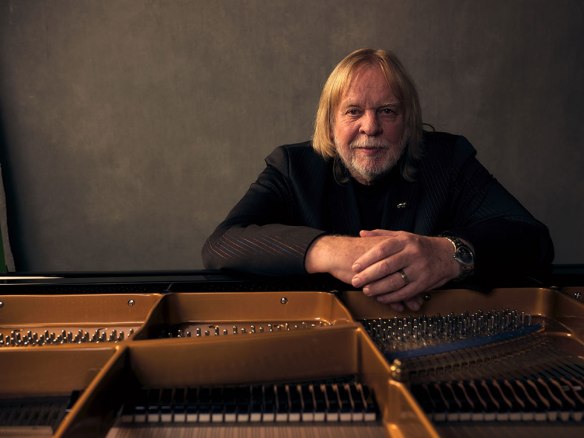
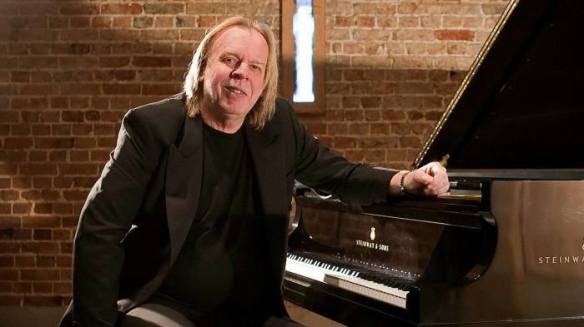
For part two of Arcana’s extensive interview with keyboard royalty Rick Wakeman we pick up where we left off, by asking the celebrated musician for his plans, virus permitting of course, to tour his new album The Red Planet.
“We’re celebrating the Mars landing in Armenia next year; we’re going to do the whole of the Red Planet live. Brian May’s going to come along and join us. That’s the plan for next year, as long as COVID-19 is behaving itself. In terms of space-themed albums I’ve got No Earthly Connection, Out There, The Red Planet and 2000 AD into the future which are all based on space. There’s enough to do a weekend but then you’ve got to convince a promoter it’s a good idea.”
Other plans are afoot. “There is so much planned for next year!” he gushes. “We’ve got the event at the National Space Centre in Leicester. There are three missions on their way to Mars at the moment, and they’re due to arrive the end of February beginning of March. We’ve gone for Saturday 27 March, because that’s just before a series of five prog rock festival dates. We thought we would have the launch then because the mainstream press will be going Mars potty. We expect by then they will have discovered how much water there was. Another great rock and roll thing that they recently discovered was that when it rains on Mars, it rains dry ice! How rock and roll is that?!” It’s almost as though Rick was meant to do a gig there. “Well that’s it!”, he laughs.
Taking a step back, he considers the implications of what the missions might find. “There are a lot of scientists and astrophysicists who believe there is a true connection between Mars and Earth, and that in the next 100 years we may find out what that is. If there is reincarnation I hope I come back as someone who might know what it was. My grandchildren might even get to know some of this in their lifetime. You can only go so far when you’re talking to them until they ask if Peppa Pig lives there, so I’m well aware it might be a bit down the line before they cotton on to what Grandpa Grumpy, as they call me, is up to!”
Talk turns to Rick’s musical work during lockdown – with several projects affected by his distance from co-writers. “The Red Planet has taken up a lot of time. I have been working on some other projects too, including work on a musical with Sir Tim Rice. We had planned quite a lot of get-togethers over the last few months, but he ended up in lockdown in Cornwall and I was in Suffolk. The counties couldn’t be further apart really. We had a lot of discussions on the phone but there’s not a lot we can do when we’re not in the same room together. That’s on the burner going nicely, another musical that is all funded and ready to go. I’ve been working on a couple of other recording projects, and also planning stuff for next year working on the premise that it will happen. I’m an optimistic person, so I don’t listen to the gloom mongering on the news at the moment. You’ve got to feel sorry for the politicians, because virtually every scientist has a different view on it all, so it’s pick the one that suits your politics the best! It’s a total no-win situation. Then in true British fashion it’s how you can bend the rules – you can open pubs but not clubs, the social distancing doesn’t apply to Bournemouth or Brighton beach. What is going on?! Each of the four nations has got a different view on how it should be done! You don’t know whether to laugh or cry really. I’m just 71 and a grumpy old man.”
I confess to assuming Rick was much younger than the age he has just stated – certainly his demeanour on the phone suggests a youthful spirit that has been retained – but he confirms. “Yes, I am 71 and as grumpy as you like. Grumpy but enthusiastic!”
Happily, he still feels that his keyboard playing has the same technical prowess, but is wary of the ageing process. “I practice every day. I do suffer from minor rheumatism and arthritis in the hand, and I do know that the day will come when I can’t have the dexterity I have now. When I do the piano concerts my hands ache, so it’s hot and cold water in the sink afterwards. I know a good doctor, who said, ‘Look at it this way – most footballers, when they get to the age of 40, they have to have knee replacements or hip replacements. The reason for that is those parts of the body have been battered, used 100 more times than the average person. Think of your hands, they have probably played at least three hours a day, sometimes more. Your hands have probably done 1000 times more exercise than the average person, so they’re going to wear out!’ He said just to keep playing and practicing and doing what you can, and then you’ll know the day when they can’t. I have made provisions a bit for that. When it happens, with some of the bigger pieces I’ve got, if I put a good band around me it will take a lot of the pressure off.”
He is aware of the possible impact on solo piano concerts. “I can still perform the pieces, but I think the piano concerts would suffer first. I don’t ever want to get to the stage – and I discussed this with my good friend Jon Lord when he was still with us – where we go on stage and we are applauded for what we were. You should be applauded for what you are, not what you were. We shall see, I hope there’s a lot more left. We’re just moving into a new house and I’ve got the most stunning music room to work in, overlooking a river estuary. I’m still working on the principle that there’s a lot left in the old boy. I love what I do, I enjoy what I do, I would lie if I said sometimes I don’t get tired, but when I get tired I just stop.”
Staying at home has other symptoms, too. “The lockdown hasn’t helped my exercise, because I like my food and I’ve eaten too much. I’ve always had a yo-yo weight problem, I’m the West Bromwich Albion of weight – up one season, down the next. I’ve got to make a bit of an effort but my wife’s brilliant at that. I’ve got a great family as well, the kids have a go at me. Grandpa Grumpy will do what he’s told I suppose!”
Classical music is part of his daily diet. “I listen to quite a lot, and most of the stuff I’ve got in the car is classical. I’ve got a huge collection of CDs of classical stuff, and I love choral music. At the moment I’ve got a ton of Prokofiev in the car – I’ve got works for cello in there, The Love for Three Oranges too, which I really love. I’ve got various compilations of opera arias, which are great in the car because I can join in and nobody can hear me sing! I use the Del Boy Trotter thing where they won’t let you join in the concert so you might as well join in the car. In the office there were about 4,000 CDs, and about half of those would be classical, but they’re all in boxes and have gone down to the new house. It’s very much what’s floating around at the moment.”
We close by pondering the benefits of music to our daily lives. “It’s incredibly good for our health in every respect”, he says passionately. And with that, our time is up – an hour in the company of one of the most enthusiastic musical minds around. When the Mars missions reach their goal early next year, we can expect to hear a lot more of Rick Wakeman, and once his house move is complete, don’t be surprised if they inspire more music! For now, though, The Red Planet comes with a strong recommendation.
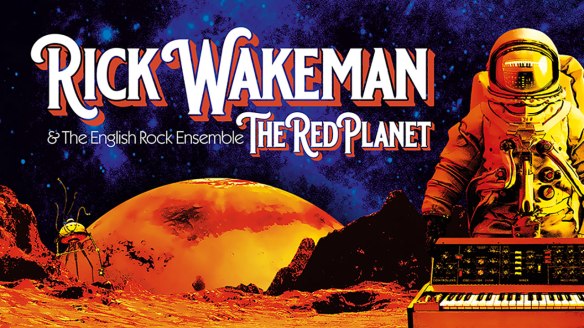
The Red Planet, by Rick Wakeman and the English Rock Ensemble, is available with several packages at his online shop
April Fredrick (soprano), Members of the English Symphony Orchestra / Kenneth Woods
Wyastone Concert Hall, Monmouth
Friday 18 September (review of the online broadcast)
Written by Richard Whitehouse
The continued difficulties in mounting live concerts with an audience has led to any number of virtual and online presentations, of which the English Symphony Orchestra’s Music from Wyastone is among the most imaginative. As organized and curated by Kenneth Woods, the ESO’s redoubtable music director (below), this promises a fresh perspective on various (often if not always) familiar pieces – performed in chamber reductions which respect the need for social distancing and illuminate aspects of the music not always evident in its more familiar guise.
Such was made manifest in the present account of Strauss’s Four Last Songs, as heard in the transcription by James Ledger made for Felicity Lott’s farewell concert at the Wigmore Hall seven years ago and whose large ensemble emphasizes the wistful eloquence of these songs without undue enervation. It helped that April Fredrick was at one with Ledger’s conception and Woods’s realization, whether in the lithe ardency of Frühling or the eddying rumination of September – this latter a candidate for the most perfectly realized of all Strauss’s songs.
The rapturous emotion of Beim Schlafengehen can verge on the cloying, but there was no risk of that here as Fredrick imbued this setting of Hermann Hesse with a plangent emotion such as most renditions gloss over, complemented by Zoë Beyers’ unaffected handling of its violin solo. Joseph von Eichendorff‘s Im Abendrot was hardly less impressive, the expressive trajectory seamlessly sustained from impassioned opening to hushed close with its valedictory allusions to Strauss and Mahler – over which Fredrick’s vocal hovered with mesmeric poise.
A chamber reduction by Tony Burke of Morgen! – Strauss’s setting of John Henry Mackay – for similar forces made for an unexpected if welcome encore. Here too it was the purity and understatement of Fredrick’s approach that most readily compelled, in the process drawing this relatively early song into the emotional orbit of those written over half-a-century later. A fine ending to this first instalment of what promises to be a rewarding series, and one which looks set to reaffirm the significance of the ESO within the context of British music-making.
Music and outer space are natural bedfellows. For more than one hundred years now, the imagination of composers has been fired by the cosmos, and Rick Wakeman is no exception.
The one-time Yes keyboard player has made no fewer than four solo albums looking beyond the Earth’s orbit, culminating in this year’s newest release, The Red Planet. Generous to a fault, he set aside an hour of his time to give Arcana a substantial interview to talk all things Mars, to look at the classical music that inspires him and to speak of the excitement of returning to progressive rock after two well-received solo piano albums.
Rick is answering the phone at home, settling down with coffee at an impressively early hour. He is in very good, conversational form, affable from the off. Firstly, and inevitably, we have to talk about the strange days in which we find ourselves. “I’m struggling with the lockdown, it’s driving me nuts!” he confesses. “There are no concerts, no theatres, no solutions. All the musicians I know are scratching their heads, and it doesn’t seem to be getting anywhere. I’ve had every single tour and concert cancelled this year, and if one more person says to me, ‘It’s alright, you can reschedule for next year’, I’ll hit them! The truth of the matter is that it’s not rescheduling for next year, it’s what I would have done anyway. Everyone’s tearing their hair out. Someone I know tried a drive-in concert, and they said they might as well have sat in the driveway of their house with the radio on. The whole thing about concerts and theatres is the atmosphere, the people around you, the audience and those on stage – where all is one in a strange way.”
He pauses to take a sip of coffee. “I’ve seen some of the government guidelines that have come through about social distancing – which they’ve got wrong, by the way, it’s ‘unsocial distancing’. If you have the two metre rule, and you get 300 people into a theatre that holds 2,000 people, those 300 people will want to go to the loo. You put them two metres apart and it makes the queue 600 metres long. It’s just nuts. I’ve got so many friends involved with theatres and they just don’t know what to do. I do feel for the whole entertainment industry and for sport. They said it’s exciting football’s back – no it’s not! It’s like watching a practice match. The whole leisure part of life has been decimated by the Coronavirus, and I don’t know what the answer is. Are they going to have everyone three seats apart? I do know of a few married couples who would be very grateful to sit three seats apart! Unless there is some sort of immunity like the flu vaccine to give society a chance, and the virus mutates enough to weaken itself so it is no worse than a cold, that’s our only hope really. I think it’s going to take a long time before people have confidence again. But there you go, I’ve had my moan for the day! It affects everyone.”
With the decimation of the live schedule, did he consider not releasing the album? “No. The official release date was 21st August, but as you know with special editions and all that lark the pre-orders go out way before then. We worked so hard and for such a long time that we said let’s just go ahead.”
He is aware of the importance of new music to those spending so much time indoors currently. “It’s interesting you say that, because we have had a lot of people say the same thing. With the so-called online concerts, the novelty wore off pretty quickly, with the quarter size screen phone concerts. People realised it wasn’t the real thing. With new music you can still get it. I personally am very glad that we just managed to finish recording before all of this hit, because it does put some new music out there. OK, it’s not in the ideal scenario, but what is that these days? We felt justified because thankfully – touch wood – the reviews have been really good all around the world. What’s interesting is the hardcore prog rockers, who are brutally honest about what they like and don’t like – it has been heart warming to see them say they like it, which makes it even more worthwhile.”
The Red Planet was recorded with a carefully assembled band, the English Rock Ensemble, and listening to the music gives a clear idea of the fun had while making it. “It was a lot of fun”, says Wakeman, “because all the pieces of the jigsaw were the right pieces. I’d been looking for a concept for a long time, and it has to come to you – you can’t go out and find it. This idea came from a friend Garik Israelian, who is an astrophysicist, a complete rocket scientist. You can’t talk to them about football or the weather; they just look at you blankly. He’s a lovely guy, and I was introduced to him by Brian May, who also introduced me to Stephen Hawking, both good friends. They run a festival called Starmus, which is a festival where all the world’s greatest astrophysicists, loads of astronauts and people from NASA give lectures for a week which are pretty amazing.”
There is a musical element to their week. “To finish, they always have a concert. Brian’s done it a few times, of course, and I’ve done it. We did it last year in Zurich, and it was the 50th anniversary of man walking on the moon. I was performing with Hans Zimmer, Brian May and Steve Vai, a massive symphony orchestra and choir. They don’t do anything by halves, and at the end of it we played We Are The Champions, and every surviving astronaut who has walked on the moon walked on the stage. I’ve heard ovations at stadiums and concerts when bands have walked on; I’ve never heard anything quite like when those astronauts walked on, led by Buzz Aldrin. We were loud, but we were drowned out!”
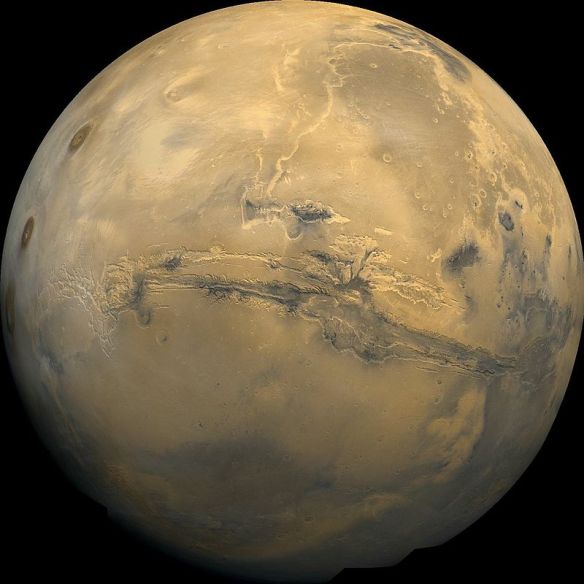
He returns to the concept behind The Red Planet. “A couple of years before that, Garik mentioned to me that 2021 would be the 50th anniversary of man arriving at Mars (seen above, in a global mosaic of 102 Viking 1 Orbiter images of Mars taken on orbit 1,334, 22 February 1980). He said, ‘It does look like your old friend David Bowie was right, there was life on Mars. A few billion years ago there were oceans and rivers. It didn’t have the atmosphere we’ve got but the new pictures, which will all be available online in a year or so, are phenomenal’. I went very quiet, and said, ‘You’ve just given me the concept I’ve been searching for.’ That’s when it all started. When I say it was hundreds and hundreds of photos, it really was, and I got those sent to me from my friends at NASA. I read up as much as I could and started picking out some of the great areas that are on there, and kept looking at them when I was sat by the piano”.
The inspiration flowed. “When I was looking at something and a musical idea appeared, I wrote it down. I built up a whole batch of musical ideas on the piano which I started putting into order. Then I started discussing with my co-producer Eric Jordan about the different sounds we were going to use. A few people had said to me, ‘You really should look at some of the classic proggy sounds that you used to use, but only used once.’ So I did! For example I went back over my No Earthly Connection album, and there were some mellotron flutes that I used as a lead instrument, but have never done since then. I wondered why that happened, because it worked so well! I looked at the various sounds that we wanted to use, and picked the three musicians I knew would understand what I wanted.”
The selection process was guided by the thoughts of his old friend. “David Bowie said to me, way back in 1971, to always pick musicians who will understand what you want. They could be the greatest musicians in the world but if they don’t understand what you’re trying to achieve, you’re not going to achieve it. I rate Lee Pomeroy as the greatest bass player in Europe if not the world at the moment, he is a phenomenal player, and understands prog probably better than any progger living. He is a lovely guy. Dave Colquhoun is a phenomenal guitarist who does not get the recognition he deserves. He is one of Brian May’s favourite players. Ash Soan, the drummer, came out and did a concert with me in Cuba. I couldn’t get over how technically clever he was, he reminded me so much of someone in the Bill Bruford mould. I contacted all three of them and they all just said yep, we get this.”
Wakeman’s enthusiasm is infectious. “The reason it sounds like we had a lot of fun is because we did! Everybody was on the same page, and nobody was frightened to say anything. We threw things backwards and forwards, and Lee or Dave would say have you ever thought about making that section longer, because we could build this or that. I’d have Eric my producer on another side, and he could be brutal at times! I would do a solo and I’d come in and go, ‘Yeah, that was good’, and he’d say, ‘I don’t think so, but if you’re happy!’ So I’d go ‘Yeah, alright, what’s the matter?’ ‘I think you’ve got a better one in you’, he would say, ‘but we won’t do it now, we can come back to it in half an hour.’ I’d go out and do something fresh and then come back to it, and it would be, ‘There you go’. To be fair 90% of the time he was right, and that was the great thing as well, that everybody was in on it.”
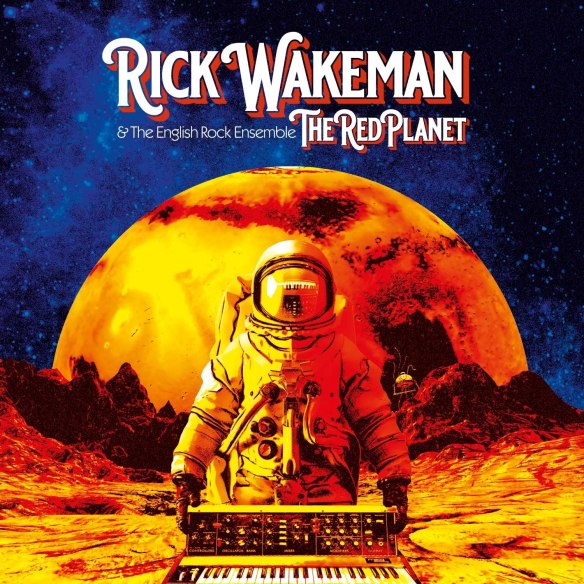
The collaborative spirit spread to the artwork. “We wanted to discuss that when we started the album, which is what we used to do in the 1970s. The cover was so, so important. The idea came up about a pop-up, and we thought that was great, let’s have a pop-up! They wanted a picture of me on the front but I said no, put a spaceman if you like. They said that won’t show him doing anything musically, and I said it would if he was playing a mini-Moog! It was all this kind of discussion. The only thing on the next pressing was that a lot of people commented we would really like to have a list of all the equipment that was used. We took that on board, and the next pressings, which won’t be far away now, will have all that information. So we do listen as well!”
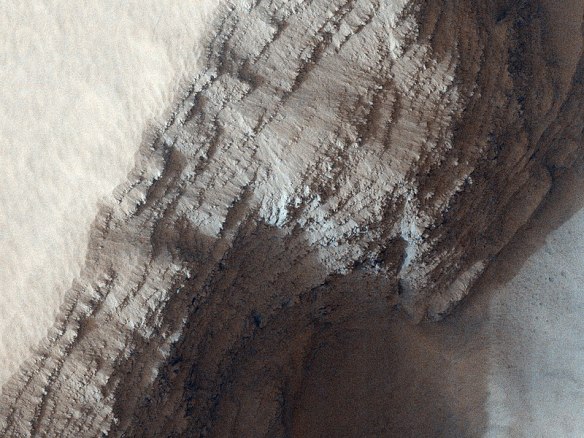
While The Red Planet will impress with its power and poise, it also leaves a mark thanks to compositions such as Arsia Mons (above), where the textures are stripped back and the band create evocative pictures. These moments show a subtlety rarely attributed to the genre. “You’re right”, agrees Wakeman, “prog doesn’t get all the credit it deserves with things like that. I think one of the reasons for that is prog started with vinyl, as you know. I’m a vinyl nut. One of the things it has is surface noise, and it’s one of the reasons that certain classical recordings struggled with vinyl, because if you had a very quiet flute section for example, suddenly the surface noise became very apparent, because it was amplified the same as everything else. Quiet pieces on prog records were very difficult because of that.”
Efforts were made to reduce the volume, but to little avail. “With Yes, we had a few places where we tried to be as quiet as possible, but what ended up happening was that in the quiet sections the instruments were brought up to quite a high volume, so you didn’t get that atmospheric background. It was the same for classical music. If you listen to the opening of Schubert’s Unfinished Symphony on vinyl, it’s so quiet all you here is a hissing noise! The moment CDs appeared, that all changed. Suddenly you could have a pin dropping and it would be as clear as anything. That was something we discussed, Eric and I, that we could make use of atmospherics knowing that it would be clear and wouldn’t have anything disturbing them. On the album, some of the atmospheric areas ended up being longer than I had originally written because of that, and that was very much where the lads said ‘that could be a bit longer, we don’t feel we’ve settled into that enough’. It was a mixture of old sounds and old things, bringing them into the 21st century and using the new technology to make them the best they could be.”
Rick Wakeman in the 1970s (from the Rick Wakeman’s Place website)
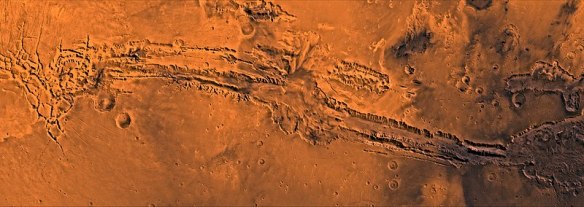
Talk of crackly records brings back a personal memory of my own, that of the opening of Mars from Holst’s suite The Planets – very much emerging from the depths. The Red Planet’s last track, Valles Marineris, has a complicated time signature that draws a parallel with Mars. Was that something Wakeman wanted to pay tribute to? “Not musically. I deliberately didn’t nick anything from Holst, but certainly it is a very powerful piece of music, and one of the things about Valles Marineris (below) is that if you go online and look at it, it’s huge! It goes on forever. I found one thing which was like a drone flying all over it and through it, and it’s just really mesmerising.”
Wakeman wanted to recreate this in musical form. “What I really wanted was to have something powerful, something that ran all the way through it in a strange way. It started as a form of Bolero, a very weird time signature, and it is weird how it changes all the time. Then I was building things on it but the underlying line was always there. When we did the recording we built it from the bottom up, and it was very important that we didn’t lose that. Sometimes it almost disappears, but it is there. When you look at the pictures online and in books, certain things catch your eye, and I wanted little bits that came in and out that would be eye-catching things, like a little melodic thing which is like, what’s that over there? It was meant to be a trip in the valley, and certainly I think Holst, considering he had no pictures of the planet, he didn’t have anything that I had, what he did with The Planets suite was nothing short of magnificent. He had no idea they were blue or red planets, he had so little to work with, and yet he captured it.”
This leads us on to other musical depictions of the great beyond. Rick himself has another three albums on the subject, which he considers. “I did an album called Out There which I enjoyed. It was sort of a concept but nothing like this. It came about when filming a concert, very seriously out the front someone said to me ‘where does music come from?’ You can’t hold it or touch it, but you can feel it inside, so where does a piece of music come from? You can’t dig it up in the garden so how does it come to you? I said that’s brilliant! And they said well give us the answer! I said can I go away and work on it? So I worked on it for quite a long time, the idea that perhaps everything came from space, which is enormous. It finished that it all came from space and filled out, and a bit like radio waves – you can’t hear Radio 4 or Planet Rock unless you tune your receiver in to get it. So maybe all this stuff is flying down, and if they just happen to be tuned in to receive it they get it. I worked on that principle, and I think it was my wife that said that’s great, but if it’s falling down from all the galaxies and that, where is it out there in the first place? I thought oh, great, here we go. So I came up with a thing called the great musical cathedral in the sky, that was firing this out all of the time.”
Unfortunately Out There, released in 2003, suffered from its juxtaposition to a terrible tragedy. “I really liked the album”, he says, “but we never promoted it for the simple reason that when I finished it, literally the day I finished it, there was the terrible disaster with the Columbia shuttle. I knew three of the astronauts on it. I changed the cover and did a tribute to them, but I didn’t do any promotion because I didn’t want anyone to think we were trying to promote it on the back of such an awful disaster. I got permission from the families to do it but the album to put it bluntly disappeared without trace. That for me was a shame because it was an interesting story.”
Another space odyssey, No Earthly Connection, was released in 1976. “I would like one day to do a two-day event where we play all the stuff from space”, he says. “I’ve made about four albums based on space now. It would be great to do them all, but I’m not sure if it would have much appeal or if any promoter would back it.”
Part two of this interview can be foundhere, with Rick discussing touring plans for The Red Planet, along with some of the classical music he has been enjoying during lockdown.





 Wakeman wanted to recreate this in musical form. “What I really wanted was to have something powerful, something that ran all the way through it in a strange way. It started as a form of Bolero, a very weird time signature, and it is weird how it changes all the time. Then I was building things on it but the underlying line was always there. When we did the recording we built it from the bottom up, and it was very important that we didn’t lose that. Sometimes it almost disappears, but it is there. When you look at the pictures online and in books, certain things catch your eye, and I wanted little bits that came in and out that would be eye-catching things, like a little melodic thing which is like, what’s that over there? It was meant to be a trip in the valley, and certainly I think Holst, considering he had no pictures of the planet, he didn’t have anything that I had, what he did with The Planets suite was nothing short of magnificent. He had no idea they were blue or red planets, he had so little to work with, and yet he captured it.”
 Arcana.fm