Routes to Beethoven – J.S. Bach

by Ben Hogwood

As we plot a course towards listening to the complete works of Beethoven, I thought a good way to start would be by listening to composers who have helped shape his output.

While I am sure we will ultimately find Beethoven out to be one of the most original composers of all, every artist will have had their grounding somewhere, which is bound to have had a say in their eventual direction. The first composer to appear under the microscope is J.S. Bach.

There are some fascinating and very different viewpoints among Beethoven scholars on the extent of Bach’s influence. In his famous book The Classical Style, dissecting the music of Haydn, Mozart and Beethoven, Charles Rosen is not convinced of much common ground. “It is worth noting, in this respect”, he says, “the extremely limited influence of the music of Bach in Beethoven’s works, in spite of the fact that his knowledge of Bach was considerable.”

Rosen goes on to note the facts – that Beethoven played both volumes of Bach’s The Well-Tempered Clavier in their entirety as a child, continuing to play it all his life, and that he copied out passages of Bach when approaching composition for the Hammerklavier Sonata. He had a copy of the Inventions for keyboard, two copies of The Art of Fugue, and was familiar with the Goldberg Variations. For Rosen, though, “…except for an obvious and touching reference to the Goldberg in the conception of the final variations of the Diabelli set, the use he (Beethoven) made of all his familiarity is very small, almost negligible in comparison to the continuous reference to Bach in the music of Mendelssohn, Chopin and Schumann. The classical style had already absorbed all that it could of Bach as seen through the eyes of Mozart in the early 1780s, and as Beethoven continued to work within these limits, his love for Bach remained always in the margin of his creative activity.”

Lewis Lockwood’s book Beethoven: The Music and the Life sees things very differently. On several occasions Lockwood highlights Beethoven’s desire to seek out the music of Bach for himself, specifically the Mass in B minor, as he approached the period of composition for the Missa Solemnis. He also focuses on Beethoven’s use of fugue throughout his later period. For in this ‘late’ period (with Beethoven still in his 40s!) it would appear he looked back at Bach for further inspiration, writing complicated but incredibly expressive fugues at key points in his music. The Grosse Fuge (the finale of his Op.130 string quartet), the Hammerklavier and several other piano sonatas, the Ninth Symphony – these are all works where we will no doubt come back to this article and consider its implications.

To build up a basic impression of Bach, I listened to the pieces referenced above and some well-worn favourites of my own. Listening to The Well-Tempered Clavier, then The Art of Fugue, it is possible to marvel at the sheer inevitability of Bach’s music, its structure and lines – but also its profound emotion and moments of humour, joy and even despair. Despite his rigorous working methods Bach pours his heart into this music, including the Goldberg Variations, which are simply sublime – and as Rosen says point towards Beethoven’s massive, late Diabelli Variations, not to mention many other works in the variation form.

Bach’s music has an incredibly sure direction, its workings are so logical and secure, each note and melodic figure seems very closely related, and the end goal – when reached – is unbelievably satisfying. Listen to the Prelude no.1 in C major from The Well-Tempered Clavier (the first item of music on this broadcast) and see if a single note is out of place or could be changed:

By contrast the forward thrust of the Fantasia and Fugue in G minor for organ is especially notable. Although Beethoven wrote virtually nothing for the organ, he surely will have picked up the discipline, application and adventure of J.S. Bach’s keyboard works. That sense of adventure can be heard in a work like the joyous Fugue in E flat major from The Well-Tempered Clavier, or even more in the standalone Toccata in C minor, below:

This shows how Bach can be unpredictable. His music is so sure of its own destiny, but that doesn’t stop it having a few emotional wobbles and flights of fancy along the way.

A work like the Brandenburg Concerto no.1 is a great example of this, where the beautifully argued lines of the first movement (above) are thrown into doubt by the extremely emotional second (below), the oboe floating above chords that are riddled with anxiety:

Moving to the larger scale works, Bach’s dramatic impetus becomes clearer. Whether Beethoven encountered the Mass in B minor is not known, but had he done so the contrasting solemnity of the Kyrie and outright exultation of the Gloria would surely have made a strong impression. Within the Credo section, when Bach reaches the moment of the Crucifixus, there is almost inaudible contemplation – after which the resurrection itself (Et resurrexit) literally bursts from the grave! The splendour of the Dona nobis pacem would seem to anticipate Beethoven’s Missa Solemnis, also in the same key of D major.

It is interesting to note Beethoven did not take up Bach’s lead in writing for solo instruments, with no sonatas for solo violin or cello in his output. Nor did he write extensively for the church as Bach did – no realms of cantatas here. Yet that is perhaps a sign of where the commissioned work now originated in music, and Beethoven’s beliefs too, which remain largely unknown. But the two composers have much in common, being innovators and inventors in so many different musical disciplines. We look forward to spending much more time with their music!

Listen

Follow our route to Beethoven by listening along with this Spotify playlist, including the works by Bach discussed in the feature above. Please do follow Arcana here for further playlists in the series!

Next up

Routes to Beethoven moves swiftly on to the music of the ‘next generation’ Bach, Carl Philipp Emanuel – Johann Sebastian’s second surviving son. Expect some fireworks!
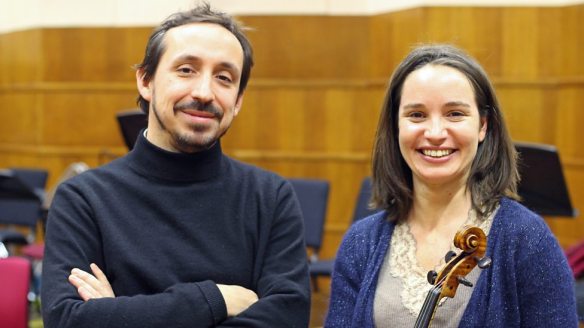
Wigmore Mondays – Lise Berthaud & David Saudubray: Schubert & Brahms sonatas

Lise Berthaud (viola), David Saudubray (piano)

Wigmore Hall, Monday 2 March 2020 (lunchtime)

You can listen to this concert on the BBC Sounds app here (opens in a new window)

Review and guide by Ben Hogwood

Neither of the two principal works in this BBC Radio 3 Lunchtime concert originated as viola pieces, but both have become repertoire staples for the instrument, the warmth of the Schubert Arpeggione Sonata and the sage experience of Brahms’s First Clarinet Sonata being ideal vehicles for its silvery tone.

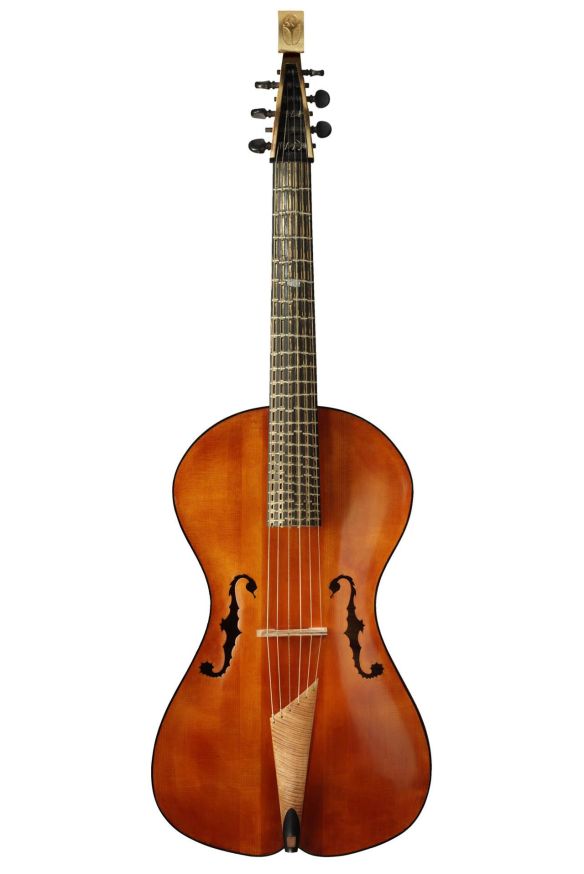
The Schubert is an especially unusual case, being the only prominent piece written for the arpeggione. This was an instrument with six strings and frets like a guitar, which was bowed and held between the knees.

Though it did not catch on as an alternative to the cello or the viola, Schubert wrote a substantial piece for a friend of his who played it. Because of the practicality of performing the work it was not until 1867 that it was finally published, with the realisation that it transcribes ideally for either cello or viola with piano accompaniment, the melodies lying under the fingers with deceptive ease.

The Arpeggione Sonata is a largely happy work, though it begins lost in thought (from 2:42 on the broadcast link). This was a measured intro from David Saudubray but as the first movement progressed the songful tone of Lise Berthaud’s viola took over, the pair enjoying the spring in the step of the faster music as though they were venturing out to dance. There was a really nice passage around the 8:38 mark, the viola using pizzicato to accompany the piano.

The second movement Adagio (14:28) explored more tender thoughts, the piano’s rocking motion suggesting the profile of a lullaby, especially with Berthaud’s soft musings above. However it was not long before we were straight into the Allegretto finale (18:13), the players investing more urgency until we arrived back at the dance (19:31), Schubert unable to resist setting the players on the floor once again. This good humour continued until the bright ending.

Brahms’s first contribution to the viola and piano repertoire is a very different animal, being from late in his career. Having decided to finish as a composer in 1890 it was something of a surprise when Brahms, having rid himself of the pressure of a Fifth Symphony, found inspiration in the clarinet. He wrote a Trio, Quintet and two Sonatas for the clarinettist Richard Mühlfeld, but it was soon brought to his attention that the Trio and both Sonatas transcribed very easily for viola – and those arrangements were made with his blessing.

As Lise Berthaud showed, the profile of Brahms’ melodies in the Sonata in F minor Op.120/1 are ideal for the instrument, the wide range of the first movement (29:07) easily under her fingers. The sweep of this melody and its subsequent development was impressive, as was the graceful second theme, with just the occasional slip from Saudubray in Brahms’s more congested piano writing. The controlled but expressive Andante was delightfully played (37:14), its roots clearly in song. A lilting Intermezzo was third (42:10), both players finishing each other’s musical sentences as equals, the music itself like a breeze in the branches of an old tree. The fourth movement (46:07), marked Vivace, threw caution away, with a peal of bells from the piano leading to a flowing and good spirited exchange, prone to the odd outspoken burst from the piano. Here was proof that the older Brahms still had the enthusiasm and musical vitality of his youth.

Repertoire

This concert contained the following music (with timings on the BBC Sounds broadcast in brackets):

Schubert Arpeggione Sonata in A minor D821 (1824) (2:42)

Brahms Viola Sonata in F minor Op.120/1 (1894) (29:07)

As an encore we had a lovely piece from Frank Bridge, the Berceuse (52:40), whose rocking motion was evident in Saudubray’s sensitive piano playing, the ideal foil to Berthaud’s velvety tone.

Further listening & viewing

The music from this concert can be heard in the playlist below, with versions of the Schubert and Brahms recorded by Berthaud herself:

As alluded to in the review, late Brahms works particularly well for the viola, as this collection shows – with both sonatas and the trio for viola, cello and piano coupled together:

Frank Bridge wrote some winsome music for his first instrument, collected here by the viola player Louise Williams and pianist David Owen Norris, joined for three songs by mezzo-soprano Jean Rigby:

In concert – Leonidas Kavakos, Philharmonia Orchestra / John Wilson: Elgar Symphony no.3; Barber & Korngold

Leonidas Kavakos (cello), Philharmonia Orchestra / John Wilson (above)

Royal Festival Hall, Southbank Centre, London
Thursday 27 February 2020

Barber First Essay Op.12 (1937)
Korngold Violin Concerto in D major Op.35 (1945)
Elgar, realized Anthony Payne Symphony no.3 in C minor Op.88 (1933; 1993-4)

Reviewed by Richard Whitehouse
Photo credit (John Wilson) Sim Canetty-Clarke

It is good to see John Wilson taking up more concert engagements, so putting his talent at the service of symphonic repertoire. Tonight, he directed the Philharmonia in a programme that culminated with quite possibly the finest reading Elgar’s Third Symphony has yet received.

The relatively brief first half commenced with Barber’s First Essay, written in the wake of his soon-to-be ubiquitous Adagio and given a high-profile launch by Arturo Toscanini with the New York Philharmonic. Succinct to a fault, the sombre rumination of its initial section soon makes way for music of brittle aggression (such as Britten surely had in mind writing the Dies irae section of his Sinfonia da Requiem two years later), and reaches a short-lived climax with the return of the piece’s opening which itself subsides into musing expectation.

A timely revival, whereas Korngold’s Violin Concerto now seems almost too familiar since coming in from the cold some quarter-century ago. Leonidas Kavakos has become one of his staunchest advocates, but while his recent Proms account often verged towards the soporific, this evening saw much greater focus; not least an initial Moderato whose yearning melodies were rendered with real incisiveness, then a Romanze whose lush textures and diaphanous harmonies never risked becoming cloying. If the final Allegro was even more impressive, this was because what is ostensibly the weakest movement emerged on a par with those before – Kavakos pointing up its effervescence while keeping any indulgence in check on route to the heady return of its opening theme, in what is a coup de théâtre even by Korngold’s standards.

Wilson has already demonstrated his Vaughan Williams credentials, and is evidently no less at home in Elgar. Some 22 years on from its premiere and the Third Symphony, as realized by Anthony Payne, continues to fascinate and exasperate in equal measure – yet, while there can be no denying its conjectural status, what came over here was Wilson’s conviction as he steered a purposeful course through the opening movement – pulling together what can feel a prolix development then evincing similar grip and determination in the coda. What follows was ideally poised between scherzo and intermezzo, its balletic and song-like strains eliding seamlessly, while the Adagio has seldom sounded more potent in its wrenching dissonances and wan consolation as lead to a coda whose fragmented texture only emphasized its pathos.

On to the finale (Wilson rightly ensured minimal pause between movements) and while there was no lack of finesse in the shaping of its themes, Wilson made relative light of there being no concrete development section by bringing its nominally tentative variants into tensile and, above all, cumulative accord. This carried through into the coda – undoubtedly the best Payne which Elgar never wrote and whose spirit of reaching out towards whatever might lie beyond was palpably conveyed as the music receded, slowly but never disconsolately, toward silence.

At some 50 minutes this was as taut and incisive a reading as the piece can yet have received, but the essential rightness of Wilson’s approach could not be doubted. Payne himself looked mightily impressed, and one can only hope a recording with the Philharmonia is in the offing.

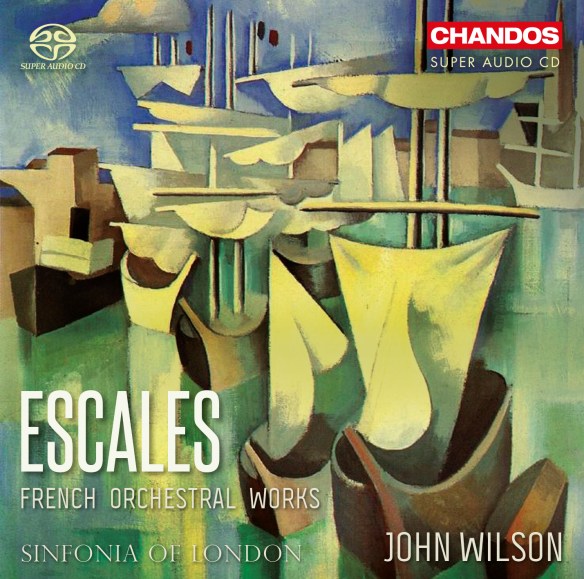
On record – Sinfonia of London / John Wilson – Escales: French Orchestral Works (Chandos)

Escales – French Orchestral Works

Chabrier España (1883)
Duruflé Trois Danses (1932)
Saint-Saëns Le Rouet d’Omphale Op.31 (1871)
Debussy Prélude a l’apres-midi d’un faune (1891-94)
Ibert Escales (1922)
Massenet Meditation from Thaïs (1894)
Ravel Rapsodie espagnole (1907-08)

Adam Walker (Debussy), Andrew Haveron (Massenet), Sinfonia of London / John Wilson

Chandos CHAN 5252 [78’19”]

Producer Brian Pidgeon
Engineer Ralph Couzens

Recorded 6-7 September 2019 (Trois Danses nos.1 & 3), 16-18 January 2019 (other works), Church of St. Augustine, Kilburn, London

Written by Ben Hogwood

What’s the story?

The Sinfonia of London, an orchestra from the 20th century given a new lease of life by conductor John Wilson, makes its second release for Chandos.

In fact we could term it as a series of Sinfonia of London buses, for you wait two decades and then two come along at once! The orchestra’s renaissance began with a stunning account of Korngold’s Symphony in F sharp last year, but now they turn their attention to France, and an imaginatively chosen program celebrating the elusive but immediately recognisable French orchestral sound.

What’s the music like?

A complete pleasure. Although irresistibly French, the music in the collection does remind us of the close bond between France and Spain, thanks to classics of the repertoire from Chabrier and Ravel and a relative rarity from Ibert.

Chabrier‘s España begins the collection and it is an absolute delight, a feel good piece given even more of a lift in this brilliant account. Wilson’s instincts for the stage come to the fore immediately, the bouncy rhythms and cheeky asides proving irresistible when presented with this much colour and warmth.

At the other end Ravel’s Rapsodie Espagnole is no less characterful. The atmospheric Prélude à la nuit ghosts in from silence, Wilson delighting in the orchestral textures and Ravel’s masterly sense of line. The persuasive rhythms of the Feria are expertly judged, the silky strings giving way as the music surges forward with terrific momentum.

Between these two gateposts are works of colour and élan. It is so good to see the inclusion of relative rarities in Duruflé’s Trois Danses, one of only two completed orchestral works in his output, and Ibert’s underrated Escales (Ports of Call) which gives the collection its name. The Duruflé sparkles in Wilson’s hands, violins caressing the longer melodies of the Divertissement, first dance of the three. Much of the composer’s relatively small output is for organ, which he effectively uses as his orchestra, but a persuasive Danse lente and thrilling Tambourin give us further proof of his prowess with large forces, harnessing the influence of Dukas. The latter features a particularly enticing saxophone solo, the recording indulging the colour and scope of Duruflé’s writing.

The Ibert, meanwhile, is a treat. Just over a minute into Escales‘ first movement, Palermo, there is what can only be described as a murmuration of violins, the music fluttering upwards in a bold sweep. Meanwhile Wilson secures a terrific drive to the description of the third ‘port’, Valencia, which ends with a flourish.

Before Escales comes a fresh faced account of Debussy’s Prélude a l’apres-midi d’un faune, the piece that effectively changed the face of music on the eve of the 20th century. Wilson and his charges capture the sense of newness, but also the enchanting and harmonies, with seductive playing from flautist Adam Walker. By contrast the Méditation from Thaïs, Massenet’s most famous orchestral excerpt, is more conventional. It could have felt misplaced here in terms of mood and musical language, but orchestra leader Andrew Haveron invests it with plenty of affection and never overdoes the romantically inclined melodies.

The packed release also finds room for a symphonic poem by Saint-Saëns. Le Rouet d’Omphale (The Spinning Wheel of Omphale) is a relatively early work and a great example of the composer’s melodic flair and ability for musical programming in thrall to Liszt. Wilson has its measure fully, pacing the music’s build ideally in arguably the finest modern recording since Charles Dutoit’s classic account with the Philharmonia in 1980.

Does it all work?

Yes. This is a brilliantly played and really well-chosen program, suiting both the curious listener and the familiar Francophile. What comes through most of all is the sheer enthusiasm and flair of the players, galvanized by Wilson in accounts that are both instinctive and incredibly well prepared.

From the opening notes of España it is immediately clear how this collection is going to go, and with the changes in mood suitably well planned and ordered – save arguably the Massenet – it is a listening experience you will want to return to often.

Is it recommended?

Wholeheartedly. This is music making as it should be, celebrating great orchestral music packed full of good tunes, instrumental colour and the ability to paint vivid pictures of its subjects. Wilson and his charges should be congratulated for an achievement which will surely land them with a glut of awards in the next few months – and only heightens the anticipation for their third release on Chandos, later this month, when they will return to Korngold for the Violin Concerto and String Sextet. In the meantime, make the most of this wonderful set of French fancies!

Listen

Buy

You can listen to clips from this disc and purchase a copy at the Chandos website here

Switched On – Air Texture VII compiled by Rrose & Silent Servant (Air Texture)

reviewed by Ben Hogwood

What’s the story?

The innovative Air Texture compilation series reaches the magnificent seven, staying true to its principles. The idea is that two producers with a connection hook up for a double compilation, whose only proviso is that the music should not be ‘straight ahead club music’. Early volumes in the series tended to be much more ambient, with some completely devoid of beats, but as the canon has developed so has the open and inclusive approach.

This is one of the more upfront releases so far, from Californian Seth Horvitz – now using his Rrose alias – and Silent Servant, aka Los Angeles resident Juan Mendez.

What’s the music like?

The great thing about each Air Texture release is the opportunity for musical discovery, and this is no exception. Both contributors have clearly given the collection a lot of thought, and the range of musical styles here extends from thick muffled ambience from the likes of Octo Octa, where time stands virtually still, to the other end of the scale and the relentless bass drum of JS Aurelius.

Along the way we hear fascinating ideas. The first set of twelve tracks includes probing sounds from Anthony Child and nice, spectral effects from Laurel Halo, whose Dies Ist Ein sounds great on headphones. Ron Morelli’s Psychic Harms of Economic Deprivation has dense and foreboding ambience, while AGF’s HUM-iLiTY displaces reality with eerie vocal effects,

The second set has the wonderfully cinematic Luke Slater track When It Twists, yet another example of his techno mastery, but backs this up with Mara’s Rebellion, a fascinating track which moves from sumptuous widescreen sounds to distorted, extraterrestrial fragments. Silent Servant’s own New World has a propulsive drum track but broad ambience behind, while the ever-reliable Phase Fatale offers the excellent Nightmare in LA, a bubbling and moody synth cauldron. Finally Zahlensender (ssb), from Function, takes us to the other end of the aural spectrum with glittering treble sounds.

Does it all work?

Yes. Some of the more confrontational sounds here mean the compilation is not one of outright ambience, as previous volumes have been, but at this point it is worth remembering the Air Texture philosophy of challenging as well as soothing. In that respect the pairing of Rrose and Silent Servant works a treat, fulfilling the brief while introducing new names as the best compilers should.

Many of the tracks here led to further exploration, but they hang together really well as a pair of sets.

Is it recommended?

Yes, without reservation. This may be the seventh release in the series but it is another feature in the cap of Air Texture’s bow, a compilation series where it really pays to immerse yourself in each instalment. For a listener to be challenged and soothed in equal measure is just how a series like this should be.

Stream

Buy