Switched On – Balance presents Sunstrip mixed by Hernán Cattáneo

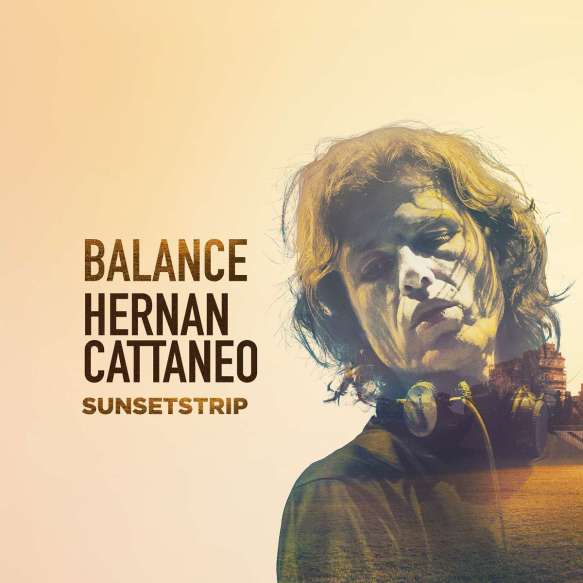
Various Artists: Balance presents Sunstrip mixed by Hernán Cattáneo (Balance)

What’s the story?

Argentine DJ Hernán Cattáneo links up with the Australian label Balance once again, returning to the double-set format for the first time in two years. His two mixes clock in at over two and half hours, focusing mostly on the deeper side of house music but with plenty of room for development.

What’s the music like?

In a word, consistent. The first three minutes of Cattáneo’s first mix set out a dreamy picture before the appearance of a reassuringly strong kick drum to get things going. Mariana Mellino & Interaxxis’ ‘Andromeda’ offers a sign of the steady tightening of intensity the Argentinian does so well, and we move smoothly through nice squiggles from Juan Hansen’s ‘Hiding Sun’, which hits a peak with some Depeche Mode-like vocals.

The mix presses on with the warm and fuzzy combination of the Kevin Di Serna tracks ‘4 Meditation’, which has a lovely sweep through space in its breakdown, and ‘System Era’ works well. Fellow countrymen Soundexile offer two tracks together, ‘Glide’ seguing effortlessly into the classy ‘Stimulation’, a lovely easy groove, before Cattáneo finishes part one with a curveball, Mercurio’s cover of Jefferson Airplane’s ‘White Rabbit’ sung by Anita Alvarez de Toledo.

The second mix is immediately more urgent, and gets off to a great start with Mike Griego feat. Paula Os and ‘Headspace’. The tempo is quicker and the percussion up a gear, as though the sun has set and we are heading into the night. The powerful sweep of ‘Dissolved In You’ by Brian Cid carries all before it, the producer reappearing later with the brooding ‘Rebirth’. Cid Inc – no relation – impresses with the shimmering textures of ‘Forgotten’, while there is an unexpected but welcome cover of The Cure’s ‘A Forest’ from COLLE. Finally Soundexile return with Wind Down (Outro Mix), the lights going up as the mix fades into the distance.

Does it all work?

Effortlessly so, thanks to Cattáneo’s experienced head. The pacing of each mix is spot on, the peaks and breakdowns expertly managed, while the beats and harmonic structure are spot on. The cover of ‘White Rabbit’ might split opinion but this is an extremely solid selection.

Is it recommended?

Yes. Cattáneo has built up great judgement on how to pace a commercial mix, and his instincts are sound here. Consistency is the key throughout!

Stream

Buy

You can get this album from Beatport here

The Peterloo Massacre: Sir Malcolm Arnold’s response

On the 200th anniversary of the Peterloo Massacre in St Peter’s Field, Manchester, this vivid musical interpretation of events on that day comes from Sir Malcolm Arnold.

Arnold completed the overture in 1968, when it was published as his Op.97. In his description of the piece for Faber Music, he described the events and his response in some detail:

Peterloo is the derisive name given to an incident that happened on August 16th, 1819 in St Peter’s Fields Manchester, when an orderly crowd of some 80,000 people met to hear a speech on political reform. On the orders of the magistrates they were interrupted by the yeomanry attempting to seize the banners they carried, and to arrest their speaker, Henry Hunt. Cavalry were sent in, and eleven people were killed and four hundred injured in the ensuing panic.

This overture attempts to portray these happenings musically, but after a lament for the killed and injured, it ends in triumph, in the firm belief that all those who have suffered and died in the cause of unity amongst mankind, will not have died so in vain.”

The extraordinary piece – which really should be better known – can be heard below, with the City of Birmingham Symphony Orchestra conducted by the composer:

It may start with a regal theme but soon the cavalry approach, and the music is thrown into disarray and discord. Ominous brass and squealing woodwind signal the onset of violence, before a description of the outright chaos on what has become a battlefield gets ever louder, like the climax of a Shostakovich symphony.

Then suddenly all is emptiness, the horrors fully revealed…but from the depths comes a beautiful lament from oboe and a repeat of the main theme from the strings, now held higher – before a salute from full orchestra ends the overture in triumph. The piece is a powerful and moving response to the tragedy, a musical portrayal of courage in the face of terror – and it proves every bit as relevant to today’s political climate as it would to the victims of the massacre.

If you want to hear more Arnold, the album from which this piece is taken includes three fine examples of his nine symphonies (nos.1, 2 & 5), and two more entertaining overtures, Tam O’Shanter and Beckus the Dandipratt:

As you will gather from those titles alone, the composer was not without a sense of humour!

The picture is a coloured print of the Peterloo Massacre, published by Richard Carlile.

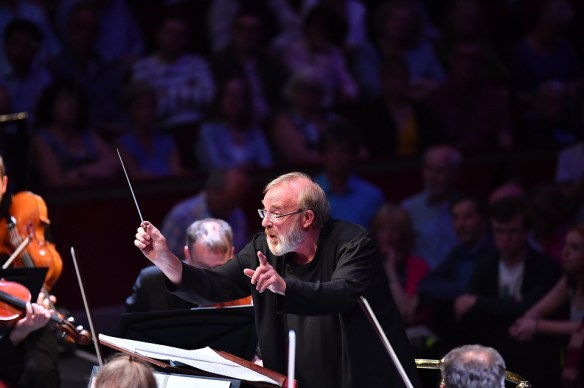
Arcana at the Proms – Prom 35: Martyn Brabbins – Enigma Variations

Idunnu Münch (mezzo-soprano), William Morgan (tenor), Nadine Benjamin (soprano), David Ireland (bass-baritone), English National Opera Chorus, BBC Singers, BBC Scottish Symphony Orchestra / Martyn Brabbins (above)

Various composers Pictured Within: Birthday Variations for M. C. B. (2019, BBC commission: world premiere)
Vaughan Williams Serenade to Music (1938)
Brahms Schicksalslied (Song of Destiny) Op.54 (1871)
Elgar Enigma Variations Op.36 (1899)

Royal Albert Hall, Tuesday 13 August 2019

Reviewed by Richard Whitehouse
Photo credits Chris Christodoulou

You can listen to this Prom on BBC Sounds here

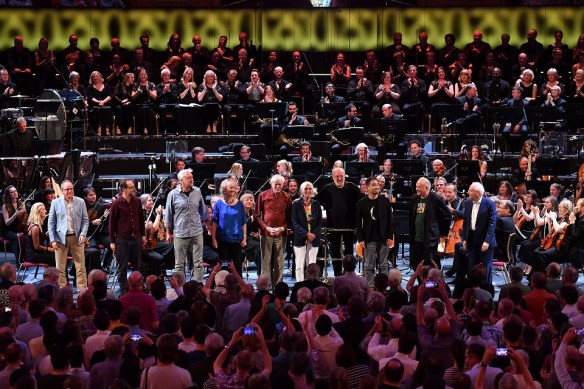
It was clearly a great idea that the BBC commission a piece to mark Martyn Brabbins’s 60th birthday, this concert also being his 36th appearance at these concerts, as well as featuring 14 composers with whom this most stylistically wide-ranging of conductors has been associated.

The result was Pictured Within: Birthday Variations for M.C.B, each composer contributing a variation on an anonymous theme in what is an inverse take on Elgar’s procedure in his own Variations on an Original Theme – whose ground-plan also furnished the formal framework. Space precludes more detailed discussion, though it is worth noting the degree to which these composers (the full list is here) were inhibited or liberated by their placing in the overall scheme. And as this theme yielded its potential more from a harmonic then melodic or rhythmic angle, the most successful made a virtue of such constraints – not least Judith Weir in her engaging 10th variation and John Pickard in a finale, The Art of Beginning, whose deft mingling of portentousness with humour might yet become the springboard for an entirely new venture.

Vaughan Williams’s Serenade to Music (premiered in this venue – but not at these concerts – 81 years ago) was conceived for 16 solo singers and the choral alternative inevitably loses some of the original’s intimacy, though not the distinctiveness in its setting of lines drawn from Shakespeare’s The Merchant of Venice. Joining the BBC Singers and members of the ENO Chorus were participants on the Harwood Young Artists programme, of whom Nadine Benjamin brought a wide-eyed wonder to the soprano solos which motivate the latter stages.

Less often heard in the UK, Brahms’s Song of Destiny is among his most ruminative choral works. Its setting of the eponymous poem by Friedrich Hölderlin might be seen as continuing from A German Requiem in its subdued fatalism, albeit with a more animated central section as hints at that starker resignation which overcame the composer in his later years. Brabbins presided over an unforced yet insightful account of a piece that, for its relative unfamiliarity, has garnered numerous distinguished admirers – among them the composer William Walton.

Closing this concert with Elgar’s Enigma Variations made for an effective symmetry as well as bringing the programme full circle. Brabbins is no stranger to the work and duly galvanized the BBC Scottish Symphony Orchestra in a performance which gave full rein to these widely contrasted portraits (never caricatures!) of the composer’s friends while also ensuring an overall unity to the greater design – with the only lengthy pause coming after a luminous account of the ninth Nimrod variation – that carried through to a finale whose elation was shorn of any bombast. There were various delights on the way, not least a winsome take on the fifth variation, with the numerous instrumental solos eloquently taken. Hard to believe Elgar extended that final variation only at the urging of others, so inevitably does this build to its resplendent ending.

Some might have wondered whether building a full Prom around the birthday of its conductor was excessive but, given the regard in which Brabbins is held and the conviction he invested into each of these pieces, that decision was manifestly justified. Many Happy Returns M.C.B!

Martyn Brabbins has recorded Elgar’s Enigma Variations with the BBC Scottish Symphony Orchestra for Hyperion. More details can be found on their website, or on the YouTube clip below:

Switched On – Emme: Into The Darkness (Modularfield)

What’s the story?

Berlin-based Argentinian Emme releases Into The Darkness, an album looking at the connection between intimate thought and the vastness of outer space. In the space of seven tracks and 36 minutes her music looks to reflect these contrasts through close-up observations and big sonic spaces.

What’s the music like?

Not as dark as the title implies, with a satisfying blend of movement and stillness. Insert The Chip and Earth Calling might be remote soundscapes suspended in air, but second track Discovery is the clincher. As it starts you might relax into thinking this will be a very slow moving, star-gazing album, but then the beat drops and the perception changes immediately. With this kinetic energy at her disposal Emme develops Into the Darkness as a dub-infused journey, while Blank Point goes further still, underpinned by a broken beat with distortion overlapping its broad riff.

As the album develops several ‘80s influences are revealed – Blancmange and OMD among them – but Emme forges an individual path while including these. The expansive XH-28:A is a case in point, as it breaks down to a solo from a plucked string instrument – mandolin or violin, I suspect – and is soon joined by an analogue set of drum fills.

The biggest track, When the Wind Whispers, feels like a collection of different viewpoints, with no drums but a restless movement between different ideas and timbres.

Does it all work?

Most of the time. There is a lot of variety here, almost with the danger of the musical styles becoming disjointed – and at 36 minutes it does feel like an extended EP rather than a fully blown album. That said, Into The Darkness has impressive ambition and despite the moments of thick ambience, Emme conjures up impressive tension and restlessness.

Is it recommended?

Yes, for the consistently interesting corners to its slightly ragged construction. Emme’s spirit of discovery should be applauded and noted for future releases.

Stream

Buy

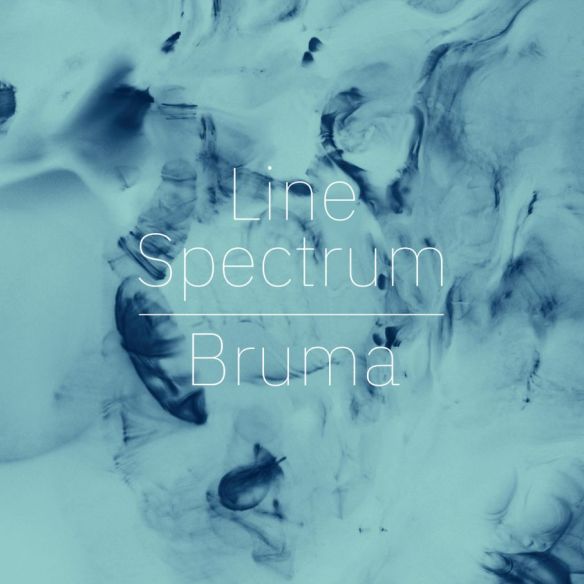
Switched On – Line Spectrum: Bruma (Glacial Movements)

What’s the story?

On their website Glacial Movements describe Bruma as ‘an album of exploration. Somewhere cold and safe’. It is the work of Ukrainian artist Oleg Puzan, whose approach is less obviously musical, building sound pictures through a massive array of small figures and bigger, weather-like effects.

What’s the music like?

Atmospheric. You will not find much in the way of obvious melody or harmony, but that is not a criticism, more an observation of the way Puzan works. The development of each of the five tracks on the album is strangely compelling, though each are closely linked together, the change between tracks coming at very definite time divisions. Although Bruma – which appears to mean a kind of sleep or hibernation – seems set to function as background music its very different textures and panoramas mean it has to be listened to in the foreground, dominating the headphones as it moves from comforting sounds to more ominous drones that approach from the distance.

A Set Of Events At The Shore, evocatively titled, is the first track, and as outlined above it is all about atmosphere and noise, creating a space with running water and natural noises – but compromising it with a not altogether pleasant drone that makes itself known quite high up the spectrum.

An intense experience on headphones, with some thick ambience but also what feels like white noise and interference as Fabric Merge progresses. No melodies as such but concentrated atmospheres. Ways gets thicker still, but the ambience and cold acoustic is more reassuring, and one that as a listener you want to dive into, with a rich chord growing to encompass the whole audible picture. The fourth track, Fluidity, has the flow of cold water in a regular pattern to sooth the mind, leading to the 15-minute final track Quietness. This is comforting but only to a point,with a disquieting sense of danger around the edge, as though you’re in a place you don’t want to get marooned in.

Does it all work?

Yes, providing you’re in the right mood. Some of the more high pitched sounds do actually become challenging after a while, but are essential to the whole experience.

Is it recommended?

Yes, because of the intensity of its ambience, though the manipulation of the many sounds on Bruma will not be to every listener’s taste.

Stream

Buy