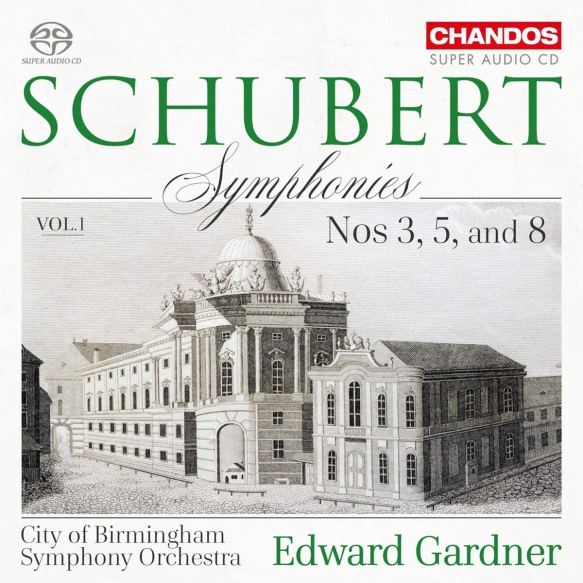
On record: CBSO / Edward Gardner – Schubert: Symphonies Vol.1 – nos. 3, 5 & 8 (Chandos)

City of Birmingham Symphony Orchestra / Edward Gardner

Schubert
Symphony no.3 in D major D200 (1815)
Symphony no.5 in B flat major D485 (1816)
Symphony no.8 in B minor D759 ‘Unfinished’ (1822)

Chandos CHSA5234 [74’11”]

Producer Brian Pidgeon
Engineers Ralph Couzens, Jonathan Cooper
Recorded 9-10 July 2018 at Town Hall, Birmingham

What’s the story?

Having already tackled the Mendelssohn symphonies (and with a further instalment featuring the overtures imminent), Edward Gardner and the City of Birmingham Symphony now turn to those by Schubert in what promises to be a notable addition to the orchestra’s discography

What’s the music like?

Even with advances made (primarily through the work of Brian Newbould) in recent decades, Schubert’s cycle still tends to fall into two categories – the half-dozen mainly of his teenage years, with overt influences from Haydn, Mozart and earlier Beethoven, then the Unfinished and Great symphonies, in which the composer forges a decisive new path at the outset of the Romantic era. Whether this survey also takes in any of those fragmentary pieces that came in-between, or the drafted ‘Tenth Symphony’ from Schubert’s final weeks, remains to be seen.

This release commences with the Third Symphony, most succinct of the earlier works in its thematic economy and formal concision. Gardner catches well the anticipatory nature of the slow introduction, then steers a secure course through the main Allegro’s alternation of pert woodwind melody with lithe tuttis. More intermezzo than scherzo, the Allegretto is as deftly characterized as the ensuing Menuetto is bracingly despatched. Gardner also minimises that sense of the final Presto as unfolding in ever-decreasing circles prior to its effervescent coda.

The Fifth Symphony is the highpoint of those from Schubert’s formative years – not least in the Mozartian poise of its opening Allegro, with the CBSO woodwind at their most felicitous. Gardner’s relatively swift tempo for the Andante might lessen its inherent charm but enables him to emphasize the searching modulations into its more restive episodes – after which, the Menuetto is more explicit in its G minor incisiveness. Nor is there any lack of impetus as the final Allegro pursues a witty while also suave course through to its almost peremptory close.

From here to the intensely introspective start of the Eighth Symphony (the ‘Unfinished’) is to enter a whole new expressive epoch. The CBSO strings are at their sonorous best in the initial Allegro, here with due emphasis on its ‘moderato’ marking and accruing considerable intensity in its anguished development then fatalistic coda. The Andante complements it in almost every respect, with Gardner ensuring that the hymnal eloquence and anxious musing of its contrasting sections achieve formal and expressive parity ultimately set in relief by the coda’s radiant benediction.

Does it all work?

Yes – thanks not least to some unerringly alert and sensitive playing, together with SACD sound whose clarity and overall perspective admirably reflects that of the refurbished Town Hall acoustic. Interpretively, Gardner occupies a fruitful middle-ground between the tensile rhetoric of Jonathan Nott (Tudor) and agile incisiveness of Thomas Dausgaard (BIS), hitherto the most consistent among recent Schubert traversals and ‘authentic’ through their conveying of this music’s essence without falling prey to merely fatuous notions of stylistic authenticity.

Is it recommended?

Indeed. An additional enhancement is the insights of Bayan Northcott, whose booklet notes will hopefully grace future instalments in a series whose second volume is keenly awaited. Perhaps Gardner and the CBSO might also consider the Berwald symphonies at some point?

Further listening

You can listen to this new release on Spotify:

Further reading

You can read more about this release on the Chandos website

Live review – English Music Festival opening night: BBC Concert Orchestra & Martin Yates play Robin Milford, Stanford, Vaughan Williams & Arnold

Sergey Livitin (violin), BBC Concert Orchestra / Martin Yates

Dorchester Abbey, Dorchester-on-Thames
Friday 24 May 2019

Berners Portsmouth Point (1918) [World premiere]
Arnold Serenade Op.26 (1950)
Stanford Violin Concerto in D major (1875) [First public performance]
Vaughan Williams orch. Yates The Blue Bird (1913) [First public performance]
Delius A Song before Sunrise (1918)
Milford Symphony no.2 Op.34 (1933) [World premiere]

Written by Richard Whitehouse
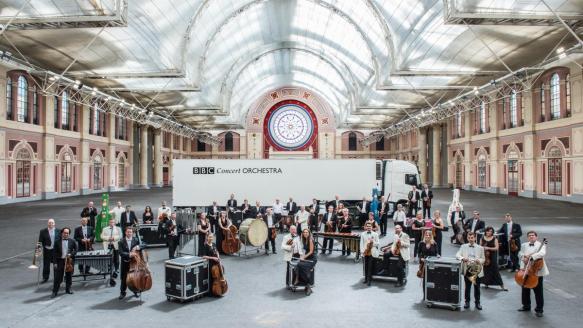
Picture of BBC Concert Orchestra (c) Sim Canetty-Clarke

The 13th English Music Festival got off to an impressive start this evening, with Martin Yates presiding over the BBC Concert Orchestra for a substantial and wide-ranging programme that brought together the hitherto unknown and the relatively familiar in appropriate EMF fashion.

Who else would provide a platform for a first public performance of the Violin Concerto in D major that Stanford wrote at Leipzig in his mid-20s but which, despite the seeming approval of Joachim, remained unheard before being recorded two years ago. Admittedly the first movement rather outstays its welcome, the themes lacking memorability and a solo part not ideally contrasted with the orchestra, but the slow Intermezzo has an appealing poise; its cadenza artfully made an extended transition into the final Rondo (a procedure likely taken over from Wieniawski’s Second Concerto – the model in several respects), its winsome second theme brought back as a lingering coda prior to the closing flourish. Sergey Levitin proved an able and sympathetic soloist in a piece which, whatever its stylistic limitations, was certainly worth rehabilitating.

As too was the incidental music Vaughan Williams devised for Maurice Maeterlinck’s play The Blue Bird, idiomatically orchestrated from the piano score by Yates. This is essentially a ballet (or rather mime) sequence for the end of the first act, its series of thematically related dances striking a fantastical note such as the composer tellingly (if unexpectedly?) conveys. It may well have proved too ambitious in its original context though makes for a lively and imaginative suite, into whose whimsical spirit the BBCCO entered with evident enjoyment.

Malcolm Arnold’s Serenade exemplifies this composer’s early maturity with its pert melodic writing, harmonic ambiguity and rhythmic impetus. A Song before Sunrise is less often heard than other Delius miniatures, but its ruminative mood – barely ruffled by passing shadows, is no less characteristic. It could not have been more different from Lord Berners’s Portsmouth Point, redolent of early Prokofiev in its mechanistic aggression that, if it lacks the ebullience of Walton’s later overture, still packs an uninhibited punch when presented as a curtain-raiser.

The concert ended with its most intriguing item. Long considered a miniaturist (at least in his expressive scope), Robin Milford was not lacking in ambition – as reinforced by his Second Symphony (so designated following the rediscovery of its predecessor from six years earlier), admired by Vaughan Williams but only now receiving its first complete performance. Its four movements ostensibly reflect classical archetypes, but the first of these modulates ever more stealthily as it unfolds, while the scherzo’s latter trio unexpectedly opens-out the expressive range. The highlight is undoubtedly a slow movement of sustained and cumulative emotional depth, closer to Nielsen than Sibelius in tonal follow-through; after which, the (intentionally?) concise finale barely manages to provide a decisive resolution without seeming perfunctory.

Not in doubt was the commitment of the BBCCO and Yates in realizing this dark horse among British inter-war symphonies. A fitting end to an absorbing event: good to hear that orchestra and conductor will be returning for the 14th EMF – scheduled for May 20th–22nd next year.

Further listening

This concert will be broadcast on BBC Radio 3 on a date as yet unknown. Much of the music is not currently available in recorded versions on Spotify. However EM Records, the label who run the festival, made this enterprising release of Stanford‘s Violin Concerto no.2, coupled with Robin Milford‘s Violin Concerto no.2, both with soloist Rupert Marshall-Luck:

For more Robin Milford this album on Toccata Classics provides great insight into his writing for chamber music forces:

Meanwhile the following playlist includes the Malcolm Arnold and Delius works, the more familiar version of Portsmouth Point by Sir William Walton, and Arnold’s Symphony no.1:

Wigmore Mondays – Gould Piano Trio play Kirchner & Brahms

Gould Piano Trio (Lucy Gould (violin), Richard Lester (cello), Benjamin Frith (piano)

Kirchner Excerpts from Bunte Blätter Op.83 (1888) (1:48-16:40 on the broadcast link below)
Brahms Piano Trio no.1 in B major Op.8 (1854, revised 1888) (18:53-54:50)

Wigmore Hall, London
Monday 13 May 2019

To hear the BBC broadcast through BBC Sounds, please follow this link

Commentary and Review by Ben Hogwood

It was refreshing to hear the music of Theodor Kirchner in this concert, especially in the context of his friendship with the infinitely better known Johannes Brahms. Kirchner was a friend not just of Brahms but of Robert and Clara Schumann. His relative lack of lasting success is regrettable, due in part it seems to an addiction to gambling, yet his output includes a large amount of piano music. He has notably arranged both Brahms String Sextets for the piano trio combination, which suits his music well.

The Bunte Blätter (Coloured Leaves) is a collection of attractive miniatures that work well in concert, and the Gould Piano Trio chose seven of the twelve available for this concert. The first, Zwiegesang (from 1:48 on the broadcast link), is notable for the sweetly romantic notions of its duet between violin and cello. A Novellette (no.5, 3:49) takes a more playful air, while Mädchenlied (no.10, 6:30) is graceful and open. The Humoreske (no.2, 9:30) is bright, especially from the piano, but the Barcarola (no.7, 10:10) is much less charming than a normal example in this form would be – a real straight-faced affair.

Finally the Scherzino (no.4, 13:15) is a charming affair and the last piece, Abendmusik (14:13) has more obvious, heart on sleeve passion to complete a lovely set of miniatures, beautifully performed.

The short forms contrasted nicely with Brahms’ Piano Trio no.1 in B major Op.8, a much more substantial affair. Lasting 36 minutes in this performance, with a judicious use of repeats in the score, it is one of several powerhouses the composer published early on in his life. He returned to it nearly 35 years after composition, applying some extensive editing to all the movements save the second.

The first few bars (from 18:53) give an immediate impression of Brahms’s scope and ambition – and it is worth bearing in mind that this version is still truncated from what he originally wrote. Richard Lester’s expressive cello melody is beautifully phrased, and the ardent writing is handled with an ideal balance of romance and poise. The aching second theme (21:23) offers a nice contrast, after which the music becomes fraught, before the trio’s entire first section is repeated. Elements of mystery come into the middle section, where Brahms develops his melodic ideas, before a return to the theme brings stability (29:25 onwards). Pianist Benjamin Frith should be praised here for his combination of technical control and full expression.

The second movement, a Scherzo, has a detached theme first heard low down in the register (33:48). Contrasting with this are sweeping contours for the flowing ‘trio’ section, its long phrases responding well to the strings’ unison (36:57), though the tuning is tricky here. There is a lovely blend of light and shade at the end, a respite from the heady music of the first movement.

The slow movement (40:44) is intimate and heartfelt, with some particularly touching moments from the strings, from the cello melody with which it begins. Set in the ‘home’ key of B major, it unfolds with a natural grace, but also hints at the romantic thoughts of the young composer. It is a movement in which to completely lose yourself before the drama of the finale begins at 48:25.

This movement is a little unconventional for its time, Brahms reverting to the minor key in music notable for its stormy passion. Despite the heaviness of texture at times, Frith’s lightness of touch again helps focus the phrasing of the melodies and the substantial counterpoint that underpins them. By the end there is a powerful feeling of a victory hard won, the emphatic closing chords sealing the deal.

Further reading and listening

The music in this concert can be heard here, in the available versions:

The full Kirchner collection of pieces can be heard here:

Meanwhile the original version of the Brahms Piano Trio no.1 can be heard on this album below from Trio Opus 8, seemingly named after the piece itself:

Early Brahms is notable for its stature and heroic passion – and the playlist below brings together some of the works falling into this category, including the Piano Sonatas nos.1 & 3, the String Sextet no.1 in B flat major & the wonderful Serenade no.1 in D major for orchestra:

Live review – London Symphony Orchestra / Sir Simon Rattle: Stravinsky, Birtwistle & John Adams

London Symphony Orchestra / Sir Simon Rattle (above)

Barbican Hall, London
Thursday 2 May 2019

Stravinsky Symphonies of Wind Instruments (original version) (1920)
Birtwistle The Shadow of Night (2001)
John Adams Harmonielehre (1985)

Written by Ben Hogwood

These days attending a London Symphony Orchestra concert brings with it a guarantee of intriguing programming and breathtaking musicianship. This one had a real ‘darkness to light’ demeanour, moving from the blacker than black recesses of Sir Harrison Birtwistle to the wide open, sunlit panoramas created by John Adams.

Before that, a composer whose influence could be keenly felt in the music of both composers. Stravinsky made many innovations in pieces other than his celebrated Rite of Spring, and Symphonies of Wind Instruments could certainly be regarded as one of his most original. With the term ‘symphony’ interpreted through its original meaning, the ‘concord of sound’, Stravinsky proceeds to build an innovative one-movement piece that contrasts busy movement with still reflection.

The instrumentation is fascinating, especially in the original version, which uses alto clarinet and alto flute. It explains the simply wonderful sounds made by the 24-piece London Symphony Orchestra wind and brass, the rich chords often baleful and downcast (the piece is a memorial to Debussy) but the faster music sprightly and energetic. A better performance of this piece would be hard to imagine, energetically guided by Sir Simon Rattle.

The music of Sir Harrison Birtwistle continues to split opinion. For this particular listener it is not an easy prospect, and I confess to having developed headaches in previous performances of Earth Dances and Neruda Madrigales, while admiring The Moth Requiem and Silbury Air. I therefore approached The Shadows of Night with some trepidation, but found it an ultimately rewarding score, its heavy darkness punctuated by relieving solos of glittering light from bassoon and E-flat clarinet, where Chi Yu Mo was simply superb.

Birtwistle’s colouring of the lower regions of the string orchestra is particularly fine, and the first five minutes were a sonic wonder to behold, as though the Barbican had opened up into a monstrous cave. Then the piccolo stated a John Dowland song, In Darkness Let Me Dwell, after which the piece lumbered through a number of sections with gathering tension. Once this was released the clarinet worked its magic, and Rattle set us down in a heap for the interval.

Following Birtwistle with John Adams was like throwing open the curtains to greet a sun-splashed new morning, and the LSO sparkled with what seemed to be new-found freedom. Harmonielehre delights in tonality, politely rejecting Schoenberg’s treatise of the same name to power forward with terrific rhythmic impetus and walls of consonant harmonies. Within themselves these create some exquisite dissonance and colour, with the brass and percussion in particular shining through. Rattle has this piece under his skin, having recorded it with the CBSO in 1993, and if anything his interpretation has gained speed and electricity. as the composer himself noted on Twitter!

The audience were swept up in the cumulative power and energy of the piece, particularly in its closing section, which carried all before it. Of all the prominent exponents of minimalism, Adams has the most effective orchestral writing, and his clear signposts of influences (Sibelius Symphony no.4, Stravinsky, Debussy and even Britten) were all used to original effect. It was an invigorating close to a terrific concert.

Further listening

The music from this concert can be heard on the Spotify playlist below:

You can read Sir Harrison Birtwistle’s thoughts on The Shadow of Night at his publisher Boosey & Hawkes’ website, and John Adams talks about Harmonielehre on his own webpage

Live review – Patricia Kopatchinskaja, CBSO / Mirga Gražinytė-Tyla: Tchaikovsky: Violin Concerto; Stravinsky: The Firebird

Patricia Kopatchinskaja (violin), City of Birmingham Symphony OrchestraMirga Gražinytė-Tyla

Symphony Hall, Birmingham
Thursday 2 May 2019

Weinberg Rhapsody on Moldavian Themes Op.47/1 (1949)
Tchaikovsky Violin Concerto in D major Op.35 (1878)
Stravinsky The Firebird – complete ballet (1910)

Written by Richard Whitehouse

With a European tour imminent and details of next season just out, the City of Birmingham Symphony Orchestra and music director Mirga Gražinytė-Tyla was evidently on a high when tackling this afternoon’s programme of contrasted works by Russian and Soviet composers.

His centenary may not fall until December, but Mieczysław Weinberg has been a mainstay of the CBSO’s current season (with the Third Symphony to follow at this year’s Proms), and the Rhapsody on Moldavian Themes was a welcome addition. At a time when Soviet composers were under intense pressure to write music of an inherently populist nature, its deployment of melodies from the territory of Bessarabia (from where his parents hailed, but not the Warsaw-born composer) draws unashamedly on a lineage from Liszt to Bartók – Weinberg’s handling of these, in what is a subtle take on the slow-fast archetype, being a stylish and personal one. Gražinytė-Tyla duly had its measure, whether in the ruminative opening with its plangent solo woodwind or the boisterous later stages when brass comes vividly and irresistibly to the fore.

An evergreen such as Tchaikovsky’s Violin Concerto should have presented no surprises, but that was to bargain without Patricia Kopatchinskaja (above) as soloist. Incapable of giving a routine performance, her sometimes reckless while always compulsive account of the first movement left little doubt as to her ringing of the changes – above all, in a spontaneous rendering of the cadenza such as convincingly brought out its improvisatory nature. Not was there any lack of inwardness in the Canzonetta, its chamber-like textures delectably drawn, and though tempi in the finale were almost self-consciously extreme, the frisson as generated by its ever-faster refrain seemed all but tangible. Gražinytė-Tyla drew an alert and attentive response from the CBSO, consistently making the most of Tchaikovsky’s delicate yet also incisive orchestration.

Only Kopatchinskaja could have come up with an encore where she, the conductor, violinist Kate Suthers and cellist Eduardo Vassallo engaged in something between a Ligeti madrigal and a Cathy Berberian improv. Something about the planet being round? It hardly mattered.

Stravinsky’s The Firebird is a piece of which all recent CBSO chief conductors have made a virtue, with Gražinytė-Tyla no exception. Perhaps surprisingly, this was an interpretation that emphasized the score’s formal unity and motivic ingenuity rather than any overly illustrative aspect; not least in the lengthy sequence between the Khorovod and Infernal Dance as can often seem to mark time judged purely as music.

Conversely, there was on occasion a lack of theatrical immediacy or evocative poise needed if the full ballet is to convince away from the stage. Highlights were a Supplication with the Firebird’s entreaties were alternately soulful and alluring, then a Berceuse whose rapt response from muted strings held the periodically restive audience in its thrall prior to an energetic while slightly matter-of-fact Apotheosis.

Any imprecisions will doubtless be ironed-out during the repeat performance on Saturday. A reminder, too, that Gražinytė-Tyla’s memorable reading of Weinberg’s 21st Symphony with the CBSO has just been released as the first fruit of her contract with Deutsche Grammophon.

Further information on this concert can be found at the CBSO website, and on the Weinberg release over at Deutsche Grammophon

Further listening

You can hear a playlist of the pieces heard on Spotify below, including Patricia Kopatchinskaja’s recording of the Tchaikovsky and the CBSO in The Firebird under Sir Simon Rattle: