Prom 14 – BBC Philharmonic / John Storgårds: Single-movement Sibelius, Zimmermann, Schubert & Wagner

Prom 14: Elizabeth Watts (soprano), Louis Lortie (piano), BBC Philharmonic OrchestraJohn Storgårds

Wagner Die Meistersinger von Nürnberg – Prelude to Act One (c1861)
Schubert (orch. Liszt) Four Songs (1825/1815/1826/1815, orch. 1860)
Zimmermann Symphony in One Movement (1947-51, rev. 1953)
Schubert (arr. Liszt) Fantasy in C, D760, ‘Wanderer’ (1822, arr. c1850)
Sibelius Symphony No. 7 in C, Op. 105 (1924)

Royal Albert Hall, Tuesday 24 July 2018

You can listen to this Prom by clicking here

Reviewed by Richard Whitehouse

John Storgårds has given some enterprising concerts during his tenure as Chief Conductor of the BBC Philharmonic Orchestra, and this evening’s Prom was a further instance with its programme of mainly one-movement pieces and an underlying emphasis on symphonic cohesion, even unity.

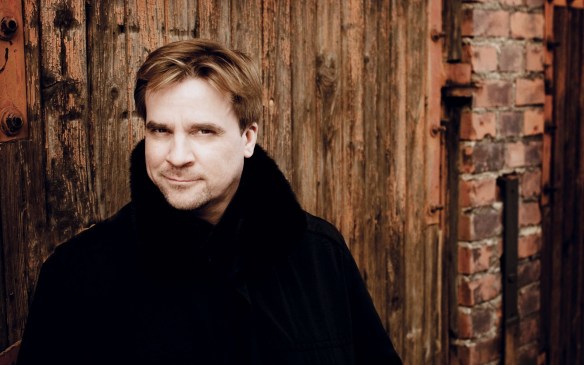
The exception was the sequence of four songs by Schubert, arranged for orchestra by Liszt so that a tenuous cohesion is evident – without this being a song-cycle as such. Elizabeth Watts (below) duly had the measure of their predominantly sombre sentiments – ranging from the distanced recollection of Die junge Nonne, via remorseless passing of experiential time in Gretchen am Spinnrade and speculative radiance of Lied der Mignon, to visceral representation of fate in Erlkönig. Storgårds teased many subtleties from Liszt’s judiciously restrained orchestration.

Preceding this came a surprisingly dour account of the Prelude from The Mastersingers of Nuremburg. This grandest of Wagner music-dramas is also the most symphonic, not least its Prelude as it deftly outlines a four-movements-in-one format. While not being oblivious to this, Storgårds might have characterized these episodes more potently, though this may have been in line with his tendency to play down the music’s opulence and majesty. What resulted was a subdued and earnest performance that hardly marked him out as a budding Wagnerian.

Concluding the first half was the Symphony in One Movement by Bernd Alois Zimmermann; a timely hearing in this centenary year of the composer’s birth. Although the more discursive original version (complete with organ histrionics) has recently been revived, this revision is audibly more focussed in form and expression as it traverses a quirky yet combative sonata design – (modified!) exposition repeat included – before emerging full circle in a mood of unbridled ferocity. Storgårds was at his interpretative best here, maintaining a tensile course over an eventful score where influences of mid-century symphonism do not outface pointers to the intricacy or intensity of Zimmermann’s mature music. A notably enthusiastic reception suggested that tonight’s audience ‘got’ what the composer was about in this singular piece.
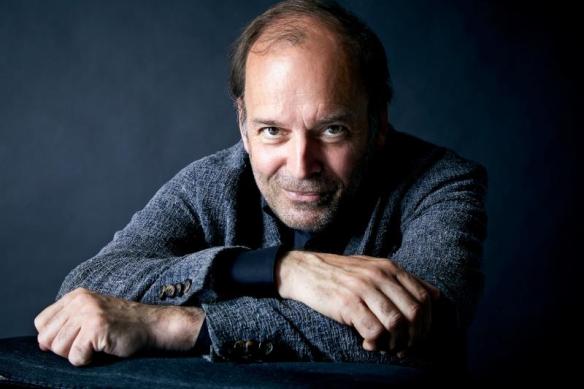
Time was when Liszt’s concertante realization of Schubert’s Wanderer Fantasy was a staple at these concerts, but this was only the second hearing in nearly six decades. 33 years ago, the soloist was Jorge Bolet at his unpredictable best, but Louis Lortie’s rendition (above) was altogether subtler as he brought out the pathos of the Andante then jocularity of the Presto. If the outer Allegro sections felt reined-in, this was not at the expense of that keen virtuosity informing Lortie’s playing in his solo passages or coruscating interplay with the orchestra at the close.

A century on, Sibelius not only ran movements together in his Seventh Symphony but fused them into a seamless and powerfully cumulative whole. Storgårds was certainly alive to this in what was a purposeful and often insightful reading; a little unsettled in those introductory pages, perhaps, but thereafter gauging the various transitions with a sure sense of where this music was headed while investing the vertiginous trombone entries with implacable majesty. One of this season’s most absorbing concerts thus far was brought to an impressive close.
Prom 8 – BBC NoW & Thomas Søndergård: The Music of Lili Boulanger & Morfydd Owen

Prom 8: Bertrand Chamayou  (piano), BBC National Orchestra of Wales / Thomas Søndergård

Lili Boulanger D’un matin de printemps; D’un soir triste (1917-8)

Mendelssohn Piano Concerto no.1 in G minor Op.25 (1831)

Morfydd Owen Nocturne (1913)

Schumann Symphony no.4 in D minor Op.120 (original 1841 version)

Royal Albert Hall, Friday 20 July 2018

Reviewed by Ben Hogwood

You can watch this Prom on BBC4 on Sunday 22 July here

Debussy and Bernstein may be the blockbuster anniversary composers this Proms year, but there are several composers whose cause is arguably more important. We heard two of them in this intriguing Prom from the BBC National Orchestra of Wales and their outgoing chief conductor, Thomas Søndergård.

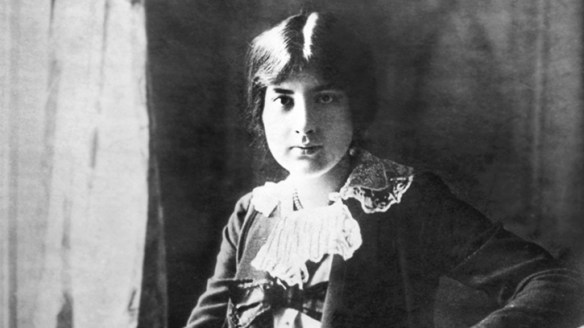
Lili Boulanger and Morfydd Owen died far too early, in their twenties, but both left works telling of an original style that should have been heard far more often than they have – which sadly is the case for all female composers. Happily the BBC has made a commitment to start putting that right, and this Prom went back to the second decade of the 20th century with two short pieces from Boulanger (below).

D’un matin de printemps (Of A Spring Morning) caught the ear immediately. Completed in 1918, it was slightly furtive at times, as though describing flowers shyly poking their heads into the fresh morning air. The transparent orchestration drew parallels with Debussy, and the colourful textures and positive harmonies made for an ideal, descriptive curtain raiser.

By contrast D’un soir triste (Of A Sad Evening) wore a troubled frown. Here the music was more ominous but also more exotic, its use of modal melodies extending its reach towards the East. Again Boulanger’s orchestration was exquisite, with a lovely rasp to the bass clarinet in the texture, and some powerfully wrought climaxes strengthened the intensity of feeling but failed to shake off the preoccupied state of mind. Both pieces made a lasting impact.

Morfydd Owen’s Nocturne began the second half. Written just before the First World War, this was an intriguing piece that was livelier than you might expect from a piece bearing that name. Initially the shady textures found the orchestra depicting the half light of the evening, but as well as atmospheric pictures there were attractive dance episodes, Owen breaking towards lighter music with a twinkle in her eye. She returned to this music on several occasions, each time casting the tune in a slightly different setting, before the piece finished with a silvery harp, sweeping us away into the night.

Complementing the anniversary composers was music from Mendelssohn and Schumann. The former’s Piano Concerto no.1 in G minor was brilliantly dispatched by Bertrand Chamayou, whose stylish playing emphasised Mendelssohn’s precocious writing for the instrument at the age of 22. Initially the speed of the music was a bit too fast, and the Royal Albert Hall acoustic didn’t help here, but soon pianist and orchestra were aligned in a performance light on its feet and, in the Andante slow movement, tender at its heart. As a well chosen encore Chamayou, popular with the Prommers, gave Liszt’s arrangement of Mendelssohn’s On Wings of Song.

Finally Schumann, and the original 1841 version of his Symphony no.4. Søndergård connected the four movements into a satisfying whole, bursting with melody, but here again made sure the slow movement had plenty of air. There can be a foreboding atmosphere to this symphony, mindful of the mental struggles that dogged the composer throughout his life, but here the BBC NoW, energetically led by Lesley Hatfield, found the positive mood running through its core. The most dramatic music of the night came in the transition between the obdurate scherzo and the triumphant finale, Sondergard stripping back the textures to a cold, hollow sound before surging forward to the rousing finish.

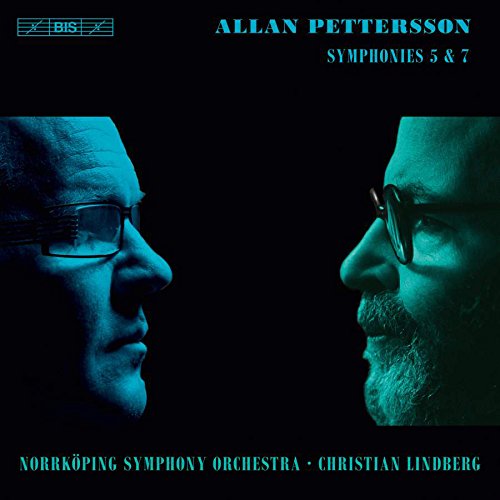
On record: Norrköping Symphony Orchestra / Christian Lindberg – Pettersson: Symphonies 5 & 7 (BIS)

Pettersson Symphonies nos.5 and 7

Norrköping Symphony Orchestra / Christian Lindberg

Pettersson
Symphony no.5 (1960-62)
Symphony no.7 (1966-67)*

BIS 2240 [82’48”]

Producers Martin Nagorni and *Hans Kipfer
Engineers Jeffrey Ginn and *Stephan Reh
Recorded *January and June and 2017 at Louis de Geer Concert Hall, Norrköping

Reviewed by Richard Whitehouse

What’s the story?

BIS’s cycle of the Allan Pettersson symphonies, by the Norrköping Symphony and Christian Lindberg, nears completion with this coupling of the Fifth and Seventh – two works of almost equal duration, though wholly different in terms of formal continuity and expressive content.

What’s the music like?

The Fifth Symphony occupies a pivotal role in Pettersson’s output. Whereas its air of ominous detachment recalls that of its two predecessors, the music’s unfolding as lengthy episodes of relative stasis and dynamism more directly resembles the symphonies of the 1960s on which this composer’s wider reputation still rests. Lindberg assuredly has the measure of its opening paragraph, with its sombrely fateful manner, then invests what is a discursive though highly focussed process of exposition, development and reprise with cumulative momentum through to an extended coda where the initial mood is revisited from an audibly more restive vantage. Easy to underestimate within context, the Fifth has latterly emerged among the most finely achieved of Pettersson’s symphonic cycle and this recording accordingly does it full justice.

Much more so than BIS’s earlier recording, Moshe Atzmon directing the Malmö Symphony in a cohesive though emotionally underpowered reading, whose playing and recording are no match for this newcomer. Understandable BIS should have re-recorded it, but less expected is this new account of the Seventh, which the Norrköping SO has previously tackled with Leif Segerstam. Powerfully propelled during its earlier stages, this nevertheless yields to Lindberg in the formal control such as the latter brings to the overtly sectional stages of its latter half.

Half a century on from its premiere and the Seventh Symphony remains the best known of Pettersson’s cycle (though it seems never to have received a public performance in the UK). This is essentially a work of two halves and Lindberg brings palpable impetus to its former half, building remorselessly over a baleful trombone motif to a seismic climax from where the music retreats in stark defeat. If what ensues is too episodic to sustain a true symphonic trajectory, this latter half features a sustained threnody and wistful coda which are among this composer’s most affecting utterances and the Norrköping players leave nothing to be desired. What a pity that, having brought this piece to Vienna’s Musikverein, orchestra and conductor were not able to have taken it on to London, where it would surely have been well received.

Does it all work?

Indeed, not given the persuasiveness of these accounts. The BIS recordings are comfortably surpassed, and though Alun Francis (with the Saarbrücken Radio Symphony) offers a more demonstrative take on the Fifth, while Gerd Albrecht (with the Hamburg Philharmonic State – both on CPO) more assiduously underlines those emotional peaks of the Seventh, both the greater refinement of the playing and definition of the SACD sound tips the scales in favour of this new disc. As a way into Pettersson’s symphonic cycle, it could scarcely be bettered.

Is it recommended?

Very much so. Annotations (once again courtesy of Per-Henning Olsson) are succinct and informative, and this series only lacks the choral Twelfth Symphony to reach completion – though before that, the symphonically conceived Second Violin Concerto is due for release.

You can read more about this release and listen to clips on the BIS website, or listen in full on Spotify below:

On record: Magdalena Kozená, Christian Gerhaher, LSO / Sir Simon Rattle – Debussy: Pelléas et Mélisande (LSO Live)

Debussy Pelléas et Mélisande

Magdalena KozenáChristian Gerhaher, Gerald Finley, Bernarda FinkFranz-Josef Selig, Joshua BloomElias Madlër, London Symphony Chorus and Orchestra / Sir Simon Rattle

LSO Live LSO0790 (three SACDs and one Blu-ray, 160’46”)
Producer James Mallinson Engineers Jonathan Stokes, James Hutchinson
Dates Live performances at Barbican Hall, London on January 9th and 10th, 2016

Reviewed by Richard Whitehouse

What’s the story?

Sir Simon Rattle and the London Symphony Orchestra release their first opera collaboration on the LSO’s label. Debussy’s Pelléas et Mélisande is a work Rattle has conducted often (including London and Salzburg), and the present account confirms his identity with this most elusive of operas.

What’s the music like?

Premiered in 1902 after a genesis of almost a decade, Pelléas et Mélisande is Debussy’s only completed opera and his treatment of Maurice Maeterlinck’s symbolist drama is a high point of musical impressionism. This recording is derived from two performances at Barbican Hall, shorn of Peter Sellars’ ‘platform staging’ but its partial re-seating of the orchestra evident in numerous instances of balance. The result is to emphasize dramatic extremes, though without necessitating extremes of tempo in what is otherwise a finely integrated reading of real poise.

The cast is a strong one, and such reservations as there are centre on the title-roles. A model of clarity and lucidity, Christian Gerhaher is arguably too self-contained to convey fully the emotional eloquence of a figure whose actions can seem almost involuntary. No less secure technically, Magdalena Kožená is elegant if at times rather generalized in her assumption – rendering the notes with unerring accuracy yet not always conveying the inner radiance of one whose presence should be disconcerting through its very intangibility and equivocation.

Gerald Finley’s is among the finest recorded Golaud – conveying his moroseness and anxiety with palpable conviction though retaining a vital degree of empathy, while Franz-Josef Selig makes of Arkel a nobler and more substantial figure than is too often the case. Bernarda Fink brings warmth and pathos to the (too?) brief role of Geneviève, with Joshua Bloom shining in his cameos as the Doctor and Shepherd, but Elias Mädler is a little too mature in timbre to be ideal for Yniold – his exchanges with Golaud a heart-rending instance of innocence corrupted.

The London Symphony Chorus acquits itself admirably during its brief contribution, with the LSO playing as well as it has done for its new Music Director in terms of fastidiousness and subtlety; climactic peaks thereby feeling the more acute for their rarity. Compared to that of his Royal Opera staging, Rattle’s conducting is freer and less inhibited – touching on a wide expressive range without sacrificing attention to detail. Each of these five acts is shaped with scrupulous regard to the action at hand while being responsive to the emergent overall drama.

Does it all work?

Indeed, for all that Pelléas et Mélisande already has an extensive and impressive discography. Roger Desormière’s 1942 recording (Warner) remains the interpretative benchmark – while, among the more recent accounts, Claudio Abbado (DG), Bernard Haitink (Naïve) and Pierre Boulez’s DVD (DG) all have serious claims on the listener. Presentation over three SACDs and one Blu-ray, with the booklet containing a succinct introduction, synopsis and bilingual libretto, is unexceptionally fine – as also the sound, if with little sense of a tangible acoustic.

Is it recommended?

Yes, though the absence of a visual component on the Blu-ray might be thought something of a missed opportunity. Something LSO Live might like to reconsider before issuing Ligeti’s Le Grand Macabre, the next Rattle/Sellars/LSO project which is due in the coming months.

You can read more about this release at the LSO Live website, or you can listen on Spotify below:

Wigmore Mondays: Elias + Navarra = Mendelssohn Octet

Elias String Quartet (above – Sara Bitlloch, Donald Grant (violins), Robin Ireland (viola), Marie Bitlloch (cello)); Navarra String Quartet (below – Magnus Johnston, Marije Johnston (violins), Rebecca Jones (viola), Brian O’Kane (cello)

Beamish String Quartet no.3, ‘Reed Stanzas’ (2011) (5:25-20:49) (Elias Quartet only)
Mendelssohn Octet in E flat major Op.20 (1825) (27:02-58:58)

Wigmore Hall, London; Monday 25 June 2018

You can listen to the BBC Radio 3 broadcast by clicking here

Written by Ben Hogwood

You would do well to find a really quiet spot before listening to this concert. That is because Sally Beamish’s String Quartet no.3, written for a first performance at the BBC Proms in 2011, begins with a distant offstage violin solo.

In her work Beamish is tapping heavily into the folksongs of the Hebrides, and the Elias Quartet second violinist Donald Grant, well versed in that literature, is an ideal player to begin the work (from 5:25), with all the inflections the style of writing brings. As the ensemble join nearly two minutes later Beamish’s harmonic workings become clearer, but the distinctive folk melody continues to pull the ear.

A set of ‘stanzas’ provide development and variations on the theme, with the one from 8:15 changing the mood considerably from wide open to closed in. From 11:25 violin and cello join in a duet, before the music breaks into a quicker and much more assertive section. Then after some pretty frenetic dialogue, the mood cuts once again towards that of the opening, moving back towards the original folk melody, which subsides to silence once again.

The performance here was an intense one, its colours and harmonies showing a clear debt to Britten, whose quartets Beamish was listening to at the time. Yet there is no fully blown pastiche here, with a distinctive style of quartet writing that stays very open and direct in its communication. It was great to see Sally Beamish in the audience.

The Elias Quartet were then doubled in number by the Navarra Quartet to play one of Mendelssohn’s many early chamber music masterpieces. The Octet is a real one-off, mastering a form few composers since have managed to achieve. It is all the more remarkable when you consider Mendelssohn completed the work at the age of just 16!

The piece begins with typically youthful Mendelssohn qualities of enthusiasm and vigour, but with a melody that immediately sticks in the head (from 27:02-41:02). The second theme (29:07) is a nice complement, serene and thoughtful. What really stands out is the fullness of texture when compared to the string quartet before, Mendelssohn beefing up the sound with the two cellos and violas at the lower end in particular. Yet he thinks nothing of changing the mood quite considerably in the course of the first movement, with a sudden vulnerability introduced around 35:50 that checks the positive thoughts around it – until a rush back to the original theme.

The second movement (from 41:30-48:18)) is a slow Andante, and it exploits the uncertainty briefly aired in the first with a darker outlook but also a romantic sense of longing. It too thinks nothing of moving to a faster section, quite a fraught exchange of ideas.

The third movement scherzo (48:39) is the most celebrated of the four movements, containing strong pointers towards Mendelssohn’s Shakespearian music, and especially the Scherzo from A Midsummer Night’s Dream. This one too is fleet of foot, with silvery shadows darting around the texture all the way through to the end at 53:03. At this point we surged into the finale, a thrilling dialogue between the four different sections of instruments (two lots of violins, violas and cellos) before a sweep to the finish at 58:58.

This was an excellent, joyous performance from the two ensembles, even if just occasionally it had too firm a foot on the accelerator pedal, with some of the tuning in the first movement going slightly awry as the ensembles pushed further forwards.

Further listening

There are no recordings currently available of Reed Stanzas, though a natural progression for further listening is a disc containing Beamish’s first two string quartets:

If the Mendelssohn appeals, this version from the Academy of St. Martin-in-the-Fields Chamber Ensemble combines the Octet with a much later work, the wonderful and underrated String Quintet no.2:

For more early Mendelssohn, you simply have to try the amazing Piano Quartets, written when the composer was just 14, and showing an uncommon mastery of writing dramatic music for the piano: