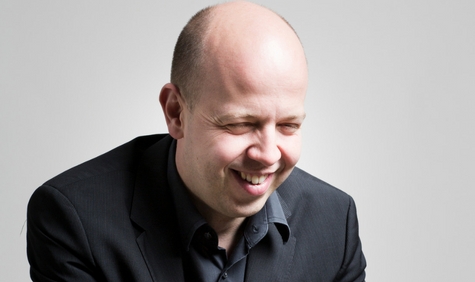
Talking Heads: Martyn Brabbins

Interviewed by Ben Hogwood

When it comes to British music, Martyn Brabbins is your man.

His current set of projects are particularly invigorating. A cycle of Vaughan Williams symphonies with the BBC Symphony Orchestra is off to a flying start, with a recording of A London Symphony on Hyperion. A cycle of the symphonies of Sir Michael Tippett with the BBC Scottish Symphony Orchestra is also underway for the same company, and will include the world premiere of the composer’s early Symphony in B flat. Then there is the small matter of English National Opera, where Brabbins is Music Director – and it’s after a stint of rehearsals and creative advice there that Arcana takes him to the pub for a well-earned drink. As you might hope for one deeply involved in English symphonies, he chooses a pale ale.

“We’ve just done the Sea Symphony!” he proclaims when the small matter of the Vaughan Williams cycle is raised. Does that mean with the first two works covered, that the nine symphonies will proceed in chronological order? “They will now,” he confirms, “we’re doing the Third (the Pastoral) and the Fourth next year. One at a time! I supposed we didn’t do the Sea Symphony first because of the chorus availability, but it doesn’t matter.”

A London Symphony (no.2) is now out on Hyperion, and has been extremely well received, not least for the extended edition used. “What I really like about it was the version we did. A real Vaughan Williams buff said to me that we should do this version. It has been recorded before, but he thought – and I agree with him now – that some of the music that Vaughan Williams put back in is absolutely fantastic.

I know the original, and even some of the music that we’ve cut out of the version we’ve done is amazing – but as a one-off performance piece that original version is a bit too long. This one is only five more minutes, but you get such pay-offs in the new music, especially at the very end of the piece and in the slow movement. The slow movement coda is absolutely ravishing. When we recorded it with the BBC Symphony Orchestra they realised it was different and they were completely convinced. I don’t remember anybody saying they preferred the original, and at the time, when we were recording in Henry Wood Hall, it felt so right because this is the orchestra for whom it was written. It is in their blood and in their spirit, possibly more than any other British orchestra.”

The orchestra has a rich recent history with VW, due to their conductor laureate Sir Andrew Davis. “He did a cycle with them,” says Brabbins, “and somehow it felt like they knew how it should go, and on a technical level they can do everything anyway. You just press the right buttons and they are so incredibly responsive, and so willing to go where you want them to go.”

Did he take their performing history into account when preparing the recording? “No, not at all. I just feel the fact they have that history means they don’t just do it how they’ve done it –they have the DNA of the music. It was like that in the Birtwistle Earth Dances, which we performed alongside the Sea Symphony at the Barbican in November. They are the only orchestra in the world that has got it in their blood. With that piece particularly it’s incredibly difficult and they have to work really hard, but in that performance it felt like they were meeting a familiar friend.”

I confess to Brabbins that I have struggled with Birtwistle at times – the Earth Dances included – due more to my own response to the music than anything else. It is however telling to witness the effect his music has on devotees such as its conductor. “It was a shattering performance, and I think anyone who was there was very positive about it”, he says. “Again the orchestra wondered why we weren’t recording it! Some of them might not like it but they take enormous pride in doing it. It’s like taking a really high, haute cuisine recipe and doing something out of the ordinary with it. It’s in every musician’s grasp but you have to grasp it. We all have those challenges in our lives I imagine, but when you’ve achieved it the rewards are so great. I think for your case it’s just repetition, listening to it more. I’ve always listened to a lot of contemporary music, and I trained as a composer, so I’ve always been interested, not in an anoraky kind of way but I’ve always found it hugely rewarding to explore music. As a professional I always want to do the best for my colleague composers. It gives me a huge sympathy for them!”

He elaborates. “When I think a composer has done their utmost to make a piece work, and they’re being practical, professional and interacting well with the musicians, when you get everything going well – like the opera I’ve been doing with Nico Muhly, Marnie – then it’s great. They’re not all like that, but I do try to pride myself on being a good intermediary between composer and orchestra. That can be very fraught, because if a composer doesn’t handle them right, you’re in deep water.”

A form of negotiation, essentially? “You have to be diplomatic but you have to be that all the time as a conductor. When there is a composer in the room there is a chance of a catastrophic outburst. I’ve witnessed players really lose their temper, and witnessed composers behave awfully – and once that happens, nobody is a winner! So I try all I can to avoid that.”

As is customary, at some point in an Arcana interview we ask our subjects to cast their mind back to their first encounters with classical music. Martyn thinks hard before taking up the story. “I remember music moving me as a child, especially when I sang it. I used to make myself feel sad singing Edelweiss from The Sound of Music. I grew up in a non-musical household, but joined a brass band at the age of eight or nine. Through that I would have got to know arrangements of classical music.”

He gives more detail on his family history. “When I think that I had a working class background, and am one of five kids, it’s pure fluke that I’m here. I’m quite proud of that, because I left school at 14. My dad and mum worked in a shop, dad became a travelling salesman, and there was no education to speak of.

My dad was a paratrooper in the Second World War, and was a prisoner of war. Looking back, he is a hero for me. He then had a tragic car crash when I was at the age of seven. I had a younger brother, an elder brother and two elder sisters, and he was in his late 40s. He never really got himself back. His kidneys failed, and he had renal dialysis for 15 years at home. Both of my parents died before I went to study conducting, in the same year. They were hugely wonderful to me, and in no way did they discourage music. Dad had a good singing voice, and I remember he had about four classical records. I used to nick them and play them very loudly in my bedroom if I could – the Karajan Verdi Requiem, Schubert’s Unfinished Symphony with Karl Böhm and Sibelius’ Symphony no.5 conducted by Anthony Collins. They are the records I remember at home in my teens.

I was born in Leicester, and dad heard Gigli and Caruso there. There was never any serious idea that I would become a musician though. One of my oldest sisters went to university, and I did in the end, but my other siblings are an electrician, a chef and a secretary who went to run a company. When you talk to other conductors there is probably a private education somewhere along the way, from Cambridge or Oxford. Don’t get me wrong, I’m not saying any of that is a bad thing – it’s wonderful! – but I never saw myself in that league. It took me a while to even think I could be a conductor because of my background, my lack of keyboard skills – and I wasn’t a chorister either. There were so many things against it but in my early 20s after graduating people said why don’t you take it seriously? That’s how it started, with a few brass bands. I played in a band but then conducted the one I had grown up in as a member. It was too far to travel to Northamptonshire and so I got a band in London, then conducted amateur choirs and orchestras. Then I went off to Russia and it all happened after that, so it was a very unorthodox route!”

Now for Brabbins it is all about giving something back, and he is equally keen to talk about this as he is his own new recordings. “I’ve just established a youth company at the ENO, the Harewood Artists Programme, and some of the youngsters are clearly from disadvantaged circumstances, but when you hear them making music and drama together I realise just how lucky I am to be here. I’m a donor to the Baylis programme here at ENO, simply because I realise that so many kids with talent are never given the chance. This has got nothing to do with CDs though! I’m president of the Salomon Orchestra, who are amateurs, and Music Director of the Huddersfield Choral Society. I’m president of the Royal Choral Union in Edinburgh, and the Towcester Choral Society where I grew up. I really care about music making for all people.”

I remark how this dedication to the community recalls tales of Vaughan Williams, and he nods vigorously. “Of course! He did amazing things, and he wrote music to speak to everyone. The Hymn Tunes on the new disc are a great example of that.”

Does he think that London now is so different from Vaughan Williams’ capital city that A London Symphony is less meaningful? “I realised this morning that I haven’t read Tono-Bungay, the H G Wells book that the piece is inspired by, so I’m going to put that right as soon as I can. I think there is still enough of a connection with the spirit of London from that period somehow. It’s a completely different city in all manner of ways, but still there is a kind of special flavour about London. You can talk to a cabbie or walk down some of the back streets, or go to some East End or South London locations, and there are certain connections. It seems to me that Londoners still have that pride in their history, so although it has changed you can still smell the same London that Vaughan Williams did – maybe not quite as smoggy! I think that is where the cover of that disc is fantastic, Simon Perry and those guys find such fantastic artwork for their discs at Hyperion.”

As the symphony cycle progresses Brabbins will inevitably arrive at the angrier wartime symphonies, the Fourth and Sixth in particular. Will he then be more mindful of his father’s role in the war? “Well Vaughan Williams was of course a driver in the First World War”, he notes, “and he went off to France. The Pastoral is influenced by his experiences in France. As for my connection, I was born in 1959, so if you think back from here that’s only 15 years after the war ended, which is incredible. You don’t think of things like that until you’re much older, but realising how close it all was is amazing. My dad was a prisoner of war, and we’ve got the telegrams from the war office saying ‘Missing In Action’. It’s incredibly touching and moving.”

“Having that family connection and experience…everything infuses how you perform, how you look at stuff. I went to Auschwitz for the first time recently, and that leaves an indelible mark on how you view things. The whole thing is so profoundly inhuman and unrepeatable, but sadly the same tragic stuff is still going on. Life is full of horrible things, and as I get older I realise my emotions in performance are much more free, and bubble over sometimes. The whole thing gets to me! I think that’s all to do with the things one goes through, your history and pre-history, and stuff that happened to you or your family. I’ve got three children and one of them has had health problems, my wife has had brain surgery previously, I lost my parents in my 20s – all those things give you a grounding in emotion somewhere, and it comes out.”

The music of Vaughan Williams will be forever close, it would seem. “I remember I was doing the Fifth Symphony on tour in China. I had to go there about 3-4 days after my father in law died, and I had to get back to see him. Because I lost my parents early he was like a father to me. We were doing Vaughan Williams’ Fifth in Beijing, and in the slow movement I just collapsed. I carried on but music has that way of speaking in a way that is unexpected, perhaps. The Fourth and Sixth as you say, there is a palpable anger there. He wouldn’t have it said that the Sixth is about the Second World War but…”

What about the striking discord in the epilogue of the London Symphony, does that have a similar quality? “Harmonically I find the whole piece very subtle, and everywhere there are places that become dissonant and then come back, bass lines that are sustained, and dissonances that come against it. I think it’s incredible music. The way he evokes place, somehow, and weather – you can almost feel the mist. The Scherzo is fantastic in this way, the Nocturne too.”

He also notes the French influence. “I think that time with Ravel was very important, and that Vaughan Williams did the right thing going to him. The orchestration, the colours and the way he subdivides the string sections – it’s amazing stuff and I’m sure that is the French influence.”

As a coupling to the London Symphony Brabbins chooses two vocal pieces, Elizabeth Watts singing Sound Sleep and Orpheus With His Lute, and then conducts the Royal College of Music Brass Band in the Variations. “The songs are very lovely, they’ve never been recorded – and there is something similar to go on the Sea Symphony disc. I have to say that for me the real thrill was doing the brass band variations, and of course now you know my background you can see that.”

“It just occurred to me that I played that piece as a boy and had never conducted it. I said to Simon Perry, how about it, and he said yes, if that’s what you want to do! I had just got this position at the Royal Northern College, and for them it’s quite a treat, for the students to prepare and record something under the conditions we did was wonderful. It’s top quality stuff, the producer Andrew Keener is a genius to work with, so educationally it was brilliant, and they get on to a successful disc, so it’s a win-win situation! For me getting that on there was great, because it takes me back to my roots.”

His own compositions have come to light at a similar time. “As an aside, James MacMillan has got a festival up in Ayrshire, and he asked me if I would conduct a brass band in the festival that’s just gone. I thought it over, and by the third beer I said yes! I hadn’t conducted a brass band for 30 years, and it was like going home. It was the Dalmellington Band, one of the top bands in Scotland, and it was so thrilling to go back and hear that sound, to feel the enthusiasm, the joy they get. It’s nice to go back to your roots.

When James asked me we came up with a few pieces – Eric Ball’s Resurgam, Herbert Howells’ Suite from Pageantry, and a world premiere from Jay Capperauld and the Mendelssohn Hebrides Overture. It was alright, once I got them not to play too loudly! I also mentioned to James that in 1980-81 I wrote two very short pieces for brass band that have never been played. I ran through one and the band couldn’t play it at the time. They’ve been in my attic for 30 years, and I sent it to James and he said we’d do them! So there were two Brabbins premieres…and someone was there and they want to publish them, which is great! It was a terrific experience all round.”

Recently Brabbins has brought the music of Sir Michael Tippett back into the spotlight, and he reflects briefly on the composer. “I knew him a little, I did a few projects with him in the latter years of his life. I knew his music, and I met him quite a few times and Meirion Bowen, his partner, who was a Guardian critic – I knew him quite well. Poor Tippett disappeared once he died, apart from the obvious pieces. So a few years ago with Steven Osborne we did the Piano Concerto, and I’ve done A Child Of Our Time – we staged it with ENO and I’ve done it in concert. I’ve not done any major repertoire apart from this, so I suggested we do a Tippett Symphony cycle. The BBC Scottish Symphony Orchestra were willing to program them, two last season and two this, and I can tell you it’s going to be good. I’ve got a copy of the first disc, and I think it’s as good as any of the other recordings. I think it will be very well received. That music is very difficult, and it needs a bit of time to get to know. The orchestra really took it to heart. We have just done the Third in concert and they really loved it. That’s quite a feat.”

“The most exciting part of the project is the ‘rediscovery’, the Symphony in B flat, which is a new discovery for me too. An academic friend alerted me to it, and we looked – and I thought we should do it! However there was a clause in his will that we had to overcome, so I asked the trustees and the Tippett Foundation, and in the end they decided on balance that it would be better for that piece to be heard, especially by people who knew Tippett. The thought being to get it out while his friends are still around! It’s a significant piece, around half an hour, and if I understand correctly it had a lot of performances, more than a handful at least. When Schott’s the publishers took him on, I think it was in the 1950s, and he decided to withdraw it. I can see what he means, but historically it is an interesting thing.”

You can hear the Symphony in B flat on the BBC iPlayer here

British music is a huge part of Brabbins’ life, and he is combining it with his work for English National Opera. “Yes, and with repertoire that has been neglected for a little too long. We’re talking about bringing back some British pieces which haven’t been done for a while. It’s a great company with an amazing history, and a wonderful orchestra and chorus. Sadly it’s had trials and tribulations in other areas, so I’m hoping we can have a period of some stability and re-establish what the company is really about, which is making great music and getting the dramas on stage, which we do well! The Barber of Seville, Aida, Rodelinda – they have had fantastic quality of voices, all of them. Marnie is really good too.”

Is there any more British orchestral music he is keen to do? “There are people around I would like to have a look at”, he says, “and not necessarily British! I’ve got scores at home of the symphonies of Gavril Popov, they’re just enormous, and there are interesting people out there. Myaskovsky I would like to do. I’ve done all the Bruch violin music, and I’d like to record the symphonies.

Over the years, for many years, I recorded what I was asked to record. Now I can say I’d like to record this, what do you think? They’re not going to say yes to a Beethoven cycle, I’d do those in concert. I should be doing stuff that other people aren’t doing and that I can do as well as anybody. I would love to do the Elgar Symphonies, all three of them, at some point. I did the First, 15 years ago, and it was a mistake. We didn’t have time, the orchestra didn’t know it and it wasn’t ideal. I’d love to do it again. It was with the Brussels Philharmonic Orchestra. They’re a fine orchestra but Elgar needs to be in your blood before you record it.”

Elgar has an increased international appeal now – but he is not the only British composer to enjoy elevated status. “I tell you where they love Vaughan Williams is Japan”, says Brabbins. “I’ve done the Antarctica and the London Symphonies, and they love it. It’s the pentatonic quality!”

Finally, what is his relationship with London in comparison to Vaughan Williams’ own? “The first time I came to London was to see Tutankhamun at the British Museum,” he recalls, “and I remember seeing someone like Houdini near the Tower of London, completely chained up. I must have been a little boy…but then I came to London to live in 1977, to go to Goldsmiths, and I lived here until 1989. I met my wife in 1977. I did 2 years as a postgraduate, she did a year, she went off to Germany to work (she’s a violinist) and she came back. We got a flat in London, in Wimbledon, in 1984, and lived there – although in 1986 I went off to Russia for two years. We decided to move out just before our first child was born. I live very near to Down Ampney, fifteen miles away in Gloucestershire. It’s a very musical county – we’ve had Howells and Holst, Elgar’s up the road, Finzi lived in Painswick, there is Vaughan Williams of course – it’s everywhere!”

You can read more about Martyn Brabbins at his website. The recordings of Vaughan Williams’ A London Symphony and Tippett’s Symphonies nos. 1 & 2 are both available now from Hyperion.

On record: Stephen Hough – Debussy: Piano Music (Hyperion)

Debussy Piano Music Stephen Hough (piano)

Debussy
Estampes (1903)
Images Set I (1905)
Images Set II (1907)
Children’s Corner (1906/8)
La plus que lente (1910)
L’isle joyeuse (1903/4)

Reviewed by Ben Hogwood

What’s the story?

This centenary-year collection from Stephen Hough takes in Debussy’s best-known suites for piano, simultaneously offering an ideal introduction to the composer’s music.

What’s the music like?

This disc is a great illustration of the strides Debussy made in piano music in the first decade of the 20th century. Starting with Estampes, Stephen Hough immediately shows the listener how the added note chords, elusive melodic figures and watery textures still create pictures of deep emotional substance. Every note counts with Debussy, and his music uses some particularly alluring chord progressions, creating pictures and moods unlike any composer of the day.

So too with both books of Images, the style further developed, while making more obvious references to the composers influential in Debussy’s development (the Hommage a Rameau for instance). The mood becomes more playful with Children’s Corner, much loved for its characterisations of infant toys. The Golliwogg’s Cake Walk is a big part of this, its winsome syncopations and catchy tune both reasons for its place as one of the composer’s best-loved pieces. It is a great example of a tricky piece made to sound simple.

Does it all work?

Very much so. Stephen Hough clearly loves these pieces; he knows just how he wants them to go, and in Children’s Corner he is not afraid to bring out the inner infant. Estampes and Images are richly coloured and commandingly played, the piano sound offering clean and precisely shaded pictures. Hough’s masterly command of the phrasing in La soirée dans Grenade is especially impressive, while Jardins sons la pluie is also brilliantly played.

The Images are lovely. Reflets d’ans l’eau melts under Hough’s soft touch, while Mouvements shows off the technical ability he has in spades, with flawless octave playing giving clarity above the whirl of notes beneath. By contrast Et la lune descend sur le temple qui fut is exquisitely restrained, Hough paying particular attention to the colour realised in his slow picture painting.

The addition of short pieces La plus que lente and L’isle joyeuse offer great space and colour, the icing on the cake of this recital.

Is it recommended?

Yes. If Debussy’s piano music is new to you, let this be the way in. If it is already familiar then these interpretations will bring it to life once more, exploring the composer’s love of the dance and also his ability to create sounds and textures placing the piano in a whole new context. Buy it and be transported away.

Wigmore Mondays: SCO Wind Soloists play Beethoven & Poulenc

Scottish Chamber Orchestra Wind Soloists (above) [Robin Williams, Rosie Staniforth (oboes), Maximiliano Martín, William Stafford (clarinets), Peter Whelan, Alison Green (bassoons), Alec Frank-Gemmill, Harry Johnstone (horns)]

Beethoven Sextet in E flat major Op.71 (1796) (from 1:49-19:22 on the broadcast link)
Poulenc Sonata for clarinet and bassoon (1922, rev.1945) (22:30-30:30)
Beethoven Octet in E flat major Op.103 (1792-3) (33:02-54:09)

Wigmore Hall, London; Monday 12 February 2018

You can listen to the BBC Radio 3 broadcast by clicking here

Written by Ben Hogwood

There is something immediately comforting and inspiring about the sonorities of a wind ensemble, and in this debut Wigmore Hall concert from the SCO Wind Soloists we got to enjoy Beethoven’s way with those sounds, as well as some typically mischievous tricks from Francis Poulenc.

The late opus numbers assigned to Beethoven’s Sextet and Octet are misleading, for both are comparatively early works that were published much later in the composer’s life. The Sextet, written in Beethoven’s mid-20s, is however unusual in missing out flutes and oboes in its instrumentation, presumably due to those available at the time.

Writing for a pair each of clarinets, bassoons and horns, there was a lovely deeper sound on offer, and this was fully exploited by the SCO Wind Soloists, with the bonus of the slight rasp Alec Frank-Gemmill and Harry Johnstone added with their natural horns. A thoughtful Adagio introduction (from 1:49 on the broadcast link) was soon replaced by a good natured Allegro (2:42).

The music of greatest depth could be found in the Adagio (8:56), with some lovely harmonies and intimate dialogue between the instruments. A brief but nimble Menuetto (13:00), horns in the lead, led to a charming, march-like Rondo (15:34) which wrapped up the piece in good spirits.

Poulenc wrote brilliantly for wind instruments throughout his life, usually with a spiky piano part adding a bit of extra punch to proceedings, but here we heard his music stripped back to just clarinet (Maximiliano Martín) and bassoon (Peter Whelan). This was a brilliant, fun performance, and in the first movement it felt as though the bassoon part had been written specifically to derail the clarinet’s flow. Whelan failed in this aim – but only just! A soft-hearted Romance (24:39) still had some deliberately awkward writing for the bassoon, but it set up a mischievous and perky finale (27:34), crowning a small gem of a piece lasting just eight minutes.

Beethoven’s earlier Octet – early-20s this time – builds on the instrumentation of the Sextet by adding two oboes to the treble end. It is more adventurous in musical content and form, and began with a lovely Allegro (33:02), which gave way to a touching second movement Andante (40:57), led off beautifully by oboist Robin Williams and shadowed equally lyrically by Peter Whelan.

The third movement, a lively Minuet (47:07), is in fact more of a Scherzo, a sign of how Beethoven was upgrading this movement to something much more assertive and energetic. The ensemble here was crisp and incisive, while in the quick finale (50:29), led off by the gurgling clarinet figures, the group enjoyed the close interplay of Beethoven’s writing.

The SCO Wind Soloists clearly relished their Wigmore Hall appearance, and have a distinctive rapport – lots of smiles, subtle encouragement and teamwork in evidence throughout the concert. It fitted the function of Beethoven’s music perfectly, and also suited the humour of the encore, an arrangement by Josef Triebensee of Fin ch’han dal vino from Mozart’s Don Giovanni (55:20). It crowned a thoroughly enjoyable concert.

Further listening

You can listen to the music played in this concert on the below Spotify playlist:

The SCO Wind Soloists will be releasing a disc of Beethoven works for wind instruments shortly on Linn Records, further details of which can be found here You can watch an excerpt from their previous release of Mozart, also on Linn, below:

Mozart and Beethoven were among the first to properly exploit the wind ensemble as a form for communal playing. Mozart wrote several Serenades for different combinations of wind instruments, the best-known of which is the lovely Gran Partita of 1781-2. In seven movements, it is one of his very finest works:

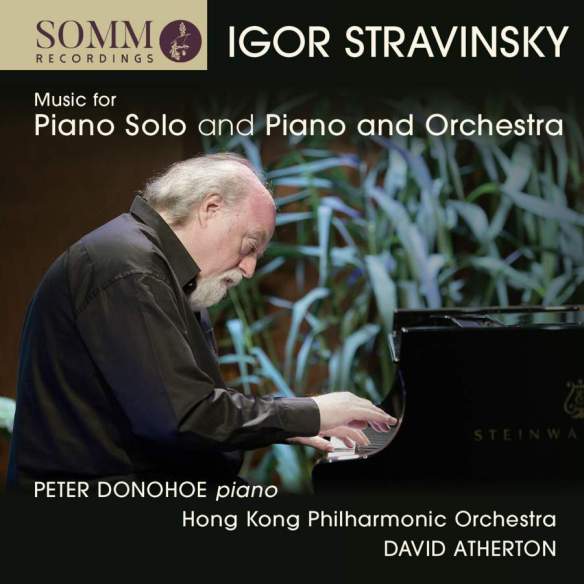
On record: Peter Donohoe – Stravinsky: Music for Piano Solo and with orchestra (Somm Recordings)

Stravinsky Music for Piano Solo and with orchestra Peter Donohoe (piano), Hong Kong Philharmonic Orchestra / David Atherton (Somm Recordings)

Stravinsky
3 Movements from Petrushka (1921)
4 Études Op.7 (1908)
Piano Sonata in F sharp minor (1903-4)
Piano Sonata (1924)
Serenade in A major (1925)
Piano-Rag-Music (1919)
Tango (1940)
Concerto for Piano and Wind Instruments (1923-4, rev.1950)
Movements for Piano and Orchestra (1958-9)
Capriccio for Piano and Orchestra (1929/1949)

Reviewed by Ben Hogwood

What’s the story?

Stravinsky’s output for piano is, perhaps not surprisingly, overshadowed by the blockbuster ballets. Yet, as recent collections from Steven Osborne and Jean Efflam-Bavouzet have shown, there is plenty to wonder at and enjoy here. Peter Donohoe takes up the mantle and goes one step further, providing an extra disc of the composer’s music for solo piano.

What’s the music like?

Extremely varied, and often spiky, exploring the piano’s capabilities as a rhythm instrument as well as a melodic one. Some of the solo works have a relatively dry musical palette, but all have interest and the earlier ones work especially well here.

The Four Études are virtuoso pieces with their roots in the language of Romantic Russian composers such as Tchaikovsky and early Scriabin. The two Piano Sonatas are a great illustration of the difference between early and middle period Stravinsky. The first, an expansive half-hour piece in F sharp minor draws inspiration from the composer’s teacher Rimsky-Korsakov as well as the Grand Sonata of Tchaikovsky. The composer had no time for it, declaring it ‘fortunately lost’ – unaware it was under lock and key in the National Library of Russia.

The Piano Sonata of 1924, a third of its length, inhabits a different world, ‘neo-classical’ Stravinsky compressing his music into forms derived from the 18th century. The perky Serenade and the short Piano-Rag-Music and Tango make a nice, sprightly contrast to the bigger works, as do the death-defying Three Movements from Petrushka. Always a spectacular experience, these sections from the ballet faithfully reproduce the colour of the orchestra and are a technical summit that pianists cannot resist conquering.

The works for piano with orchestra are fascinating. The Concerto for Piano and Wind has a stern face and is on occasion a bit caustic – the composer contrasting ‘sounds struck and blown’ in driving rhythms. In its slow music however there is a more intimate, even vulnerable heart. Movements, a set of five postcards dating from Stravinsky’s move away from conventional tonality, remain full of interest in their syncopations, tonal movement and snapshots of humour. Finally the three-movement Capriccio is a refreshing burst of energy in its outer movements, the last movement especially turning into a riot.

Does it all work?

Yes. Peter Donohoe is an expert guide to this music, his pedigree in Russian piano music almost unrivalled among his contemporaries. Those recordings of Prokofiev, Rachmaninov and Shostakovich serve him in good stead to present a consistent and illuminating portrait of Stravinsky in his very different phases.

He is a model of clarity in the trickier contours of the more modern works, making the most of the composer’s rhythmic impetus and bringing in humour when the chance allows. In the slow movement of the Concerto he sets the mood with a calming simplicity, enjoying heartfelt dialogue with the chorales of the Hong Kong winds.

In the more overtly Romantic music he is a model of virtuoso performance. The flurry of notes in the fourth Etude are superbly delivered, while in the grand Sonata in F sharp minor Donohoe makes a compelling case for the work despite its massive structure. The shorter pieces work well too, the spiky side to Stravinsky coming to the surface.

David Atherton, also a seasoned interpreter of the composer, secures excellent playing from the Hong Kong Philharmonic Orchestra wind in the Concerto especially, their block sounds beautifully rendered. Those sonorities are also beneficial to the Capriccio and Movements, which are suitably punchy. These are slightly older recordings, from the mid to late 1990s, but hold up extremely well.

Is it recommended?

Yes. The musical contents may not be as immediately appealing as the ballets, maybe, yet this is a collection rewarding closer inspection. Spending time with this music gives a greater insight into Stravinsky’s development as a composer, and even if you love the more Romantic side of Russian piano music the solo works bring their own rewards.

Talking Heads: Huw Watkins

It may not yet feel like it (in the UK at least!) but Spring is just around the corner. With a timely intervention, Huw Watkins (above) has not long had the first performance of a piece with that very title, given by the orchestra of which he is Composer-in-Association, the BBC National Orchestra of Wales. When Arcana catches up with him, however, his thoughts are with a boyhood favourite, the Britten Piano Concerto – centrepiece of a concert he has curated for the orchestra.

Immediately Watkins is enthusiastic about the Britten performance, and the orchestra’s prowess. “I have to say the orchestral parts are sounding brilliant, and touch wood it’s gone pretty well. It’s a really fun piece to play, and I don’t think the orchestra have ever played this piece before. They are so quick to learn though, and the rehearsal we have just done was done in two hours rather than three!”

The Britten brings its own particular challenges. “I do play concertos but I’m a composer and chamber musician really, so I’m not on the regular circuit. It is always a bit nerve wracking playing with an orchestra again, but this is a work that I am familiar with and have known since university. I did it with the orchestra there, so got to know it very well. It’s a lovely, youthful piece, and the conductor Martyn Brabbins, who I’ve been working with, has done it a lot and knows it very well. He was really excited about this performance, and it was lovely to work with him. I play a lot of chamber music so you have to listen in a different way with the orchestra, leading rather than following.”

Watkins recalls for Arcana his first ever encounters with classical music. “It’s difficult to remember exactly, because music was always around. Paul was already playing the cello and piano, my dad was an amateur viola player, and mum was teaching in school. Before my teenage years I loved playing the piano but I had become a bit bored with it. Then I listened to Stravinsky’s Petrushka and it blew me away when I first heard it – and so did the Britten that I’m about to play! It’s so immediately likeable and fun.”

He then recalls the first meeting he had with the BBC National Orchestra of Wales. “I remember that I’d written a piece in 2000, a Sinfonietta-type piece that they did with Grant Llewellyn. I’ve withdrawn it from publication now but it was a great learning piece. As a composer it’s hard to get access to an orchestra regularly so that was a really big thing. Shortly after I wrote my Piano Concerto, which I played myself with tonight’s conductor Martyn Brabbins. We go back a long way!”

How would he describe Spring in the form of a program note? “I didn’t really want to do what was just an aural picture, but the opening felt like that moment just before spring starts. A lot of pieces of music do that but it had a pregnant feel to it. Giving a title to a piece of music is really hard, because if you think of something poetic you become chained to it, but it’s nice to have something to think about in the audience. With this piece I think there is a sense of something blooming and broadening out. That was in my mind, and the idea of looking forward to spring.”

You can listen to Spring here

What are his own personal reflections on the season? “When spring comes you notice it getting lighter, and getting energy back. It would be nice to be able to have a break but the trouble with composing is that the deadlines come through thick and fast. I do need to plan a bit of a break, you can’t just keep churning it out. I do want to find time to listen to other pieces, it can be distracting to hear other people’s work when you’re writing so I generally choose not to. I’m lucky with the demand there is at the moment, the BBC NoW is a source of three commissions and writing for the orchestra is very enjoyable, if time consuming!”

Watkins divides his time between composition and the piano, and over recent years has shown himself to be an extremely quick learner. This has enabled him to record several discs of lesser-known British repertoire for cello and piano for Chandos. In partnership with cellist brother Paul Watkins, this was an experience he clearly enjoyed. “A lot of that repertoire was new to us, and I think the John Foulds Cello Sonata in particular is an absolute masterpiece. The York Bowen Cello Sonata was good too. We were lucky to do those discs. I find I’ve always been a quick sight reader but I can’t always rely on that as I get older! I want to spend more time on new pieces, but I want to concentrate on doing pieces more than once, to really get to know them.”

The challenge with such a busy schedule on both fronts is achieving balance between work as a performer and a composer. “My piano playing feeds into my creativity and my compositional life”, he says. “I think you lose a perspective if you’re not involved in live performance as a musician, and with how audiences respond.”

Some opportunities are just too good to pass though, including last year’s commission for a carol for the Service of Nine Lessons and Carols at King’s College, Cambridge. “It was an incredibly inspiring thing to be asked to do. I wanted to write something simple, to write something pure and plain. The atmosphere in that service on Christmas Eve is amazing, and that’s probably my only chance to go to the service as well!”

You can discover more about Huw’s contribution to the service here

Later in the year Watkins the pianist will step forward as soloist in the Piano Concerto by Philip Cashian, an eagerly awaited world premiere at the Aldeburgh Festival. “Yes, that’s something we were preparing to do this time last year with the BBC Symphony Orchestra,” Watkins recalls. “We had three days rehearsing it with Oliver Knussen and he sadly became ill on the morning of the concert, and it had to be rescheduled. It’s a really good piece, energetic and athletic. Philip is great at writing fast and rhythmically lithe music.”

Knussen is a conductor Watkins has worked with before, and who has had a considerable influence on his life as a performer and composer to date. “I find him completely inspiring”, he gushes. “I’ve been lucky to do a couple of concertos with him, the Tansy Davies and Helen Grime (Huw’s wife). He’s brilliant to hang out with too, he knows and knew so many people. I hope he writes it all down! It would be great to read a book by him eventually, especially as he’s also hilarious and very good company. He wrote a piece for the violinists Tamsin Waley-Cohen and I recently. It was the first new piece he had written since 2010, so that was really special. I think this has started him back to regular writing, and it is a truly gorgeous piece. It was a real honour. We were getting e-mails with a page a day of this amazing, handwritten score.”

Watkins counts Knussen as a lasting inspiration. “He really is one of the towering figures of the last 50 years in the music of this country, a composer with such a brilliant ear. With him it’s really important that you play the right notes, because he has thought out the harmony so thoroughly. It is so beautiful to listen to. He is definitely very high up my list, and I’ve been very lucky to work with a lot of contemporary composers. Gerald Barry is another I have really enjoyed working with, and I played in his opera The Importance of Being Earnest. I admire it greatly, although it is hugely difficult to play!”

There is plenty for Watkins to explore on the instrumental front, and for now he has plenty to get his teeth into with this relatively ‘traditional’ approach. “I don’t think instruments are ‘tired out’ yet, there is still so much you can get out of it. There was a Thomas Adès piece Seven Days, a kind of video ballet, and I thought that was absolutely brilliant. I wouldn’t rule it out in my own writing but there is still so much to do!”

His own music has a tonal base, with melodic points of reference, but continues to look forward int is approach, drawing a little on the past in form and function but introducing new melodic and harmonic thoughts. “That’s a nice way of putting it”, he says approvingly. “I don’t want to go back to something safe and cosy, I want to write fresh things. I’ve immersed myself in some out there music but I am now writing the music I really want to write. I get some writers who say it’s conventional but I don’t care to be honest! I think someone like Britten still did things with tonality that still make it new and fresh. If everything is self-consciously new it can be fake! It’s no good denying the tonal audacity and the hierarchy of the intervals with Britten – and shows that there are still things you can do. That’s not to say the other developments are not valid, but I wouldn’t dismiss it.”

We move on to discuss the BBC National Orchestra of Wales, now 90 years old. Watkins is hugely appreciative of their achievements and function. “I think the part I know is since the 1980s, when they became a fully fledged Symphony Orchestra. I can only speak from my own experience in the St David’s Hall, which was new then. It has become an incredibly good orchestra, but they also make an effort to go around Wales which I think is extremely important. Places like Abergavenny and Bangor would not always have a symphony orchestra near them, so it’s very important. They don’t have to worry quite so much about full houses so they can do stuff that’s off the beaten track, and it’ll also be on the radio.”

“That’s a very healthy thing. It’s good for composers to think a little bit commercially when writing, but also good that people like the BBC NoW commission these pieces. At the end of February I’m doing a workshop with young composers, and Martyn Brabbins is doing conductor masterclasses. That’s a real services because it’s hard for people to learn their craft. The orchestra does get better and better, we were so impressed with the Britten and I know that tomorrow it will be better still. Cardiff’s lucky to have the Welsh National Opera too, it improves the life of a city. I feel very lucky to be Composer in Association here, it’s been a very nice experience for me.”

Watkins will perform Philip Cashian’s Piano Concerto at the Aldeburgh Festival, part of a concert with the BBC Symphony Orchestra and Oliver Knussen that will include Copland’s Appalachian Spring and Music For A Great City. For more details you can go to the Snape Maltings website