
Stephen Kovacevich – a truly great pianist

kovacevich
Steven Kovacevich Photo: David Thompson/EMI Classics

If you were asked to name some of the world’s greatest living classical pianists, the chances are it would not be long at all until you got to the name Stephen Kovacevich.

Kovacevich has just reached the age of 75, but despite some recent health problems it is clear when Arcana has the privilege of meeting him that he is in good physical, mental and musical shape. He is the perfect host, too, pouring coffee as we prepare to discuss aspects of his career to this point, based around the recent issue of a handsome box set with the collected recordings he has made for Philips. These include legendary performances of Bartók, Beethoven, Mozart and Brahms – all of which he will discuss over the course of the next half hour.

kovacevich-philips

To begin with, however, it’s back to the start. What are his earliest memories of playing the piano? “I can’t remember the very first one”, he considers, “but I know that it was in San Pedro, about an hour and a half south of Los Angeles. My grandmother had an upright piano, and I probably tinkered with that but I just remember that it was there. I don’t remember much. Then I had at around the age of seven the local piano teacher, who was OK, then I had lessons with a very good teacher in San Francisco where my family moved to Berkeley. I remember thinking that I wasn’t very good, because I found it difficult at the age of eight or nine, but by the age of eleven I was playing quite well. I gave quite a good concert then, and looking back I probably wouldn’t be ashamed of it today – or maybe I would be! Then I studied in San Francisco until I came here to work with Myra Hess, a great artist.”

myra-hess
Myra Hess

“She was a profound artist”, he says of his teacher, “and I had a choice of going to Juilliard, with a scholarship at the college there, or coming to London. I chose London because of the repertoire, and Myra Hess’s repertoire interested me more. Juilliard is so competitive.”
What were the lasting things he learned from study with her? ““I was 18 or 19”, he recalls, “and I could play well, but I think it was rather monotonous in terms of variation of sound. I remember the first lesson was on the Brahms Variations on a theme of Handel.

The theme, which can be sight read, we worked 45 minutes just on that, trying to get a ‘trumpet sound’ that was perfect, a sound that was ‘dolce’. Just working on that started to provoke other areas of your imagination. She was a great teacher, with repertoire that interested me at that time. I hadn’t liked Beethoven very much until I heard her play it, and she really understood late period Beethoven. I was privileged and benefited greatly from that, because genuinely – if immodestly – it was the only music I was interested in.”

I mention to Stephen how I have been listening recently to his recording of Bartók’s Piano Concerto no.2, made with Sir Colin Davis and the London Symphony Orchestra for Philips:

“It’s one of the best I ever did!” he says emphatically. “Everything I could do musically, mechanistically, emotionally, is there, and I was lucky because when I first heard the piece I then went and bought the score. I’m not being coy, but I just didn’t think I could play it! I dropped in on Colin Davis and I wasn’t fishing but I simply said, “Colin, I’ve heard this incredible piece but I think it’s beyond my abilities”. He was in charge at the BBC Symphony Orchestra at the time, and he asked me to play it at a Prom nine months later.”

“I knew if I couldn’t do it that I could always cancel, but that I would never forgive myself for not trying! I had never played anything so difficult – and actually there isn’t anything more difficult! It was the making of me – in some ways a bit too much, because I developed muscles, and a sound which was on the cusp sometimes of being too …but I had it in my repertoire. It made a lot of things possible, but also psychologically, if you can play the third Rachmaninov concerto, the second Bartók, the second Brahms maybe, the Beethoven Hammerklavier Sonata, if you can do these things it gives you a certain pride. The Chopin Études, I can’t play them properly but I can play them alright. But Bartok’s Second I can play. So that gave me some confidence. It’s a frightening piece, you know!”

Kovacevich goes on to reminisce about his early experiences with the concerto. “The first performance I gave was at the Proms, and a very distinguished composer who learned with Myra Hess, he turned the pages for me. In the middle of the second movement he got lost, and just sat down! Thank God the passage is so difficult that I had memorised it. He just sat down and gave up, and this was a live Prom!”

And what about that recording session? Just listening to the results, the listener gets an idea of the sheer adrenalin generated by the performance. “Colin and I had performed it ten times – in New York, and on tour with the Scottish National Orchestra, and in several performances with the BBC. I knew the recording went well because the first performance at the Proms was OK but nothing special. Then the next performance I stopped in the studio recording, but the performance after that was the opening night of the Edinburgh Festival, a live broadcast. I was so terrified I couldn’t even do the BBC balance test. Can you believe it?! They did it cold. There is a passage which I had missed before and two of my friends, very famous and wonderful young players, they embraced each other when it was coming up, and I got through it! And when I did I went completely nuts and really played out of my skull. So I knew if I could survive a concert then I could do a recording. I just went for it, and I remember Colin knew it very well by then too, we knew how we did it together, so we did not have any problems. I think it took three sessions. One session we concentrated on the sound but then we did two and a half sessions on it.”

What was it about Stephen’s relationship with Sir Colin that worked so well? “Well it stopped, but when it worked I can only say there was similar passion and energy, and in those a similar sense of tempo. He then became more spacious, so it didn’t work because I didn’t do that – and both are perfectly valid journeys. At that time he was a firebrand, with the Beethovens and the Brahms and the Bartók. I think he loved the first and third, and that’s appropriate. At the time he was doing the Rite of Spring but interestingly enough he stopped becoming interested in doing it. I had to trust him on it but I didn’t understand it. I think he turned away from that kind of wild stuff. I never heard anyone conduct Berlioz the way he did; I heard two staged performances of The Trojans – just marvellous. Why he stopped, I don’t know, but it did. Thankfully we did more Mozart piano concertos, Schumann, Grieg, Bartók and both Brahms, Stravinsky and all the Beethovens.”

One of Kovacevich’s favourite stories is of his recording with Martha Argerich of Bartók’s Sonata for two pianos and percussion. One of the pianos had been dropped, and was unplayable – but somehow they found a replacement so that recording could take place at an unearthly hour. Was that the right time to record it after all?! “I think the second movement is definitely a late night piece”, he agrees, “but the rest is so difficult – almost as difficult as the Second Piano Concerto. Again it’s a piece of savagery. The first movement, if that’s not an onslaught I don’t know what is! As you know the piano was dropped, and they tried to say that nothing had happened, and then at about 8 at night they were trying to find another piano for the session. Steinway was closed, I don’t know how they found it, but at about two in the morning another piano arrived, and that’s when Martha starts working. I was gaga at that stage but the adrenalin kicked in, and we finished probably around 6:30 or 7:00. If you had said I was going to be recording at 2:30 then of course I wouldn’t have accepted it, but there was nothing else we could do!”

Kovacevich will give a concert at the Wigmore Hall in honour of his birthday, taking place on Monday 2 November. The first half consists of Debussy’s En blanc et noir and Rachmaninov’s Symphonic Dances, both with Argerich at the second piano. When did he last play these pieces? “I last played the Debussy with Martha at her festival in Lugano, about two months ago, so that is in our fingers.

The Rachmaninov is the first time I’ve ever played it, and I just came back from Brussels two or three days ago where we rehearsed. I think our rehearsing is done. My new love is Rachmaninov. I’ve always loved him but now I think I’ve completely fallen for him!” Is that in a sense that makes him want to play his music? “Yes. I’d like to learn some of the solo music, but it’s no joke at my age to learn this type of repertoire, especially when it’s not the kind of repertoire that is my home territory. Now my favourite Rachmaninov concerto is the second. I can’t play it, but I have a few months where I don’t have a concert. I have to learn the Bartók Second Violin Sonata, and I will try and do the Second Piano Concerto or some of the shorter pieces.”

Clearly he still has a keen spirit of discovery, and I ask what it is about Bartók that particularly appeals to him? “The rage, because you feel much of the music – rather similar to Beethoven – has protest, anger, rage at the brutality and suffering that people go through. When you feel it is not just an individual thing, but society is doing it – like the Second World War which was going on – that’s a feeling of oppression. I think he captures that sense of rage and I think Beethoven is the only one to my mind who does it in the same way. Stravinsky’s rage in The Rite of Spring is ferocious, but you don’t feel it is a negative piece. Whereas Bartók’s Duke Bluebeard’s Castle, the String Quartets, the Piano Concerto no.2, the Out of Doors suite – the music of the night and The Chase especially. The Chase (the last movement of Out of Doors) is about one animal chasing another, with a chomp at the end! That’s it, but it is not music for Blue Peter!”

I note that when listening to the Out of Doors Suite, it seems Bartók finds parts of the piano that no one else seems to find. Kovacevich nods. “The piano writing is magnificent, and the music of the night – Ravel or Debussy did not write more exquisite music and super sensitive sonorities, but the music of the night in the second piano concerto, that’s a dark atmosphere, and the chase is frightening.”

This is perhaps why some see Bartók’s music as containing roots of rock, and I suggest it may be why his music has been used in horror films. Stephen agrees, but has more to add. “Another fact that isn’t known about him, which I have read, is that he had the feeling of an isolated person. When he was very young he had a skin disease that was so unpleasant to observe that at that age, only his mother could touch him. It cleared up, and he had beautiful skin after, but there was a feeling that he was probably physically isolated. I’m guessing but I think it stayed with him.”

A love of dance also stayed with Bartók in his music. “Absolutely. You take the Mazurkas of Chopin, you push it a bit further and you get some of the dance rhythms in Bartók. Also a composer who is surprisingly dark sometimes in his dances, but where nobody plays them, is Grieg. He is not the boy next door! I love Grieg. He wrote so little, but Peer Gynt is wonderful. It is also terrifying, and I find Anitra’s Dance scares me! There is a shadow there.”

The Philips set includes Kovacevich’s recordings of the late Brahms piano works, providing a nice contrast to the concertos:

Does he find now that at the age of 75 he appreciates composer’s late works more than he used to? “No, I don’t think so. I have always had a weakness for composers’ third period works. Beethoven, Mozart, Schubert, Brahms as well. I was always intrigued, so I don’t think about that.” Can it go the other way, to exploring composers’ young works? “I enjoy early Beethoven much more now than I did in my twenties, for sure. But the late stuff, there is something about the third periods which is different.”

At the moment Schubert appears to be the one with whom he feels the strongest connection – and his last Piano Sonata, the famous B flat major work numbered as D960:

“This work means a lot to me and to many, many people,” he says. “In the late Beethoven sonatas, in Op.110 the aria speaks so personally about late thoughts, and I think that the B flat sonata in the slow movement is in that area. The sonata before has this amazing outburst in the slow movement, and where does that come from? If you just played that passage, you would never know it was Schubert! It could be Liszt, Rachmaninov, Musorgsky, but never would you think it was Schubert. And where does it come from? Woody Allen, in his film Crimes and Misdemeanors, in the murder scene, he chooses that String Quartet of Schubert with the eerie tremolos at the beginning, they are like a slap in the face. Woody Allen, who knows music upside down, chooses Schubert for moments when the centre does not hold:

Does it feel with the Schubert piano music that he is playing songs sometimes? “I wouldn’t say so. Maybe with some of the Impromptus, but I think when he writes piano sonatas it’s not just melody with accompaniment, there are more ingredients than that.” I comment how in late Schubert it feels like time has stopped sometimes. “Well the late String Quintet is a good example of that, but it is inexplicable. I mean, I love it but I have no idea what it’s all about! There is something there, where the imagination is supercharged from him. And also the lyricism, it defies analysis, you don’t know why it is so beautiful – it just is.”

Given the story of the Bartók session above, I wonder if he has any other unusual stories of recording sessions or performances? “I was doing a Prom once, where I was playing the world premiere of the Piano Concerto by Richard Rodney Bennett, and they had forgotten to lock the wheels of the piano! It was a live broadcast, and as I played the piano started to move away from me, and it went straight into the cello section! So these guys were playing cello and they saw this massive beast heading towards them. The piece begins quite quietly and there is about a ten second break just after you start, so in those ten seconds I reached into the piano, pulled it back to me.

Of course the audience laughed, and this time it didn’t move. That was quite scary! Yet even as I was bowing, the phone rang backstage and the Beeb said, “It’s the Daily Express. Did your piano start to go into the cello section?!” Unlike me I just calmly pulled the piano back. And of course the audience loved it.”

Kovacevich has conducted more recently, and enjoyed a series with the London Mozart Players at the Cadogan Hall, performing all the composer’s symphonies and piano concertos. Did it give him extra insight into the music in any way? “Not into the music, but with conducting it is different to the piano. No matter how anxious you might be you don’t have to play the notes, so when you’re on stage conducting, and you know the piece very well, you can actually concentrate on the music, to a degree more than when you are playing. So I was walking on stage and looking forward to the concert. The first time I performed the Ninth Symphony I was looking forward to it! The first time I played the Emperor Concerto I wasn’t looking forward to it!”

“I loved conducting”, he says. “I’ve conducted the Beethoven Symphonies, the Brahms, Sibelius‘ Fourth, the Tchaikovsky Pathétique. I wanted to do those pieces. I’ve lost interest, I don’t know why exactly – I think because when I am conducting I have to concentrate so much that part of my concentration is actually on playing the piano. I have done all the Beethoven concertos from the keyboard, and I find it easier to play them when I’m conducting too – I think the Emperor paradoxically is easier to play! The Fourth is harder to coordinate, as it has more flexibility, and when we performed we placed the piano in the middle of the orchestra so that the winds and I could hear each other. I loved doing those concerts at the Cadogan Hall where we did the concertos and symphonies.”

What role has music played in Stephen’s life outside of performing? “It has been a source of consolation, which is one of the things that music is for. Late Beethoven when I was younger was a source of consolation. I remember being very blue and Wagner‘s Die Meistersinger getting me out of it night after night. Also Brahms – it’s like someone consoling you.”

And does he listen to any music besides classical? “I like the ‘black jazz’ from America in the 1930s and 1940s and I love the American musicals, I think they are phenomenal. I love Gershwin, I think he’s phenomenal, and he has a lyrical gift which is fabulous, really inspiring. The fact he and Schoenberg used to play tennis in Los Angeles – can you imagine?!”

Talk turns to audiences, and more specifically how classical music could boost its own. “How often, especially in the days when I dressed in tails to go to a concert – you would get into a taxi and the driver would say what you are doing? I would say I’m playing a concert – do you ever go? “No”, would be the response. Do you enjoy it? “Yes”. Why don’t you go? I don’t know how many times but the response is “I’m embarrassed – I wouldn’t know how to behave”. I know the same thing. I would love to go more jazz, but I’m shy to go to a jazz club because I think I would not know how to behave. The feeling of sticking out – if classical music could get rid of that it would be good. It’s an uphill battle.”

Does he think classical music can portray itself as being slightly removed? “I would think only a small percentage of musicians would want to exclude anybody. This whole idea of clapping between the movements, I find it fine – but some people are horrified by it, and I think that’s ridiculous.” So is it less the musicians but more the audiences? “You could say it destroys continuity, but Mozart and Beethoven had plenty of breaks between movements. I think most musicians would welcome it. I don’t stand up when it happens but I acknowledge it with a nod of the head and a smile, for sure. When I was young I went to some Indian concerts with Ravi Shankar, and during the concert people were shouting but not loudly. I asked for the translation and they were saying, “to this there is no answer”. That is such a wonderful response to a turn of phrase!”

The Complete Philips Recordings by Stephen Kovacevich is out now as a box set – and is available to buy from the Universal music store here

Wigmore Mondays – Alexei Ogrintchouk and friends play music for oboe and string trio

Picalexei-ogrintchouk

Picture used courtesy of the BBC

Alexei Ogrintchouk (oboe), Boris Brovtsyn (violin), Maxim Rysanov (viola) and Kristina Blaumane (cello) – Wigmore Hall, London, live on BBC Radio 3, 12 October 2015

Listening link (open in a new window):

http://www.bbc.co.uk/programmes/b06hjxlv

on the iPlayer until 18 November

Spotify

In case you cannot hear the broadcast, here is a Spotify playlist of the music in this concert, from available versions on Spotify. Alexei Ogrintchouk has recorded the Mozart, while available versions of the Haydn, Britten and Schubert pieces are also included.

What’s the music?

Attributed to Haydn: Divertissement in B flat, HII:B4 (not known) (10 minutes)

Britten: Phantasy Quartet, Op 2 (1932) (13 minutes)

Schubert: String Trio in B flat, D471 (1816) (8 minutes)

Mozart: Oboe Quartet in F, K370 (1781) (14 minutes)

What about the music?

Often in chamber music the strings get a lot of the glory, so it is good to report on a concert where the oboe is invited to take centre stage. The instrument is on occasion associated with sad music (Midsomer Murders use it a lot!) and it is perfect for autumnal listening, but it should be remembered that the oboe is also responsible for a lot of happy music too, as Mozart’s Oboe Quartet testifies.

This piece is a beauty, seemingly free of any constraints in its outer fast movements, while the inner slow movement is short yet poignant, set in the minor key. Mozart wrote it for the virtuoso Friedrich Ramm, and composed the oboe line to sit above that of the violin, thus using the higher register of the instrument a lot.

Britten uses a wider range of colour in his Phantasy, written as a competition piece when he was at the Royal College of Music. Thanks partly to the advocacy of the legendary oboist Leon Goossens, but also to his musical craft, the piece won its competition in Paris. Set over nearly 15 minutes, it has a dramatic profile, beginning as a march that seems to process in from nothing – started by the cello – until the sweep of lyrical oboe and punchy strings together is striking.

The first piece in the concert is a two movement Divertissement attributed to Haydn but, it is not wholly certain who actually wrote it. To my slightly untrained ears it sounds like it could be earlier than Haydn, but regardless of who the composer is the music is polite and attractive, the four instruments set in close dialogue.

Schubert’s single movement for String Trio is in the same key – B flat major – and has a similar profile, though does make the most of a striking descending motif throughout. Originally Schubert wanted this to be the first movement of a bigger piece, but after sketching some bars of the slow movement he stopped writing.

Performance verdict

Over the last few years Alexei Ogrintchouk has developed from a very promising musician to an oboist right at the top of his game – and that was evident throughout a highly enjoyable concert.

The peak was undoubtedly reached in the Mozart, where he met the virtuosic demands of the piece head on but without losing the airy, lyrical approach that makes the Oboe Quartet such a charmer. The performance of the Britten dug in much more firmly, the strings encouraged to project outwards, and this they did with impressive power when the march took hold. Britten’s genius in working with small forms was evident even at this point, and not a note was wasted in the performance.

Both the Haydn and Schubert performances charmed, the Schubert nicely placed so that the strings had a brief moment in the sun – which they enjoyed, with lightness and dexterity, clearly listening to each other.

What should I listen out for?

Attrib.Haydn

2:01 – this light hearted piece begins with an oboe-led melody, while the cello supplies a chugging pulse. The music is polite and attractive. At 5:13 a central section begins, based on the melody from the start.

7:50 – a slightly slower second movement, a courtly dance – in the form of a rondo, which essentially means the same theme recurs at regular intervals. The violin and viola assume greater importance in this movement. The theme itself makes a final appearance at 11:02.

Britten

14:25 – the beginning is almost imperceptible, a little phrase from the cello which is gradually joined by the other two stringed instruments. When the oboe joins at 15:07 the tone is songful, though the spiky accompaniment continues, leaving some tension until a firm statement of the main tune at 16:12. Then a different section takes over, with heavier string writing.

20:25 – the writing now has a softer, hazy hue, as the strings enjoy a slower and more obviously lyrical section. At 22:30 a higher melody from the oboe floats above the texture.

24:52 – the main march idea makes a reappearance, striding forward purposefully – until the music fades, as though it were walking over the horizon and out of earshot.

You can read more about the Britten Phantasy on a blog entry I made two years ago here

Schubert

29:52 – the Schubert String Trio, set in one movement, begins with an attractive melody led by the violin. There is a distinctive downward sweep that is heard from 30:40, and which becomes an important part of the piece. The three instruments stay closely aligned throughout. After developing his main tune, Schubert restates it at 35:22.

Mozart

40:04 – the oboe is already high in its register when the distinctive tune of the first movement is heard, top of an extremely light texture. The strings are busy in their accompaniment. Mozart then proceeds to manipulate his memorable tune through different methods of presentation, until a slight lull at 43:53 – and the return of the main tune at 44:57.

46:44 – A slight shadow falls over the music for the second movement Adagio, where the strings are softer and the oboe a little mournful if still beautiful in its first melody. At around 48:57 the oboe is left exposed in a kind of cadenza, leading up to the thoughtful end.

49:57 – once again the brightness in this music is evident as a light hearted theme sways between oboe and strings. The oboe enjoys the recurrences of its tune, with Mozart subtly varying the accompaniment each time before finishing on the high ‘F’ of the oboe at 54:00.

Further listening

If you enjoyed the sound of the oboe, then a logical next step is a couple of orchestral pieces, added to the bottom of the playlist, that use the instrument to its fullest capabilities:

First of all is Ravel’s subtle but gorgeous Le tombeau de Couperin, the oboe taking up the first theme in the Prélude and also enjoying prominence in the slow Menuet.

Then we have Vaughan Williams’ beautiful, autumnal Oboe Concerto, heard here in a new recording from the oboist Nicholas Daniel. The wistful quality perhaps gives away the fact this piece was written in the Second World War. Daniel’s disc is reviewed on Arcana here

GrauSchumacher Piano Duo at the Wigmore Hall

GrauSchumacherPianoDuo
GrauSchumacher Piano Duo

Richard Whitehouse on the UK premiere of a substantial new work from Philippe Manoury, along with homages to J.S. Bach from Busoni and Kurtág
Wigmore Hall, London Monday 19 October

J.S. Bach (arr. Kurtág): Gottes Zeit ist die allerbeste Zeit, BWV106 – Sonatina; Alle Menschen müssen sterben, BWV643; Aus tiefer Not schrei ich zu dir, BWV687 (various)

Busoni: Fantasia contrappuntistica, BWV256b (1920, arranged for two pianos in 1921)

Manoury: Le Temps, mode d’emploi (2014) [UK premiere]

Andreas Grau and Götz Schumacher (piano duo)

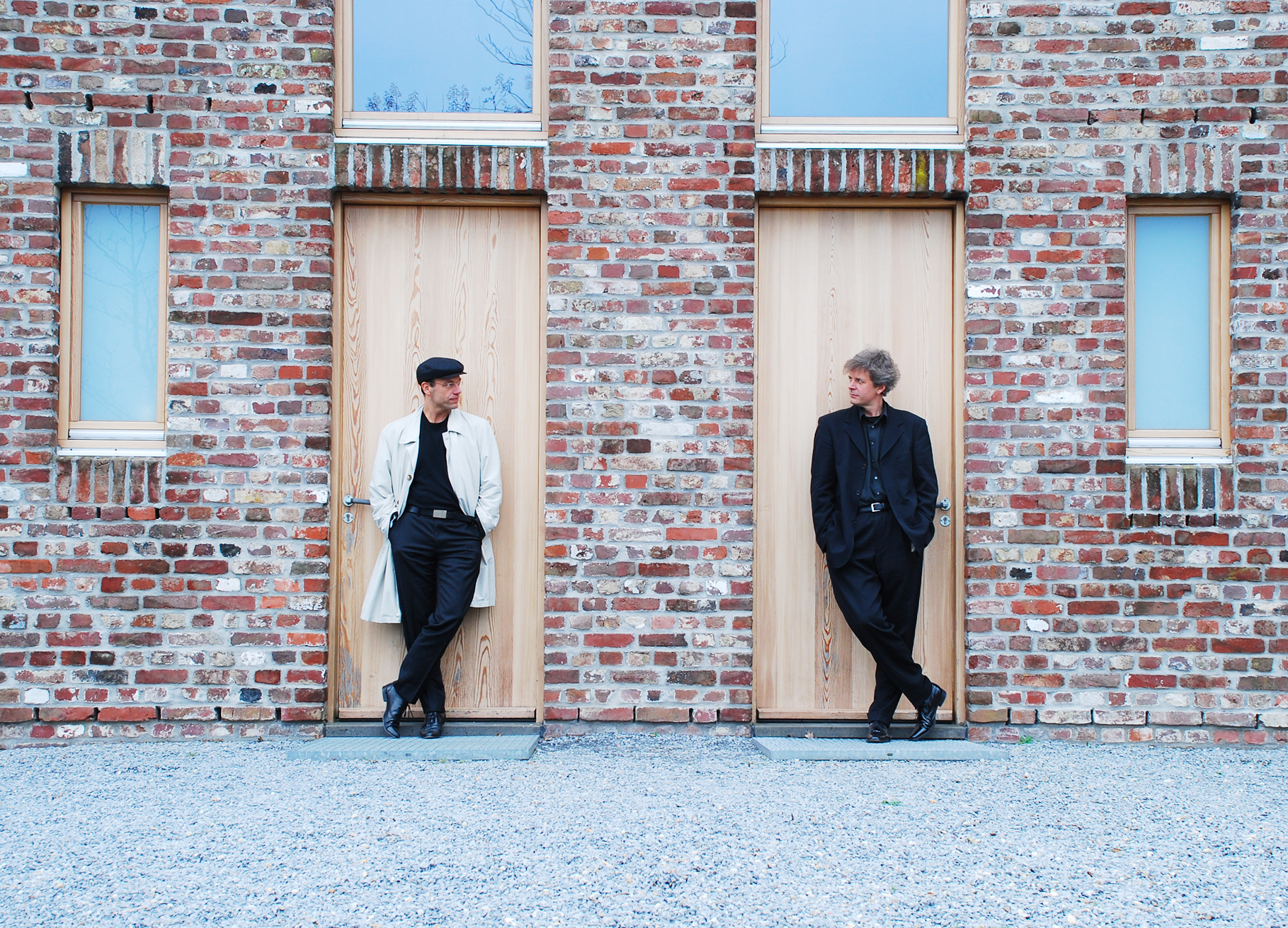
The GrauSchumacher Duo – comprising pianists Andreas Grau and Götz Schumacher – follows in a distinguished lineage of such partnerships (among them Alphons and Aloys Kontarsky, or Bracha Eden and Alexander Tamir), but at least in the UK is known primarily through its substantial discography (notably for the enterprising NEOS label) than for its live performances. All credit, then, to Wigmore Hall for scheduling this recital as part of its focus on contemporary music, and which featured the first British hearing for a major new work.

Now in his early sixties, Philippe Manoury is well established among his peers in Western Europe while enjoying occasional UK performances (his large-scale orchestral and choral piece Zeitlauf caused something of a stir in London three decades ago). Live electronics has been a constant presence in his music, and Le Temps, mode d’emploi is no exception. Lasting around 50 minutes, this falls into eight continuous sections in which the consciously-applied virtuosity of the pianists is underpinned by electronics in terms of spatial diffusion and textural stratification. At the same time, the music audibly evolves in terms of its salient motifs dispersed across the sound spectrum and that merge into an accumulation of activity exceeded only by the plethora of echoes heard towards the close. Cohesive, then, while also overly uniform in sonic profile (is it surprising that electronically treated piano timbre seems to have moved on only incrementally since Stockhausen’s Mantra half a century ago?), with the actual material rather less memorable than those processes to which it is being subjected.

What was undeniable was the alacrity with which GrauSchumacher tackled this epic among piano duos, or the clarity with which those from Experimental Studio of South-West German Radio projected the complex sound transformations throughout the fabled Wigmore acoustic.

Before the interval came a welcome hearing for Busoni’s Fantasia contrappuntistica – a half-hour fantasy on, around and about Bach that began as a completion of his 14th contrapunctus from The Art of Fugue in 1910, soon to assume its definitive guise before being arranged for two pianos in 1921. This account pointed up the interplay of stark declamation and limpid passagework characterizing the initial chorale-variations, the increasing textural intricacy of the initial three fugues, then the tensile unfolding of the intermezzo with its three variations – leading, via a terse cadenza, to a climactic fourth fugue which was slightly underwhelming here, but the performance quickly regained focus for a haunting recollection of the chorale followed by the stretta (a concluding passage played at a faster tempo) that steers this piece through to its brief though magisterial conclusion.

An impressive reading overall, that gained from its having been placed in context with three Bach transcriptions by György Kurtág. Anyone present at one of the latter’s intimate recitals of these pieces with his wife may have found GrauSchumacher a touch too literal in overall execution, yet the sonatina from Bach’s Actus tragicus and the two chorale-preludes which followed evinced no lack of poise or elegance. Easy to overlook given what was to come, perhaps, while at the same time being telling instances of the maxim that ‘less is more’.

The Oberon Symphony Orchestra play Beethoven and Shostakovich

oberon-so
Picture (c) Alexander Robinson

Richard Whitehouse on the young, thriving Oberon Symphony Orchestra‘s latest concert, pairing Beethoven with Shostakovich at their home of St James’s, Sussex Gardens, London on Saturday 26 September

Beethoven: Piano Concerto no.4 (1806)

Shostakovich: Symphony no.5 (1937)

Jean Paul Ekins (piano), Oberon Symphony Orchestra / Samuel Draper

This evening’s concert given by the Oberon Symphony, the orchestra’s tenth such event since its inception, brought together a concerto which is poised expressively between Classical and Romantic eras, then a symphony bridging the divide between personal and public expression.

For all its popularity, Beethoven’s Piano Concerto no.4 remains a tough challenge in terms of its emotional understatement and often elusive interplay of soloist and orchestra. There was no denying Jean Paul Ekins’ technical adroitness, his crystalline tone and limpid passage work being rarely in doubt, but equally a lack of expressive variety and a degree of preciousness in terms of phrasing that gave the opening movement – steady if by no means stolid in its underlying tempo – a uniform and even unyielding profile; the highlight being a cadenza that dovetailed ideally into the surging coda. Not so a rather prosaic transition from slow movement into finale, yet the dialogue of the former was (rightly) one of stark contrast and the latter exuded ample impetus through to its rather awkwardly negotiated final chords.

Throughout this reading, Samuel Draper proved an astute and attentive accompanist – before he and the orchestra came into their own with Shostakovich’s Symphony no.5. Still the most often heard of what is now among the most familiar of symphonic cycles, its performance has grown more difficult over time given those extra-musical ‘interpretations’ to have been foisted on its musical content. Having steered an involving course between its yearning and plaintive main themes, Draper infused the first movement’s development with a purposeful momentum so that the climactic reprise unfolded as an arc of decreasing intensity towards a coda of aching suspense. Trenchant in forward motion, the scherzo was dispatched with a keen irony and, in its trio, appealingly deadpan playing from leader Richard Gratwick.

A degree of thinness in string tone was by no means to the disadvantage of a slow movement which eschewed widescreen emotional expression for intense inwardness, not least with the chorale-like transformation of its initial theme in a central passage of real eloquence. Nor was the ensuing climax found wanting, as Draper secured a searing clarity across the strings prior to a wistfully resigned close. Even finer was the finale: the hardest movement to bring off, its tempo changes worked ably in terms of a cumulative overall structure – making nonsense of any claim it lacks formal focus; with a palpable emergence from the restless searching at its centre towards an apotheosis which evinced the fraught inevitability that was surely intended. The closing bars then drove home the work’s defiantly individual stance with bracing resolve.

A gripping account of a piece which should never be taken for granted, not least in its knife-edge ambivalence, and that found the Oberon SO at its most committed. Draper had begun by noting the 75th anniversary on this day of the suicide of philosopher Walter Benjamin – the victim of a political and cultural intolerance that has by no means abated, and to whose memory this performance was dedicated. Such a procedure can risk indulgence, though here the sincerity of his remarks was more than matched by the conviction of the music-making.

The next Oberon concert takes place on 5th December 2015, where the orchestra will play Tchaikovsky’s Pathetique Symphony. Here they are in the composer’s Fifth:

Further information can be found at the orchestra’s website

Wigmore Mondays – Sol Gabetta and Polina Leschenko play Rachmaninov

sol-gabetta

Sol Gabetta (cello), Polina Leschenko (piano) – Wigmore Hall, London, live on BBC Radio 3, 12 October 2015

Listening link (open in a new window):

http://www.bbc.co.uk/programmes/b06gqgpr

on the iPlayer until 11 November

Spotify

In case you cannot hear the broadcast, here is a Spotify playlist of the music in this concert, from available versions on Spotify. Sol Gabetta has recorded all of these pieces, with the pianists Bertrand Chamayou (Chopin) and Olga Kern (Rachmaninov), and, in the case of the Tchaikovsky, in an orchestral version with the Prague Philharmonic Orchestra conducted by Charles Olivieri-Monroe.

What’s the music?

Chopin: Introduction and Polonaise brillante, Op.3 (1829) (8 minutes)

Tchaikovsky: Lensky’s Aria (1879) (6 minutes)

Rachmaninov: Cello Sonata, Op.19 (1901) (34 minutes)

What about the music?

There is something about music for cello and piano from Eastern Europe that communicates directly with lovers of classical music, and in particular smaller scale chamber music. This may be because the cello’s range is like that of a vocalist, which becomes very clear in the arrangement of Lensky’s Aria that Sol Gabetta and Polina Leschenko play here. The cello has a way of portraying the solemn contemplation that Lensky goes through before his duel and inevitable death at the hands of Eugene Onegin.

On a far more cheerful note are the works by Chopin and Rachmaninov. Chopin wrote very little music where the piano was not the starring instrument, and even in this Introduction and Polonaise brillante the piano part is challenging to say the least! Chopin did love writing for the cello though, and showed in this late student piece how his melodic style became very well suited to the instrument. Later in his life he completed a substantial sonata for cello and piano.

The Rachmaninov Sonata is one of the big Romantic works for cello and piano, with a piano part whose difficulty is comparable to that of the piano concertos – and interestingly the composer had only just completed his famous Second Piano Concerto when he got to work on this piece. It is full of big tunes and bold musical statements but has a tender heart too, which we get to see in the third movement Andante. The finale is one of sheer jubilation, the composer moving from the earlier, stormy music of the minor key to bask in the full sunshine of the major key – with a good melody never far from the cello throughout.

Performance verdict

This was a technically spectacular concert from two performers clearly at the top of their game, and thoroughly enjoying their music making.

The Chopin was a delight, all the youthful vigour captured in Polina Leschenko’s grand introduction, with its impressive pyrotechnics in the right hand. Meanwhile Gabetta’s tone was particularly beautiful, an aspect common to the pair’s performance of Lensky’s Aria, the arrangement – apparently completed by cellist Werner Thomas-Mifune – making a seamless transition to the instrument.

The Rachmaninov Sonata was a tour de force, the piano if anything dominating a performance rich in romantic feeling but also keen to impose itself through challenging and fast speeds. This did on occasion become too much and some of the phrases were constricted, especially in the second movement Scherzo, which hurried forward as though late for an urgent appointment, and some of the detail was lost – a shame, as despite its big statements, this piece does have some lovely detail.

The slow movement Andante was lovely, Gabetta’s tone and phrasing ideal, her knack of holding back on some of the phrases just right. The finale resembled pealing bells at times, its sheer exuberance proving irresistible, and here the performance had what felt like exactly the right tempo, pausing for breath half way through.

Even allowing for those slight gripes though, this was an extremely impressive, high voltage performance from two musicians clearly enjoying their craft.

What should I listen out for?

Chopin

1:35 – a grand introduction from the piano, showing off the youthful composer’s impetuosity. The cello, however, is perhaps closer to his heart with a songful and broadly phrased melody above.

4:12 – the Polonaise itself begins, with a distinctive rhythm that speeds up as the three beats in the bar go on (from 1 crotchet to 2 quavers to 4 semi-quavers, for the musos amongst us!). It takes the profile of a florid march, and is passionate and extrovert. The piano leads the rhythm, with power and a little charm, while the cello provides the songful melody. The end, when it comes, is vigorous and like a drink fizzing over.

Tchaikovsky

11:27 – a solemn mood is immediately evident from the pensive piano introduction, with Lensky awaiting his duel with Onegin. The cello picks up on this, reproducing the tenor line with a feeling of imminent dread, especially when the end approaches at 16:58.

Rachmaninov

17:56 – the sonata begins with a tentative slow introduction (marked Lento), as though testing the water, but feels on much firmer ground when the faster Allegro moderato begins at 18:55.

19:58 – the second theme of the first movement, first heard on the piano. This is classic Rachmaninov, combining Romantic thoughts with a melancholic undertone. Then from 21:23 the pair repeat the faster section before an intense development of the main material, the cello now playing lower in its register and the piano taking a hard hitting approach

26:53 – the piano now brings out the second theme in the ‘home’ key, where it retains its original melancholic quality, before the music gathers itself for a final big statement, finishing at 29:21.

29:34 – the Scherzo second movement begins at quite a fearsome tempo, led by the piano. Here the emphasis is much more rhythmic, though there is a distinctive six-note figure that dominates the movement. At 30:16 we hear a second theme, more songlike in nature.

31:29 – the contrasting ‘Trio’ section of the second movement, much smoother in nature. Then at 33:19 the stormy clouds of the Scherzo approach once again, with even greater force this time. The end, at 35:34, is beautifully done – quiet but atmospheric.

35:46 – the slow movement begins, marked Andante (at a walking pace). The piano introduces the tune, which is once again a deeply felt melody of contemplation. The cello takes it up at 36:34, and the theme proceeds to dominate the whole movement.

41:30 – the fourth and final movement bursts out the blocks. The key has switched from G minor, the sonata’s overall key, to G major – and the mood is completely contrary to the previous movement, full of jubilation. The music gets particularly stormy around 44:30, with cello and piano making particularly passionate statements.

A slower, quieter episode gives brief pause for reflection before a restatement of the last movement’s main theme at 46:59. At 49:44 the slower music returns, beautifully shaded by the performers, before the helter-skelter closing pages wrap up the piece from 50:52.

Encore

53:33 – the fourth and last movement of Shostakovich’s Cello Sonata. The composer’s spiky approach to this music is stressed in an interpretation that almost spills over into violence at times!

Further listening

The combination of cello and piano was one that 19th century composers loved to use – fuelled no doubt by Beethoven’s success in bringing the instruments forward as equal partners.

One of the most successful composers writing for cello and piano was Brahms – so here is a link to the powerhouse combination of Mstislav Rostropovich and Rudolf Serkin playing his two sonatas for the combination, both of which are known as repertoire staples:

Perhaps less well known but equally glorious are the two cello sonatas by Mendelssohn, also rich in melody and deep feeling. Here they are played by Jan Vögler and Louis Lortie:

Finally Chopin went on to write a Sonata for cello and piano, one that is perhaps best heard in a recording by Johannes Moser and Ewa Kupiec. The companion piece on the disc is the Piano Trio: