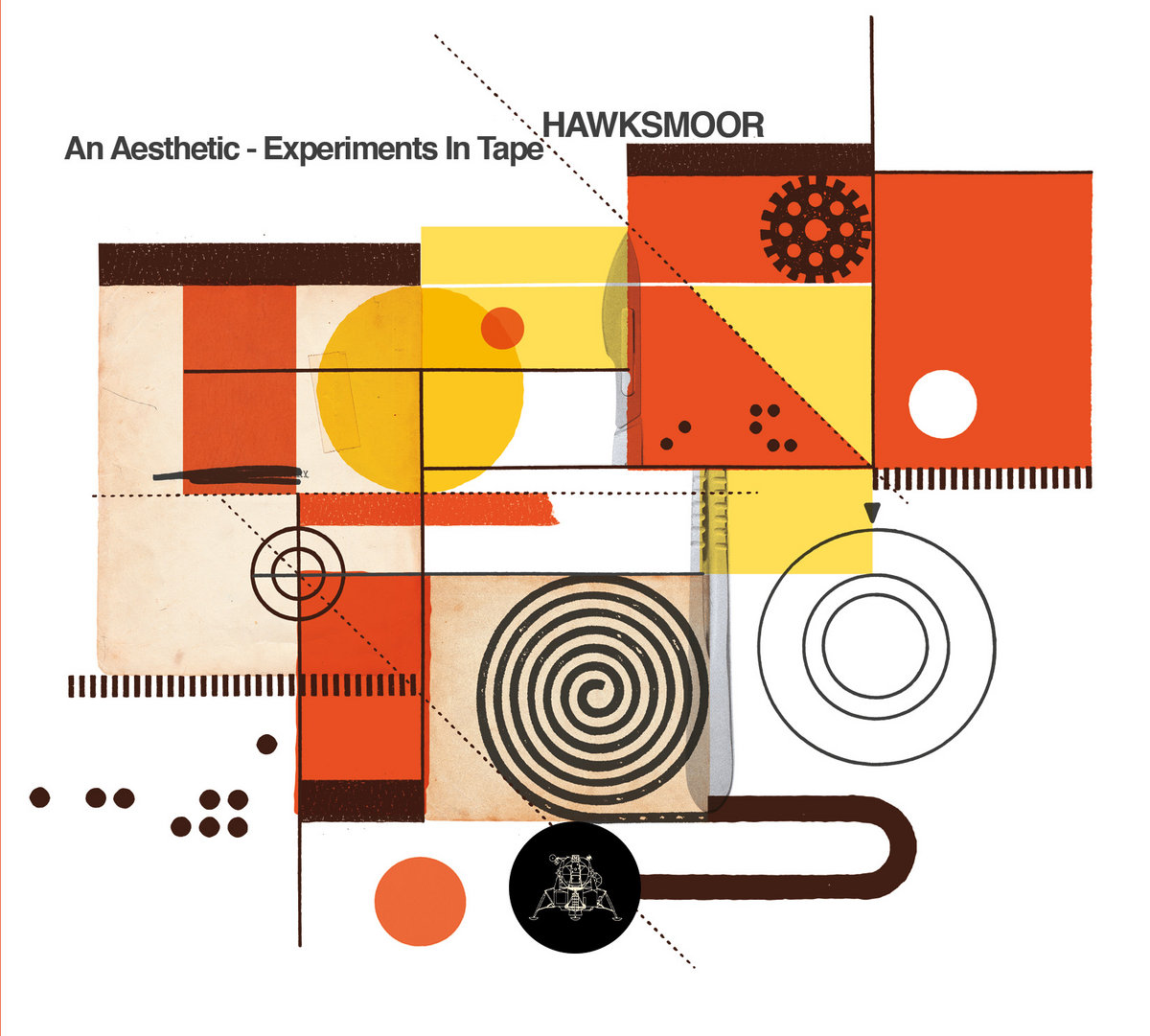
To quote the Bandcamp guide for this release, “James McKeown is a Bristol-based musician known for his innovative approach to music production and sound design. With a passion for combining modular synths with layers of live bass, guitars and experimental techniques, McKeown has carved out a niche in the electronic music scene, captivating audiences with his unique sonic explorations.”
An Aesthetic is a series of ten pieces taking the concept of hauntology further than before, and “into a liminal space of sonic saturation”. This is done through layering the wow, flutter and warble of tape artefacts, creating a unique sonic landscape.
This, then, is music for blank tape – but in a thoroughly intriguing compositional process, released on Lunar Module, the new Castles in Space CD imprint.
What’s the music like?
As the above implies, otherworldly and haunting. This is music to accompany a film where all is not quite as it seems, and where images suddenly rear up in front of the camera. That at least is what is threatened by Aesthetic II, whose bright tones are compromised by a claustrophobic atmosphere.
Aesthetic III is both oppressive and weirdly comforting, a wall of sound that feels like a massive duvet round the ears by the end, while Aesthetic VII is more ominous still. Aesthetic V crackles but settles into one of the most ambient tracks of the ten. Aesthetic VIII is the longest of all, the D-120 of the selection (for TDK fans!), and a wobbly but winsome track, with a rather beautiful chord progression that recurs at regular intervals. Aesthetic IX has the broadest melody, almost a spiritual in its plaintive quality, while the concluding Aesthetic X is a satisfying exploration of the bass range.
Does it all work?
It does – the ten pieces form a kind of suite that can be easily experienced in one sitting, and the lack of digital correction is appealing.
Is it recommended?
It is. An Aesthetic is a fascinating set of collages and inventive sound pieces that fit well together, creating an atmospheric whole. Not for all moods, that is for sure, but a consistently rewarding listen.
For fans of… Flying Saucer Attack, Pram, Bvdub, My Bloody Valentine
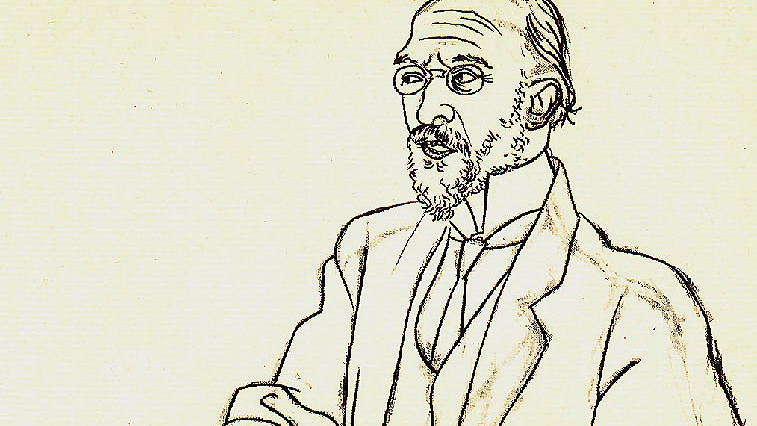
by Ben Hogwood Picture: Erik Satie, by Pablo Picasso
Today marks the death of one of the most innovative 20th century composers, Erik Satie.
Satie was well ahead of his time…to the extent that even now, one hundred years on, some of his music gives the appearance of being fresh off the page. And indeed, there is some ‘new’ music to enjoy from his pen, as pianist Alexandre Tharaud has recently collated an album of Satie Discoveries, to be reviewed shortly on this site.
Satie’s music has proved incredibly versatile, and his most popular pieces are heard every day – not just on classical music radio, but as part of relaxing playlists and TV soundtracks. It is certainly fair to say that if you enjoy the music of Einaudi, Nils Frahm, Olafur Arnalds and the like, each of them would credit Satie as a lasting influence.
Here are some of his best-known pieces, with the Gymnopédies and Gnossiennes for piano proving some of his most minimal yet most memorable compositions. To counter those, it helps to have something of the more modern Satie – the Three Pieces in the Shape of a Pear, and two orchestral ballets – Relâche and Parade. Listen carefully to the latter and you will hear a tune that sounds remarkably like the theme to Postman Pat! You can access the playlist on Tidal here:
Music by Ludwig van Beethoven Libretto by Joseph Sonnleithner and Georg Friedrich Treitschke, after Jean-Nicolas Bouilly Sung in German with English surtitles
Leonore, disguised as Fidelio – Sally Matthews (soprano), Florestan, her imprisoned husband – Robert Murray (tenor), Don Pizzarro, prison governor – Musa Ngqungwana (bass-baritone), Rocco, gaoler – Jonathan Lemalu (bass-baritone), Marzelline, his daughter – Isabelle Peters (soprano), Jacquino, prison warder – Oliver Johnston (tenor), Don Fernando, king’s minister – Richard Burkhard (baritone), First Prisoner – Alfred Mitchell (tenor), Second Prisoner – Wonsick Oh (bass)
John Cox (original director), Jamie Manton (revival director), Gary McCann (designer), Ben Pickersgill (lighting)
Garsington Opera Chorus, The English Concert / Douglas Boyd
Garsington Opera, Wormsley Friday 27 June 2025
review by Richard Whitehouse Photos by (c) Julian Guidera
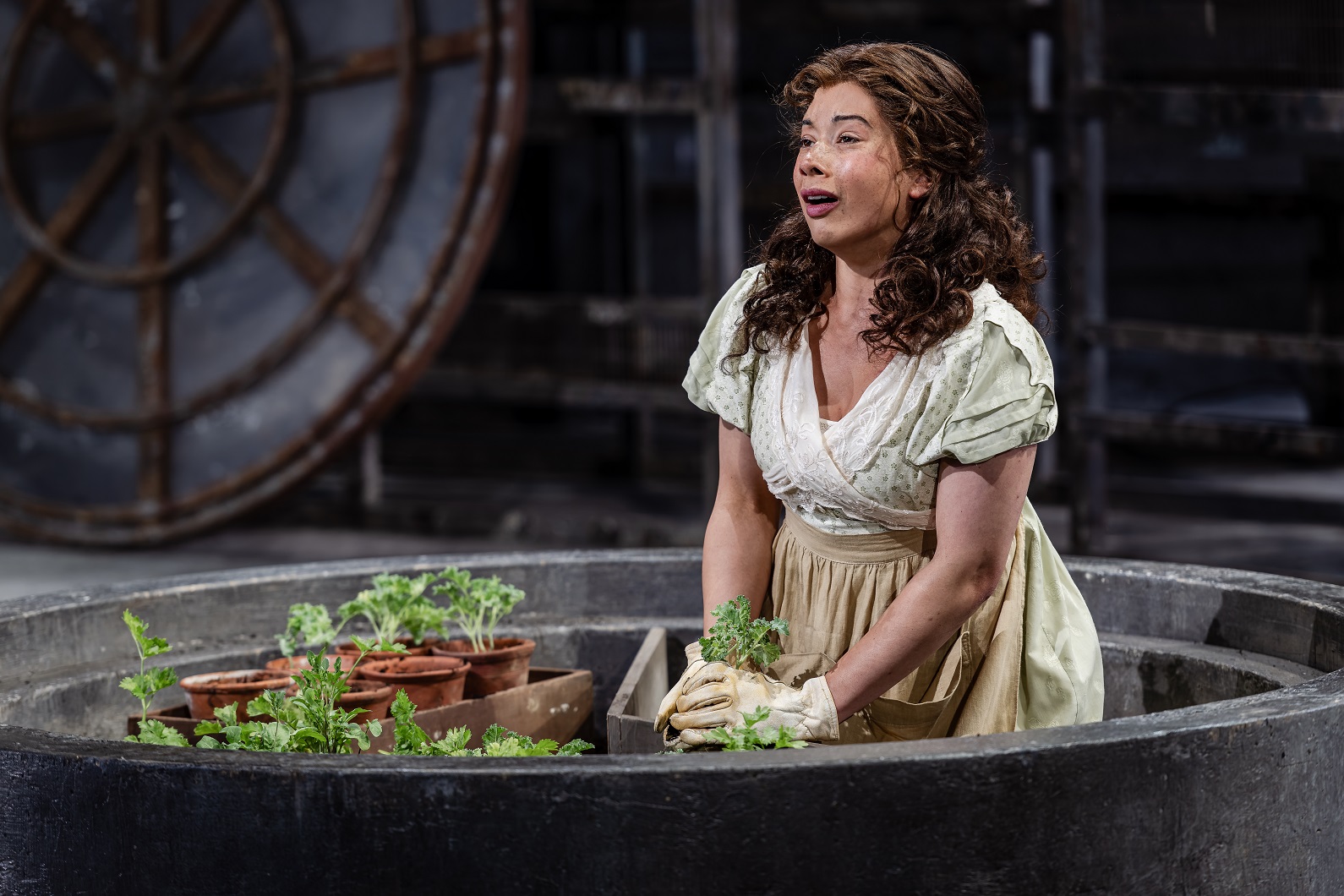
Few operas have been subject to matters of time and place as has Fidelio. Beethoven’s sole opera, by his own admission, caused him the greatest difficulty among all his works to ‘get right’ and, even today, it can all too easily emerge as a compromise between what had been intended and what (conceptually at least) was feasible. All credit, then, to Garsington Opera for this revival which not only avoided the likely pitfalls first time around but has improved with age – in short, a production that amply conveys the essence of this flawed masterpiece.
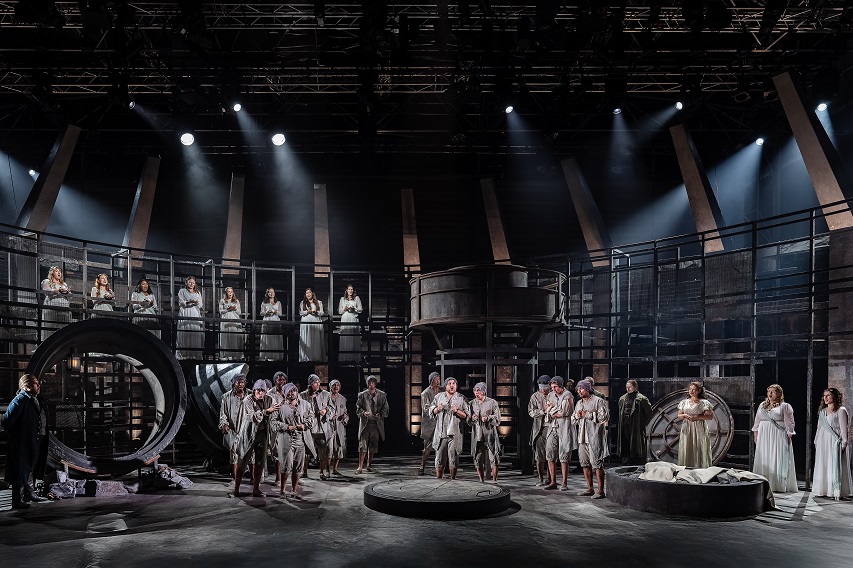
That original staging had been directed by John Cox, whose productions are rarely less than durable and with such as his 1973 Capriccio or his 1975 The Rake’s Progress being close to definitive. For this second revival, Jamie Manton has streamlined the basic concept such that everything which takes place can be envisaged from the outset and hence ensures consistency across the production as a whole. He is abetted by Gary McCann’s designs, their monochrome stylings imparting a grim uniformity which could not be more fitting given that this drama is played out around and inside a prison. In particular, the hole front-of-stage from out of which the prisoners emerge and into which Florestan is to be committed is a device made elemental merely by its presence, while the final scene avoids the agitprop from an earlier era in favour of a straightforward tying-up of narrative loose-ends the more affecting for its understatement. Effective without being intrusive, Ben Pickersgill’s lighting enhances the changing moods of an opera which takes in domestic comedy and visceral drama prior to its heroic denouement.
Vocally the opening night was a little uneven without there any real disappointments. If Sally Matthews initially sounded a little inhibited in the title-role, this most probably reflected its ambivalent nature rather than any lack of expressive focus; certainly, her commitment in the ‘Abscheulicher…Komm Hoffnung’ aria such as defines her emotional persona was absolute, as was her seizing hold of that climactic quartet to which the entire drama has been heading. Sounding as well as looking his part, Robert Murray avoided the rhetorical overkill that too often mars portrayals of Florestan – his mingled vulnerability and fatalism maintained right through to the duet ‘O namenlose Freude’ whose eliding of elation and doubt intensified its emotive force whatever its actual length, though without pre-empting what is still to come.
As Don Pizarro, Musa Ngqungwana was imposing in presence and thoughtful in approach – his lack of histrionics preferable in a role which too often descends into caricature. That said, he was upstaged in their duet ‘Jetzt, Alter, jetzt hat es Eile!’ by Jonathan Lemalu who was in his element as Rocco; materialist aspiration outweighed by the humanity invested into a role where comedy rapidly gives way to pathos. Marzelline and Jaquino may have but little to do after the first scene, but Isabelle Peters was eloquence itself in her aria ‘O war ich schon mit dir vereint’ while Oliver Johnston veered engagingly between eagerness and consternation. Richard Burkhard made for an authoritative if never portentous Don Fernando, while Alfred Mitchell and Wonsick Oh afforded touching cameos during a memorable ‘Prisoners’ chorus’.
Nor was the Garsington Opera Chorus to be found wanting as a whole in its contribution to the finales of each act – the first as moving in its pallor, infused with radiance, as the second was in the unfettered joyousness which offset any risk of that final scene becoming merely a celebratory tableau. The English Concert sounded rarely less then characterful, even though humid conditions likely explained some occasionally approximate intonation – happily not in Rachel Chaplin’s scintillating oboe obligato which shadows Florestan’s aria ‘In des Lebens Frühlingstagen’ as if an extension of his character. Douglas Boyd directed with assurance an opera with which he has long been familiar, his tempos unexceptionally right and always at the service of the opera. The author Michael Oliver was surely correct in his observation that the Leonore original is superior in theatrical terms to the Fidelio revision, yet this latter was nothing if not cohesive through Boyd’s astute dovetailing of individual numbers, as between speech and music, so that any seeming discontinuities were made more apparent than real.
Some 211 years after the successful launch of its final version and Fidelio remains an opera acutely sensitive to political context and polemical intent. Beethoven himself was, of course, partly responsible for this but subsequent generations have sought, often recklessly, to foist their own preoccupations onto his music so as to distort or even negate its essence. There was no risk of that happening here thanks to the balanced objectivity of this production but also to its conviction that the composer’s guiding vision is, and always will be, its own justification.
Fidelio runs until 22 July 2025 – and for further information and performances, visit the Garsington Opera website
Weinberg String Quartet no.16 in A flat minor Op.130 (1981) Weinberg String Quartet no.17 Op.146 (1986( Shostakovich String Quartet no.15 in E flat minor Op.144
Wigmore Hall, London Friday 27 June 2025
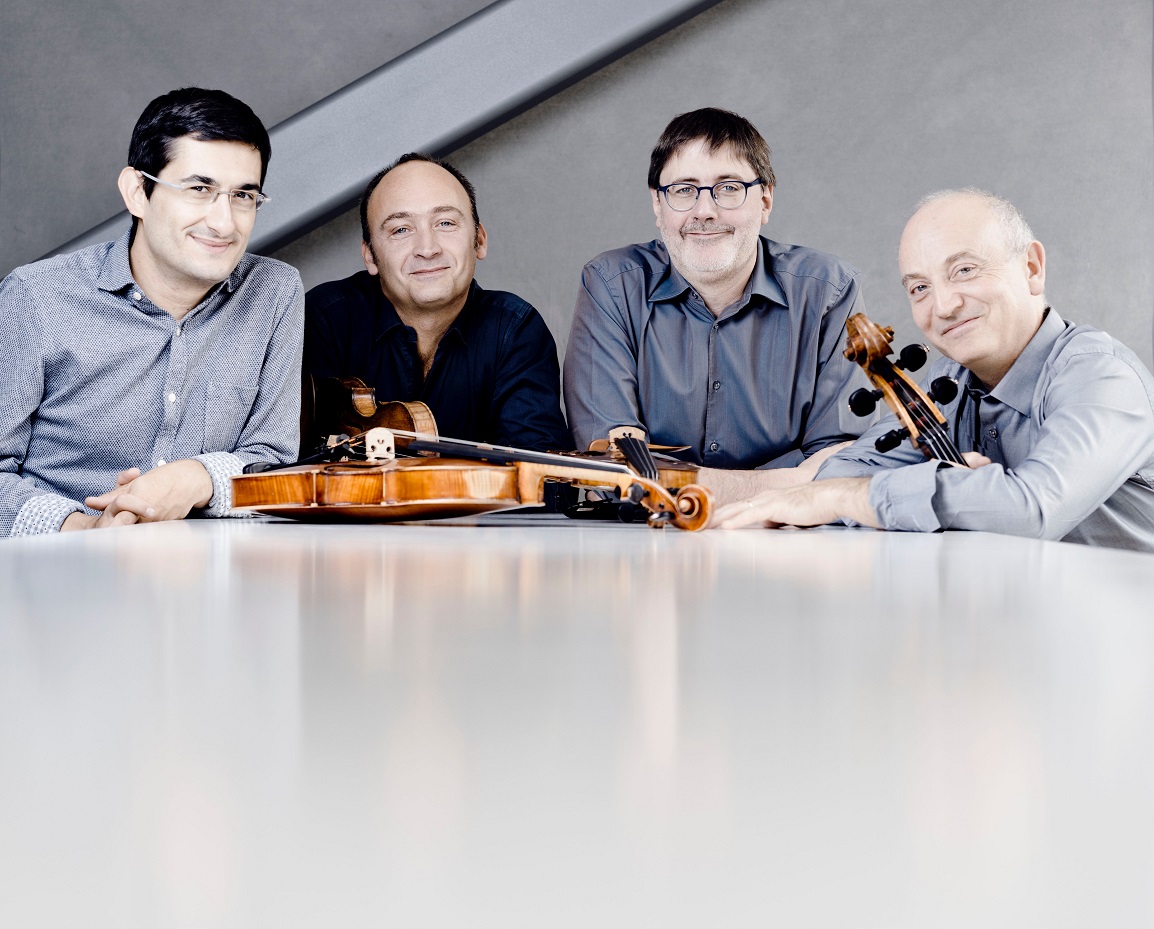
by Ben Hogwood Photo (c) Marco Borggreve
After giving fresh insight and context to the 32 string quartets and two piano quintets of Shostakovich and Weinberg, Quatuor Danel finally brought their Wigmore Hall cycle of both composers to a close. The journey began just before the COVID pandemic but was necessarily aborted. However on the series resumption in 2023 Wigmore Hall artistic and executive director John Gilhooly generously suggested the quartet begin the concerts afresh, a gesture acknowledged by Quatuor Danel first violinist Marc Danel before the group’s encore.
Danel admitted it had been difficult deciding which work should close the combined cycle, yet this concert proved the group had made the right decision, closing with some of Shostakovich’s final musical thoughts. Before that we heard the two very contrasting last quartets by Weinberg. His String Quartet no.16 was completed in 1981, the year in which his sister would have reached her sixtieth birthday had she not been murdered, along with the composer’s parents, in the Holocaust. Bearing her dedication, the quartet is a work of conflicting emotions, with an underlying tension trumped by a strong and lasting resolve.
Stylistically, Weinberg’s writing reflects his reacquaintance with the music of Bartók. This was evident from the heavy-set bow strokes of the first movement, where Danel led with power and precision. Weinberg allows time for calmer thoughts, but there was a guarded watchfulness that the Quatuor Danel conveyed most vividly here. The contrast between Scherzo and Trio in the second movement was striking, the emphatic gestures of the former upturned by the ghostly outlines of the otherworldly trio, which hinted at an alarm going off in the distance. The climax of the Lento felt like the culmination of a unified protest from all four instruments, its dissonant cries living long in the memory, before the waltz of the finale. Cold to the touch, the four instruments were muted but not silenced, and a period of moving stillness in the music held the attention before the waltz returned for the thoughtful closing bars.
With the String Quartet no.17, completed five years later, the mood changed completely. With a more explicit tonal language, this piece started in high spirits, Weinberg relishing the opportunity to revisit and quote from his earlier works, doing so in the spirit of pure musical enjoyment. A rustic first theme was brilliantly played here, as was the richly voiced chorale proving such an effective counterpart. This single movement work falls into four distinct sections, and eloquent solos from Danel and cellist Yovan Markovitch were memorable, before the feathery textures that began the finale, after which the chorale theme returning in an even brighter light. The positive disposition of the quartet gave it a youthful appearance beyond the references to early works, the composer enjoying childhood recollections through the viewpoint of relative seniority. The Danel ensured we were aligned in that viewpoint, too.
Shostakovich’s String Quartet no.15, however, is indisputably the work of a man in the twilight of his life. Written in six slow movements, it is one of the most distinctive utterances in the repertoire both of Shostakovich and the string quartet, and no performance should leave its audience unmoved. In the course of 40 minutes, Shostakovich leaves us with music that in terms of speed never really gets out of first gear, but whose intensity is unrelenting from its very first bars.
The Danel found that intensity with unerring accuracy, right from the first drawn-out melodies. Musically we seemed to have travelled back several centuries, the work unfolding with almost painful slowness, Shostakovich’s frailty made clear through music. And yet there is a spiritual quality looking ahead to the music of Arvo Pärt and Silvestrov, a kind of minimalism conveyed in searching, long-phrased melodies.
The Quatuor Danel were sparing in their use of vibrato, which made for an even more effective expressive tool when used, while their intonation was commendably flawless in such a difficult key for strings. In the second movement, ironically titled Serenade, the music felt inverted, its distinctive outcries made through crescendos reaching for the very soul. Marc Danel gave a searing solo at the beginning of the central Intermezzo, after which he sat, head bowed, listening to his three colleagues, while the viola solo from Vlad Bogdanas for the Funeral March was similarly charged. The Epilogue returned to the remarkable stillness present for much of this work, after which there was an equally moving silence.
It would be difficult to suggest an encore for music with such finality, but the quartet found an answer – in the shape of the first movement of Shostakovich’s String Quartet no.1. This might be thought an odd choice, but, as Danel explained, its music was a timely reminder for the world in which we live that the sun would come back. Hearing Shostakovich’s first and last statements for quartet in such proximity, it was hard not to agree with him – and so – with huge credit to the players for some memorable performances – this wonderful cycle concluded in the best possible way.
You can hear the music from the concert below, in recordings made by Quatuor Danel -including their most recent cycle of the Shostakovich quartets on Accentus:
Ruby Hughes (soprano), Natalie Clein (cello), Julius Drake (piano)
Schubert arr. Jones Der Hirt auf dem Felsen (The Shepherd on the Rock) D965 (1828) Kodály Sonatina for cello & piano (1922) Tavener Akhmatova Songs: Dante, Boris Pasternak, Dvustishie (Couplet) (1993) Brahms 2 Songs Op.91 (1884) Trad arr. Britten I wonder as I wander (1940-41), At the mid hour of night (Molly, my dear), How sweet the answer (The Wren) (both 1957) Deborah Pritchard Storm Song (2017) Janáček Pohádka (Fairy tale) (1910, revised 1923) Ravel Kaddisch from 2 Mélodies hébraïques (1914) Bloch From Jewish Life (1924) Schubert Auf dem Strom (On the river) D943 (1828) (Encore) Berlioz La Captive
Queen Elizabeth Hall, London, 27 June 2025
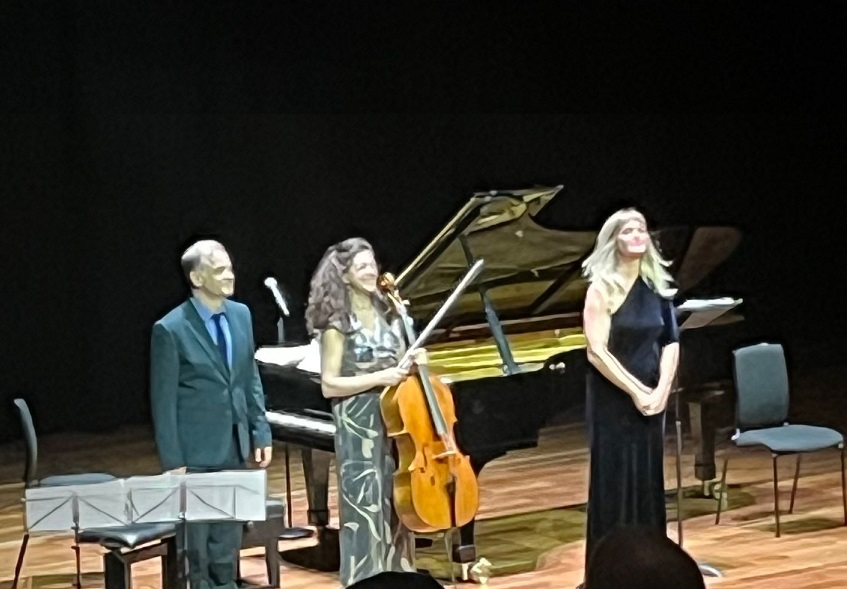
by John Earls. Photo credits (c) Philip Sharp (above), John Earls (below)
Two of the most affecting sections of Ruby Hughes’ excellent 2024 album with the Manchester Collective End of My Days are three of John Tavener’s Akhmatova Songs (Dante, Boris Pasternak and Couplet) and Maurice Ravel’s Kaddish (from 2 Mélodies hébraïques).
These also featured to dramatic effect in this fascinating concert programme of Schubert and Other Folksongs spanning two centuries, where Hughes was joined by Natalie Clein (cello) and Julius Drake (piano).
In this performance the Tavener song miniatures were performed for voice and cello and were at turns powerful, beautiful and urgent across their nine-minute duration. The prolonged silence from the audience afterwards was noticeable. Ravel’s lament-like Kaddish, this time for voice and (sparse) piano, was similarly respectfully performed and observed.
There were non-vocal pieces for cello and piano where Clein and Drake displayed what a well matched duo they are. Zoltán Kodály’s Sonatina was luminescent, Leoš Janáček’s Pohádka absorbing (not least the cello bowing and pizzicato) and Ernest Bloch’s From Jewish Life was both lovely and mournful.
But this was a concert where Ruby Hughes’ amazing voice was to the fore but often in an understated, but no less impactful way. The captivating trio of Benjamin Britten folksong arrangements with their minimal piano trills were a case in point.
The trio performances were also impressive in their delivery and range. Brahms’ 2 Songs (Op.91) were both gorgeous, while Deborah Pritchard’s Storm Song (from 2017, the most recently written piece) was powerfully unnerving between its haunting start and end (the composer was in the audience to take a well deserved bow).
The concert was bookended by two songs written by Franz Schubert shortly before his death in 1828 at the age of just 31. As David Kettle remarks in his excellent programme notes, to call them simply songs is to do them a disservice. Der Hirt auf dem Felsen (The Shepherd on the rock), arranged by Peter Jones for voice, cello (replacing the clarinet) and piano, traversed a journey of yearning and joy that was both delicate and impassioned. The closing Auf dem Strom (On the river) saw Hughes capturing the drama convincingly throughout.
An encore of Berlioz’s La Captive concluded this concert that combined fascinating and thoughtful programming with performances of beautifully judged expression.




 Arcana.fm