On Record – Robert Simpson: Chamber Music, Volume One (Toccata Classics)

bEva-Maria Hartmann (soprano); cEmma Johnson, dPeter Cigleris (clarinets); dDerek Hannigan (bass clarinet); cRaphael Wallfisch (cello); dWill Duerden, dLevi Andreassen, dDaniil Margulis (double basses); cJohn Lenehan, bCornelis Witthoefft (pianos); aTippett Quartet (John Mills, Jeremy Isaac, violins; Lydia Lowndes-Northcott, viola; Božidar Vukotić, cello)

Robert Simpson
String Quartet in D major (1945)a
Songs – Trocknet nicht!b; The Cherry Tree (both c1942)b
Clarinet Trio (1967)c
Quintet for Clarinet, Bass Clarinet and Three Double Basses (1981)d

Toccata Classics TOCC0701 [70’59’’]
English/German texts & English translation included
Producer / Engineer Michael Ponder

Recorded c3 June 2021 & d20 November 2023 at St George’s, Pinner View, London; a7 February 2023 at Studio TQHQ, Ruislip; b12 August 2024 at Lehmann Studios, Stuttgart

Released in January 2025

Reviewed by Richard Whitehouse

What’s the story?

Toccata Classics issues the first of two releases intended to ‘plug the gaps’ in the survey of Robert Simpson’s chamber music recorded by Hyperion in the 1980s and 1990s, featuring mainly younger musicians who demonstrate keen understanding of this composer’s idiom.

What’s the music like?

Although hardly a cohesive collection as such, this album provides an alternative overview across the greater part of Simpson’s output. Nothing here could be considered inessential, while one of these pieces most likely ranks among his finest compositions from any period.

Composed (and duly accepted) as an examination exercise for Simpson’s Batchelor degree at Durham, the String Quartet in D thereafter remained unpublished and unheard until this recording. At just over 20 minutes, the modest dimensions belie its formal deftness and its expressive subtlety – a trenchant initial Allegro followed by an Adagio where Haydnesque wit makes way for Beethovenian profundity, an ingratiating Allegretto closer to intermezzo than scherzo then a final Presto of an exhilaration effortlessly sustained through to its close.

Simpson was always uneasy with the setting of texts (his two published choral works solve this issue in different though equally ingenious way), but these early settings of Goethe and Housman suggest a distinctive and, moreover, convincing approach which could well have become more so had he persevered. Interestingly, both have an almost confessional quality that the composer, still in his early twenties, might have felt better conveyed in instrumental terms. Something that can never be known for sure, but the attraction of these songs remains.

The late 1960s found Simpson writing two major chamber works with clarinet. The Clarinet Quintet has long been regarded among his finest works, but the slightly earlier Clarinet Trio has seldom been heard and is something of a revelation. From its spellbinding introduction, the initial Allegro makes a virtue of abrupt contrast between impulsiveness and remoteness, with the slow movement a fugitive if searching interlude making the final Allegro the more unequivocal as this builds to a powerful apotheosis offset by the otherness of its closing bars.

Simpson afficionados will be familiar with the Quintet for Clarinet, Bass Clarinet and String Trio (Hyperion CDA66626), though maybe not the original incarnation with its three double basses. In fact the musical content sounds, for the most part, better suited to those arresting sonorities – not least the ethereal chorale-like texture of an opening Adagio which, after the mounting energy of a central Allegro, is infused with appreciably greater eloquence on its return and sees the whole work to an ending the more inevitable for its deep-seated repose.

Does it all work?

Pretty much throughout. The present accounts lack little in overall conviction, nor does the sound lack anything in clarity or perspective, while the annotations by Matthew Taylor are as informative as might be expected from one for whom Simpson was a significant mentor.

Is it recommended?

Yes, with the follow-up (Sonata for Two Pianos and Brass Quintet) duly awaited. Incidentally, Taylor recorded the Flute Concerto (with Susan Milan) and Variations and Fugue on a Theme of Bach for the Simpson centenary in 2021 but which is yet to be released. Maybe this year?

Listen / Buy

You can hear excerpts from the album and explore purchase options at the Toccata Classics website

Published post no.2,768 – Thursday 15 January 2026

In Concert – BBC Symphony Orchestra / Martyn Brabbins @ Maida Vale Studios: Liadov & Tchaikovsky

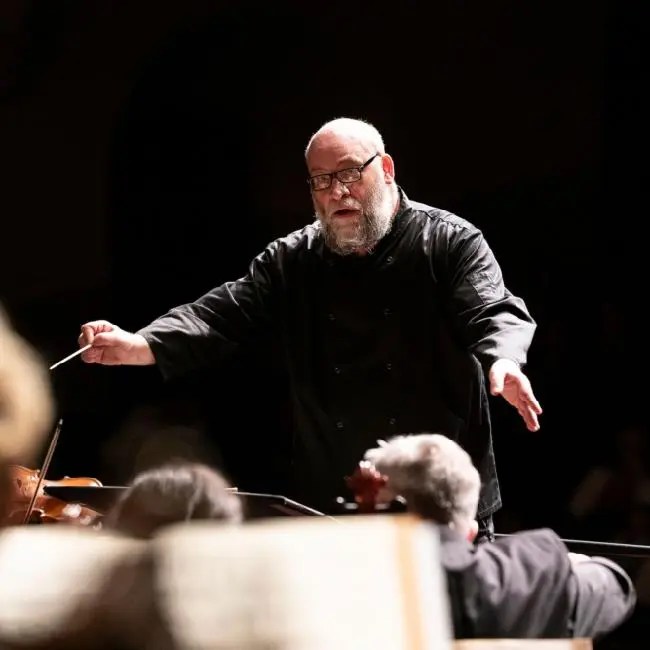
BBC Symphony Orchestra / Martyn Brabbins (above)

Liadov Ballade: About Olden Times Op.21b (1889)
Tchaikovsky Symphony no.1 in G minor Op.13 ‘Winter Daydreams’ (1866)

Studio 1, BBC Maida Vale Studios, London
Tuesday 13 January 2026 (2:30pm)

Reviewed by Ben Hogwood

The BBC Symphony Orchestra and Martyn Brabbins provided the ideal antidote for a dark and wet January afternoon with this winsome hour of music at the BBC Studios in Maida Vale.

They began with a rarity. It is a regret that the 19th century Russian composer Anatoly Liadov did not write more large-scale orchestral works, for his short form pieces are both evocative and colourful. The ballade About Olden Times appears to be an orchestration of a piano piece with the same name, and it captured the sentimental and soulful qualities of old Russian folksong without overdoing a heart-on-sleeve approach. The influence of Liadov’s teacher, Rimsky-Korsakov, was evident in the imaginative orchestration, and the cello section bore the palm for their rendering of the particularly beautiful opening tune.

About Olden Times was written two years after Liadov met Tchaikovsky, who by then was well-established as a symphonist and a composer for the stage. There are strong hints of this potential in Tchaikovsky’s Symphony no.1, written just after the composer graduated from St Petersburg Conservatory. Carrying the subtitle Winter Daydreams, it is an accomplished piece combining youthful vigour and freshness with impressive craftsmanship; displaying also the scene-setting abilities that would serve Tchaikovsky well in his symphonic poems.

Often interpretations of this piece look backwards towards Mendelssohn and Schumann, but Martyn Brabbins saw the work as a springboard to Tchaikovsky’s future success in opera and ballet, as well as that of a red-blooded, symphonic thinker. The first movement, Dreams of a Winter Journey, was beautifully shaded and led with poise and purpose by the BBC SO winds. There was a particularly beautiful oboe solo (thought to be from Alison Teale) for the Adagio, subtitled Land of Desolation, Land of Mists, its theme taken up with heart-melting emotion by the strings.

The untitled Scherzo was coolly played but fresh to the ear, the music warming appreciably for the Trio section where a charming waltz tune unfolded. The finale was terrific, Brabbins accentuating the contrast between its downcast introduction and the rush of positivity as Tchaikovsky transforms from minor to major key for an exultant, homeward-bound theme. The winter journey was over, with spring now in the air as Brabbins paced the final acceleration to perfection, the symphony’s bracing closing bars capping a thoroughly enjoyable hour of music.

Listen

You can hear this concert as part of Classical Live, to be broadcast on BBC Radio 3 on Monday 26 January, and available on BBC Sounds.

Published post no.2,767 – Wednesday 14 January 2026

In Concert – Cuarteto Casals @ Wigmore Hall: Bach, Shostakovich & Turina

Cuarteto Casals [Abel Tomàs, Vera Martínez-Mehner (violins), Cristina Cordero Beltrán (viola), Arnau Tomàs (cello)]

J.S. Bach Art of Fugue BWV1080: Contrapunctus 1, 4, 6 & 9 (1742, rev.1748-9)
Turina La oración del torero Op.34 (1925)
Shostakovich String Quartet no.3 in F major Op.73 (1946)

Wigmore Hall, London
Monday 12 January 2026, 1pm

Reviewed by Ben Hogwood

Cuarteto Casals began this BBC Radio 3 Lunchtime Concert with a quartet of movements from The Art of Fugue, Johann Sebastian Bach’s four-part masterpiece of musical counterpoint. The collection has that rare quality of being able to combine technical prowess and emotional substance, and these were evident right from the outset. Initially plaintive, Contrapunctus 1 grew in scope and stature, though while three of the quartet opted against vibrato cellist Arnau Tomàs did not, meaning his instrument was more rounded in tone. A convincing Contrapunctus 4 featured lively exchanges, while Contrapunctus 6 enjoyed the dotted rhythms redolent of a French ‘ouverture’. Finally Contrapunctus 9 was a light-footed dance, its slower theme commendably clear towards the end.

Vera Martínez-Mehner then swapped with Abel Tomàs to assume first violin duties for Joaquin Turina’s chamber tone poem La oración del torero. This vivid account of bullfighters praying for their lives before a fiesta was written in the wake of a scene witnessed by the composer, observng the toreadors ‘backstage’ in the chapel. Martínez-Mehner and Cristina Cordero Beltrán, perhaps unwittingly, were ironically clad in red for a performance that turned up the temperature a good 20 degrees inside the Wigmore Hall. Their highly descriptive account featured castanet evocations that were on point and searching solos that led to a radiant concluding section. Turina’s chamber music is rarely heard in the concert hall, and while this performance revealed a healthy debt to Debussy’s string quartet in particular, it showed off an attractive melodic style. On this evidence it would be rewarding to hear the composer’s string quartets and piano-based chamber music much more frequently.

The temperature cooled notably for the Shostakovich, though here again the quartet were able to use the extremes of their dynamic range. With the String Quartet no.3 closely attuned to the end of the Second World War, it was difficult not to think of telling parallels with the current situation in Russia and Ukraine, evident on every page. The songful melody of Martínez-Mehner’s opening tune cast initial warmth, but this soon dissipated, the quartet’s confidential asides drawing a notably hushed response from the Wigmore Hall audience.

Parallels with Shostakovich’s Eighth Symphony, completed just three years earlier, were revealed – the heavy-set viola tread of the second movement recalling its scherzo, while the solemn fourth movement Passacaglia, placed as in the symphony, found an equivalent emptiness, nowhere more so than in the stricken unison from viola and cello towards the end.

Yet there was hope, as the questioning finale struck a more positive tone in spite of heavy irony, and a cold dread as the Passacaglia music reappeared. The music hung in a still suspension through the coda, in only the way Shostakovich can, revealing answers that were hard to come by while peace and dread co-existed in equal measure. Silence followed, and there was understandably no encore.

Listen

You can listen to this concert on BBC Sounds, until 11 February. Meanwhile click here to listen to a playlist of the works in this concert on Tidal, with the J.S. Bach and Shostakovich recorded by the Cuarteto Casals themselves.

Published post no.2,766 – Tuesday 13 January 2026

New music – Daphni: Good Night Baby / Talk To Me (Jiaolong)

by Ben Hogwood, with quotes taken from the press release

Daphni recently announced his first album since 2022’s Cherry, which Arcana reviewed here. The Dan Snaith pseudonym – which he somehow operates alongside Caribou – will release Butterfly on 6 February via Jiaolong. To give fans a couple more tasters ahead of the album, having already shared Waiting So Long (feat. Caribou) and Lucky, today he releases two new tracks, Good Night Baby and Talk To Me.

Good Night Baby has enjoyably skittish beats and a warm, playful side. Snaith says it is “a good illustration of how far a finished track can end up from its origin / of how rudderless I am when making music most of the time. This one started out more like the mostly drums only track that you hear towards the end… but somewhere along the way turned into a big mushy loved up track with all the feels.”

Talk To Me is very different, with a slightly sinister vocal that speaks of AI gone wrong. Snaith calls it “the polar opposite of Good Night Baby. It’s rare that I manage to keep my tracks as sparse and spare as this one—just wubs, drums, voices and occasionally a little synth melody. I didn’t think that this was done until I played it out but on a big soundsystem it struck me that this was all it needed.” Minimal is the word here, though there is still plenty going on with the beats and lightly ethereal backdrop.

Adding to the single releases, Snaith has prepared a BBC Radio 1 Essential Mix under his Daphni pseudonym, premiering on 17 January. It will feature music from Miles Davis, Liquid Liquid, Floorplan, Underworld through to MPH, Flava D, Champion, Mala and unreleased music by Daphni himself.

Daphni will also be hosting three radio shows on NTS leading up to the release:
21 January, 1-2pm GMT
28 January, 1-2pm GMT
6 February, 4-5pm GMT

Listen / Buy

You can listen to all the available audio from the Butterfly album below:

Published post no.2,765 – Monday 12 January 2026

New music – Whitelands: Blank Space (Sonic Cathedral)

by Ben Hogwood, taken from the press release

London shoegazers Whitelands have released Blankspace, the fourth single from their forthcoming album Sunlight Echoes, due from Sonic Cathedral on 30 January.

There is an impressive depth to this track, for as the press release recognises there is “some real grit underpinning the melody. Unsurprising, as it’s about a particularly dark period in singer Etienne Quartey-Papafio’s life. “I was faced with mortality and very difficult things,” he says. “I’m still not sure how to talk about it.” “It’s about coming face-to-face with death, grief and mortality,” expands bassist Vanessa Govinden. “This one song became a way to carry all of that heaviness.”

You can watch the striking visualiser by Whitelands’ guitarist Michael Adelaja below:

Published post no.2,764 – Sunday 11 January 2026