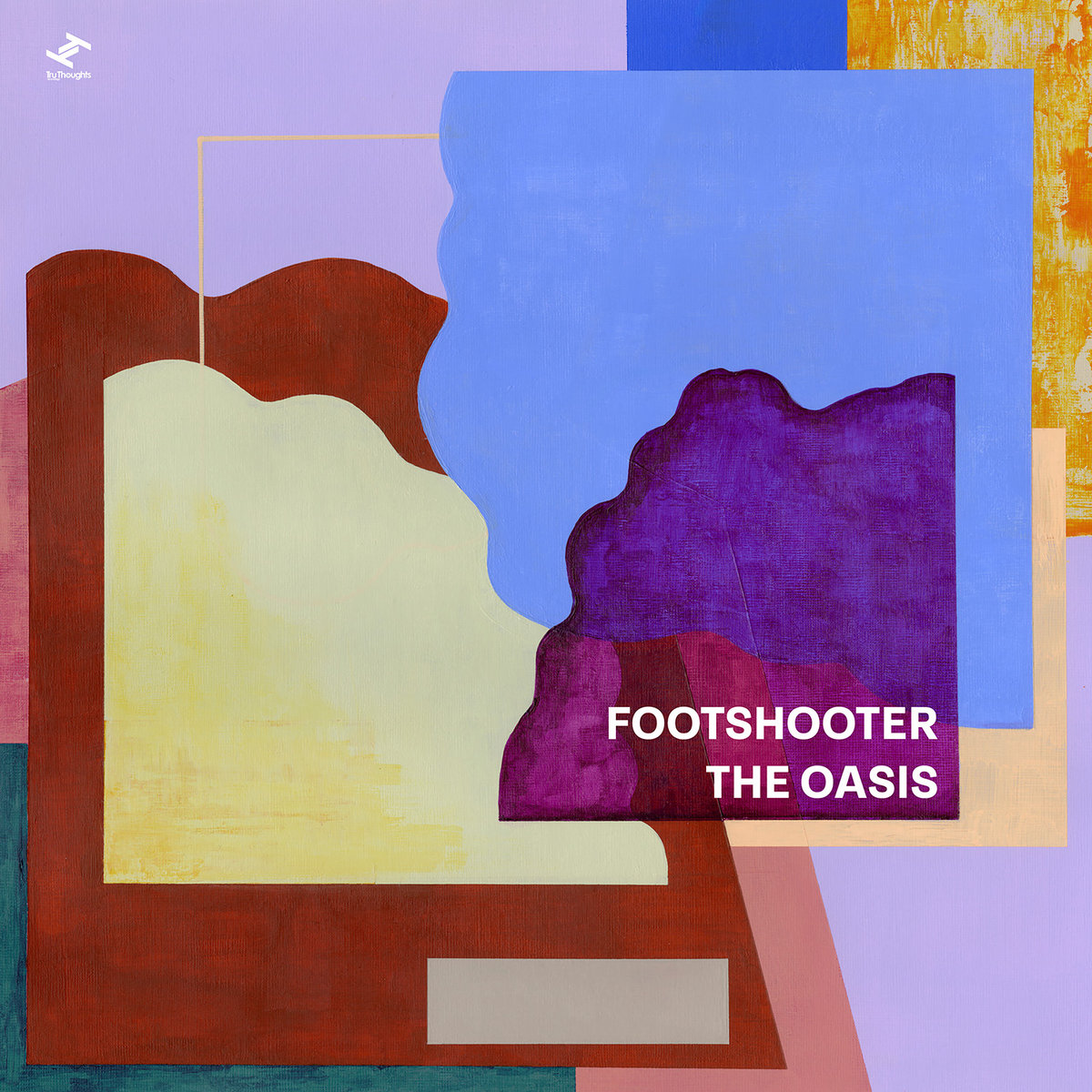
Footshooter is South London-based producer and DJ Barney Whittaker. He describes his first album for the Tru Thoughts label as “a collection of moods from the last three years. As with all my projects, collaboration and sharing is at the heart of it.”
Music is Whittaker’s oasis, and always in the spirit of collaboration – which explains the plethora of artists appearing on this album. Under his Footshooter alias Whittaker operates in a number of musical styles, providing supple instrumental music that the vocalists can bend and shape into their own.
What’s the music like?
The great thing about Footshooter’s music is that it refuses to be pinned down, moving easily between different styles while retaining its identity.
The guests are really well deployed, especially Ezra Collective saxophonist James Mollison. He adds a brilliant solo part to the broken beat of Cycles, while Surrey Canal Road is a mellow yet descriptive musical portrait in his hands.
Obelisk enjoys a distinctive vocal pairing from Natty Wylah and brother portrait, while the excellent Boomerang dresses Ehireme Omoaka’s spoken word with a fine trumpet solo from Wilf Petherbridge. Wilf appears later on Parc de Belleville, this time his solo laced with a bittersweet melancholy.
Folding could easily be heard by a pool in the Mediterranean, but it’s an emotive track too, complementing an expansive piano line with sultry yet deeply felt vocals from Allysha Joy. Here To Learn moves a bit more towards deep house, in the company of a lithe vocal from Andre Espeut, but then Sermon steps back for contemplation in the company of Sara El Harrak.
Does it all work?
It does – The Oasis is nicely structured, and inhabits a place of positive musical energy.
Is it recommended?
Enthusiastically. It isn’t an exaggeration to call Footshooter a visionary producer, and the way he has written for the wide range of contributors on this record shows how versatile he is. A vibrant album.
For fans of… Joe Armon Jones, Seven Davis Jr., Jazzanova, Moodymann
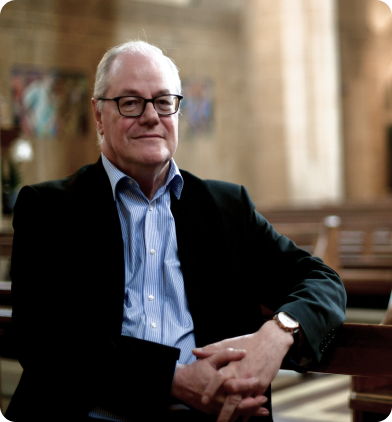
On Sunday we learned of the sad news that Matthew Best, the British conductor and bass singer, had sadly passed away at the age of 68.
To many collectors, Best will be known for a series of very fine recordings made with two ensembles that he founded, the Corydon Singers and Orchestra, for Hyperion in the 1980s and 1990s. These discs became cornerstones of the label’s choral repertoire. Here is the text of an obituary shared by Matthew’s artist management team at Intermusica:
“It is with deep sadness that we inform you of the death of renowned British conductor and bass, Matthew Best. Matthew passed away today, 11 May 2025, surrounded by his loving family.
Matthew’s long career was defined by his extraordinary versatility earning him a distinguished reputation worldwide. An opera singer for over thirty-five years with over one hundred bass, bass-baritone and baritone roles in his repertoire, he also worked extensively as a choral and orchestral conductor across the UK and Europe, at various stages during his career as a composer, arranger and editor.
Julia Maynard, Director, Vocal & Opera, said:
“Matthew was one of the finest basses of his generation and an intuitive musician and interpreter of many of the major roles in the bass repertoire. He was a warm, funny, utterly engaging artist, teacher, friend, and a much loved parent, grandfather and husband. Our thoughts are with his most treasured family”
As a singer, Matthew was a regular guest artist for all the major UK opera houses, singing extensively the roles of Wotan in the complete Wagner Ring Cycle, The Flying Dutchman, King Mark, Amfortas, Kurwenal, King Heinrich, Scarpia and Jochanaan, and premiering new works by Jonathan Harvey, Julian Anderson and Kaija Saariaho. Matthew’s extensive concert career made his a familiar face across the country and in Europe and the USA, working with many distinguished conductors including Muti, Haitink, Colin Davis, Andrew Davis, Mehta, Nelsons, Salonen, Mackerras, Marriner, Runnicles, Gardiner and Hickox.
As an active composer and arranger, Matthew conducted the premiere of his operetta Alice (based on Lewis Carroll’s Alice in Wonderland) in Cambridge in February 1979, directed by Nicholas Hytner; with further performances as part of the 1979 Aldeburgh Festival, with a guest appearance by Sir Peter Pears. Matthew produced performing editions for a number of works, including of a rare Bruckner manuscript for inclusion in his Bruckner cycle for Hyperion Records.
Matthew was equally well known as a conductor specialising in choral, vocal and orchestral music, in 1973 Matthew founded the Corydon Singers and later, in 1991, Corydon Orchestra and went on to make over thirty highly-regarded recordings for the Hyperion label. His extended conducting career took him to many of the orchestras and festivals of the UK and Europe, where he was regular guest conductor with, amongst many others, the English Chamber Orchestra, London Mozart Players, Northern Sinfonia, City of London Sinfonia and BBC Singers. For the 1998/99 season he was Principal Conductor of the Hanover Band, and in 2017, Matthew became Music Director of the Academy Choir Wimbledon and Academy Baroque Players. In his final performance with the Academy Choir on 8 March 2025, he conducted the London Mozart Players in a performance of Brahms Requiem and Strauss Metamorphosen for Strings.
Since 2015, Matthew had been a highly regarded teacher at the Royal Northern College of Music, shaping the careers of many students, several of whom have gone on to have active professional careers. In April 2025, Matthew was awarded a Fellowship of the Royal Northern College of Music in acknowledgement of his remarkable career, an award he was able to collect in person from Head of Vocal Studies and Opera, Professor Lynne Dawson.
Our thoughts are with Matthew’s wife Roz and family at this incredibly sad time.”
The below link will take you to a Tidal playlist collecting a number of Matthew’s recordings as a singer, but principally those made with the Corydon Singers. My own personal favourites include those selections from albums of Vaughan Williams, Rachmaninov, Beethoven and Bruckner, finishing with a terrific performance of Vaughan Williams’ Dona nobis pacem.
On Thursday we learned the sad news of the passing of Ronald Corp, a much-loved conductor and composer. Ronald’s worth to The London Chorus, where he was musical director for 30 years, can be felt in the warmth of the tribute on their website
Below is a link to a Tidal playlist including a number of Ronald’s colourful recordings for Hyperion and Epoch. For the former he recorded works by Satie and Milhaud that have aged incredibly well, and he was also responsible for a renewed interest in British Light Music – all through albums made with the New London Orchestra. In addition he showed his prowess as a composer through premiere recordings of his Piano Concerto no.1 and Symphony no.1 released by Epoch. The symphony appears at the end of the playlist:
Petroc Trelawny (orator), The London Chorus, New London Orchestra / Adrian Brown
Vaughan Williams Six Choral Songs (1940) Martinů Memorial to Lidice (1943) Walton Spitfire Prelude and Fugue (1942) Bliss Morning Heroes (1929-30) Holst/Rice I Vow to Thee My Country (1921)
Holy Trinity Church, Sloane Square, London Thursday 9 May 2025
Reviewed by Richard Whitehouse
The London Chorus and New London Orchestra have put on notable concerts in recent years, few more ambitious than this programme to mark not merely the 80th anniversary of Victory in Europe Day but also the 50th anniversary of Sir Arthur Bliss’s death in appropriate manner.
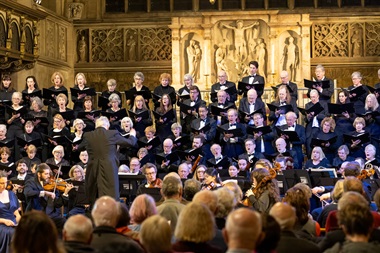
The first half comprised an unlikely but effective sequence of pieces written at the start of or during the Second World War. Rarely revived as such, Vaughan Williams’s Six Choral Songs to be Sung in Time of War works well as a whole: settings of Shelley that touch on aspects of courage, liberty, healing, victory, then pity, peace and war – before A Song to the New Age characterizes its utopian leanings in subdued and even ambivalent terms which seem typical of its composer. Suffice to add that the London Chorus had the full measure of its aspiration.
Two succinct if otherwise entirely different pieces brought out the best from the New London Orchestra. Rarely so overt in emotion, Martinů was well-nigh explicit when commemorating Nazi atrocities in music of plangent harmonies and chorale-like fervency both evocative and affecting. Derived from his score to the film The First of the Few, Walton had come up with a showpiece whose ceremonial prelude is vividly countered by its incisive fugue – making way for a brief if poignant interlude before matters are brought to a head in the rousing peroration.
Although intimately bound up with the First World War, Morning Heroes is wholly apposite for the present context. Conceived as the exorcism of his wartime experiences, Bliss’s choral symphony elides deftly between a distant past and its present; the first of its five movements featuring an orchestral introduction to set out the underlying mood and salient motifs, before Hector’s Farewell to Adromache had Petroc Trelawny eloquently evoking that scene on the ramparts of Troy without excess rhetoric. Adrian Brown’s understated direction meaningfully pointed up the expressive contrast between this and The City Arming – the setting of Walt Whitman whose interaction of chorus and orchestra was powerfully sustained right through to the simmering unease at its close, with the onset of hostilities in the American Civil War.
The two parts of the central movement saw each section of the London Chorus come into its own: the women in Vigil, a confiding take on lines by Li-Tai-Po (Li Bai) such as relates the emotions of those left behind; and the men in The Bivouac’s Flame, plangently evoking life at the front with further lines from Whitman’s Drum Taps. Choral forces reunite in Achilles Goes Forth to Battle, a setting from later in The Iliad which brings about the work’s climax via The Heroes – a rollcall commemorating those of Antiquity. After this, the starkness of Wilfred Owen’s Spring Offensive is the greater for its sparse accompaniment – Trelawny’s oration a model of understatement as this segued into the setting of Robert Nichols’s Dawn on the Somme with those ‘morning heroes’ themselves evoked affirmatively if fatalistically.
A concert which ended in fine style with Holst’s stirring anthem had begun in subdued fashion with Dawn on the Somme – Ronald Corp’s elegy, given hours after his death was announced. Someone who had always given his all to this chorus and orchestra, he will be greatly missed.
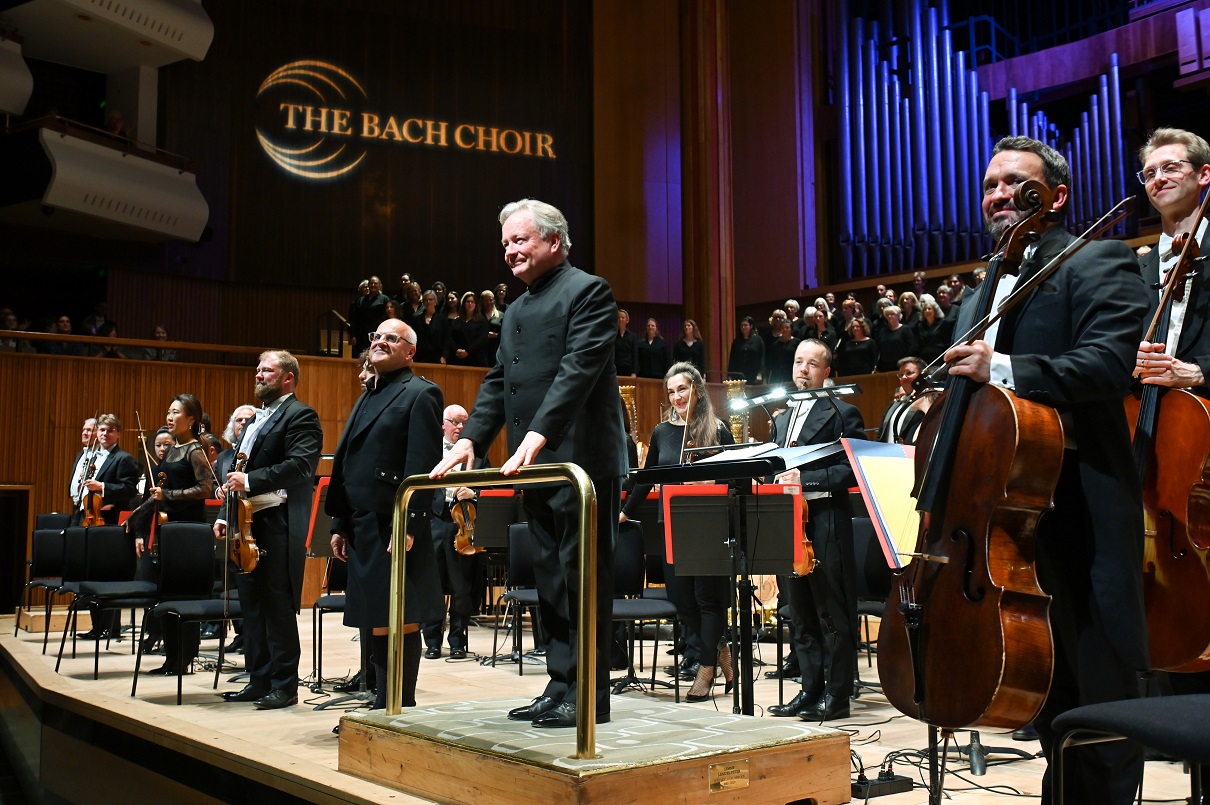
Amy Carson (soprano), Harry Jacques (tenor), Christopher Purves (baritone), The Bach Choir, Philharmonia Orchestra / David Hill
Delius The Song Of The High Hills (1911) Blackford La Sagrada Familia Symphony (2022, world premiere) Walton Belshazzar’s Feast (1931)
Royal Festival Hall, London Thursday 8 May 2025
Reviewed by Ben Hogwood Pictures (c) Chris Christodoulou
This imaginative concert presented three British works telling stories from overseas, their reach extending to Norway, Spain and Babylon respectively.
Although born in Bradford, Frederick Delius spent much of his life abroad, living in America and then France – from where he would visit Norway for many a summer holiday with his wife. One such vacation in 1911 inspired him to write The Song Of The High Hills, a continuous sequence in three sections for wordless choir and orchestra capturing the mountain plateau, or ‘vidda’, that they found on their walks. Images from the plateau were shown on a screen behind the chorus as they performed.
Musically the work draws from Grieg and Debussy (his Nocturnes in especially) but inhabits a world all of its own, Delius achieving an unusual, rapt stillness when describing the high plains. David Hill, a long time exponent of his music, marshalled a strong performance, albeit one that didn’t quite sustain the rarefied atmosphere of the central section. It did cast quite a spell, mind, thanks to a beautiful oboe solo from Timothy Rundle on the approach, and some superbly controlled singing from The Bach Choir, headed by soloists Amy Carson (soprano) and Harry Jacques (tenor). The climax of the middle section was bolstered by three timpani, before the orchestra returned us to base camp. Speeds were on the fast side, but the Philharmonia Orchestra gave consistently luminous textures.
London-born composer Richard Blackford has shown considerable flair when writing for orchestra, and this was immediately evident in the world premiere of his La Sagrada Famila Symphony. Completed in 2022 and already recorded on the Lyrita label, it is a musical response to a 2019 encounter with Gaudí’s vision, concentrating on three great facades of the building – Nativity, Passion and Glory.
Blackford’s symphony was rich in colour but also vividly descriptive, his responses matched by an accompanying film, directed by the composer. Nativity began with awe-inspiring salvos from the brass but grew into a more intimate study, with elements of Hindemith and Berg in the orchestral writing, before a propulsive passage threw off the shackles. Passion was the emotional centrepiece, a vivid study in the brutality of the Good Friday story. Grotesque elements were emphasised by sudden closeups of Josep Maria Subirachs’s sculptures, their drawn expressions reflected in the music. The death of Christ was especially notable, marked by a solo of moving eloquence from cellist Martin Smith, then a sharp cry of dismay from Mark van de Wiel’s clarinet.
Glory was less obviously jubilant than might have been expected, mystical and reverent, but again it was an accurate response to the imagery as the film briefly went inside the massive structure. Blackford’s imagery danced in the listener’s mind on its own merits, with the thrilling surge at the end, bolstered by the organ, reminiscent of Messiaen or Scriabin. David Hill secured a fine performance from the Philharmonia, bringing the splendour of Gaudí’s cathedral to the concert hall. The emphatic finish brought with it a reminder of the building’s likely completion in 2026, a mere 144 years after construction began!
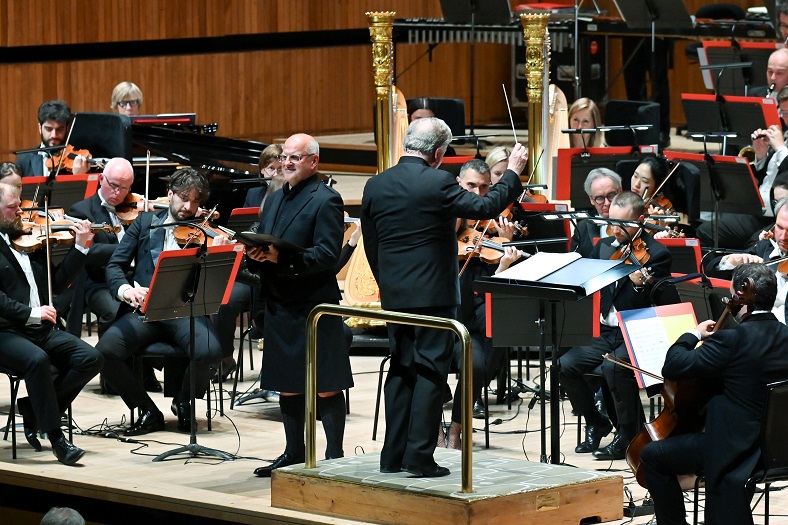
A British choral classic followed in the second half. Belshazzar’s Feast was initially denounced by Sir Thomas Beecham (a Delius fan, coincidentally) but Walton’s cantata has become a popular occasion piece. It is a vivid account of Babylonian decadence, before a human hand appears, writing on the wall of the banqueting hall to prophesy Belshazzar’s downfall. David Hill applied expert pacing to the storytelling, the Bach Choir on top form as the tension grew, spilling over into the exultant Praise Ye section. The paeans to the Babylonian Gods were starkly thrilling, contrasted by the terrifying unison shout of “Slain!” at Belshazzar’s death. The Philharmonia were superb, too, offstage brass bringing widescreen sound from either side of the stage and the percussion giving brilliant descriptions of the elements – iron and wood especially.
When the writing on the wall began, an ominous hush descended on the choir, the orchestra spreading a macabre chill through the hall – before the triumph of the closing pages, the Israelites free at last. Baritone Christopher Purves was a fine soloist, narrating the events and capturing the mood throughout. With 220+ in the choir, our ears were ringing long after the concert had finished, a timely reminder of a ruler whose inflated ego had brought about his downfall. Could there be any parallels in today’s world, I wonder?



 Arcana.fm