
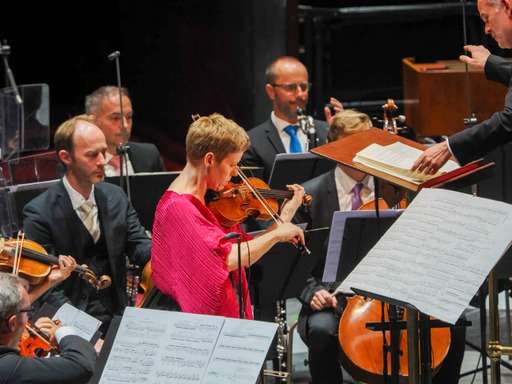
BBC Proms 2023 – Isabelle Faust, Alexander Melnikov, Les Siècles / François-Xavier Roth – Ligeti & Mozart

Prom 47 – Isabelle Faust (violin), Alexander Melnikov (fortepiano), Les Siècles / François-Xavier Roth

Ligeti Concert Românesc (1951)
Ligeti Violin Concerto (1989-93)
Mozart Piano Concerto No. 23 in A, K488 (1786)
Mozart Symphony No. 41 in C, K551, ‘Jupiter (1788)

Royal Albert Hall, London
Sunday 20 August 2023

by Richard Whitehouse photos by Sisi Burn / BBC

A major step in the evolution of musical ‘authenticity’ or vanity project of its artistic director? Celebrating its 20th anniversary, the Paris-based Les Siècles and François-Xavier Roth tonight made their third appearance at the Proms in a programme divided between Ligeti and Mozart.

Long in limbo as with most works of Ligeti’s early years, Concert Românesc now ranks as its composer’s primary crowd-pleaser – a ‘concerto for orchestra’ compact yet entertaining. Roth drew winsome charm from its initial Andantino and no mean impetus from its scherzo, before an Adagio whose dialogue of two horns (one high in the gallery) prefigures those intonational experiments three decades on. The finale did not lack verve, but anyone having heard Jonathan Nott give this piece for a Proms encore will recall just how much more scintillating it can be.

It may have had a long gestation, but Ligeti’s Violin Concerto is now established as the most recent such piece to have entered the repertoire. Technically assured but never merely showy, Isabelle Faust is a fine exponent, and it was not her fault if a lengthy platform reset made for a restive audience response in the teasingly understated Praeludium or plangent fervency of Aria, Hoquetus, Chorale which is one of the composer’s most potent inspirations. Diversely yet modestly scored, this work needs to be projected for its emotional impact to be felt and a certain bemusement met its coruscating Intermezzo and anguished Passacaglia, but not its engaging Appassionato in which Faust’s methodical cadenza fitted seamlessly into context. As, also, did the sparse Andante of Erwin Schulhoff’s Solo Violin Sonata given as an encore.

There was a similar sense of ends not always equating with means in Mozart’s Twenty-Third Piano Concerto after the interval. Playing a (Graf?) fortepiano from deep within the orchestra, Alexander Melnikov summoned playing of admirable dynamic subtlety and emotional poise – notably an Adagio whose bittersweet fatalism was consummately rendered. Just how much detail and articulation could be heard in the farther reaches of this acoustic was uncertain, but the rapport between soloist and orchestra in a sparkling final Allegro could hardly be gainsaid.

Playing to period-pitch in the second half (just occasionally offset by vagaries of intonation), Les Siècles came into its collective own with an engrossing account of Mozart’s Forty-First Symphony, its Jupiterian connotations evident from the outset of an opening Allegro whose distinction between (relative) dynamism and stasis was thrown into relief with Roth’s use of pause for expressive punctuation. Best here were an Andante whose muted while often dense textures were precisely articulated, then a Menuetto whose sweeping gait found contrast in a quizzical trio whose closing phrase was pointedly curtailed. Not that Roth had other than the measure of the finale, fully integrating its thematic unity into a powerfully controlled overall structure, but its underlying progress felt just a shade dogged in the light of what preceded it. That said, there was no lack of impetus when, after the longest of those pauses, Roth led his forces through the magisterial coda; duly setting the seal on a programme that played to this orchestra’s strengths if not always having been designed with the Royal Albert Hall in mind.

For more on the 2023 BBC Proms, visit the festival’s website at the BBC. Meanwhile click on the names for more information on artists Les Siècles, conductor François-Xavier Roth, violinist Isabelle Faust and pianist Alexander Melnikov. You can discover more about Ligeti at this dedicated website

Wigmore Mondays – Alexander Melnikov: Early piano music by Clementi, Haydn & Mozart

Alexander Melnikov (fortepiano)

Wigmore Hall, Monday 13 January 2020 (lunchtime)

You can listen to this concert on the BBC Sounds app here (opens in a new window)

Review and guide by Ben Hogwood

Something of a history lesson from the versatile pianist Alexander Melnikov, who is capable of moving between modern piano music on a concert grand and 19th century music on the instrument for which it was written, the fortepiano. Essentially the instrument is a forerunner of the grand version we are used to nowadays, but it allows us to see the join between the harpsichord – the go-to keyboard of much of the 18th century – and the bigger and more modern instruments the likes of Beethoven began to write for. Here Melnikov played an instrument by Paul McNulty after Walter & Sohn from an original of 1805. Alexander Skeaping deserves credit as the tuner and supplier.

Melnikov’s program was brilliantly conceived, including music by Mozart and Haydn but linking them through one of the leading pianists and composers of the day, Muzio Clementi. Beethoven was one of his greatest advocates and often played his sonatas, while Clementi promoted his fellow-composer in London, where he arrived in the early 1770s. At this point the English capital was regarded as the centre for keyboard innovations, and in the music for this concert – superbly played and interpreted by Melnikov – you can feel the sense of freedom and exploration as the music looks outwards and forwards towards Beethoven.

The pianist begins with a musical impression of Haydn by Clementi, a brief Prelude from his Musical Characteristics album written as a guide for to give performers an idea of the style of other composers. This short number (from 3:04 on the broadcast link) starts with a broad C major chord, helping us get used to the piano sound. The mood is free and expansive, with a busy left hand. The pianist adds a short improvised section, where it proves difficult to spot the joins, but this serves to lead us straight to a Haydn work, the Piano Sonata in C sharp minor HXVI:36 (4:53).

This was a very rare key for Haydn to use – and rare for piano music, with Beethoven’s Moonlight sonata the next excursion some 20 years later. Melnikov’s performance captures the exploratory air of the piece, beginning with quite a stern statement but then playfully holding back with some of the clipped right hand notes to emphasise the composer’s wit. Melnikov’s affinity for the music is clear, with some beautifully played melodies. The piano sound is lovely, with none of the tinny textures often associated with the earlier instruments.

The second movement is a Scherzando (14:26), Melnikov playing a graceful dance with a really satisfying sense of ebb and flow. The third movement (18:21) is the slowest, a slow and solemn Menuetto moving to a thoughtful and serene final section (20:14) where Haydn moves to the major key. The playing here, using the ‘damper’ pedal, is really lovely.

The next pair of works begin with Clementi’s second ‘impression’ of Mozart (24:17), where a great deal of technical control is required! Me The two composers famously sparred in an improvisation session in Vienna in 1781, so knew a lot about each other – but from the reports did not perhaps see eye to eye.

Clementi’s tribute is keenly felt however, before Mozart‘s own exploratory Fantasia (25:55) receives a carefully thought yet natural performance. Though a short piece, this unfinished work varies greatly in mood and tempo, with quick cascades from on high contrasting with dark left-hand thoughts, before a sunnier closing section to sweep away the clouds. Melnikov gives the music plenty of room, sometimes exaggerating the pauses but always to the benefit of the music.

The concert finished with one of Clementi’s own sonatas, the substantial Piano Sonata in G minor published in 1795. Before it we heard another Prelude from the Musical Characteristics, this time a portrait of himself with a tumbling figure and some highly chromatic music (32:55). The Sonata itself begins at 34:27 with a stern introduction of two-part writing, but that soon cuts to a busy and bright first movement proper. There are a number of abrupt mood swings in this movement, anticipating Beethoven’s way of changing quickly between thoughts, and Clementi also employs some daring harmonies for the time. Melnikov responds brilliantly to these, again his performance given as though performing a characterised stage work, with a stormy closing section.

The second movement (42:40) is marked Un poco adagio (loosely translated as ‘a little bit slow’) and is subtly charming, like a slower dance, before the third movement (48:38), marked Molto allegro (quick and lively), actually hangs back a bit in this performance before going full throttle to a thrilling finish. Again Melnikov’s right hand contours are brilliantly realised.

This was a really enjoyable concert, and great to see the importance of Clementi’s role properly realised. He was one of the true pioneers of early piano music, and without his part it is unlikely Mozart or especially Beethoven would have made their own mark.

Repertoire

This concert contained the following music (with timings on the BBC Sounds broadcast in brackets):

Clementi Musical Characteristics Op.19: Preludio II alla Haydn in C major (publ.1787)
Haydn Piano Sonata in C sharp minor HXVI:36 (publ.1780)
Clementi Musical Characteristics Op.19: Prelude I alla Mozart in A major (publ.1787)
Mozart Fantasia in D minor K397 (?1782)
Clementi Musical Characteristics Op.19: Prelude I alla Clementi (publ.1787)
Piano Sonata in G minor Op.34/2 (publ.1795)

Further listening

Alexander Melnikov has not yet recorded any of the music in this concert, but the playlist below includes recorded versions on the fortepiano wherever possible.

Thirty years ago it would have been unthinkable to consider we would now have a huge resource of recordings made on the fortepiano. This is thankful in part to early protagonists such as Melvyn Tan, but one pianist to have recorded a vast amount of this repertoire is Ronald Brautigam. His recordings of Beethoven are rewarding, but in Haydn he sparkles – such as in this disc of five sonatas, including the one heard in this concert:

Melnikov’s own discography on more historical instruments is in its relatively early stages, but this disc of piano music through the ages from Schubert to Stravinsky is well worth hearing:

Finally from this time comes a thrilling cycle of Beethoven sonatas for piano and violin – pioneering music which Arcana will explore in greater detail as part of 2020 Beethoven. This version with Isabelle Faust is one of the very best:

BBC Proms 2017 – Alexander Melnikov and the Latvian Radio Choir perform Shostakovich at the Cadogan Hall

Alexander Melnikov (piano, above), Latvian Radio Choir /Sigvards Kļava

Shostakovich 24 Preludes and Fugues, Op.87 (1950-51): no.1 in C major; no.2 in A minor

Ten Poems on Texts by Revolutionary Poets, Op.88 (1951): To the Executed, The 9th of January

24 Preludes and Fugues, Op.87: no.3 in G major; no.4 in E minor

Ten Poems on Texts by Revolutionary Poets, Op.88 (1951): The last salvos have sounded; They’ve won…

24 Preludes and Fugues, Op.87: no.7 in A major; no.8 in F sharp minor

Ten Poems on Texts by Revolutionary Poets, Op.88 (1951): May Day Song

Cadogan Hall, Monday 14 August 2017

Listen to this concert on the BBC Radio Player

The Latvian Radio Choir‘s BBC Proms mini-tour has been marked by inventive programming, and this grouping of revolutionary texts, set to music by Shostakovich, was a mile away from the previous night’s chaste yet subtly uplifting All Night Vigil by Rachmaninov.

Here the choir settled in an ideal acoustic, Cadogan Hall, but with some unsettling songs. Shostakovich wrote the Ten Poems on Texts by Revolutionary Poets in 1951, acutely aware of the need to please the powers that be but still writing from the heart in a style that builds on the big opera choruses of Musorgsky. The unaccompanied choir sang grisly tales of ‘two prematurely fallen fighters’ (To The Executed), then the people ‘riddled with bullets and lead’ (The 9th of January). Their delivery was sharp and incisive when required in the faster music, then cold and distinctly wintry in the composer’s slower thoughts, which were almost beyond solace.

It was down to Alexander Melnikov (above) to supply the effective contrast in excerpts from Shostakovich’s largest piano work, the 24 Preludes and Fugues, Op.87. A homage both to Bach and to his pianist friend Tatiana Nikolaeva, the cycle contains some of the composer’s most intimate and confidential thoughts. Running through each of the 24 major and minor keys, the work progresses as a ‘cycle of fifths’, with a Prelude and Fugue in each major key (for instance ‘C’) immediately followed by its relative minor key (in this case ‘A’).

Melnikov chose three ‘pairs’ – in C (with A minor), G (with E minor) and later on A (with F# minor). Each were closely linked to the choir’s texts, sentiments and tonality. The purity of C major was briefly cast under a shadow, the sunny Prelude countered by a thoughtful Fugue that emerged gradually into the attentive silence of Cadogan Hall. The rippling A minor Prelude flowed at great speed, as did the Fugue, but the G major prelude was solemn and magisterial, filling a much bigger space, a series of bright colours when compared to the downtrodden E minor Fugue.

As we moved from piano to choir the contrasts were striking, yet the emotions followed a clear path, so that when Melnikov returned he provided solace in A major. This cut to the sardonic humour of the F# minor Prelude, paired with a serene but baleful Fugue, a bridge to the empty triumph of the choir’s closing number, May Day Song.

This was a terrific concert, well planned and thought-provoking in its execution, especially given today’s political climate. Shostakovich was a composer under extreme duress at this time – but sadly that era of writing music is not so far removed as we think it might be.

Ben Hogwood

You can listen to Alexander Melnikov’s recording of the complete Shostakovich Preludes and Fugues on Spotify below: