In concert – Augustin Hadelich, BBC SO / Sakari Oramo @ BBC Proms: Stravinsky, Mendelssohn, Anthony Davis & Richard Strauss

Augustin Hadelich (violin), BBC Symphony Orchestra / Sakari Oramo

Stravinsky Le chant du rossignol (1914/17)
Mendelssohn Violin Concerto in E minor, Op. 64 (1838-44)
Anthony Davis Tales (Tails) of the Signifying Monkey (1997) [European premiere]
Richard Strauss Till Eulenspiegels lustige Streiche, Op. 28 (1894-5)

Royal Albert Hall, London
Thursday 24 July 2025

Reviewed by Richard Whitehouse Photos (c) BBC / Mark Allan

Now in his second decade as chief conductor of the BBC Symphony Orchestra, Sakari Oramo can be relied on for innovative Proms programmes; tonight’s framing a staple of the concerto repertoire and an unfamiliar orchestral work with influential symphonic poems. In the case of The Song of the Nightingale, Stravinsky recycled sections from the latter two acts of his opera Le Rossignol into an illustrative sequence no less successful when heard in abstract terms. As exhilarating as are those earlier stages with their depiction of the bustling Chinese court, it is what follows – arrival of the mechanical nightingale, illness of the emperor then return of the real nightingale to restore his health – that proves most memorable. Above all, that plaintive song of the fisherman – heard on solo trumpet and rendered with due pathos by Niall Keatley.

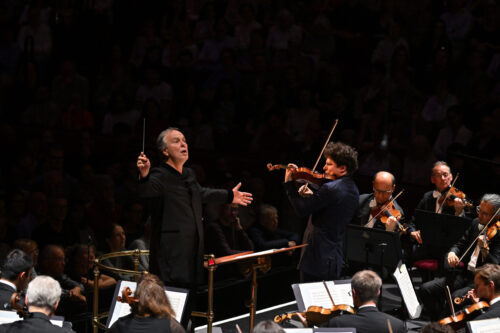
Oramo has worked with Augustin Hadelich on numerous occasions and this evening’s account of Mendelssohn’s Violin Concerto confirmed their rapport right from the outset. Not its least attraction was the deftness of orchestral response in music as wears its Romanticism with the lightest of touches, with Hadelich’s handling of the first movement’s central cadenza no less assured than Oramo’s ushering in of its reprise. The slow movement had no lack of eloquence, nor the finale of that genial humour wholly typical of its era as it headed toward its engaging close. Hadelich responded to the (rightly) enthusiastic applause with his own arrangement of Por una Cabeza – originally a song penned by Carlos Gardel and Alfredo Le Pera, and which has latterly become a favourite addition to film-scores whenever a tango element is called for.

Although he is best known for his operas, notably X: The Life and Times of Malcolm X which has enjoyed several revivals since its Philadelphia premiere four decades ago, Anthony Davis has written numerous concertos and orchestral works with Tales of the Signifying Monkey the final part of a triptych that can be played together or separately. Inspired by an African fable about how the monkey uses its innate guile to keep lions and other predatory animals at bay, this proceeds as a stealthily cumulative entity in which elements of jazz and even swing, are prominent within the stylistic mix. An aura of anticipation, frequently with an ominous tinge, is always apparent and if the outcome is at all anti-climactic, it could well another take on the maxim of travelling in hope. Certainly, the BBCSO seemed to enjoy making its acquaintance.

Usually encountered at the beginning of a concert, Richard Strauss’s Till Eulenspiegel’s Merry Pranks is no less effective (and perhaps even more so) when heard at the close. So it proved tonight with a performance which, while eschewing the uproarious humour often instilled into these increasingly scatological events, was always adept in its conveying of the music’s capricious demeanour. Composed in the wake of his ill-received first opera Guntram, the present work was a ready incentive for that orchestral virtuosity which was Strauss’s metier – above all, its climactic confrontation between its protagonist and the judiciary that results in the former’s execution. The real Till likely survived to old age, only to expire during the Black Death, but his fictional self is doubtless more appealing when characterized so judiciously as it was here.

You can listen back to this Prom concert on BBC Sounds until Sunday 12 October.

Click on the artist names to read more about Augustin Hadelich, the BBC Symphony Orchestra and their chief conductor Sakari Oramo – as well as composer Anthony Davis. Click also for more on the BBC Proms

Published post no.2,609 – Monday 28 July 2025

Wigmore Mondays: Augustin Hadelich & Charles Owen – Brahms, Ysaÿe & Adams

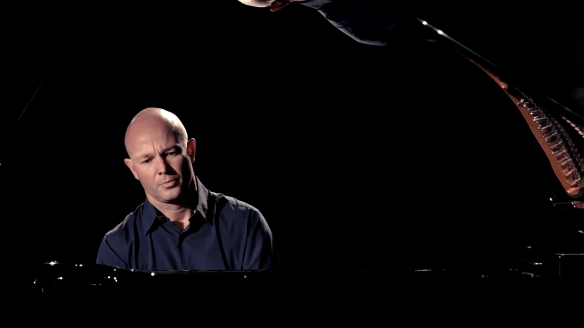
Augustin Hadelich (violin, above), Charles Owen (piano, below)

Brahms Violin Sonata no.1 in G major Op.78 (1878-9) (1:57-28:08)
Ysaÿe Sonata for solo violin no.4 in E minor Op.27/4 ‘Fritz Kreisler’ (1923) (30:31-40:44)
Adams Road Movies (1995) (43:33-1:00:24)

Wigmore Hall, London; Monday 10 December 2018

You can listen to the BBC Radio 3 broadcast by clicking here

Written by Ben Hogwood

This was the third Monday lunchtime in the last six weeks where BBC Radio 3 and the Wigmore Hall have been concentrating on music for violin and piano. This nicely constructed recital complemented the previous pair from Aleksey Semenenko and Inna Firsova, and Tai Murray and Silke Avenhaus, where we had heard two of the three violin sonatas by Grieg.

On this occasion we heard a contemporary of those works, the BrahmsViolin Sonata no.1 in G major – a work written for his friend, the great violinist Joseph Joachim – and one also picked up by Clara Schumann. It is a highly attractive work and received an affectionate performance here, Augustin Hadelich and Charles Owen straight into the beatific air of the first movement (from 1:57 on the broadcast) With an equally genial theme from 3:24, this was Brahms at his most radiant, with a sweet tone from the violinist and flowing countermelodies from Owen. The airy role reversal at 5:20, with Owen playing the tune and Hadelich giving pizzicato (plucked) accompaniment was a lovely moment – as was the content beginning of the coda (11:35). In between this the music was passionate and animated, Brahms developing his source material.

The second movement (from 12:34) also benefited from Hadelich’s sweetly toned instrument, shaping up to be a lovely reverie until a much more animated central section blew away the cobwebs (15:00). Returning at 16:23, the main theme gained an extra layer from double stopping on the violin (playing more than one string at once), and Owen’s piano line continued as a model of sensitivity.

Clara Schumann stated that she would happily have the last movement of this sonata to accompany her on her journey ‘to the next world’, and you could hear why in this performance (from 20:05), which brought out its bittersweet quality. Brahms moves between G minor and G major, a delicate balancing act of music that sounds a bit fretful and gentler, uplifting thoughts. Hadelich and Owen caught them perfectly here, the latter’s nicely pointed piano working particularly well on the dance-like second idea of the movement. From 25:37 the major-minor tension resumed, resolved in a serene coda from 26:20, ending quietly.

Ysaÿe wrote his six solo violin sonatas at great speed, publishing them all together in 1923. The fourth pays particular homage to Bach, incorporating the dance forms that were used in his Sonatas and Suites for solo stringed instruments. It was dedicated to the violinist-composer Fritz Kreisler, one of the very greatest string players. Not surprisingly it makes technical demands on the performer but Hadelich was brilliant here (from 30:31), careful not to overdo the virtuosity at the expense of musical communication.

The three sections of the sonata moved from a dramatic first movement Allemanda (30:31) through a slowly evolving Sarabande used by the composer as a fugue (34:50) and then a bracing Finale (37:57). The Sarabande had the most striking sonorities of the three, thanks to the inventive pizzicato techniques matched spotlessly by Hadelich, but the last movement was a tour de force with which to finish!

Following this was one of the first pieces John Adams wrote for chamber forces, his evocative trip Road Movies, after a period where he admits to ‘studiously avoiding the chamber music format’. Yet, as this entertaining three movement piece proves, his music translates effortlessly to the smaller scale. The piano (played heroically here by Charles Owen!) supplies a lot of the rhythmic impetus and the bass foundations, leaving the violin to operate more freely up top.

The first movement, Relaxed Groove, is described by the composer as ‘a relaxed drive down a not unfamiliar road. Material is recirculated in a sequence of recalls that suggest a rondo form’. Both performers got to the nub of the bluesy music straight away, and also evoked the ‘solitary figure in an empty desert landscape’ in the second movement, entitled Meditative (49:11), where Hadelich had to detune his bottom string from a ‘G’ to an ‘F’. Finally the toe-tapping 40% Swing (55:19) closed out this virtuosic piece, both players smiling as they enjoyed its grooves and motifs.

We disembarked from the Adams vehicle, but an encore was waiting to see us on our way – a rather fine arrangement by Ysaÿe of the Chopin Nocturne in C sharp minor, played with appropriate tenderness by Hadelich. Owen’s flowing accompaniment, too, was finely judged.

Further listening

Augustin Hadelich has not yet recorded any of the works in this recital, but the following playlist brings together the music heard in the concert, including a version of the encore arranged by Nathan Milstein:

For those enjoying the Ysaÿe Solo Sonata, a logical next port of call would be the unaccompanied 24 Caprices by Paganini, which Hadelich has recently recorded:

For those enjoying the Adams, here is a disc including not just Road Movies but a collection of the composer’s works for keyboard: