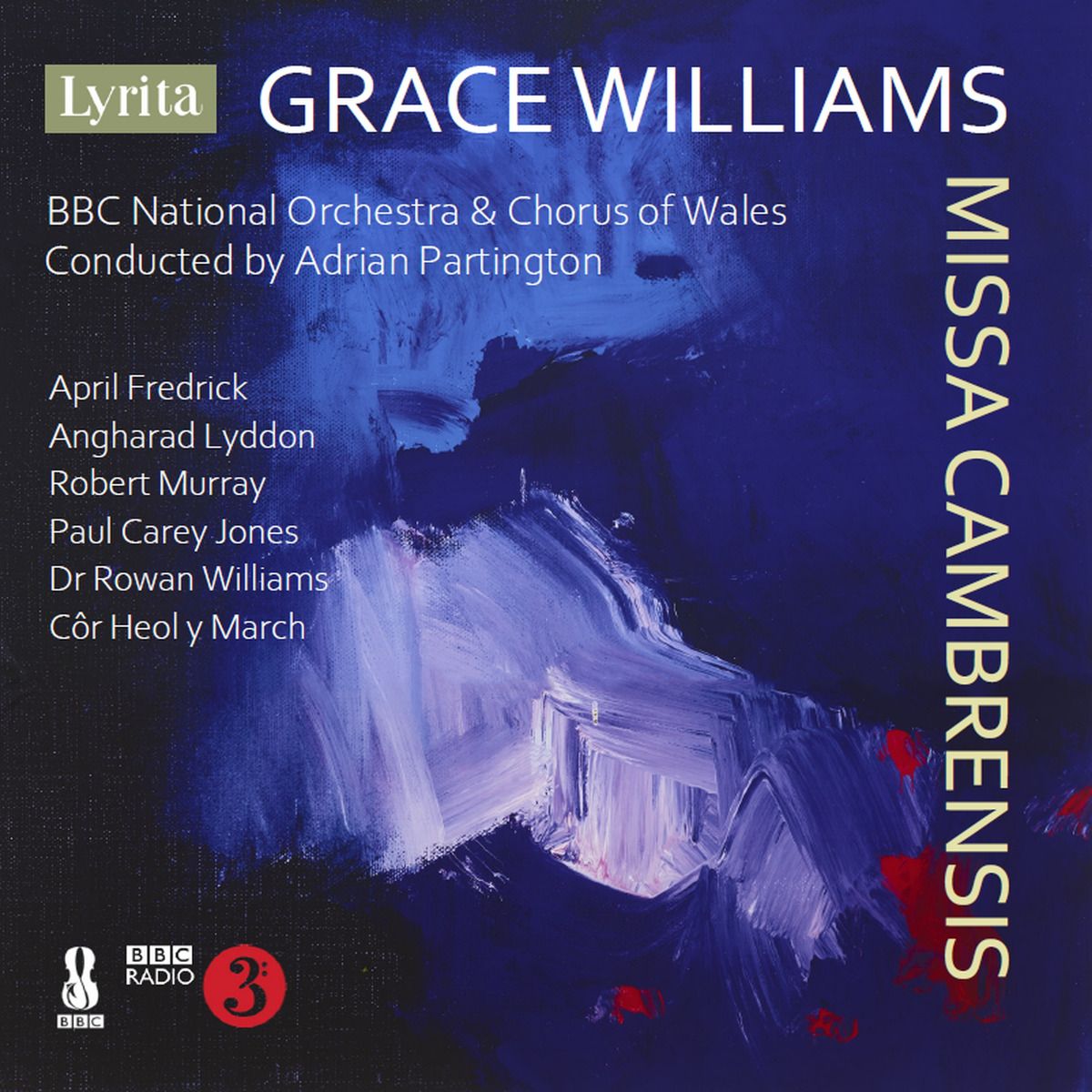
On Record – Soloists, BBC National Chorus and Orchestra of Wales / Adrian Partington – Grace Williams: Missa Cambrensis (Lyrita)

Grace Williams Missa Cambrensis (1968-71)

April Fredrick (soprano), Angharad Lyddon (mezzo-soprano), Robert Murray (tenor)
Paul Carey Jones (bass), Dr Rowan Williams (narrator); Côr Heol y March, BBC National Chorus and Orchestra of Wales / Adrian Partington

Lyrita SRCD442 [66’41’’] Latin / Welsh text and English translation included
Producer / Engineer Adrian Farmer, Engineer Simon Smith

Recorded 20-21 January 2024 at BBC Hoddinott Hall, Cardiff

Reviewed by Richard Whitehouse

What’s the story?

Lyrita continues its coverage of Grace Williams (1906-1977) with her largest concert work, Missa Cambrensis, in a recent studio recording which confirms it as the defining statement from a composer who, almost half a century since her death, is only now receiving her due.

What’s the music like?

As Paul Conway observes in his typically thorough booklet notes, Missa Cambrensis is one among a number of works by Williams that is Welsh only in a titular sense. Premiered at the Llandaff Festival in 1971, it was well received by fellow composers, critics and public alike but not heard again until 2016 in a performance one recalls as originally intended for release on Lyrita and which can be heard via the composer’s dedicated website. Not that the present account is other than successful in conveying the essence of this powerful yet elusive piece.

Many settings of the Mass since Haydn have unfolded a symphonic trajectory, but Williams goes further with the division into five clearly defined movements. The initial Kyrie Eleison not only introduces most of those salient motifs but also establishes that tone, mystical in its undulating equivocation, such as characterizes this work’s long-term expression: the contrast here between choral and soloistic textures duly accentuated by their hieratic and supplicatory quality. This duly sets up an emotional contrast intensified in the Gloria, outwardly the most straightforward part of the work but with a calmly ecstatic response at Laudamus te then an eloquent Dominus Deus that are nothing if not personal, together with an intensely wrought Cum Sancto Spiritu whose culminating Amen’s convey a distinctly ambivalent affirmation.

As most often, the Credo is the most substantial portion but Williams rings the changes by dividing this into halves, a pertinent division coming at Et homo factus est and Crucifíxus étiam pro nobis. In between are interpolated a setting of Saunders Lewis’s Carol Nadolig (A Christmas Carol) for children’s voices with viola, cello and harp of melting pathos, offset by a starkly narrative treatment of the ‘Beatitudes’ prior to a mostly ruminative resumption of the Credo. Pivoting between contemplation and elation, the Sanctus is rounded off by a joyful Hosánna in excélsis which is not to be heard again after the subdued eloquence of the Benedictus. An anguished response to the Agnus Dei feels the more acute, as also a searching Dona Nobis Pacem which brings the work full circle to its contemplative close.

Does it all work?

Yes, and with an understated while readily identifiable personality that surely makes this the most potent setting of the Mass from a Welsh composer. Subliminal influences might not be hard to discern, among them Britten’s War Requiem, but they never detract from Williams’s own idiom. The soloists cannot be faulted in terms of commitment, with Rowan Williams a notably incisive reciter, while Adrian Partington secures a lustrous response from his choral and orchestral forces. Overall, it is hard to imagine the work given with greater conviction.

Is it recommended?

It is indeed, not least in the hope that further live hearings of Missa Cambrensis may prove forthcoming. Good news, moreover, that Lyrita has now acquired the premiere performance of Williams’s only completed opera, The Parlour, which is scheduled for imminent release.

Listen & Buy

You can read more about this release at the Wyastone website

Published post no.2,516 – Monday 28 April 2025

Online concert – English Symphony Orchestra / Kenneth Woods: Composer Portrait – Walter Arlen

Walter Arlen
Songs of Songs (1955)
The Poet in Exile (1991)

Anna Huntley (mezzo-soprano), Gwilym Bowen (tenor), Thomas Mole (baritone), BBC National Chorus of Wales, English Symphony Orchestra / Kenneth Woods

Studio recording at BBC Hoddinott Hall, Cardiff, 17-20 February 2022

by Richard Whitehouse

Although he is likely best known by his trenchant music criticism for the Los Angeles Times, Vienna-born Walter Arlen has made a distinguished contribution to music administration and is increasingly being recognized as a composer. Several releases of his songs and piano music can be heard on the Gramola label, and this latest of the English Symphony Orchestra online concerts provides a welcome introduction to two of his works that feature orchestra – the one drawing on ancient Jewish sources with the other on poems from a leading modern author.

Whether The Song of Songs is indeed harbinger of monogamy in the Judeo-Christian moral code, it contains some of the eloquent expression in either of the Biblical testaments and has long provided a potent inspiration for musical treatment. In just under 30 minutes, Arlen’s ‘dramatic poem’ takes in the main narrative – the lively opening chorus features much sub-divided writing for female chorus underpinned by incisive orchestral textures. As the piece unfolds, it becomes evident that emotional emphasis is placed upon the solo contributions – whether those of King Solomon as sung with burnished warmth by Thomas Mole, those of the Shepherdess rendered with winsome poise and not a little insouciance by Anna Huntley, or those of the Shepherd which Gwilym Bowen here projects with no mean virility but also tenderness. Nor is the BBC National Chorus of Wales found wanting in passages with textural intricacy and intonational accuracy at a premium. If the final resolution does not bring the expected closure, the direct and unaffected appeal of this setting certainly warrants revival.

Yet the real discovery is The Poet in Exile, a song-cycle to texts by the Polish-American author and cultural eminence Czesław Miłosz. For all its undoubted depth and profundity, these texts are not easily rendered in musical terms, and it is to Arlen’s credit that he goes a considerable way towards elucidating them thus. As the latter states, these poems ‘‘dealt with situations echoing my own remembrance of things past’’; a quality which holds good from the trenchant rhetoric of ‘Incantation’, via the sombre rumination of ‘Island’ then the whimsical elegance of ‘In Music’ and controlled fervour of ‘For J.L.’ (with its distinctive obligato for harpsichord), to the confiding intimacy of ‘Recovery’. Inquiring listeners may already have heard these songs with piano on one of the Gramola releases with Christian Immler accompanied by Danny Driver (GRAM98946), but this version – as orchestrated by Kenneth Woods after an arrangement by Eskender Bekmembatov – makes for a richer and wider-ranging context for a vocal line projected with real assurance by Thomas Mole.

Throughout these works, the musicians of the ESO are heard to advantage in the spacious acoustic of Hoddinott Hall and are directed by Woods with sure sense of where to place the emotional emphasis – especially important in conveying the meaning of the songs. If not a major voice, Arlen’s output is always approachable and often thought-provoking. Anyone who has encountered it will enjoy getting to know his music on a larger scale and hearing it played so persuasively: a worthy present for the composer in advance of his 102nd birthday.

These works are available for free public viewing from 13-17 May on the English Symphony Orchestra website

For further information on Walter Arlen, click here – and for the appropriate Gramola Records link click here. Meanwhile click on the names for more on Czesław Miłosz, the English Symphony Orchestra and Kenneth Woods

Arcana at the Proms – Prom 28: Tadaaki Otaka conducts the BBC National Orchestra of Wales in Rachmaninov & Huw Watkins

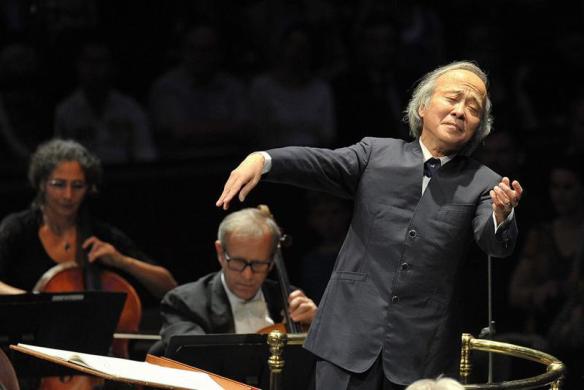
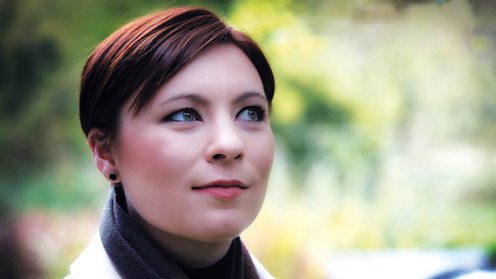
Prom 28: Iurii Samoilov (baritone), Natalya Romaniw (soprano, below), Oleg Dolgov (tenor), BBC National Chorus of Wales, Philharmonia Chorus, BBC National Orchestra of Wales / Tadaaki Otaka (above)

Takemitsu Twill by Twilight (1988)
Huw Watkins The Moon (2018-19) (BBC commission: world premiere)
Rachmaninov The Bells (1912-13)
Borodin Prince Igor – Polovtsian Dances (1869-87)

Royal Albert Hall, Thursday 8 August 2019

Reviewed by Ben Hogwood
Photo credit (Tadaaki Otaka) Chris Christodoulou

You can watch this Prom on the BBC iPlayer here

Given his commission brief, to write a choral piece celebrating the 50th anniversary of the first Moon landing, Huw Watkins must have been tempted to set Neil Armstrong’s immortal ‘one giant leap’ quote to music. Instead however he opted to ‘capture our experience of viewing the moon from Earth’. In doing so he set four intriguing texts pre-dating the first manned visit to our original satellite – two from Percy Bysshe Shelley, and one each from Philip Larkin and Wilfred Owen.

The four were stitched together like phases of the moon in a continuously running 20 minutes, with plenty of opportunity for the orchestra to have their say in between. Watkins has an interesting musical language, always rooted in tonality but using evocative colours and harmonies hinted at in works for chorus and orchestra by Holst, Vaughan Williams or even Hugh Wood.

The Moon had a very satisfactory flow to it, and was passionately delivered by the 130-strong BBC National Chorus of Wales, who clearly enjoyed the experience. Given its length it makes a tricky piece to programme or to appraise on one listen, but it is to be hoped in this anniversary year we get more chances to acquaint ourselves with a composer who writes in a very human voice, and found the ‘definite and bright’ description of Larkin’s verse. That may sound like an obvious statement to make, but surprisingly few composers form a connection with their audience as pronounced as Watkins did here, and even less make the words as clear as he did.

He was of course helped by his ‘home’ orchestra, conducted by a returning prodigal in Conductor Laureate Tadaaki Otaka. Making his first visit to the Proms since 2015. Otaka opened with a piece by his dear friend Toru Takemitsu. Twill By Twilight, in memory of Morton Feldman, was in clear thrall to the Debussy of Nocturnes, creating a dreamy atmosphere. The piece is typical of Takemitsu’s compositions in its dealing with orchestral colour, melody and harmony on equal standing, and it runs slowly if inevitably. In this performance it panned out beautifully, the expansive orchestral sound guided by Otaka’s steady yet relaxed direction.

Otaka has a special place for the works of Rachmaninov, having recorded the symphonies and piano concertos for Nimbus back in the early 1990s. Yet the Russian composer’s choral symphony The Bells was absent from this project, and it was great to hear it in such full-bodied form here. The BBC National Chorus of Wales were boosted still further by the 100-strong Philharmonia Chorus, making a terrific bank of sound that carried all before it – and yet which, thanks to Otaka’s careful balancing, was complemented by the orchestra.


Loud Alarm Bells, the third movement, was suitably terrifying especially at the end, Otaka driving at a quick tempo, and this balanced out the relative joy felt in the first movement, Silver Sleigh Bells, where tenor Oleg Dolgov was a fulsome presence. Soprano Natalya Romaniw sang beautifully in Mellow Wedding Bells, the second movement, her voice effortlessly soaring up to a top B flat without a hint of effort, while baritone Iurii Samoilov offered a darker hue for the depths of Mournful Iron Bells, whose late shift from darkness to light was beautifully done. Rachmaninov’s choral epic has been well served by the Proms in recent years – I remember a terrific outing directed by Vladimir Jurowski – and this was another fine advocacy.

Finishing with Borodin’s Polovtsian Dances was a masterstroke, sending the audience home with several tunes in the locker that simply refused to leave for the rest of the evening! What a gifted melodist Borodin was, and how frustrating that because of his day job – a chemist – he did not leave more for us to enjoy. What he did leave still gives much pleasure, however, and the Polovtsian Dances benefited from such a big choir at their disposal.

The women floated the tune of the Young Girls’ Dance beautifully, while the men – while not quite hitting the passion of Russian voices in this music – were still fulsome and bold. Several orchestral solos stood out, not least from clarinetist Robert Plane, while Otaka’s pacing and linking of the sections was ideal. At 71 the conductor still looks in fine fettle, and his ‘sleep’ gesture at the end was borne more of mischief than genuine fatigue. It seems he, like the rest of us, was fired anew by the passionate Russian music of the concert’s second half.

Ask the Audience at the BBC Proms – Tony Winter on the BBC National Orchestra of Wales playing Vaughan Williams, Parry & Holst

For the latest in Arcana’s Ask The Audience series Tony Winter gives his verdict on the BBC National Orchestra of Wales and their Prom of English music.

Prom 17: Tai Murray  (violin), Francesca Chiejina (soprano), Ashley Riches (bass-baritone),  BBC National Chorus and Orchestra of Wales / Martyn Brabbins

Parry Symphony no.5 in B minor (Symphonic Fantasia ‘1912’) (1912)
Vaughan Williams The Lark Ascending (1914, rev 1920)
Parry Hear my words, ye people (1895)
Holst Ode to Death, Op.38 (1919)
Vaughan Williams A Pastoral Symphony (Symphony no.3) (1921)

Royal Albert Hall, Friday 27 July 2017

You can watch this Prom on the BBC iPlayer here

ARCANA: Tony, how would you describe your musical upbringing?

I had a brief encounter with the violin which I never really got on with – I didn’t get on with the teacher – and then when I was about 13 the guitar, but that was rock music. I played the guitar for years. When I retire it’s going to come out again! I played in a band called The Committee, but to be fair by the time they’d risen to fame they’d chucked me out!

Name three musical acts you love and why:

I love Bach, just because of the melodies. I think you can look at other people and say the orchestration is great but for me the genius is the melody. James Rhodes says ‘the immortal Bach’, which sums it up.

I’ve been playing a lot of David Bowie recently with his demise, I was a big fan of Bowie up to about the Let’s Dance era, and now suddenly I’ve been playing some of the later albums as I’ve been guilty of overlooking some of them. I don’t like it when it gets too commercial! But I think later on he was saying that he didn’t give a shit, which is an approach I’ve always liked. The Outside album was described as ‘difficult and industrial’ but I think it’s great. I wonder in 200 years if people will be playing Bowie? He died at the same age as Shostakovich but who knows? Only time will tell. How many people were on stage tonight, over 100? I’m sure everyone would be using that if there weren’t cost implications to it!

I don’t know whether to say the Rolling Stones or Mozart for the third!

Have you been to classical music concerts before, and if so what has been your experience?

I’ve been to a few over the years – I’ve even started going to a few operas! Living close to the Watford Coliseum I’ve been going to concerts there as I’m a bit of a lazy bugger. I tend to go to any classical concerts they put on there. I’ve seen Beethoven’s 9th, that was a bit echoey. James Rhodes sticks in the mind for his more modern presentation which particularly appealed to my kids. They’re learning the piano so that helped but it helped that he stood up and made a few jokes. I’m not saying everyone has to turn into a variety act but he judged it right. I like sitting at the front in an intimate gig, but coming here tonight though I think I should drag my sorry arse into London more as I don’t think you could fit that orchestra on the stage in Watford!

Can you give a snapshot of the music you’ve been listening to in the past week?

Yesterday I was going through making a playlist for stuff we’re going to play on holiday when we’re driving in the car. I found something on Tidal called ‘Music Your Kids Like That Won’t Drive You Crazy’ but we were doing one of our own. We had a couple of Michael Jackson tracks – Thriller, Pretty Young Thing (there’s some good grunting on that!) My daughter jumps up and down on the sofa to it.

I stuck on some David Bowie because my wife wanted Adam Ant – Stand And Deliver – and the video put me in mind of Ashes To Ashes – which then made me think of Life Is Lost, which refers back to that song. Bowie was brilliant at referring back to things from years before. We had A-ha, Earth, Wind and Fire – an ever-growing playlist!

Apart from that I’ve been playing Daniel Barenboim’s recording of the Bach Well-Tempered Clavier at work. It’s my fallback and I put it on when it all gets a bit too much for me!

What did you think of tonight’s Prom?

I thought it was excellent! Parry I know absolutely nothing about. With Holst I know the proverbial Planets but nothing at all about the piece we heard tonight, and Vaughan Williams I’m very familiar with. I’m a huge fan anyway, and think his music is absolutely sublime, but it also comes from being a massive fan of The Fast Show – with Ralph and Ted! A friend of mine used to say ‘rural cowpat music’, which is not my take on it but there you go. I do think it is reminiscent of a lost England – not even John Major’s Middle England, an England before that – and certainly not Theresa May’s Brexit idiot England that we have now. We’re getting a bit political here!

What did you think of the Parry’s Fifth Symphony?

I thought it was a bit short – that’s not a symphony! I was quite impressed with it, and some of it was reminiscent of Carnival of the Animals for me, some of the slow bits in the score. I’m not at all familiar with it but I did enjoy it.

Which of the pieces left the most impression tonight?

It’s the one I am most familiar with – which is The Lark Ascending. The soloist (Tai Murray) was fabulous and it is one of my favourite pieces anyway, I just love it. It’s like the pop concert where the Rolling Stones do Satisfaction I think!

How would you describe your experience in the Arena tonight?

It was great. I love standing up in there, I think it’s more rock ‘n’ roll, you can move to the front. Someone came and stood in front of us in the first half but there you are! I really enjoyed it.

Verdict: SUCCESS

Prom 17 – BBC NoW & Martyn Brabbins: Vaughan Williams ‘Pastoral’ Symphony, Parry Symphony no.5 & Holst

Prom 17: Tai Murray  (violin), Francesca Chiejina (soprano), Ashley Riches (bass-baritone),  BBC National Chorus and Orchestra of Wales / Martyn Brabbins

Parry Symphony no.5 in B minor (Symphonic Fantasia ‘1912’) (1912)
Vaughan Williams The Lark Ascending (1914, rev 1920)
Parry Hear my words, ye people (1895)
Holst Ode to Death, Op.38 (1919)
Vaughan Williams A Pastoral Symphony (Symphony no.3) (1921)

Royal Albert Hall, Friday 27 July 2018

Reviewed by Ben Hogwood Photos of Martyn Brabbins and Tai Murray (c) BBC/Mark Allan

You can watch this Prom on BBC4 on Sunday 22 July here

This was a fascinating concert, a celebration of Sir Hubert Parry both in his music and the work of his pupils.

Parry – composer of the music to Jerusalem and royal anthem I Was Glad for many of us – wrote five symphonies, and it is bordering on ridiculous that only one of them, the Symphony no.5 in B minor, has been heard at the Proms before. Hopefully this excellent performance from the BBC National Orchestra of Wales under Martyn Brabbins will open the door to further hearings, for it presented the piece as an extremely coherent stream of consciousness.

With its Schumann-like dimensions, the Fifth flows for 27 minutes unabated, and is almost constantly melodic, its themes and motives passed through the instruments. There were some lovely moments of clarity in the first movement where a certain English splendour came through, whereas elsewhere Parry was in thrall to Richard Strauss and his hero Brahms without ever slipping into parody.

The programmatic nature of the piece is revealed in the titles of its movements (Stress, Love, Play and Now) and Brabbins shaped his response accordingly, lovingly tendering the phrases but enjoying the more adventurous and colourful aspects of the score.

The rapt stillness of Vaughan WilliamsA Lark Ascending followed, in which the audience were immediately relocated to the stillness of an English field to witness the freedom of the lark as its song spiralled upwards. Tai Murray (above) was the violinist inhabiting its character, and she allowed the music all the room it needed. Brabbins enjoying the softly burnished strings – some beautiful shading from the BBC Welsh – before the slightly more playful and folksy central section took hold. Her encore, a gravity defying account of Ruggiero Ricci’s arrangement of Tárrega’s Recuerdos de la Alhambra, felt a little misplaced but was played with exceptional athleticism and virtuosity.

There was more music from Vaughan Williams’ teacher Parry after the interval, in celebratory festival mood for Hear my words, ye people. This presented a couple of tricky performance issues, with the soloists Francesca Chiejina (below) and Ashley Riches just in front of Sir Henry Wood’s bust at the back of the stage, with a 120-strong choir behind them. To the side were the brass of the BBC Welsh – but all gelled together in classic Anglican exultation, nicely held together by organist Adrian Partington, who delivered sensitive registrations on the Royal Albert Hall organ.

Parry’s celebrations were checked by a polar opposite in a work from another of his pupils, Holst’s Ode to Death – a choral setting of Walt Whitman. This left an incredibly powerful impact in an understated way, leaving us mindful of the First World War – to which the piece responds. The best Holst music takes its listener to the brink of another world and this was another such occasion, Brabbins overseeing a performance of subtlety and beauty but uncertainty too, especially when the composer’s oblique harmonies and silvery orchestration were at work. As in the Parry, the BBC National Chorus of Wales were superb.

Vaughan Williams invested heavily in the First World War, not from a position of overwrought patriotism but from a sense of duty to his country. What he saw as an ambulance driver in France in 1916 is not fully documented, but it left a lasting impression fully realised in A Pastoral Symphony, his third – following musical depictions of the Sea (no.1) and London (no.2).

While ostensibly a peaceful work, there are hints around the edges that its composer is struggling to come to terms with peace in the wake of such a terrible conflict. Martyn Brabbins felt this too, and brought from the orchestra some beautifully judged phrasing, colourful textures and eloquent playing, none more so than Neil Brough‘s exquisite off-stage trumpet solo in the second movement.

Everything was headed for the appearance of soprano Chiejina at the height of the fourth movement, and the balance was ideal as her wordless vocalise sounded from on high – a touch too much vibrato for my taste, but leaving a strong impact nonetheless. In our uncertain times now, we would do well to heed Vaughan Williams’ subtle but incredibly powerful warning of the consequences of war.