BBC Proms #6 – BBC Philharmonic Orchestra / Sir Andrew Davis: Vaughan Williams & Tippett Fourth Symphonies

Prom 6 – BBC Philharmonic Orchestra / Sir Andrew Davis

Vaughan Williams Symphony no.4 in F minor (1931-4)
Tippett Symphony no.4 (1976-7)

Royal Albert Hall, London
Tuesday 19 July 2022

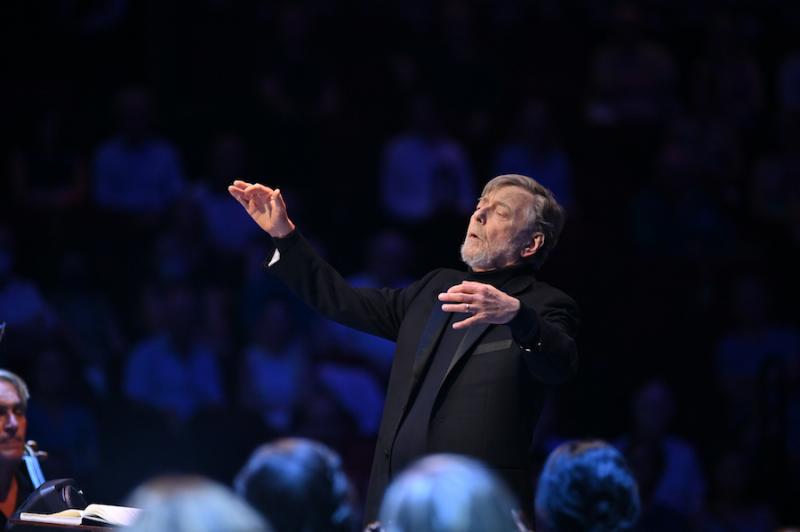
Reviewed by Richard Whitehouse Photo (c) Chris Christodoulou

Whether or not the Fourth Symphonies by Vaughan Williams and Tippett had previously been scheduled together, they made for a striking and provocative programme such as was its own justification. Omer Meir Wellber clearly thought so when this concert was planned and, even though indisposition had led to withdrawing from this year’s Proms, the presence of Sir Andrew Davis on the podium could hardly have been more conducive to the BBC Philharmonic Orchestra giving performances of the interpretive insight and technical conviction as were evident this evening.

Admittedly the Albert Hall’s opulent acoustic is never the best setting for VW4, the visceral impact of whose opening was inevitably diluted. Allowing for rather more expressive leeway than he might otherwise have done, Davis paced this explosive movement securely with just a slightly listless take on its coda detracting from the whole. The Andante was the highlight here – its fatalistic course exuding gravitas but never dragging, with the tritonal plangency of its main climaxes palpably in evidence and pathos of its final bars enhanced by an affecting contribution from flautist Alex Jakeman. This acoustic may have obscured something of the Scherzo’s contrapuntal ingenuity but not its sardonic humour or, in the trio, didactic coyness. The stealthy transition into the Finale could have had even greater cumulative focus, but what followed had all the requisite impetus – its central interlude raptly delineated, then the drama of its ‘epilogo fugato’ conveying increasing velocity through to the starkly inevitable return of the opening gesture and what is the most unequivocal four-letter ending of any symphony.

Interesting to recall the temporal distance between these pieces is now less than that between the Tippett and the present. Enthusiastically received at its Chicago premiere and one among a handful of his works still revived following his death, Tippett’s Fourth Symphony evinces  a ‘birth to death’ trajectory that differs – crucially so – from its assumed model of Sibelius’s Seventh in not being a cumulative design; its climax being rather the kinetic developmental paragraph at its centre and from where the piece fans out, in a sequence of evolving episodes, back to the launching of its introduction and onward to the passing of its coda. Although he may have directed performances of greater tautness, Davis here secured a persuasive balance between unity and diversity – bringing a metaphysical poise to its ‘slow movement’ then a deft whimsicality to its ‘scherzo’, whose respective qualities underlined the confrontational drama elsewhere. Lavish writing for brass and percussion helps makes this Tippett’s most virtuosic such statement, in which the BBC Philharmonic was rarely to be found wanting.

A less successful component of this reading was the latest attempt to represent the ‘breathing effect’ specified by the score, in which the real-time voice of CJ Neale seemed hardly more successful than those attempts of wind machine, sampler et al to realize Tippett’s speculative imagery. No matter – any such overreaching was part and parcel of this composer’s inherent ambition; an ambition, moreover, which his present-day successors would do well to emulate. Almost a century and half-century on, both these works pose challenges constantly to be met.

In concert – BBC Philharmonic Orchestra & Jac van Steen – David Matthews Symphony no.10 world premiere, Schubert & Brahms

jac-van-steen

Brahms Piano Concerto no.1 in D minor Op.13 (1854-8)
Schubert
Overture to Rosamunde D797 (1820)
David Matthews
Symphony no.10 Op.157 (2020-21) [World premiere]

Stephen Hough (piano, below), BBC Philharmonic Orchestra / Jac van Steen (above)

MediaCity UK, Salford Quays
Friday 20 May 2022, 3pm

Written by Richard Whitehouse

A substantial programme was the order of the day for this afternoon’s studio concert from the BBC Philharmonic with Jac van Steen, given at the orchestra’s regular base in MediaCityUK and that featured a first performance anywhere for the Tenth Symphony by David Matthews.

Whereas his previous symphony was written for relatively modest dimensions, the Tenth marks a return to larger forces: triple woodwind (with doublings), four horns, three each of trumpets and trombones, tuba and four percussionists alongside timpani, celesta, piano, harp, and strings. It also finds Matthews (above) retackling the one-movement format that dominated his earlier symphonies, allied to a subtle process of developing variation such as ensures unity across a varied and eventful discourse. Not least when that massive opening chord sets out a long-range tonal and harmonic trajectory for this work overall, and to which a pensive (offstage) cor anglais solo then intensifying string fugato provide both continuation and contrast by anticipating the types of expression and motion as variously come to the fore.

Distinctive in themselves yet drawn into a tensile and cohesive entity, the constituent sections take in a wistful intermezzo then an agile scherzo on the way to a central culmination whose increasingly explosive energy likely marks a point of greatest engagement with that opening chord. The music duly heads into a slower episode of sustained emotional raptness, elements heard earlier gradually being recalled through an unforced while never discursive process of reprise towards a coda whose ending seems the more conclusive for its poised equivocation. An absorbing and often gripping exploration of symphonic tenets such as Matthews has long pursued, persuasively realized by the BBCPO and van Steen – whose support of the composer – having already recorded the Second, Sixth and Eighth Symphonies – hardly needs restating.

Before the interval, Stephen Hough (above) was soloist in Brahms’s First Piano Concerto – a piece he has given many times (not least a memorable reading at London’s Royal Festival Hall in the early 1990s, Andrew Davis also giving a seismic account of the Symphony by the late Hugh Wood). There was emotional breadth aplenty in the initial Maestoso, but also latest energy as came to the fore in a combative development and tempestuous coda. Nor was the symphonic aspect underplayed in what is still the most monumental opening movement of any concerto.

If the central Adagio lacked a degree of repose in its orchestral introduction, Hough’s take on its almost confessional solo passages brought the required inwardness, with the course of this movement towards its agitated peak or enfolding serenity at its close never in doubt. Nor was that of the closing rondo, especially a central episode whose string fugato was deftly rendered then the piano’s gentle response enticingly conveyed. After the cadenza, horns and woodwind emerged as if leaving a benediction prior to the triumph that coursed through those final bars.

Throughout this performance, van Steen was an alert and responsive accompanist – then put the BBC Philharmonic through its paces with an animated account of Schubert’s Rosamunde (a.k.a. Die Zauberharfe), which made for an engaging if unlikely entrée into the Matthews.

For more information on David Matthews you can visit his website here. For more on the artists in this concert, click on the names to access the websites of Stephen Hough, Jac van Steen and the BBC Philharmonic Orchestra

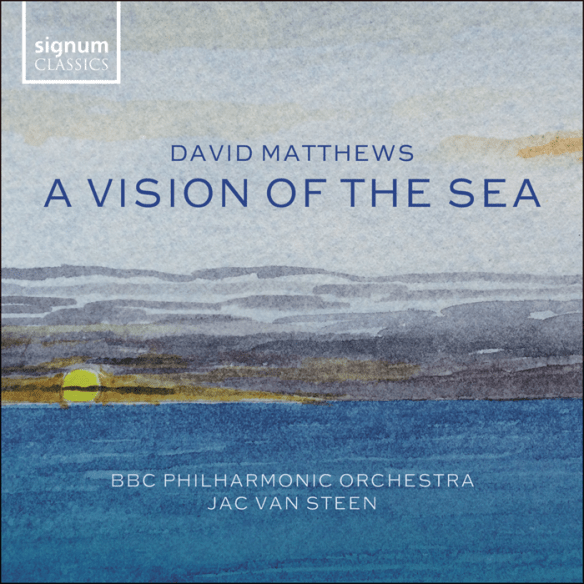
On record: BBC Philharmonic Orchestra / Jac van Steen – David Matthews: A Vision of the Sea (Signum Classics)

BBC Philharmonic Orchestra / Jac van Steen

David Matthews
Toward Sunrise Op.117 (2012)
Symphony no.8 Op.131 (2014)
Sinfonietta Op.67 (1995)
A Vision of the Sea Op.125 (2015)

Signum Classics SIGCD647 [67’42”]
Producer Michael George
Engineer Stephen Rinker

Recorded 7 November & 6 December 2017, BBC Studios, Mediacity, Salford, UK

Reviewed by Ben Hogwood

What’s the story?

This album is billed as an approachable route in to the music of David Matthews, one of the most prominent living British symphonic composers. Matthews has nine symphonies under his belt already, and we hear the Eighth as part of this programme, but he has a wealth of orchestral music alongside, from which Jac van Steen and the BBC Philharmonic Orchestra draw three works.

What’s the music like?

Matthews’ Symphony no.8 forms the centrepiece of the program, a substantial three-movement work completed in 2014. Its taut musical arguments suggest the influence of Sibelius, the harmonic language appears to build on late Vaughan Williams, and there are references to Debussy and Stravinsky in the orchestral colours used by the composer.

Yet this is by no means a derivative work. Matthews writes in the booklet note that he no longer feels the need to defend writing tonal music, and this argument gets the strongest possible endorsement from the music itself. From the opening chord, rich in woodwind, the musical exchanges are compelling, the harmonies often bewitching, and the form instinctive, written as it is by a hand of symphonic experience.

Too many newer symphonies are let down by their faster music, but not in this case. The first movement unfolds with powerful statements from brass and strings, their energetic arguments punctuated by rolling timpani. The bracing energy is complemented by a reflective Adagio, whose soft chords achieve contemplation in the context of a surrounding, uneasy mood. The music builds, reaching an impressive apex with full-bodied string sound before returning to its original state.

Matthews finishes with an uplifting set of four dances, inspired in part by vapour trails on the Kent coast. The bright colours and persuasive triple time rhythms add a lightness of touch to the full orchestra passages, resembling the profile of the second movement Sibelius’ Fifth Symphony…in a good way! The lightness of touch Matthews achieves at the final resolution is both unexpected and charming.

After the Eighth Symphony we hear the Sinfonietta from nearly 20 years earlier. A tightly compressed piece, its leaner textures generate a good deal of tension, as does the jousting between instrumental sections of the orchestra. The piece is in effect a short concerto for orchestra, culminating with thunderous timpani and short but probing melodies. It is convincing in its outcome, but less accessible with its more oblique melodies.

The accompanying pieces show Matthews’ ability to paint pictures with an orchestra. His tone poem Toward Sunrise begins the album. It is a response to the sun’s ability to make its own music through magnetic loops coiling away from its outer atmosphere, captured in sound by students at Sheffield University. Matthews takes two notes heard in that recording and transfers the motif to the depths of the lower strings, conveying the passing shadows of the night from which the sun will emerge. As the sunrise itself begins the orchestra tingle with anticipation, a volley of timpani rings out and the first rays poke through as the piece ends. It is the ideal piece with which to start.

The hiss of waves on the beach is immediately audible in A Vision of the Sea, a four-part tone poem completed in 2013. British composers have long written effective pictures of the sea, notably Vaughan Williams, Britten and Bridge, and Matthews can be added to that list. His first-hand account of English Channel vistas, punctuated by herring gulls, gets into the minds’ eye of the listener, painted with the help of ghostly piano and an expert use of the percussion section. The vision ends with another sunrise, and the crash of the waves on the shore.

Does it all work?

It does. The program is ideally judged, each work succeeding on its own terms but working as part of the bigger whole. The clinching factor is these authoritative performances from the BBC Philharmonic Orchestra, who have a very strong relationship with Matthews’ music. They appreciate his credentials as a fine symphonist, and his ability to create pictures in an instant.

Is it recommended?

Yes, with great enthusiasm. So many works premiered in this century are not followed up with second performances or recordings, which can be frustrating for concert goers, so it is wholly satisfying to see Signum and the BBC Philharmonic investing so much in this release. Their efforts are handsomely rewarded.

For further information on this release, visit the Signum Classics website.

On record – Louis Lortie, BBC Philharmonic Orchestra / Edward Gardner – Saint-Saëns: Piano Concertos 3 & 5 (Chandos)

Saint-Saëns
Rhapsodie d’Auvergne Op.73 (1884)
Piano Concerto no.3 in E flat major Op.29 (1869)
Allegro appassionato in C sharp minor Op.70 (1884)
Piano Concerto no.5 in F major Op.103 ‘Egyptian’ (1896)

Louis Lortie (piano), BBC Philharmonic Orchestra / Edward Gardner

Chandos CHAN 20038 [66’51”]

Producers Mike George and Brian Pidgeon
Engineer Stephen Rinker

Recorded 13 January 2018 (Rhapsodie d’Auvergne), 20 & 25 February 2019 (other works), Media City UK, Salford, Manchester

Written by Ben Hogwood

What’s the story?

This is the second installment of Saint-Saëns piano concertos from Louis Lortie, Edward Gardner and the BBC Philharmonic Orchestra. It completes the cycle of five they have been recording for Chandos.

Saint-Saëns’ Piano Concertos tend to be overlooked in the concert hall, with only occasional performances for no.2 and no.5, which was written in part during a holiday in Egypt. Their neglect is unfortunate, as there is much to enjoy as the pieces unfold. The demands on the solo pianist may be considerable, but the rewards outweigh the effort required for sure.

What’s the music like?

This new release offers the Piano Concerto no.3 in E flat major, still a relatively early work, where Saint-Saëns builds on the influence of Beethoven and Liszt to create a piece with memorable themes and unusual formal devices. We then move to his later period and the Piano Concerto no.5, the ‘Egyptian’. This is a daring piece in the sense that Saint-Saëns was not following the trend of modern music set by the post-Wagner composers, or the new sound worlds offered by Debussy and Ravel. Instead he was writing for the virtuoso pianist in a descriptive and positive sense – conventional but stretching the established ‘rules’ of the concertos. This piece is ultimately fun and packed with tunes, while asking the soloist to achieve some pretty difficult technical feats. There is a faint exoticism capturing the carefree mood of the composer on vacation.

Topping up the positive outlook are the Rapsodie d’Auvergne and the Allegro appassionato, both shorter pieces for piano and orchestra with a similarly sunny outlook. The Allegro appassionato has more drive, while the Rapsodie is a breezy piece for the great outdoors. As the booklet writer Roger Nichols observes, it is based on a tune the composer ‘heard sung by a peasant washing her clothes in a stream in the Auvergne. As such, it is possibly the only folksong from France that Saint-Saëns ever included in his music’.

Does it all work?

Yes. This is extremely positive music, celebrating the combination of piano and orchestra with a good deal of energy.

The concertos are nicely balanced. The better known Fifth, stacked high with good tunes, finds Ed Gardner keen to develop its exotic air with the lush textures of the BBC Philharmonic strings in the first movement. There is a dramatic salvo to begin the second movement, where Lortie gets the melodic inflections just right, then an exotic minimalist passage towards the end, cutting to a real flight of fancy into the finale. Lortie gets a terrific substance to the sound of the lower end of the piano.

The Piano Concerto no.3 if anything fares even better, its status elevated well above the derivative thanks to the stress on its memorable themes. There is a heroic air to the piano part that Louis Lortie develops very nicely, and his commanding performance gives the piece its essential forward drive.

The Rhapsodie d’Auvergne is a bubbly piece, starting softly but gaining ground during the development of its theme. There are brief connections with Brahms before an effervescent and watery sequence, with excellent work in the right hand from Lortie.
Meanwhile the Allegro appassionato is a red-blooded affair very much in the vein of Liszt, asking the soloist for a few feats of athleticism while remaining close to the composer’s melodic heart.

Is it recommended?

Yes. This is an ideal release for banishing any lingering winter blues! There may be some really good recordings around already of the concertos, thanks to Stephen Hough and the City of Birmingham Symphony Orchestra under Sakari Oramo (Hyperion), and looking further back the classic 1980s recordings made by Pascal Rogé and the London Philharmonic Orchestra with Charles Dutoit (Decca).

These sparkling new versions, beautifully recorded, offer a great deal of passion and panache, and at the very least take their place alongside the best..

Listen

Buy

You can listen to clips from this disc and purchase a copy at the Chandos website here

Prom 14 – BBC Philharmonic / John Storgårds: Single-movement Sibelius, Zimmermann, Schubert & Wagner

Prom 14: Elizabeth Watts (soprano), Louis Lortie (piano), BBC Philharmonic OrchestraJohn Storgårds

Wagner Die Meistersinger von Nürnberg – Prelude to Act One (c1861)
Schubert (orch. Liszt) Four Songs (1825/1815/1826/1815, orch. 1860)
Zimmermann Symphony in One Movement (1947-51, rev. 1953)
Schubert (arr. Liszt) Fantasy in C, D760, ‘Wanderer’ (1822, arr. c1850)
Sibelius Symphony No. 7 in C, Op. 105 (1924)

Royal Albert Hall, Tuesday 24 July 2018

You can listen to this Prom by clicking here

Reviewed by Richard Whitehouse

John Storgårds has given some enterprising concerts during his tenure as Chief Conductor of the BBC Philharmonic Orchestra, and this evening’s Prom was a further instance with its programme of mainly one-movement pieces and an underlying emphasis on symphonic cohesion, even unity.

The exception was the sequence of four songs by Schubert, arranged for orchestra by Liszt so that a tenuous cohesion is evident – without this being a song-cycle as such. Elizabeth Watts (below) duly had the measure of their predominantly sombre sentiments – ranging from the distanced recollection of Die junge Nonne, via remorseless passing of experiential time in Gretchen am Spinnrade and speculative radiance of Lied der Mignon, to visceral representation of fate in Erlkönig. Storgårds teased many subtleties from Liszt’s judiciously restrained orchestration.

Preceding this came a surprisingly dour account of the Prelude from The Mastersingers of Nuremburg. This grandest of Wagner music-dramas is also the most symphonic, not least its Prelude as it deftly outlines a four-movements-in-one format. While not being oblivious to this, Storgårds might have characterized these episodes more potently, though this may have been in line with his tendency to play down the music’s opulence and majesty. What resulted was a subdued and earnest performance that hardly marked him out as a budding Wagnerian.

Concluding the first half was the Symphony in One Movement by Bernd Alois Zimmermann; a timely hearing in this centenary year of the composer’s birth. Although the more discursive original version (complete with organ histrionics) has recently been revived, this revision is audibly more focussed in form and expression as it traverses a quirky yet combative sonata design – (modified!) exposition repeat included – before emerging full circle in a mood of unbridled ferocity. Storgårds was at his interpretative best here, maintaining a tensile course over an eventful score where influences of mid-century symphonism do not outface pointers to the intricacy or intensity of Zimmermann’s mature music. A notably enthusiastic reception suggested that tonight’s audience ‘got’ what the composer was about in this singular piece.

Time was when Liszt’s concertante realization of Schubert’s Wanderer Fantasy was a staple at these concerts, but this was only the second hearing in nearly six decades. 33 years ago, the soloist was Jorge Bolet at his unpredictable best, but Louis Lortie’s rendition (above) was altogether subtler as he brought out the pathos of the Andante then jocularity of the Presto. If the outer Allegro sections felt reined-in, this was not at the expense of that keen virtuosity informing Lortie’s playing in his solo passages or coruscating interplay with the orchestra at the close.

A century on, Sibelius not only ran movements together in his Seventh Symphony but fused them into a seamless and powerfully cumulative whole. Storgårds was certainly alive to this in what was a purposeful and often insightful reading; a little unsettled in those introductory pages, perhaps, but thereafter gauging the various transitions with a sure sense of where this music was headed while investing the vertiginous trombone entries with implacable majesty. One of this season’s most absorbing concerts thus far was brought to an impressive close.