Ask the Audience at the BBC Proms – Annie Turner on the BBC Symphony Orchestra

Ask The Audience Arcana at the Proms
annie-turnerThis is the latest in the series where Arcana invites a friend to a Prom who does not normally listen to classical music. In an interview after the concert each will share their musical upbringing and their thoughts on the concert – whether good or bad! Here, Annie Turner (above) gives her thoughts on Prom 62.

Baiba Skride (violin), Siobhan Stagg (soprano), Christopher Maltman (baritone) BBC Symphony Orchestra / Siobhan Young

Bayan Northcott Concerto for Orchestra (2014-2016, world premiere); Mozart Violin Concerto no.5 (1775); Zemlinsky Lyric Symphony (1922-23)

You can listen on the BBC iPlayer here

Arcana: Annie, what was your musical upbringing?

I was born in 1980 and so my earliest musical memories would be Vangelis, Dire Straits, Phil Collins and stuff like that, so I’m very fond of that music in a sentimental way. I was really interested in playing music, and I remember when I was about seven or eight I was absolutely desperate to learn the recorder, as the older kids in school were playing them. My mum asked the teachers but they said I was too young, and I had to wait until I was nine!

I learned recorder and got to play in the school concerts, but after that you pick up another instrument, so I did keyboard. I went to a country school in Australia, so there wasn’t a big music program. I learned piano for a while but struggled with the music because I didn’t find it interesting! It was classical, and it was a bit boring for me as a kid, but I really loved listening to music and working out the fidelity for myself. My dad was really into Andrew Lloyd Webber, and I used to work out bits of melody from Phantom of the Opera and Cats.

Then I stopped and didn’t pick it up again until high school when I was interested in bands. I got interested in grunge and wanted to play it, so I got into drums and guitar lessons, and really loved that. By the time I was that age I got really shy and didn’t want to play in front of anybody, so I was a bedroom musician. I still kept studying music at school though, and then when I graduated from high school I really wanted to play in a band.

I moved to Melbourne to go to university, and it was my dream to play in a band, so I just had to get over my stage fright! I joined any band that would have me…and I’ve played in some terrible bands and some awesome bands, but I mostly ended up playing drums in all of them, so I dropped the guitar. I played in a heavy metal band, a punk band and an experimental bands, a few jam bands. I did that for a few years, and we recorded and toured which was great. Then I moved to London and didn’t do it again, because London was a bit too big and intimidating and it was hard to have the resources. So that was my musical upbringing!

Could you name three musical acts you love, and why you love them?

There is a Norwegian black metal band called Satyricon, which I love, and I love them because I find their music is well written, well-constructed, engaging, it’s very melodic, atmospheric, it’s quite dark as well which I find when you’re in that mood. It’s frenetic, there’s a lot of energy to it, and I find it really interesting.

I don’t find I listen to acts any more, I listen to songs rather than acts…but I actually love Calvin Harris! I’ve followed his career, and I don’t love everything that he’s done, but I really love the fact he’s a pop purist. He writes and produces but he does it very well in a purely pop way but I think he respects that genre. He does quality work and it’s such good, good pop I think it’s genius – the construction, the way he has that mix of happiness and sadness in one song. Pop music you have to capture the kind of strategy of teen romance, which is kind of ‘gaggy’ but at the same time it’s got drama, some of it’s got humour, and I just think he’s excellent and very intelligent pop auteur.

For the third I would have to say I love Nirvana really, because that was the band I really got into in depth, because it was rebellious, artistic, subversive, but also even though it was very aesthetically abrasive it was pop music right down the line in the middle. It got me very interested in playing music as well as listening to music, and as well it had more implications for popular music. I was very obsessed with that band for a good five years!

What has been your experience of classical music so far?

I’m generally familiar with the big hits because you hear them on TV, and on adverts, and there are definitely pieces I’ve come to know and like, but other than that it’s really through watching films. I did a degree in film theory, and studied lots of films, but didn’t really study the music on the film.

I guess also there was a time when I would tune the radio to Classic FM because I didn’t want anybody to sing at me, I didn’t want to hear any words! I wanted something I knew would be relatively calm and peaceful. I know it’s not always like that though, and that classical music can be tumultuous! I was seeking something that would be a bit more calming I suppose. I remember I did buy an iTunes album of the greatest hits of the classics, but I didn’t really follow it any further than that.

How did you rate your first Proms experience?

I really enjoyed it. I had no expectation, and I guess I thought I might have got bored because if I didn’t know the music I might not follow it. I was surprised that I really did find myself getting enthralled, so I rated it to the point where I would definitely come back on my own. I would like to investigate it more, ask for tips, you know?

I like the opera Carmen, but any other opera I don’t like, because sometimes it sounds to me like yelling. I know you could say I listen to death metal, and that’s shrieking, but you know, it’s just yelling! The vocal music we just saw I didn’t think about it that way, I heard the music and looked at their faces, saw that emotion, and it felt a bit like I was watching a play. I think I might be coming around to being converted!

What did you think of the Bayan Northcott Concerto for Orchestra, the first piece?

That started off really avant-garde, and more modern, and I guess that surprised me in how it developed. It developed very smoothly into something that was a bit more formulaic in a classical sense. I had to remind myself that I didn’t really know what was going on, and the transitions I enjoyed. I felt that one took you on a bit of a journey that was quite surprising. I particularly liked the dynamics where you could hear something that was really loud, layered and reverberant, and then you could get something that was really quiet and minimal on one instrument. I enjoyed the delicacy of the sound, because when you see a band or a DJ you don’t get that, you just get ‘loud’ or ‘off’!

What did you think of the Mozart?

I thought I recognised it from having heard it before. I really liked it, and having someone palying solo you can focus in on it and follow their emotion, which was new and interesting, and I thought it was interesting too how the orchestra seemed to be all on the same level.

Normally you go to see a band and you think I’m seeing my idols, or seeing this famous person, and the people who created the music. They’re in a higher hierarchy so to speak. With the orchestra I had this sense that they’re just normal people, serving the music and all enjoying it. I liked it when it wasn’t about the composer, the rock star, and not about the conductor – they’re not facing us, they’re just delivering it. I really liked that sense of the music being the star. That was a new experience, you could see a different perspective even in the formalities of ‘now it’s my tern to stand up and play’, the ritual of it. It was really touching, and I think classical music might tend to have this image of being a little bit posh, a little bit fancy, but actually these people are not royalty, they’re working for the music. There wasn’t any grandiosity, it was very humble.

And the Zemlinsky?

That was probably my favourite. I was a bit apprehensive because it was like opera, and I’ve not really liked opera before, plus it sounded like it was in German. I don’t speak German, but I wouldn’t have thought it would be a language that would lend itself to singing! But OK, I was really surprised. I stopped thinking about the music. My mind did keep wandering and I was thinking about my own life, and I don’t know if the music was really influencing that or not, but it wasn’t like I was standing there going oh, that was a great bit of trombone, I was thinking about my own life! I was thinking about what was going on in my life.

I’ve recently started doing meditation, and know that it’s good to be present and mindful, so I did start to drag myself back and focus on the sounds and what was going on. It was good, though I did feel like it was a soundtrack to my thoughts. There was a lot of percussion and I really liked the textures of the drums, how deep that sound is, and I think there was a lot of melancholy and ‘blue’ notes. I like that darker sound, I guess that might be a bit of a cliché, but the sadder stuff probably says more to me than the jolly little dances I suppose!

I deliberately didn’t research the program, so think I will read that on the bus home which will be really interesting, to see what was in the text!

Would you go again?

I would. It would be amazing to see a piece I was already familiar with and really liked, so next year I can find out which composers I like more and make a plan to see more of them. At the same time I would also select something at random – something familiar and something new – and see how that works!

Verdict: SUCCESS
 

BBC Proms 2016 – Zemlinsky’s Lyric Symphony, Mozart & Northcott world premiere – Baiba Skride, Simone Young & BBC SO

bbcso-zemlinsky

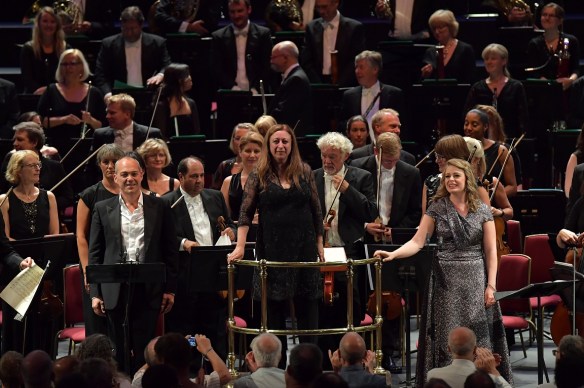
Soloists Christopher Maltman and Siobhan Stagg take the applause with conductor Simone Young and the BBC Symphony Orchestra after their performance of Zemlinsky‘s Lyric Symphony (c) Chris Christodoulou

Prom 62; Royal Albert Hall, 31 August 2016

You can listen to the Prom on the BBC iPlayer

Every festival has its ‘down’ periods – and here it was the turn of the Proms. Don’t stop reading there though, as by ‘down’ period I mean a Royal Albert Hall that was perhaps half full and music that was relatively unknown. The combination can on occasion lead to an unsatisfactory evening, but here it was a heartening opposite.

It was good to note a rare UK appearance for the Australian conductor Simone Young, her first at the Proms. Young is predominantly an opera specialist, so it was perhaps inevitable that Zemlinsky’s Lyric Symphony of 1923 should bring out the very best in her brief relationship with the BBC Symphony Orchestra.

This powerful, passionate account got off to the best possible start, assertively bringing Zemlinsky’s themes of doomed love to the front of the layered texture and packing the music with drama. Here Young was helped by the woodwind and brass, horn player Nicholas Korth in particular, though when singers Christopher Maltman and Siobhan Stagg got into action theirs was the defining contribution.

Baritone Maltman’s silky contribution was brilliantly judged, an ideal complement to Stagg’s soaring soprano, though the biggest notes on her part were saved for the particularly anguished lines in the poems of Rabindranath Tagore. When she began Stratt was a little coy, beautifully so, for this got the audience on to her side and meant we all felt her tragedy in Vollende denn das letzte Lied (Then finish the last song). Maltman it was who ended the symphony, striving for peace, which Young ultimately found in the beautifully floated coda.

The performance was the shade to the light of Mozart’s Violin Concerto no.5. This did receive a slightly heavy performance in comparison to others, but the strings of the BBC SO were beautifully graceful in the slow movement and accommodating to soloist Baiba Skride (below, with the orchestra) in the outer fast movements.

bbcso-skride-mozart

Skride’s violin makes a beautiful sound, and it was a feature of her performance that the notes were floated towards the audience, respectful of the orchestral accompaniment but making the most of Mozart’s melodic inspiration. The choice of cadenzas by Brahms’s contemporary Joseph Joachim was a little risky but the virtuosic passages were sensitively handled, while in the finale, the so-called ‘Turkish’ part of the concerto that actually sounds more Hungarian, there was a pleasing rustic feel, as though we had all been ushered outdoors together. As a footnote to this, Skride chose a movement from a sonata by the eighteenth century composer Johann Paul von Westhoff as her encore.

First up on the program was a world premiere, Bayan Northcott’s Concerto for Orchestra. It is great to have so many in the Proms season, with the unfortunate caveat that not many of these pieces get a second hearing. This one was a premiere in two respects, being Northcott’s first work for orchestra alone. At the age of 76 that is an impressive achievement, and his care over the composition could be sensed in a compressed piece that was full of incident. Debts to 20th century composers such as Hindemith were occasionally felt, but the enthusiasm of the two fast movements drove the music forward, speaking in tunes but also impressing the ear with their instrumental textures too.

Ben Hogwood

Ask the Audience at the BBC Proms – Tim Squier on Beethoven, Dutilleux and HK Gruber

Ask The Audience Arcana at the Proms
gruber-buskingThis is the continuation of a series where Arcana invites a friend to a Prom who does not normally listen to classical music. In an interview after the concert each will share their musical upbringing and their thoughts on the concert – whether good or bad! Here, Tim Squier gives his thoughts on Prom 34.
Håkan Hardenberger (trumpet), Claudia Buder (accordion), Mats Bergström, BBC Symphony Orchestra / Sakari Oramo

Dutilleux Timbres, espaces, movement (1990)
Gruber Busking (2007)
Beethoven Symphony no.5 in C minor (1804-1808)

You can listen on the BBC iPlayer here

Arcana: Tim, what was your musical upbringing?

It was my mum that brought me up, and in terms of music it’s not worth going there really! It was very middle of the road – Cliff Richard, some of The Beatles. I discovered most things myself pretty much, she would have the radio on sometimes – but when I first discovered my own music it was via an alarm clock, an FM radio that she gave me. It was all the pop of the time in 1984-1986 – Madonna, Prince, A-ha, your Now 1984. Certainly in my early years there was Band Aid – and I wasn’t particularly cool. There wasn’t anything of a classical background in there!

Could you name three musical acts you love, and why you love them?

Harold Budd is a big one for me. I do love my ambient and he doesn’t seem to put a foot wrong really. He just seems to have a certain emotion and style where you can just get lost in it. It can be background but it can be foreground as well. I can work to it, and not be fully tuned in, or I can be sitting down and listening to it and it works just as well.

I’m going for artists who have been with me for a long time, and Fleetwood Mac are an act that I could never really get enough of. They’ve gone through different phases like the 1980s pop side but I can also do the Peter Green stuff, and the Stevie Nicks especially. I just keep discovering new things off the albums too, like Oh Daddy from Rumours recently. Stevie Nicks solo – just brilliant, too. Not every single track but she’s the sort of person you can see her rehearsal footage on YouTube and it’s amazing. I’m watching it thinking it’s better than the album version!

For the third one I’ll go for someone electronic – Carl Craig. Certainly between 1990 and 1996 where he couldn’t put a foot wrong. He could do an ambient track, a banging techno track, stuff that doesn’t all into a genre – something for the dancefloor, something for the home. Carl recorded a lot of that on cassette tape, it didn’t sound very good but still did the business!

What has been your experience of classical music so far?

I think almost unintentionally my first experience of anything like classical music would have been through film scores. One of my best friends in London has been responsible for playing me some classical music but not so much for a long time now. I have been to one Prom before but it was a long time ago and I can’t remember the actual pieces – but I know I enjoyed it. I quite enjoy listening to it but I don’t know much about it. I’ve heard some Ravel before, and quite enjoyed that.

How did you rate your first Proms experience?

The Royal Albert Hall is always a joy, it’s a great venue – and the acoustics are really good for classical rather than pop I think. I really rated the first piece (the Dutilleux) and enjoyed that the most I think.

What did you think of the Dutilleux?

It was thoroughly enjoyable, I’m a real sucker for that deep sound from the lower strings – there is a certain orchestral sound I really love, the lower frequency, and you get a lot of that in film scores. There was a lot of that coming through and it flowed really well. I wasn’t bored at all, I really loved it.

What did you think of the HK Gruber?

It started out interesting, and the introduction was good, but the trumpet was too much of a focal point and I found myself drifting out. I was trying to listen to the background more but because of the positioning I was trying to hear what was going on my right hand side, but every time I tried I could hear the trumpet. There was a variety of devices going on (the mutes and three different trumpets – Ed) I’ll always give things a chance, and I tried but it didn’t work out!

And the Beethoven?

That was really enjoyable, a nice take on it – it’s been a while since I heard the entire piece and I think it really worked. There were some quirky moments, it was great watching the whole orchestra. There was one really young player who really stood out (oboist Henry Clay), he was really good. Another thing going back to the first piece, the Dutilleux – the percussion was great. With the Beethoven I loved the whole thing and there was a really nice stereo effect coming through, the clarity was there more and I could pick up on certain things, especially being a bit of an audiophile.

There are bits you forget as well – you don’t get them played on Capital Radio four times a day after all! It was good to hear those. So I think the Dutilleux first, then the Beethoven, then the Gruber.

Would you go again?

Absolutely, for sure. I’m quite open to new musical experiences and will try most things but would do this again!

Verdict: SUCCESS

You can read Arcana’s review of the whole Prom here – and you can listen to it on the BBC iPlayer

BBC Proms 2016 – BBC Symphony Orchestra / Sakari Oramo: Beethoven’s Fifth, Dutilleux & HK Gruber

gruber-busking

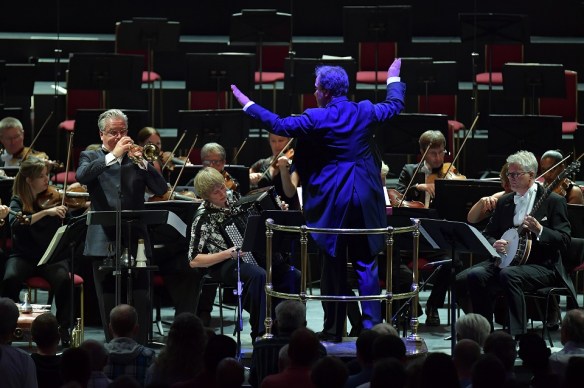
Soloists Håkan Hardenberger (trumpet), Claudia Buder (accordion) and Mats Bergström (banjo) pictured during the performance of HK Gruber‘s Busking, with the BBC Symphony Orchestra conducted by Sakari Oramo (c) Chris Christodoulou

Prom 34; Royal Albert Hall, 10 August 2016

You can listen to the Prom on the BBC iPlayer

Sakari Oramo continues to inspire. His tenure with the BBC Symphony Orchestra to date has been characterised by imaginative programming and excellent performances, and putting an obvious spring in the orchestra’s musical steps.

Last year they delivered a Prom capped by Beethoven’s Seventh Symphony, an account that fizzed with enthusiasm and vigour, and these same qualities were on show for the Fifth Symphony here. Oramo’s speeds were on the aggressive side, the slow movement arguably losing a bit of expressive heart because of it, but the faster movements unquestionably thrilling in their verve and forward drive.

Because of this approach, music that could have been over familiar received a new, sparkling coat of paint, and excellent woodwind contributions, particularly from new oboist Henry Clay, elevated the standard of playing. Guest leader Malin Broman set the tone with great vigour.

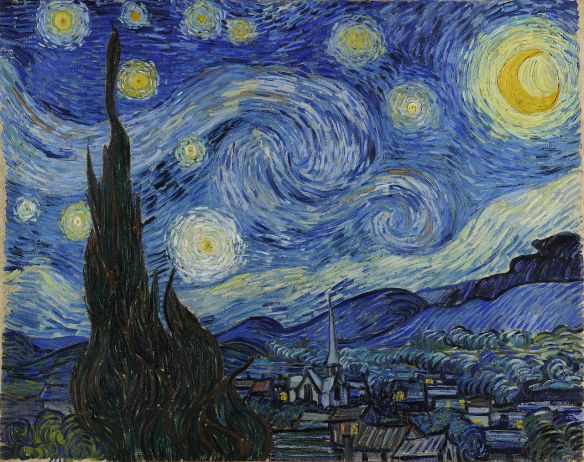
The first half gave us two contemporary pieces of very different impact. Timbres, espaces, movement became a three-movement orchestral piece when Henri Dutilleux revised it in 1990, and in this performance we could revel in its beautifully shaded colours, its sudden, strident unisons, and its captivating rhythms – all reflecting the painting on which it is based, Van Gogh’s Starry Night.

1280px-Van_Gogh_-_Starry_Night_-_Google_Art_Project

These were expertly delivered by the BBC Symphony percussion, while in the second movement the glorious spectacle of twelve cellos highlighted the genius in the composer’s part writing as well as the deep lyricism of his melodies. This was the third Dutilleux performance of the week, capping a very strong trio begun with The Shadows of Time and the Cello Concerto Tout un monde lointain…

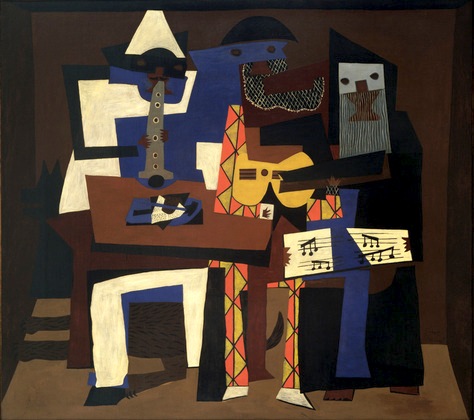
Less obviously successful was the substantial piece by HK Gruber, Busking – a work from 2007 receiving its UK premiere. Again the composer’s inspiration was a painting, in this case Picasso’s Three Musicians:

Picasso_three_musicians_moma_2006

Despite an excellent performance, in which trumpeter Håkan Hardenberger turned various shades of red and purple, all the while staying fully in command of his instruments, this was a piece that unfortunately ran out of steam quite early on.

A very promising beginning, with swaying syncopation brought on by the trumpeter with just his mouthpiece, ultimately lost its rhythmic impetus. Unfortunately the balance between the three soloists also became skewed heavily in favour of the trumpet, at the expense of brilliantly played detail from accordion (Claudia Buder) and banjo (Mats Bergström).

A doleful slow movement briefly evoked a melancholy cabaret, and did so very effectively, but here again the tones of the trumpet dominated, despite Hardenberger’s use of the mellow flugelhorn. This was not the fault of the players – and could also reflect Arcana’s position in the arena – but it was a shame to miss out on the touches of humour elsewhere. By the third movement, where some energy returned, the piece had by that time run out of substance.

That should not count against the overall success of this Prom, however, as the excellent performances of the BBC Symphony Orchestra reaped their just rewards.

Ben Hogwood

You can hear other Dutilleux performances at the BBC Proms by following the links below:

The Shadows of Time with the Philharmonia Orchestra conducted by Esa-Pekka Salonen

Tout un monde lointain… with Johannes Moser (cello) and the BBC Philharmonic Orchestra conducted by Juanjo Mena

BBC Proms – Of Land, Sea and Sky…

prom-15

Andrew Davis conducting the BBC Symphony Chorus and Orchestra

(c) Chris Christodolou

Prom 15; Royal Albert Hall, Tuesday 27 July 2016

Tchaikovsky The Tempest (1873)

Anthony Payne Of Land, Sea and Sky (2016) [BBC commission: World premiere]

Bruch: Violin Concerto No. 1 in G minor (1866) (Ray Chen, violin)

Vaughan Williams Toward the Unknown Region (1906)

The focal point of this evening’s Prom was a first hearing for Of Land, Sea and Sky, the latest work from Anthony Payne and a BBC commission to mark his 80th birthday in a week’s time.

Taking its departure from a description of white horses in the Rhône Valley as they seemed to merge into the surrounding water, this piece comprises eight continuous sections in which the relationship between image and illusion is considered from numerous perspectives.

Payne evidently looked at various texts before deciding to write his own: what resulted is functional in the best sense, each of the choral sections conveying its appropriate imagery without any superfluous literariness. Choral writing is less certain in that it often feels more of a textural gloss on, than integrated into orchestral writing whose clarity and resourcefulness continues from Payne’s previous large-scale works; indeed, the piece as a whole seems to unfold as a sequence of variations on the motifs set out in the opening pages, with an orchestral postlude effecting a final synthesis as the very notion of illusion is rendered in suitably elusive terms.

Of Land, Sea and Sky is typical of Payne in that its approachable (and recognizably English) while never derivative idiom is likely to yield any number of subtleties on repeated hearings. The present performance seemed an assured one, Andrew Davis securing a committed response from the BBC Symphony Orchestra and Chorus in music whose intricacy benefited from the cushioning resonance of the Albert Hall acoustic. This also marked the fourth Proms collaboration between conductor, orchestra and composer, and will hopefully not be the last.

The programme had opened with a hearing for The Tempest, Tchaikovsky’s still relatively unfamiliar symphonic fantasy inspired by, yet by no means indebted to Shakespeare’s play. The framing seascape music, with its sombre horn writing, resonates long after the music has ended, and if what comes in-between – notably the eloquent but unmemorable ‘love’ theme – finds the composer at less than his best, this was perhaps reinforced by a reading that lacked nothing in cohesion without sustaining a cumulative momentum across the piece as a whole.

After the interval, Ray Chen made his much-heralded Proms debut with Bruch’s First Violin Concerto. A little histrionic, the preludial first movement was vividly and at times ardently projected, with a heightened transition into an Adagio whose fervency was purposefully held in check. Nor, other than a slightly hectoring edge in passagework, was there much to fault in the final Allegro; despatched with a flamboyance continued in the encore – Paganini’s 21st Caprice in A, which provided ample means for Chen to display his meaningful virtuosity.

The concert ended with a welcome revival for Vaughan Williams’s Toward the Unknown Region, the composer’s first major success and a piece whose impression is greater than its modest length. If the rapt inwardness of the first half feels more successful than the fervency of what follows, Davis ensured a cumulative tension such as made the final pages – the BBC Symphony Chorus giving its all and the Albert Hall’s organ enhancing the resplendence – a fitting testimony to Walt Whitman’s conviction as to the soul’s tangibility in death as in life.

Richard Whitehouse