BBC Proms 2016 – BBC Symphony Orchestra / Sakari Oramo: Beethoven’s Fifth, Dutilleux & HK Gruber

gruber-busking

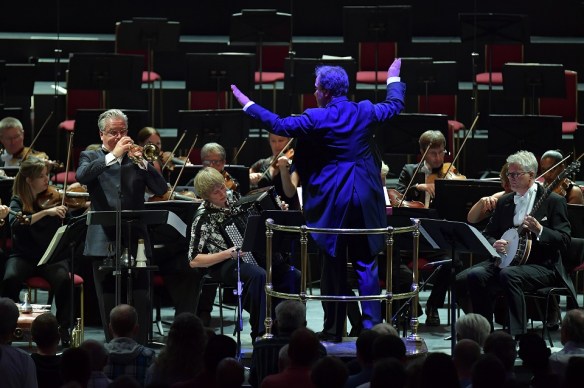
Soloists Håkan Hardenberger (trumpet), Claudia Buder (accordion) and Mats Bergström (banjo) pictured during the performance of HK Gruber‘s Busking, with the BBC Symphony Orchestra conducted by Sakari Oramo (c) Chris Christodoulou

Prom 34; Royal Albert Hall, 10 August 2016

You can listen to the Prom on the BBC iPlayer

Sakari Oramo continues to inspire. His tenure with the BBC Symphony Orchestra to date has been characterised by imaginative programming and excellent performances, and putting an obvious spring in the orchestra’s musical steps.

Last year they delivered a Prom capped by Beethoven’s Seventh Symphony, an account that fizzed with enthusiasm and vigour, and these same qualities were on show for the Fifth Symphony here. Oramo’s speeds were on the aggressive side, the slow movement arguably losing a bit of expressive heart because of it, but the faster movements unquestionably thrilling in their verve and forward drive.

Because of this approach, music that could have been over familiar received a new, sparkling coat of paint, and excellent woodwind contributions, particularly from new oboist Henry Clay, elevated the standard of playing. Guest leader Malin Broman set the tone with great vigour.

The first half gave us two contemporary pieces of very different impact. Timbres, espaces, movement became a three-movement orchestral piece when Henri Dutilleux revised it in 1990, and in this performance we could revel in its beautifully shaded colours, its sudden, strident unisons, and its captivating rhythms – all reflecting the painting on which it is based, Van Gogh’s Starry Night.
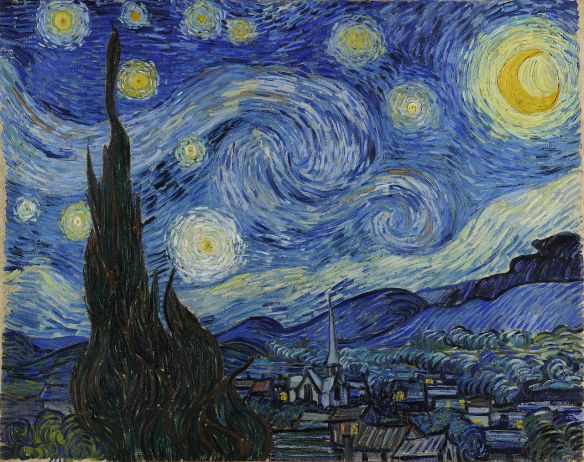
1280px-Van_Gogh_-_Starry_Night_-_Google_Art_Project

These were expertly delivered by the BBC Symphony percussion, while in the second movement the glorious spectacle of twelve cellos highlighted the genius in the composer’s part writing as well as the deep lyricism of his melodies. This was the third Dutilleux performance of the week, capping a very strong trio begun with The Shadows of Time and the Cello Concerto Tout un monde lointain…

Less obviously successful was the substantial piece by HK Gruber, Busking – a work from 2007 receiving its UK premiere. Again the composer’s inspiration was a painting, in this case Picasso’s Three Musicians:
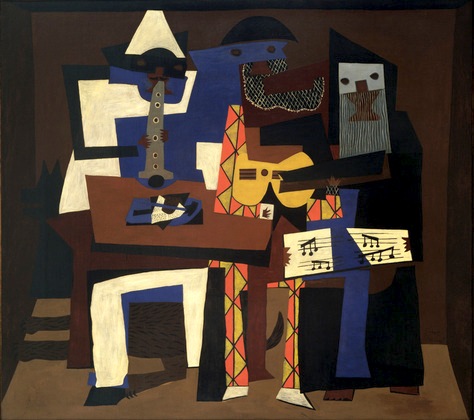
Picasso_three_musicians_moma_2006

Despite an excellent performance, in which trumpeter Håkan Hardenberger turned various shades of red and purple, all the while staying fully in command of his instruments, this was a piece that unfortunately ran out of steam quite early on.

A very promising beginning, with swaying syncopation brought on by the trumpeter with just his mouthpiece, ultimately lost its rhythmic impetus. Unfortunately the balance between the three soloists also became skewed heavily in favour of the trumpet, at the expense of brilliantly played detail from accordion (Claudia Buder) and banjo (Mats Bergström).

A doleful slow movement briefly evoked a melancholy cabaret, and did so very effectively, but here again the tones of the trumpet dominated, despite Hardenberger’s use of the mellow flugelhorn. This was not the fault of the players – and could also reflect Arcana’s position in the arena – but it was a shame to miss out on the touches of humour elsewhere. By the third movement, where some energy returned, the piece had by that time run out of substance.

That should not count against the overall success of this Prom, however, as the excellent performances of the BBC Symphony Orchestra reaped their just rewards.

Ben Hogwood

You can hear other Dutilleux performances at the BBC Proms by following the links below:

The Shadows of Time with the Philharmonia Orchestra conducted by Esa-Pekka Salonen

Tout un monde lointain… with Johannes Moser (cello) and the BBC Philharmonic Orchestra conducted by Juanjo Mena

BBC Proms – Of Land, Sea and Sky…

prom-15

Andrew Davis conducting the BBC Symphony Chorus and Orchestra

(c) Chris Christodolou

Prom 15; Royal Albert Hall, Tuesday 27 July 2016

Tchaikovsky The Tempest (1873)

Anthony Payne Of Land, Sea and Sky (2016) [BBC commission: World premiere]

Bruch: Violin Concerto No. 1 in G minor (1866) (Ray Chen, violin)

Vaughan Williams Toward the Unknown Region (1906)

The focal point of this evening’s Prom was a first hearing for Of Land, Sea and Sky, the latest work from Anthony Payne and a BBC commission to mark his 80th birthday in a week’s time.

Taking its departure from a description of white horses in the Rhône Valley as they seemed to merge into the surrounding water, this piece comprises eight continuous sections in which the relationship between image and illusion is considered from numerous perspectives.

Payne evidently looked at various texts before deciding to write his own: what resulted is functional in the best sense, each of the choral sections conveying its appropriate imagery without any superfluous literariness. Choral writing is less certain in that it often feels more of a textural gloss on, than integrated into orchestral writing whose clarity and resourcefulness continues from Payne’s previous large-scale works; indeed, the piece as a whole seems to unfold as a sequence of variations on the motifs set out in the opening pages, with an orchestral postlude effecting a final synthesis as the very notion of illusion is rendered in suitably elusive terms.

Of Land, Sea and Sky is typical of Payne in that its approachable (and recognizably English) while never derivative idiom is likely to yield any number of subtleties on repeated hearings. The present performance seemed an assured one, Andrew Davis securing a committed response from the BBC Symphony Orchestra and Chorus in music whose intricacy benefited from the cushioning resonance of the Albert Hall acoustic. This also marked the fourth Proms collaboration between conductor, orchestra and composer, and will hopefully not be the last.

The programme had opened with a hearing for The Tempest, Tchaikovsky’s still relatively unfamiliar symphonic fantasy inspired by, yet by no means indebted to Shakespeare’s play. The framing seascape music, with its sombre horn writing, resonates long after the music has ended, and if what comes in-between – notably the eloquent but unmemorable ‘love’ theme – finds the composer at less than his best, this was perhaps reinforced by a reading that lacked nothing in cohesion without sustaining a cumulative momentum across the piece as a whole.

After the interval, Ray Chen made his much-heralded Proms debut with Bruch’s First Violin Concerto. A little histrionic, the preludial first movement was vividly and at times ardently projected, with a heightened transition into an Adagio whose fervency was purposefully held in check. Nor, other than a slightly hectoring edge in passagework, was there much to fault in the final Allegro; despatched with a flamboyance continued in the encore – Paganini’s 21st Caprice in A, which provided ample means for Chen to display his meaningful virtuosity.

The concert ended with a welcome revival for Vaughan Williams’s Toward the Unknown Region, the composer’s first major success and a piece whose impression is greater than its modest length. If the rapt inwardness of the first half feels more successful than the fervency of what follows, Davis ensured a cumulative tension such as made the final pages – the BBC Symphony Chorus giving its all and the Albert Hall’s organ enhancing the resplendence – a fitting testimony to Walt Whitman’s conviction as to the soul’s tangibility in death as in life.

Richard Whitehouse

The 2016 BBC Proms are go! Here’s what happened in Prom 1…

proms-2016

The national flag of Argentina waves in response to Sol Gabetta‘s account of the Elgar Cello Concerto

(c) Ben Hogwood

The BBC Proms are go!

The 2016 season is underway, and in a packed Royal Albert Hall this evening we were treated to the first of 75 Proms. As is traditional Sakari Oramo and the BBC Symphony Orchestra gave us a flavour of the season, but also a substantial second half in the form of Prokofiev‘s cantata and film score, Alexander Nevsky.

To begin, a sad reflection of the world’s troubles could be keenly felt in La Marseillaise, the Proms showing solidarity with France after the horrors in Nice. After such an event music can feel inconsequential but it can also bring people together and provide some sort of comfort – and in the big, swooning tunes of Tchaikovsky‘s Romeo and Juliet Oramo provided just that. The woodwind chorale on the approach to the end was particularly moving.

Sol Gabetta then stamped her own personality on Elgar‘s Cello Concerto, taking a few liberties with the tempo – but none of these were for personal gain, rather reflecting her own interpretation of the music. The pauses at the end of some of Elgar’s phrases were unexpected but profound, while the silvery accompaniment of the BBC SO spoke of Autumn rather than our supposed high summer. Gabetta’s encore, Dolcissimo by the Latvian composer Peteris Vasks, found her singing as well as playing cello, reducing the Royal Albert Hall to reverent silence.

Things got even colder for Prokofiev‘s film score Alexander Nevsky, though there were thrilling moments when the massed choir of the BBC National Chorus of Wales – just over 200 in all – let rip. The basses reached their lowest notes with commendable accuracy, while the Battle On The Ice, where Nevsky faces his German and Estonian foes, was thrilling and immediate.

Yet the show was stolen by Olga Borodina, the Russian mezzo-soprano ghosting onto the stage for a keenly felt account of The Field of the Dead near the end. Her emotion was first hand, and Oramo’s sensitive hand on the tiller encouraged a similarly heartfelt response from the orchestra.

It was a concert that bodes well for the season – and this year Arcana is planning two different approaches to its coverage of the BBC Proms. There will be a few straight ‘reviewed’ concerts, but the focus of our coverage will be on taking people to the Proms who have not been before. To that end our reviews of Proms will not be by experts, rather by first-time punters chosen from a pool of friends and contacts. Further to that, all reviews will be from the Arena, which is the ultimate Proms experience – and which to my knowledge is the best place for sound quality, let alone atmosphere.

No other source reviews from here as far as I am aware…so stick with Arcana in the weeks ahead, particularly through August. I can assure you we will be bringing classical music to new audiences on a weekly basis!

Ben Hogwood

In concert – Ryan Wigglesworth and the BBC Symphony Chorus and Orchestra at the Barbican

ryan-wigglesworth

Picture (c) Benjamin Ealovega

Barnabás Kelemen (violin), BBC Symphony Orchestra / Ryan Wigglesworth (above)

Barbican Hall, London / Wednesday 2 March

This typically well-planned BBC Symphony Orchestra concert had a surprise or two in store. Bookending the quartet of works on display were two pieces by Stravinsky – the Agon ballet from 1957 and the Symphony of Psalms.

They provided a good illustration of how Stravinsky changed styles as a composer, and how in spite of that he retained a fascination with older polyphonic styles. Some of the sound worlds in Agon, a set of twelve tableaux for twelve dancers, frequently alighted on melodic figures or chords that felt ‘old’, holding dissonances and deliberately leaving chords unresolved.

Agon is viewed as the work where Stravinsky starts to take his leave from a more obviously tonal approach to composition. In this performance it was lean yet colourful, with excellent solos from leader Stephanie Gonley, mandolin player Nigel Woodhouse, harpist Sioned Williams and Christian Geldsetzer and Richard Alsop, the two BBC SO lead double bass players, who nailed their otherworldly harmonics on each appearance.

The Symphony of Psalms was more obviously outgoing but saved its greatest emotional impact for the quieter music, the closing pages of ‘Omnis spiritus laudet Dominum’ (‘Let everything that hath breath praise the Lord’) from the BBC Symphony Chorus given out with softly oscillating orchestral figures.

Stravinsky uses the lower end of the orchestra in this piece, with no violins or violas, adding extra percussive punch from two pianos – all aspects that Wigglesworth brought forward in a taut performance. Great credit should however go to chorus master Hilary Campbell, who was unfortunately not mentioned in the concert programme. She is clearly popular with the singers, and helped secure that extra degree of accuracy and emotional involvement. One of Stravinsky’s most cinematic scores, it was in this performance a powerful statement of affirmation.

Wigglesworth positioned his own Violin Concerto modestly after the interval – I say modestly as in its five years of existence the piece has already ramped up an impressive number of performances. On this evidence its status is well-deserved, for it is a tightly structured unit of no little tension, the soloist searching for his ultimate melody while the reduced, ‘classical’ orchestra try and find their ultimate tonality.

barnabas-kelemen

Soloist Barnabás Kelemen (above) was a macho presence, with a little too much testosterone at times when the violin was surging forward, but he balanced that with some incredibly sensitive playing at the quietest moments of the piece, where the audience strained on his every note. Both melody and tonality were resolved in moments that confirmed Wigglesworth as a composer of impressive style and instinct.

The one dud in the program was Britten’s Four Sea Interludes and Passacaglia from the opera Peter Grimes, seen through the visual projections of Tal Rosner. This was a commission from four American orchestras in Britten’s centenary year 2013, with each interlude was set to the images of the city from which the commission came. For its UK premiere Rosner added a portrait of London to go with the other orchestral excerpt from the opera, the Passacaglia. This was centrally placed, keeping the order in which the scenes appear in the opera.

Although well played by the orchestra, the idea sadly fell flat on several levels. Although Britten spent time in America – and indeed began Peter Grimes there – the work’s roots are so entrenched in Suffolk that to suggest anything other than the Aldeburgh coastline through the music feels completely wrong. Rosner’s constructions were skilled, and had a few fine moments where close-up images of the Golden Gate Bridge rotated in technicolour.

Sunday Morning, with its bright building blocks of orchestral colour, was revealed to be a minimalist precursor of the music of John Adams through the clever constructions of its visuals. However despite Britten’s more universal appeal as a composer these days, Peter Grimes surely belongs wholeheartedly in Suffolk – and any suggestion to the contrary, however well intended, feels wrong.


Proms premiere – Luca Francesconi: Duende

luca-francesconi

Luca Francesconi

Leila Josefowicz (violin), BBC Symphony Orchestra / Susanna Mälkki (Prom 13)

Duration: 20 minutes

BBC iPlayer link

http://www.bbc.co.uk/iplayer/episode/p02wv00w/bbc-proms-2015-season-luca-francesconi-duende-the-dark-notes

What’s the story behind the piece?

leila-josefowicz
Leila Josefowicz playing Duende Photo (c) Chris Christodoulou

“Historically”,– says Luca Francesconi, “duende is the demon of flamenco. As Federico Garcìa Lorca explains, it is a subterranean force of unheard-of power that escapes rational control. To recover a primitive force in the instrument that perhaps most embodies the history of the West it is necessary to make a perilous descent into the underworld of dark notes, or a flight beyond the orbit of the earth. Which amounts to the same thing. Extremely difficult. But without duende we remain bolted to the ground.”

The work, for violin and orchestra, is a joint commission from the Swedish Radio Symphony Orchestra, the Orchestra Sinfonica Nazionale della RAI and the BBC Symphony Orchestra.

Leila Josefowicz, the violin soloist, has expanded on ‘duende’. “We acknowledged that we both have Duende, which cannot be learned…this is something we knew we could share with the world, he with his composition and me being the interpreter and musical messenger. I appreciate his incredible musical imagination, his scores bursting with colour and drama”.

Did you know?

Francesconi, born in 1956, has studied with both Karlheinz Stockhausen and Luciano Berio. His chamber opera Quartett, about the end of the world, was heard at the Royal Opera House in 2014.

Initial verdict

This is a striking piece, right from the start, where the violin begins with some feather light string crossing at a very high pitch, seemingly evoking night time insects or other sounds. There are some incredibly taxing passages for the instrument early on, which Josefowicz is completely equal to.

There is some frenetic activity both from violin and orchestra, but at around 7 minutes in the violin really soars, making a rather beautiful sound easily audible even above the glinting, treble-heavy accompaniment.

Around 13’10” there is a notable gear change, the violin digging in for some seriously virtuosic and demonic passages. Then at around 17” a slow, nocturnal atmosphere asserts itself, with various whistles and clicks from the violin to long-held notes from the orchestra.

I found it a little more difficult to hold attention with the piece in the closing stages, but it is doubtful that is the fault of the composer. A second hearing will confirm!

Second hearing

tbc!

Where can I hear more?

You can watch a performance of the Piano Concerto no.2, completed in 2013, below: