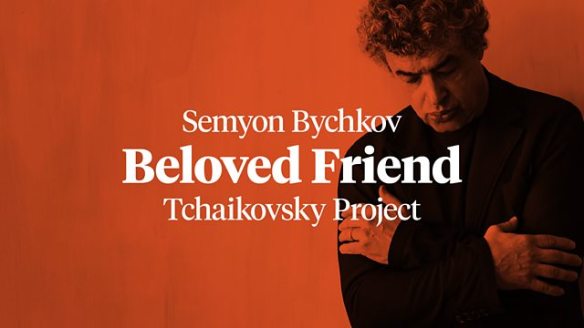
Richard Whitehouse on the BBC Symphony Orchestra, conducted by Semyon Bychkov (above) in the second of their Tchaikovsky-themed concerts
Tchaikovsky Serenade for strings in C major, Op. 48 (1880)
Tchaikovsky Piano Concerto No.3 in E flat major, Op. 75 (1893)
Taneyev Overture: The Oresteia, Op.6 (1889)
Tchaikovsky Francesca da Rimini, Op. 32 (1876)
Kirill Gerstein (piano), BBC Symphony Orchestra / Semyon Bychkov
Barbican Hall, London; Monday 24 October
The Beloved Friend series being curated by Semyon Bychkov provides a revealing overview of Tchaikovsky through some lesser performed works. Not the least of which is the Serenade for strings that, though its individual movements emerge frequently on radio, is not so often encountered in concert. Too short to occupy a second or even first half, it makes for a lengthy yet viable opening item when, as tonight, a full-sized string section is deployed with panache.
Bychkov ensured a fervent response in the first movement, its animated main sections framed by the rhetorical motto theme that ultimately returns as an apotheosis, then found suavity as well as elegance in the Waltz. Despite lack of inwardness, the Elegy yielded real clarity in its denser passages, while the Finale proceeded briskly yet characterfully to its resolute close.
Next followed a rare revival of the Third Piano Concerto, itself reworked from an abandoned symphony and what would doubtless have become a three-movement entity had Tchaikovsky completed its Andante and Finale to his satisfaction prior to his death (these latter, as realized posthumously by Taneyev, make an effective whole – as Alexander Markovich demonstrated in a Royal Festival Hall account eight years ago).
As a stand-alone piece, the Allegro brillante (best known in its ballet incarnation by George Balanchine) unfolds a quirky and characterful sonata design – its themes distinctive for their emotional restraint, with a stealthy interplay between piano and orchestra that Kirill Gerstein (above) audibly relished. Momentum faltered marginally after a scintillating cadenza, but the final pages strode onwards to a decisive if peremptory ending.
Overall, a convincing account of music which warrants greater exposure. Hopefully Gerstein will yet tackle this work’s three-movement incarnation: for now, he returned for a reading of Méditation – the fifth of Tchaikovsky’s Op. 72 collection – that oozed eloquence and poise.
More discussed than played in the West, Sergey Taneyev was as least as much a composer as pedagogue; a notable output of orchestral and chamber music capped by his ambitious opera The Oresteia. Beginning life as this latter’s introduction, the present overture expanded into an autonomous entity that surveys the opera’s dramatic content and is an eventful symphonic poem in its own right. Its complementary halves representing an archetypal ‘war and peace’ in dramatic as well as musical terms, the piece is harmonically questing and often texturally adventurous – not least in its extensive though never self-conscious writing for harps. Some 15 years after Taneyev last enjoyed a fair measure of exposure in London, Bychkov directed a fastidious performance to remind listeners that they are the poorer for this music’s neglect.
Even in an era intent on ‘concerto and symphony’ programming, Tchaikovsky’s Francesca da Rimini has never lacked for performances – this symphonic fantasia mingling drama with pathos to a heady degree even for this composer. Bychkov accordingly upped the ante in the tempestuous opening, then secured a suitably rapt response from woodwind and strings in the central section depicting Paolo and Francesca. Its balletic continuation drifted as is often the case, but the final pages portrayed the hapless lovers’ descent into hell with unerring ferocity.
Recorded by BBC Radio 3 for future broadcast in Afternoon on 3, and available for 30 days thereafter via the Radio 3 website
Richard Whitehouse on the BBC Symphony Orchestra, conducted by Martyn Brabbins (above) in a concert recorded at the orchestra’s home in Maida Vale
Rubbra Symphony No.11 Op. 153 (1979)
Grøndahl Trombone Concerto (1924)
Brian Symphony No.6 Sinfonia tragica (1948)
Jörgen van Rijen (trombone), BBC Symphony Orchestra / Martyn Brabbins
Maida Vale Studios, Tuesday 11 October
The BBC Symphony continues to schedule some of its most distinctive concerts at its Maida Vale studios, and this afternoon saw Martyn Brabbins at the helm for a sequence of English and Danish music – all being pieces that are rarely, if ever, encountered in UK concert halls.
When Edmund Rubbra’s Eleventh Symphony received its premiere at the 1980 Proms, it must have felt appreciably more distant in aesthetic than it now does. Yet timelessness was central to the composer’s music; nowhere more than this 18-minute summation of both his symphonic and orchestral thinking. Its two continuous sections – a ‘moderate’ Andante, then a ‘calm and serene’ Adagio – offer only incremental expressive change, though the cumulative emotional impact as Rubbra evolves intervallic motifs via a seamless process of developing variation is undoubted; as also his fashioning of alternately diaphanous and granitic instrumentation. This latter was superbly rendered by the BBCSO, with Brabbins attentive to the music’s wealth of detail and its by no means untroubled emergence towards an eloquent plateau of tranquillity.
Next came a welcome revival for the Trombone Concerto by Launy Grøndahl, best known as a conductor (he premiered Robert Simpson’s First Symphony in Copenhagen) but who, on the basis of those pieces to have been recorded, evinced a modest while appealing compositional talent.
The outer movements of his concerto alternate between trenchant and lyrical ideas, the latter having a deftness to offset the hints of rhythmic stolidity elsewhere, but it is the central Andante – in its initial blues-inflected theme and resourceful deployment of piano – that most readily confirms its composer’s prowess. Here, as throughout the piece, Jörgen van Rijen (above) was unfailingly perceptive – underlining the extent to which Grøndahl, a violinist by training, had mastered the technical range of an instrument whose overall potential remains to be realized.
During the break, Van Rijn performed Slipstream by the German-born composer and metal guitarist Florian Magnus Maier (b1973) – its interplay of live playing and recorded repetition, via a loop-station operated by the musician, affording a fresh twist to Reich-style minimalism.
Brabbins has championed Havergal Brian extensively on disc; his live advocacy so far limited (!) to a revival of the Gothic symphony at the 2011 Proms. At just under 20 minutes, Sinfonia tragica comes near the opposite end (albeit conceptually) of his orchestral output. Envisaged as the prelude to an opera on J. M. Synge’s Deirdre of the Sorrows that was soon abandoned, it was not incorporated into his canon for two decades, yet its symphonic status is not hard to discern.
The BBCSO duly had the measure of its progress, as unpredictable as it is inevitable – from the fugitive gestures of its opening section, through the (surprisingly?) long-breathed melodic writing at its centre, to the eruptive activity and stoic processional of its final pages. A persuasive reading of a piece that ranks among its composer’s most immediate utterances.
Indeed, this was a persuasive concert overall – one that made light of the turgid accusations sometimes levelled at Rubbra, or the unplayability too often associated with Brian. Hopefully the BBCSO and Brabbins will continue their exploration of this rewarding music at future studio concerts.
This concert will be broadcast on BBC Radio 3 during November – further details to follow
Ask The Audience Arcana at the Proms This is the latest in the series where Arcana invites a friend to a Prom who does not normally listen to classical music. In an interview after the concert each will share their musical upbringing and their thoughts on the concert – whether good or bad! Here, Annie Turner (above) gives her thoughts on Prom 62.
Baiba Skride (violin), Siobhan Stagg (soprano), Christopher Maltman (baritone) BBC Symphony Orchestra / Siobhan Young
Bayan NorthcottConcerto for Orchestra (2014-2016, world premiere); MozartViolin Concerto no.5 (1775); ZemlinskyLyric Symphony (1922-23)
I was born in 1980 and so my earliest musical memories would be Vangelis, Dire Straits, Phil Collins and stuff like that, so I’m very fond of that music in a sentimental way. I was really interested in playing music, and I remember when I was about seven or eight I was absolutely desperate to learn the recorder, as the older kids in school were playing them. My mum asked the teachers but they said I was too young, and I had to wait until I was nine!
I learned recorder and got to play in the school concerts, but after that you pick up another instrument, so I did keyboard. I went to a country school in Australia, so there wasn’t a big music program. I learned piano for a while but struggled with the music because I didn’t find it interesting! It was classical, and it was a bit boring for me as a kid, but I really loved listening to music and working out the fidelity for myself. My dad was really into Andrew Lloyd Webber, and I used to work out bits of melody from Phantom of the Opera and Cats.
Then I stopped and didn’t pick it up again until high school when I was interested in bands. I got interested in grunge and wanted to play it, so I got into drums and guitar lessons, and really loved that. By the time I was that age I got really shy and didn’t want to play in front of anybody, so I was a bedroom musician. I still kept studying music at school though, and then when I graduated from high school I really wanted to play in a band.
I moved to Melbourne to go to university, and it was my dream to play in a band, so I just had to get over my stage fright! I joined any band that would have me…and I’ve played in some terrible bands and some awesome bands, but I mostly ended up playing drums in all of them, so I dropped the guitar. I played in a heavy metal band, a punk band and an experimental bands, a few jam bands. I did that for a few years, and we recorded and toured which was great. Then I moved to London and didn’t do it again, because London was a bit too big and intimidating and it was hard to have the resources. So that was my musical upbringing!
Could you name three musical acts you love, and why you love them?
There is a Norwegian black metal band called Satyricon, which I love, and I love them because I find their music is well written, well-constructed, engaging, it’s very melodic, atmospheric, it’s quite dark as well which I find when you’re in that mood. It’s frenetic, there’s a lot of energy to it, and I find it really interesting.
I don’t find I listen to acts any more, I listen to songs rather than acts…but I actually love Calvin Harris! I’ve followed his career, and I don’t love everything that he’s done, but I really love the fact he’s a pop purist. He writes and produces but he does it very well in a purely pop way but I think he respects that genre. He does quality work and it’s such good, good pop I think it’s genius – the construction, the way he has that mix of happiness and sadness in one song. Pop music you have to capture the kind of strategy of teen romance, which is kind of ‘gaggy’ but at the same time it’s got drama, some of it’s got humour, and I just think he’s excellent and very intelligent pop auteur.
For the third I would have to say I love Nirvana really, because that was the band I really got into in depth, because it was rebellious, artistic, subversive, but also even though it was very aesthetically abrasive it was pop music right down the line in the middle. It got me very interested in playing music as well as listening to music, and as well it had more implications for popular music. I was very obsessed with that band for a good five years!
What has been your experience of classical music so far?
I’m generally familiar with the big hits because you hear them on TV, and on adverts, and there are definitely pieces I’ve come to know and like, but other than that it’s really through watching films. I did a degree in film theory, and studied lots of films, but didn’t really study the music on the film.
I guess also there was a time when I would tune the radio to Classic FM because I didn’t want anybody to sing at me, I didn’t want to hear any words! I wanted something I knew would be relatively calm and peaceful. I know it’s not always like that though, and that classical music can be tumultuous! I was seeking something that would be a bit more calming I suppose. I remember I did buy an iTunes album of the greatest hits of the classics, but I didn’t really follow it any further than that.
How did you rate your first Proms experience?
I really enjoyed it. I had no expectation, and I guess I thought I might have got bored because if I didn’t know the music I might not follow it. I was surprised that I really did find myself getting enthralled, so I rated it to the point where I would definitely come back on my own. I would like to investigate it more, ask for tips, you know?
I like the opera Carmen, but any other opera I don’t like, because sometimes it sounds to me like yelling. I know you could say I listen to death metal, and that’s shrieking, but you know, it’s just yelling! The vocal music we just saw I didn’t think about it that way, I heard the music and looked at their faces, saw that emotion, and it felt a bit like I was watching a play. I think I might be coming around to being converted!
What did you think of the Bayan Northcott Concerto for Orchestra, the first piece?
That started off really avant-garde, and more modern, and I guess that surprised me in how it developed. It developed very smoothly into something that was a bit more formulaic in a classical sense. I had to remind myself that I didn’t really know what was going on, and the transitions I enjoyed. I felt that one took you on a bit of a journey that was quite surprising. I particularly liked the dynamics where you could hear something that was really loud, layered and reverberant, and then you could get something that was really quiet and minimal on one instrument. I enjoyed the delicacy of the sound, because when you see a band or a DJ you don’t get that, you just get ‘loud’ or ‘off’!
What did you think of the Mozart?
I thought I recognised it from having heard it before. I really liked it, and having someone palying solo you can focus in on it and follow their emotion, which was new and interesting, and I thought it was interesting too how the orchestra seemed to be all on the same level.
Normally you go to see a band and you think I’m seeing my idols, or seeing this famous person, and the people who created the music. They’re in a higher hierarchy so to speak. With the orchestra I had this sense that they’re just normal people, serving the music and all enjoying it. I liked it when it wasn’t about the composer, the rock star, and not about the conductor – they’re not facing us, they’re just delivering it. I really liked that sense of the music being the star. That was a new experience, you could see a different perspective even in the formalities of ‘now it’s my tern to stand up and play’, the ritual of it. It was really touching, and I think classical music might tend to have this image of being a little bit posh, a little bit fancy, but actually these people are not royalty, they’re working for the music. There wasn’t any grandiosity, it was very humble.
And the Zemlinsky?
That was probably my favourite. I was a bit apprehensive because it was like opera, and I’ve not really liked opera before, plus it sounded like it was in German. I don’t speak German, but I wouldn’t have thought it would be a language that would lend itself to singing! But OK, I was really surprised. I stopped thinking about the music. My mind did keep wandering and I was thinking about my own life, and I don’t know if the music was really influencing that or not, but it wasn’t like I was standing there going oh, that was a great bit of trombone, I was thinking about my own life! I was thinking about what was going on in my life.
I’ve recently started doing meditation, and know that it’s good to be present and mindful, so I did start to drag myself back and focus on the sounds and what was going on. It was good, though I did feel like it was a soundtrack to my thoughts. There was a lot of percussion and I really liked the textures of the drums, how deep that sound is, and I think there was a lot of melancholy and ‘blue’ notes. I like that darker sound, I guess that might be a bit of a cliché, but the sadder stuff probably says more to me than the jolly little dances I suppose!
I deliberately didn’t research the program, so think I will read that on the bus home which will be really interesting, to see what was in the text!
Would you go again?
I would. It would be amazing to see a piece I was already familiar with and really liked, so next year I can find out which composers I like more and make a plan to see more of them. At the same time I would also select something at random – something familiar and something new – and see how that works!
Soloists Christopher Maltman and Siobhan Stagg take the applause with conductor Simone Young and the BBC Symphony Orchestra after their performance of Zemlinsky‘s Lyric Symphony(c) Chris Christodoulou
Every festival has its ‘down’ periods – and here it was the turn of the Proms. Don’t stop reading there though, as by ‘down’ period I mean a Royal Albert Hall that was perhaps half full and music that was relatively unknown. The combination can on occasion lead to an unsatisfactory evening, but here it was a heartening opposite.
It was good to note a rare UK appearance for the Australian conductor Simone Young, her first at the Proms. Young is predominantly an opera specialist, so it was perhaps inevitable that Zemlinsky’s Lyric Symphony of 1923 should bring out the very best in her brief relationship with the BBC Symphony Orchestra.
This powerful, passionate account got off to the best possible start, assertively bringing Zemlinsky’s themes of doomed love to the front of the layered texture and packing the music with drama. Here Young was helped by the woodwind and brass, horn player Nicholas Korth in particular, though when singers Christopher Maltman and Siobhan Stagg got into action theirs was the defining contribution.
Baritone Maltman’s silky contribution was brilliantly judged, an ideal complement to Stagg’s soaring soprano, though the biggest notes on her part were saved for the particularly anguished lines in the poems of Rabindranath Tagore. When she began Stratt was a little coy, beautifully so, for this got the audience on to her side and meant we all felt her tragedy in Vollende denn das letzte Lied (Then finish the last song). Maltman it was who ended the symphony, striving for peace, which Young ultimately found in the beautifully floated coda.
The performance was the shade to the light of Mozart’s Violin Concerto no.5. This did receive a slightly heavy performance in comparison to others, but the strings of the BBC SO were beautifully graceful in the slow movement and accommodating to soloist Baiba Skride (below, with the orchestra) in the outer fast movements.
Skride’s violin makes a beautiful sound, and it was a feature of her performance that the notes were floated towards the audience, respectful of the orchestral accompaniment but making the most of Mozart’s melodic inspiration. The choice of cadenzas by Brahms’s contemporary Joseph Joachim was a little risky but the virtuosic passages were sensitively handled, while in the finale, the so-called ‘Turkish’ part of the concerto that actually sounds more Hungarian, there was a pleasing rustic feel, as though we had all been ushered outdoors together. As a footnote to this, Skride chose a movement from a sonata by the eighteenth century composer Johann Paul von Westhoff as her encore.
First up on the program was a world premiere, Bayan Northcott’s Concerto for Orchestra. It is great to have so many in the Proms season, with the unfortunate caveat that not many of these pieces get a second hearing. This one was a premiere in two respects, being Northcott’s first work for orchestra alone. At the age of 76 that is an impressive achievement, and his care over the composition could be sensed in a compressed piece that was full of incident. Debts to 20th century composers such as Hindemith were occasionally felt, but the enthusiasm of the two fast movements drove the music forward, speaking in tunes but also impressing the ear with their instrumental textures too.
Ask The Audience Arcana at the Proms This is the continuation of a series where Arcana invites a friend to a Prom who does not normally listen to classical music. In an interview after the concert each will share their musical upbringing and their thoughts on the concert – whether good or bad! Here, Tim Squier gives his thoughts on Prom 34.
Håkan Hardenberger (trumpet), Claudia Buder (accordion), Mats Bergström, BBC Symphony Orchestra / Sakari Oramo
Dutilleux Timbres, espaces, movement (1990)
Gruber Busking (2007)
Beethoven Symphony no.5 in C minor (1804-1808)
It was my mum that brought me up, and in terms of music it’s not worth going there really! It was very middle of the road – Cliff Richard, some of The Beatles. I discovered most things myself pretty much, she would have the radio on sometimes – but when I first discovered my own music it was via an alarm clock, an FM radio that she gave me. It was all the pop of the time in 1984-1986 – Madonna, Prince, A-ha, your Now 1984. Certainly in my early years there was Band Aid – and I wasn’t particularly cool. There wasn’t anything of a classical background in there!
Could you name three musical acts you love, and why you love them?
Harold Budd is a big one for me. I do love my ambient and he doesn’t seem to put a foot wrong really. He just seems to have a certain emotion and style where you can just get lost in it. It can be background but it can be foreground as well. I can work to it, and not be fully tuned in, or I can be sitting down and listening to it and it works just as well.
I’m going for artists who have been with me for a long time, and Fleetwood Mac are an act that I could never really get enough of. They’ve gone through different phases like the 1980s pop side but I can also do the Peter Green stuff, and the Stevie Nicks especially. I just keep discovering new things off the albums too, like Oh Daddy from Rumours recently. Stevie Nicks solo – just brilliant, too. Not every single track but she’s the sort of person you can see her rehearsal footage on YouTube and it’s amazing. I’m watching it thinking it’s better than the album version!
For the third one I’ll go for someone electronic – Carl Craig. Certainly between 1990 and 1996 where he couldn’t put a foot wrong. He could do an ambient track, a banging techno track, stuff that doesn’t all into a genre – something for the dancefloor, something for the home. Carl recorded a lot of that on cassette tape, it didn’t sound very good but still did the business!
What has been your experience of classical music so far?
I think almost unintentionally my first experience of anything like classical music would have been through film scores. One of my best friends in London has been responsible for playing me some classical music but not so much for a long time now. I have been to one Prom before but it was a long time ago and I can’t remember the actual pieces – but I know I enjoyed it. I quite enjoy listening to it but I don’t know much about it. I’ve heard some Ravel before, and quite enjoyed that.
How did you rate your first Proms experience?
The Royal Albert Hall is always a joy, it’s a great venue – and the acoustics are really good for classical rather than pop I think. I really rated the first piece (the Dutilleux) and enjoyed that the most I think.
What did you think of the Dutilleux?
It was thoroughly enjoyable, I’m a real sucker for that deep sound from the lower strings – there is a certain orchestral sound I really love, the lower frequency, and you get a lot of that in film scores. There was a lot of that coming through and it flowed really well. I wasn’t bored at all, I really loved it.
What did you think of the HK Gruber?
It started out interesting, and the introduction was good, but the trumpet was too much of a focal point and I found myself drifting out. I was trying to listen to the background more but because of the positioning I was trying to hear what was going on my right hand side, but every time I tried I could hear the trumpet. There was a variety of devices going on (the mutes and three different trumpets – Ed) I’ll always give things a chance, and I tried but it didn’t work out!
And the Beethoven?
That was really enjoyable, a nice take on it – it’s been a while since I heard the entire piece and I think it really worked. There were some quirky moments, it was great watching the whole orchestra. There was one really young player who really stood out (oboist Henry Clay), he was really good. Another thing going back to the first piece, the Dutilleux – the percussion was great. With the Beethoven I loved the whole thing and there was a really nice stereo effect coming through, the clarity was there more and I could pick up on certain things, especially being a bit of an audiophile.
There are bits you forget as well – you don’t get them played on Capital Radio four times a day after all! It was good to hear those. So I think the Dutilleux first, then the Beethoven, then the Gruber.
Would you go again?
Absolutely, for sure. I’m quite open to new musical experiences and will try most things but would do this again!
Verdict: SUCCESS
You can read Arcana’s review of the whole Prom here – and you can listen to it on the BBC iPlayer

 Next followed a rare revival of the Third Piano Concerto, itself reworked from an abandoned symphony and what would doubtless have become a three-movement entity had Tchaikovsky completed its Andante and Finale to his satisfaction prior to his death (these latter, as realized posthumously by Taneyev, make an effective whole – as Alexander Markovich demonstrated in a Royal Festival Hall account eight years ago).
 Next came a welcome revival for the Trombone Concerto by Launy Grøndahl, best known as a conductor (he premiered Robert Simpson’s First Symphony in Copenhagen) but who, on the basis of those pieces to have been recorded, evinced a modest while appealing compositional talent.
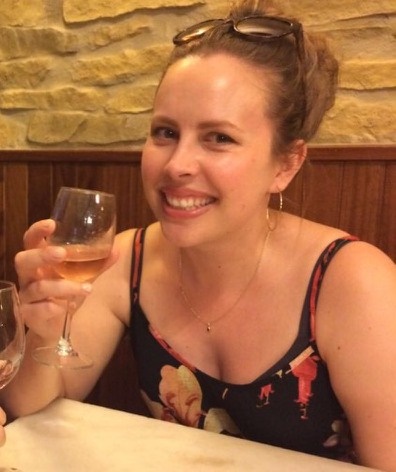 This is the latest in the series where Arcana invites a friend to a Prom who does not normally listen to classical music. In an interview after the concert each will share their musical upbringing and their thoughts on the concert – whether good or bad! Here, Annie Turner (above) gives her thoughts on Prom 62.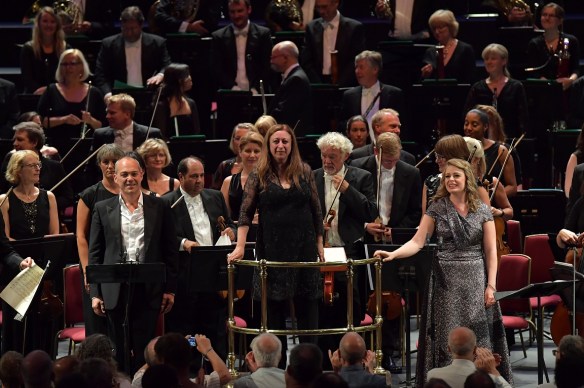

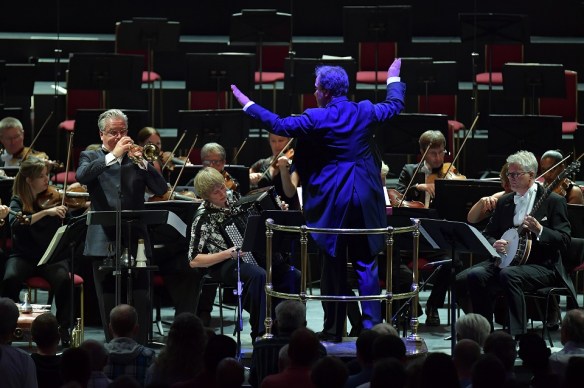 This is the continuation of a series where Arcana invites a friend to a Prom who does not normally listen to classical music. In an interview after the concert each will share their musical upbringing and their thoughts on the concert – whether good or bad! Here, Tim Squier gives his thoughts on Prom 34.
