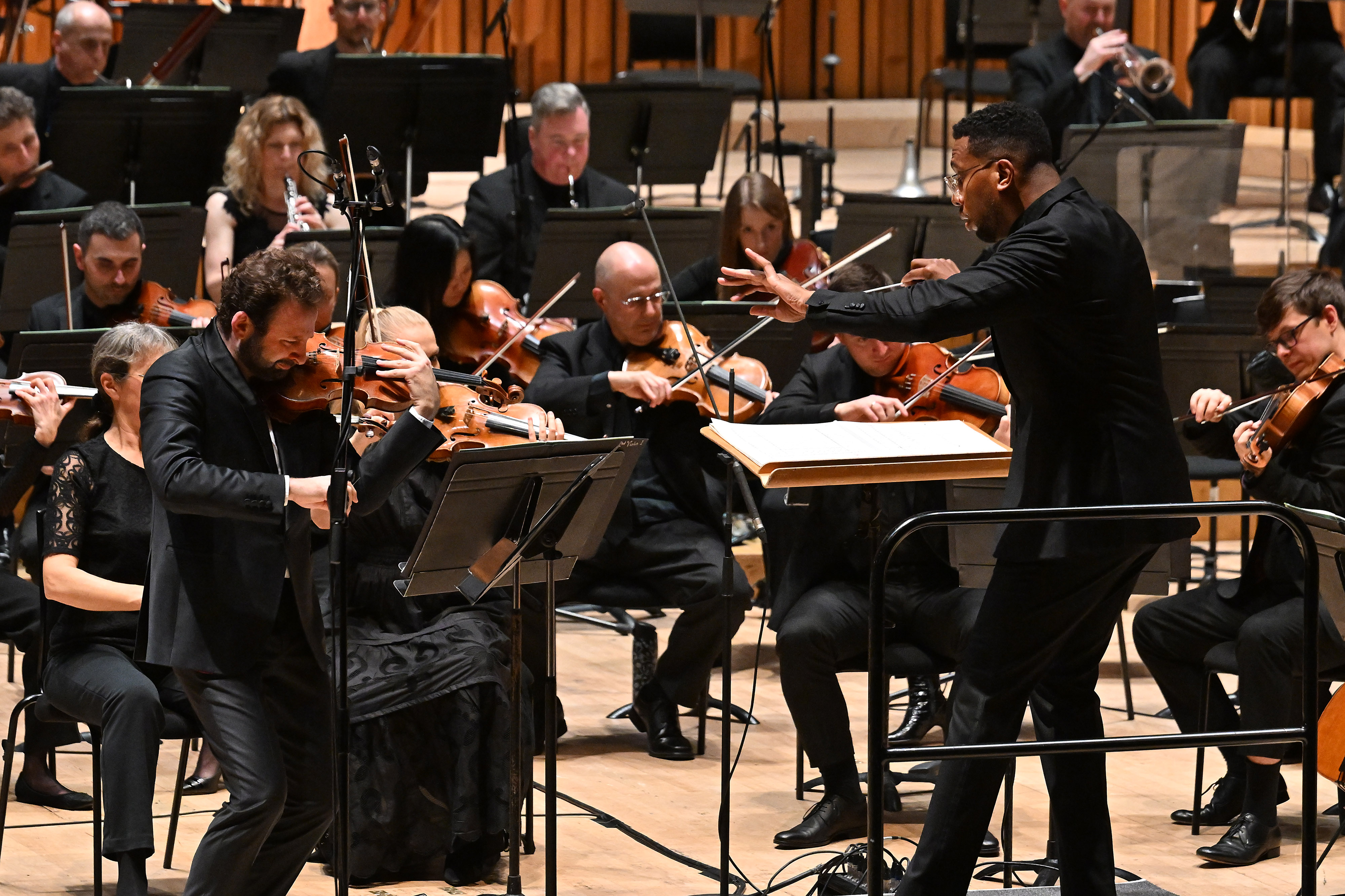
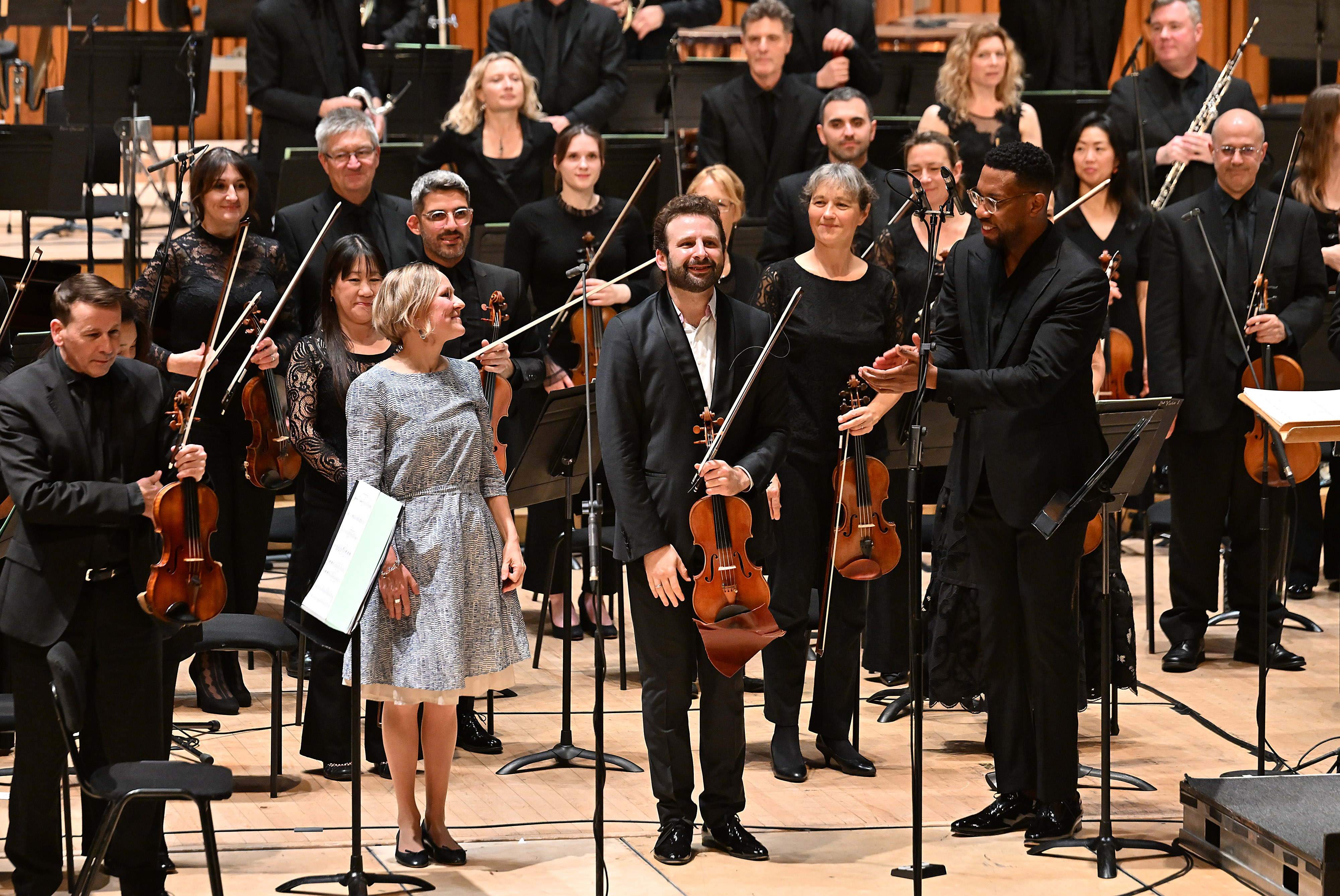
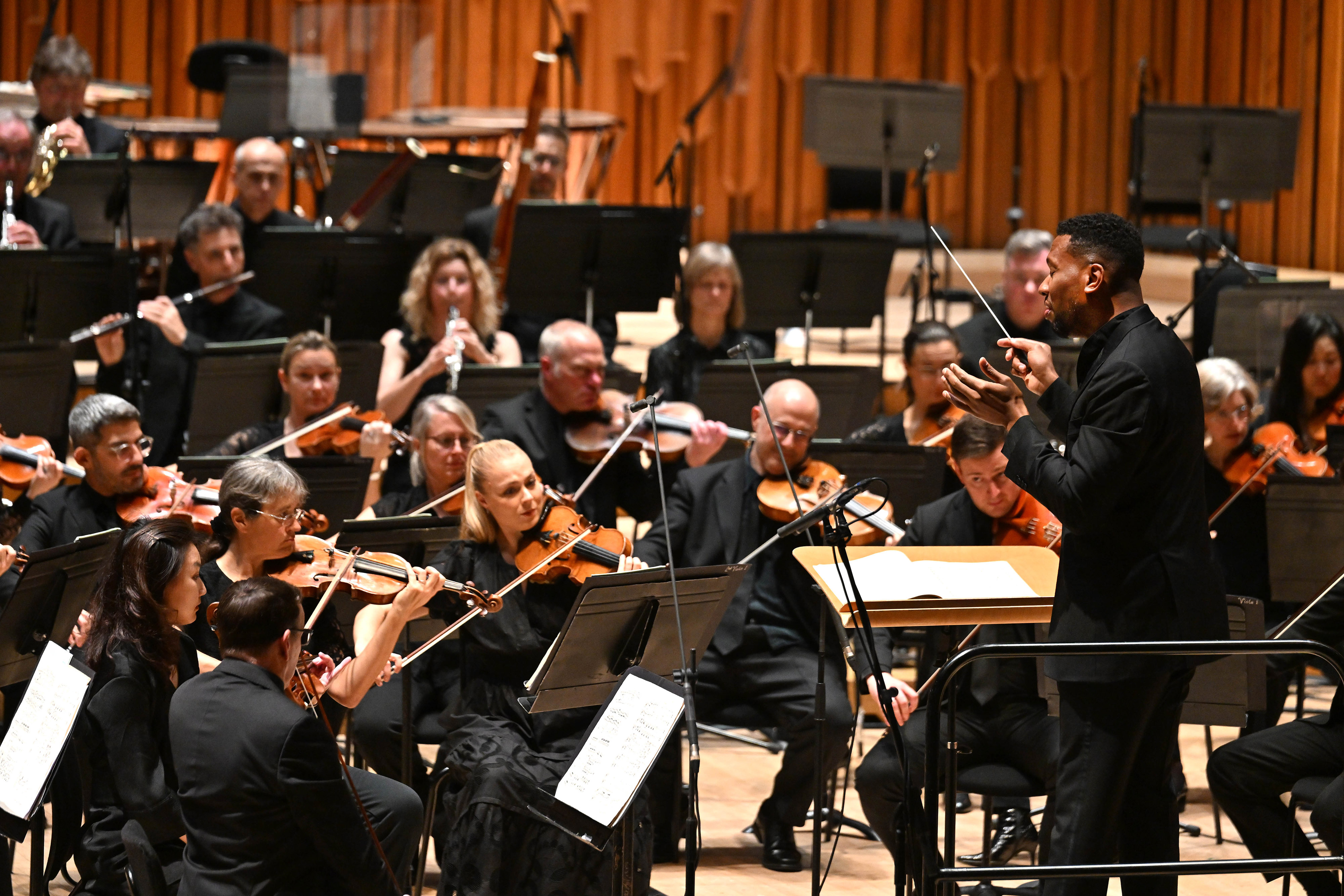
Arcana at the Proms – Prom 8: Nick Drake – An Orchestral Celebration

Olivia Chaney, Marika Hackman, BC Camplight, Scott Matthews, The Unthanks, BBC Symphony Orchestra / Jules Buckley

Royal Albert Hall, London
Wednesday 24 July 2024

reviewed by John Earls Pictures below (c) John Earls and (bottom) Chris Christodoulou

This November sees the 50th anniversary of the tragic death of the English singer-songwriter Nick Drake at the age of 26, having released just three albums of beautiful, bittersweet songs. Little known at the time, his reputation and influence has grown significantly.

This 2024 BBC Prom – an ‘orchestral celebration’ of his music – was destined to be something quite special and credit should go to British journalist and broadcaster John Wilson for proposing it.

Jules Buckley, here conducting the BBC Symphony Orchestra, has been involved in a number of BBC Proms over the years giving orchestral twists to contemporary music. Many of Drake’s songs were released at the time with string arrangements by Robert Kirby (it was good to hear Buckley pay tribute to Kirby who he referred to as “Nick Drake’s foil”) and these were developed, as well as some new ones added, by a number of other arrangers for this concert.

Following a gripping opening of the instrumental Introduction from Drake’s Bryter Layter album, BC Camplight gave excellent performances of Fly and Pink Moon which was deftly accompanied by strings and horns. Alas, his closing of the concert with Drake’s classic Saturday Sun didn’t quite cut it, being a bit too schmaltzy for this reviewer. However, the final all orchestral piece, an arrangement by Sam Gale of Horn, a sparse solo guitar piece from Pink Moon, was luminous and intense, culminating in a poignant solo trumpet.

Marika Hackman gave enchanting versions of Fruit Tree and River Man and her take on Time Has Told Me was a wonderfully smoky blues accompanied by drums, organ and guitar (Neill MacColl did some sterling work throughout the evening).

Scott Matthews opened his account with a wonderful Way to Blue with dramatic strings and timpani which, from where I was sitting, at times slightly overpowered his delicate voice, something rectified in the second half for his lovely performances of Northern Sky and From the Morning.
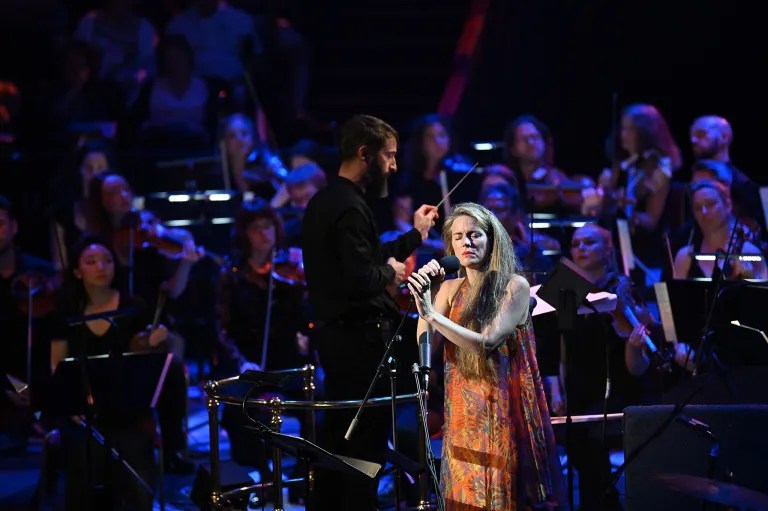
Olivia Chaney (above) gave a strong vocal performance of Hazey Jane I and a terrific version of At the Chime of a City Clock where the strings and horns were again particularly effective. Her solo piano rendition of Time of No Reply was outstanding.

Two of the most moving moments did not feature Nick Drake songs at all but those of his mother Molly. The Unthanks performed touching versions of What Can a Song Do to You? and Set Me Free and were joined by Drake’s sister Gabrielle reciting some of Molly’s poems in both cases. It was extremely affecting.

One can only imagine what Gabrielle Drake must have thought hearing the songs of her brother (and mother) performed in this way after so many years to a packed Royal Albert Hall that listened respectfully and lovingly. It was fitting testimony to the enduring quality of the music of an extraordinary songwriter.

This concert (including interval discussion with John Wilson, Radio 3 presenter Elizabeth Alker and Gabrielle Drake) is available on BBC Sounds until early October. For more on the 2024 BBC Proms, visit the festival’s website at the BBC, and click on the link to read John Earls’ review of Richard Morton Jack’s biography on Nick Drake: The Life. 

John Earls is Director of Research at Unite the Union and tweets / updates his ‘X’ account at @john_earls

Published post no.2,250 – Thursday 25 July 2024

On Record – BBC Symphony Orchestra / Martyn Brabbins, Sir Andrew Davis – Payne: Visions and Journeys (NMC)

BBC Symphony Orchestra / Martyn Brabbins, Sir Andrew Davis (Visions and Journeys)

Anthony Payne
Orchestral Variations: The Seeds Long Hidden (1992-4)
Half-Heard in the Stillness (1987)
Visions and Journeys (2002)

NMC D281 [62’15’’]
Producers Philip Tagney, Ann McKay (Visions and Journeys) Engineers Simon Hancock, Philip Burwell (Visions and Journeys)
Broadcast performances on 22 September 2006, Maida Vale Studios, London; live performance 9 August 2002 Royal Albert Hall, London (Visions and Journeys)

Reviewed by Richard Whitehouse

What’s the story?

NMC issues a tribute to Anthony Payne (1936-2021) featuring three of the most representative among his mature orchestral works and so makes for a viable overview, featuring an orchestra and conductors who between them gave numerous performances of his music in his lifetime.

What’s the music like?

Earliest here is Half-Heard in the Stillness, a short yet evocative tone poem making use of the Memorial Chimes which Elgar wrote for the Loughborough carillon in 1923. By this stage in his career, Payne had evolved an idiom that effortlessly but meaningfully elides between post -war Modernism and a late Romanticism (not necessarily British in derivation) such as gives his later output its tonal and expressive lustre. The outcome is ‘landscape’ music that intimates far more than it states, to an extent which the senior composer would surely have appreciated.

Most extensive of these pieces, The Seeds Long Hidden is a sequence of orchestral variations which outlines an autobiographical trajectory. Other than the opening gesture from Brahms’s First Symphony (a hearing of which in 1947 determined the course of Payne’s life thereafter), the works alluded to over the course of its 10 variations are not quoted directly but rather flit across the music and so inform the context from which the ‘theme’ variously emerges. While there is a constant and productive eddying between relative stasis and dynamism, moreover, the overall cumulative thrust seems one of clarification towards an emotional climax of self-realization which quickly recedes into the calm equivocation of the closing bars. If this is, as the composer states, a ‘musical autobiography’, it is an overtly self-effacing and oblique one.

As the first major work that Payne wrote in the aftermath of his realization of Elgar’s ‘Third Symphony’, Visions and Journeys is inevitably bound up with the re-establishing of his own idiom: a statement of intent to be pursued over what became the final phase of his creativity. Nominally inspired by frequent journeys he and his wife – the soprano Jane Manning – made to the Isles of Scilly, this is in no sense pictorial or illustrative in intent. That said, its overall follow-through from unforced anticipation, via understated fulfilment, to underlying regret could not otherwise have been made explicit; the degree to which this is transcended being both the music’s purpose and its primary fascination. A blueprint, indeed, for the select few works that were to come and which reinforced Payne’s standing as a composer of substance.

Does it all work?

Yes, as long as one approaches these works not as compromise between competing aesthetic tendencies but as their synthesis in music which is often eloquent and always appealing. The playing from the BBC Symphony Orchestra could hardly be bettered, with Martyn Brabbins and the late Sir Andrew Davis always committed in their advocacy. Occupying that amorphous middle-ground between the rarified and accessible, Payne’s music neither rejects nor courts popularity but the rewards are considerable for those willing to spend time in its company.

Is it recommended?

Indeed, in the hope a follow-up release which features Spirit’s Harvest (initially intended for inclusion here) and Payne’s culminative statement Of Land, Sea and Sky may yet be possible. The composer’s introductory notes explain everything while giving absolutely nothing away.

Listen & Buy

You can listen to sample tracks and purchase on the NMC website. For further information, click on the names for more on Martyn Brabbins, the BBC Symphony Orchestra and composer Anthony Payne

Published post no.2,218 – Sunday 23 June 2024

In appreciation – Sir Andrew Davis

by Ben Hogwood

Yesterday we heard the sad news of the death of the British conductor Sir Andrew Davis, at the age of 80.

The warmth of the tributes made on social media to Sir Andrew are an indication of his standing as a highly respected conductor who was for many a friend as well as a fellow musician. As a live performer he excelled at the BBC Proms, becoming the festival’s musical figurehead in the 1990s as chief conductor of the BBC Symphony Orchestra, a post he held from 1989 until 2000. Yet he also made his mark overseas, through posts held with the Toronto Symphony Orchestra (from 1975 until 1988) and the Melbourne Symphony Orchestra (from 2013).

The playlist below attempts to summarise his considerable contribution to recorded music – and in particular his many outstanding discs of British music. The reader is particularly directed towards an extensive and hugely rewarding series of Elgar for Chandos, but the list below includes early Berlioz, Delius, Elgar, a recent highlight of Stravinsky‘s Violin Concerto recorded with James Ehnes and the BBC Philharmonic Orchestra, and an outstanding version of Vaughan WilliamsSymphony no.6, capturing a side of the composer seldom heard at the time of recording.

Published post no.2,156 – Monday 22 April 2024

In concert – Ilya Gringolts, BBC Symphony Orchestra / Roderick Cox: Debussy, Wennäkoski, Lyatoshinksky & Stravinsky

Ilya Gringolts (violin), BBC Symphony Orchestra / Roderick Cox

Debussy Prélude à l’après-midi d’un faune (1891-4)
Wennäkoski Prosoidia (BBC co-commission: world premiere)
Lyatoshinsky Grazhyna
Stravinsky The Firebird – suite (1919)

Barbican Hall, London
Friday 3 November 2023

Reviewed by Ben Hogwood. Pictures courtesy of BBC/Mark Allan

If the number of concertgoers whistling the Finale of Stravinsky’s Firebird down Silk Street to the tube was anything to go by, this typically creative BBC Symphony Orchestra program had made its mark.

This was in spite of a late change of conductor, Roderick Cox replacing the indisposed Eva Ollikainen – yet the transition was seamless, Cox an alert and subtly commanding presence who clearly enjoyed making music with his new charges. All those qualities were evident in a hazy, sensuous account of Debussy’s Prélude à l’après-midi d’un faune, the temperature raised in spite of the autumnal weather outside. This is, as Paul Griffiths observed in the booklet notes, where Debussy’s ‘music begins here afresh. So does modern music generally.’ Daniel Pailthorpe’s flute solo set the tone, the BBC Symphony Orchestra revelling in alluring wind melodies and hazy, soft-focus strings. The sense of the new – even 120 years after completion – was tangible throughout.

Lotta Wennäkoski’s Prosoidia was also new – still drying on the page in fact, as this was the world premiere of a co-commission from the BBC SO, Lahti SO and Norrlands Opera for violin and orchestra. Though not billed in the title as a violin concerto it assumed that function, though Ilya Gringolts (above) moved between his own solo statements and conversations as part of the orchestra. Throughout he showed impeccable technique and great expression. The orchestra’s role was headed by percussion and harp, with some exquisite shading especially in the quiet music. How refreshing to hear a composer confidently writing music that the audience strained to hear, the resultant effect all the more powerful for this restraint. Here Wennäkoski was reflecting linguistic instructions inspired by ‘prosody’ – the word referring to the musical properties of speech: rhythm, pitch, stress and pauses. Her focus gave the work a moving humanity, a concerto where wordless instrumental voices spoke with great intensity.

The second movement, Word Stress, had a primal savagery, the orchestral voices clamouring to be heard and on occasion drowning the violin. Here the influence of Bartók was palpable, Wennäkoski drawing perhaps on her studies in Budapest. A moving third movement followed, inspired by Ingmar Bergman’s film Cries and Whispers – and in particular a scene where the voices are replaced by the Sarabande from Bach’s Cello Suite no.5. Written in memory of the recently departed Kaija Saariaho, Wennäkoski’s teacher, it was an intimate discourse, recalling the equivalent passage in Berg’s Violin Concerto where the composer also quotes from Bach. Here the approach was less explicit but formed an engaging tableau, where the dynamic dimmed and textures became spare at the thoughtful close. A concerto with an appealing economy and frank musical language, Prosoidia deserves a regular place in the repertoire.

After the interval we heard music from Boris Lyatoshinsky, described in Martin Anderson’s composer profile as ‘the first explicitly Ukrainian composer of the modern age’. Grazhyna, a symphonic poem about a fictitious 15th century female Lithuanian chieftain, cast its eyes back to Liszt and Saint-Saëns in its orchestral narrative, but the modern harmonic language of 1955 spoke more of Myaskovsky and Shostakovich’s music for the stage, not to mention the lasting influence of Lyatoshinsky’s teacher Glière. Roderick Cox presided over a convincing interpretation, impressively grasping the piece in spite of what was surely limited preparation. From the brooding violas portraying the River Neman, we heard a plangent cor anglais lament from Max Spiers, then a high voltage tutti as the battle scene raged. Though short on distinctive melodies, Grazhyna was dramatic to the last as the river music returned, capping an atmospheric and compelling account.

This was also the case for Stravinsky’s 1919 suite from The Firebird, fashioned by the composer into a crowd-pleasing five movements, and creeping in stealthily on the lowest strings. This was an assured interpretation, Cox cajoling the well-drilled BBC SO through a thrilling Infernal Dance, having enjoyed the vivid colours of The Princesses’ Round Dance. The bassoon of Andrea de Flammineis excelled in the Berceuse, where Stravinsky’s ‘sweet and sour’ melodies were in evidence, before the bold as brass Finale that sent the audience home whistling. This was an impressive concert all round, showing the strength in depth the BBC Symphony Orchestra possess these days. Their ensemble, a winning combination of experience and raw talent, is enjoying a purple patch.

You can listen to this concert on BBC Sounds – and read all about the 2023/24 season and book tickets at the BBC Symphony Orchestra website. Click on the artist names for more on violinist Ilya Gringolts and conductor Roderick Cox, and for more on composer Lotta Wennäkoski

Published post no.1,999 – Saturday 4 November 2023

BBC Proms 2023 – BBC Symphony Orchestra / Semyon Bychkov: Bruckner Symphony no.8

Prom 65 – BBC Symphony Orchestra / Semyon Bychkov

Bruckner Symphony no.8 in C minor WAB108 (1884-7, rev. 1889-90 [ed. Nowak])

Royal Albert Hall, London
Monday 4 September 2023

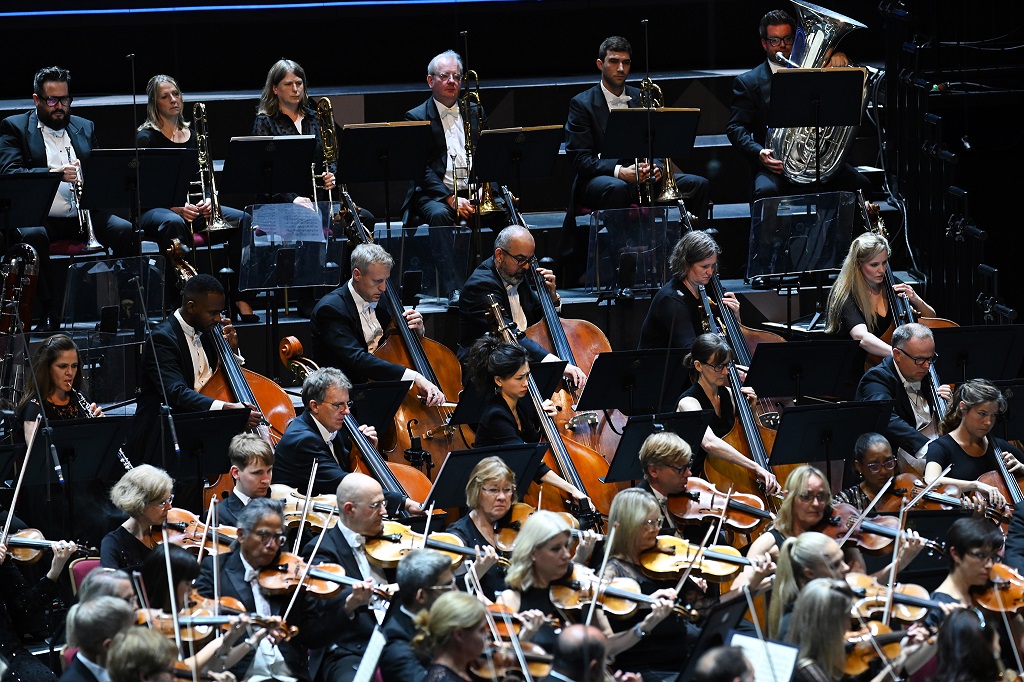
by Richard Whitehouse photos by Chris Christodoulou / BBC

It may have taken 70 years for its Proms premiere but the Eighth has since become the second most often played of Bruckner’s symphonies (this being its 21st hearing), and a near capacity house greeted tonight’s performance by the BBC Symphony Orchestra with Semyon Bychkov.

At home across a broad repertoire, Bychkov has of yet directed relatively little Bruckner, and the first movement took its time to settle. Fugitive rather than speculative in their emotional import, those distinct motivic elements lacked a final degree of definition and only began to take on greater cumulative focus during a development whose unfolding drama was matched but not exceeded by the climax of the coda – after which, that inexorable winding down into silence was precisely controlled while curiously unevocative in its sense of time running out.

With the outer sections taken at a swift but never headlong tempo that enabled its underlying ostinato pattern to be perceived throughout, the Scherzo exuded energy while also mystery in what remains Bruckner’s most powerful instance of a genre he made his own. The brass was at its most assured, and Bychkov duly avoided any temptation to make the lengthy trio a self-contained episode. Its unforced progress brought winsome contributions from woodwind and harps, the reprise then having audibly greater impetus as it surged towards its decisive close.

As so often in this symphony, the Adagio found the interpretation and its realization in most potent accord. Mindful to draw its continual thematic restatements into a consistent process of developing variation, Bychkov conveyed the music’s expressive but also spatial grandeur with an assurance hardly less evident in its unfolding tonal trajectory. Nor did the excising of material in revision impede its course, even if the sudden appearance of cymbals and triangle at its climax sounded more than usually redundant. A pity, moreover, that momentary failings of intonation among Wagner tubas affected what was otherwise his near perfect rendering of the coda – Bruckner’s distilling of main motifs, underpinned by the halting accompaniment, finding closure only at that point where everything stops as the movement comes full circle.

From here the Finale set out with due purposefulness, even though the occasional rhythmic hesitancy gave notice of an approach in which the whole did not quite match the sum of its admittedly impressive parts. Strategically coinciding with those divisions of the movement overall, the chorale-like main theme brought a resplendent response as left its eloquent then ominous successors sounding incidental within the ongoing formal scheme, and though the extensive development did not lack for variety of content, its discursiveness made for a less than perfect unity. Any remaining tentativeness was none the less dispelled in a coda whose gradual emergence made for an apotheosis of unusual clarity – the superimposing of themes not just ingenious in its technical skill but cathartic in its conveying of a journey completed.

The illustrious rollcall of conductors who have tackled this work at the Proms speaks for itself, and while Bychkov might not yet have joined the ranks of Wand, Haitink and Mehta et al, his belief in and commitment to Bruckner’s Eighth was amply communicated to all those present.

For more on the 2023 BBC Proms, visit the festival’s website at the BBC. Meanwhile click on the names for more information on the BBC Symphony Orchestra and guest conductor Semyon Bychkov – and finally composer Anton Bruckner