On Record: Emily Howard: Torus (NMC Recordings)

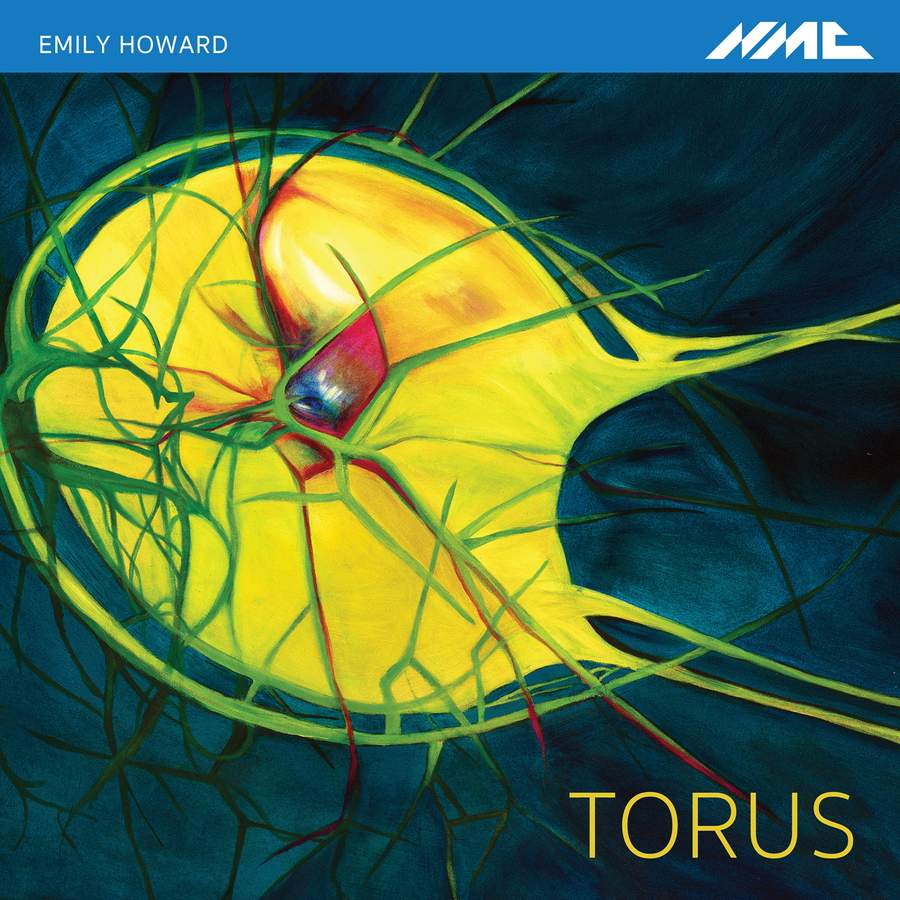
Emily Howard

Antisphere (BBC Philharmonic Orchestra / Vimbayi Kaziboni)
Producer Matthew Bennett, Engineer Stephen Rinker
Recorded 29 November 2022, Bridgewater Hall, Manchester

sphere (BBC National Orchestra of Wales / Mark Wigglesworth)
Producer Dean Craven, Engineer Stephen Rinker
Recorded at the Aldeburgh Festival, 23 June 2018, The Maltings, Snape

Compass (Julian Warburton (percussion), Birmingham Contemporary Music Group / Gabrielle Taychenné)
Producer & Engineer David Lefeber
Recorded 4 December 2022, Royal Northern College of Music, Manchester

Torus (BBC Symphony Orchestra / Martyn Brabbins)
Producer Ann McKay, Engineer Christopher Rouse
Recorded 11 November 2019, Barbican Hall, London

NMC Recordings D274 [68’58″]

Reviewed by Richard Whitehouse

What’s the story?

NMC releases a second collection of music by Emily Howard – now in her early forties and established among the most distinctive while forward-looking composers of her generation, heard in scrupulous performances by a notable line-up of British orchestras and ensembles.

What’s the music like?

Few world premieres from recent years have left an impression comparable to that of Taurus at the Proms in 2016. Its appearance, moreover, marked a further stage in an evolution which had commenced just over a decade earlier and has continued apace, with major commissions from British and European organizations. This has been paralleled by Howard’s commitment into researching the intrinsic properties of sound, most recently via the Centre for Practice & Research in Science and Music (PRiSM) at Manchester’s Royal Northern College of Music.

As it now stands, Torus is the first part in an informal trilogy of pieces collectively entitled Orchestral Geometries. It evolves along the perceived trajectory of a doughnut-shaped ball whose central void is crucial to music evoking absence as much as presence. Not that a work subtitled Concerto for Orchestra could be found lacking in either immediacy of content or virtuosity of gesture, which qualities come demonstrably to the fore as it unfolds and make for a composition involving in its expressive profile and fascinating in its formal process.

By contrast, Sphere is a succinct yet eventful journey through and around the global shape in question and which, in this context, might reasonably be thought an extra-terrestrial interlude – its ideas pithy while exuding enough potential for their development in subsequent pieces.

This is what happens in Antisphere which forms its conceptual opposite though also its aural continuation, the piece gradually encompassing the ‘sound-space’ through an engrossing and imaginative demonstration of orchestral prowess. Evident too is an increased focus upon the visceral nature of the musical content, likely reflecting a form which can precisely be defined in mathematical terms but remains all but intangible as regards human perception. Fortunate, then, that Howard has been able to render this concept as an emotional and affective whole.

Hardly less absorbing is Compass, the most recent of these pieces. This takes the spatial and nautical connotations of its title as the basis for music which unfolds as a cohesive dialogue between string septet and percussion that complements it and offers contrasts at every turn.

Does it all work?

It does, not least for providing an arresting take on that interplay of ‘heart and brain’ that has been a mainstay of Western music. The cerebral basis of all these pieces may be undeniable, though equally so is the precision of their forms and, above all, the allure of their expression judged intrinsically as sound. Much the same could be said of the music of Iannis Xenakis, the centenary of whose birth was commemorated last year, and whose thinking is continued by Howard from a vantage that is inherently personal while being decisively of the present.

Is it recommended?

It is, not least for its excellent performances by three of the BBC orchestras and Birmingham Contemporary Music Group, with booklet notes by Paul Griffiths and mathematician Marcus du Sautoy. This impressive release reinforces Howard’s significance in no uncertain terms.

Listen & Buy

Torus is released on Friday 28 April. You can explore buying options at the NMC Recordings website, and listen to clips from the album at the Presto Music site. You can read Arcana’s interview with Emily Howard by clicking on the link, and click on the names for more on the composer Emily Howard, plus performers Vimbayi Kaziboni, Mark Wigglesworth, Julian Warburton, Gabrielle Teychenné and Martyn Brabbins

BBC Proms #44 – Soloists, BBC Symphony Chorus & Orchestra / Sakari Oramo: Ethel Smyth ‘Mass’ & Debussy ‘Nocturnes’

Prom 44 – Nardus Williams (soprano), Bethan Langford (mezzo-soprano), Robert Murray (tenor), Božidar Smiljanić (bass), BBC Symphony Chorus, BBC Symphony Orchestra / Sakari Oramo

Debussy Nocturnes (1897-9)
Smyth Mass in D (1891, rev. 1924) [Proms premiere]

Royal Albert Hall, London

Saturday 20 August 2022

Reviewed by Richard Whitehouse Photos (c) Chris Christodoulou

His third Prom this season found Sakari Oramo conducting the BBC Symphony Orchestra in an unlikely yet, in the event, thought provoking double-bill of pieces composed at either end of the same decade and which duly played to the strengths of all those who were taking part.

The music of Ethel Smyth has been a prominent feature of this season and while her Mass in D comes too early in her career to be considered ‘mature’, it does evince many of those traits as defined the operas that followed. Written during a brief flush of adherence to Anglicanism, this is demonstrably a concert rather than liturgical setting (which makes its apparent status as the first Mass heard publicly in England for almost 300 years the more ironic) and, moreover, one of a ‘symphonic’ rather than ‘solemn’ conception despite the audible debt to Beethoven.

Smyth reinforces this aspect by placing the Gloria at the close – thereby making it the finale of a sequence in which the Kyrie, building gradually to a baleful climax before returning to its initial sombreness, becomes an extended introduction to the Credo whose numerous sub-sections facilitate a sonata-form design of no mean formal cohesion and expressive breadth. For their part, the Sanctus, Benedictus and Agnus Dei function as extended slow movement whose (for the most part) emotional restraint enables the soloists to come to the fore – after which, the Gloria takes its place as a finale not least in terms of drawing on previous themes and motifs through to the forceful though never merely bathetic culmination. That Smythe did not essay a symphony given her evident structural command seems the more surprising.

Tonight’s performance was no less assured than that which Oramo gave at the Barbican (and subsequently recorded, albeit with different soloists) three seasons ago. The soloists made the most of their contributions – Nardus Williams bringing a plaintiveness and elegance that was ideally complemented with Bethan Langford’s warmth and understated fervency, and though Robert Murray’s ardency showed signs of strain, he was no less ‘inside’ his part than Božidar Smiljanić, whose solo was more affecting for its burnished eloquence. The BBC Symphony Chorus responded as one to the full-on contrapuntal writing of those main movements, while Richard Pearce ensured the (too?) extensive organ part did not muddy the orchestral textures. Oramo directed with clear enjoyment a work that, for the most part, justified its 62 minutes.

In the first half, Oramo presided over a searching account of Debussy’s Nocturnes – its three movements still sometimes encountered separately but far more effective heard as a complete entity. Not its least impressive aspect was the ease with which these followed on from each other with a cumulative inevitability – the fugitive shading of Nuages (melting cor anglais playing by Helen Vigurs) leading to the half-lit activity of Fêtes, with its darting gestures and a central march-past of vivid understatement, then on to the sensuous allure of Sirènes.

As enticing as the women’s voices of the BBCSC sounded in this closing movement, it was the fervency with which Oramo infused its recalcitrant content such as made it the natural culmination of the sequence – the final bars dying away with a tangible sense of fulfillment.

Click on the artist names for more information on Nardus Williams, Bethan Langford, Robert Murray, Božidar Smiljanić and Sakari Oramo and for more information on the BBC Symphony Orchestra head to their website. For more on composer Dame Ethel Smyth, click here

BBC Proms #26 – The Labèques, BBC Symphony Orchestra / Semyon Bychkov: Julian Anderson premiere, Martinů & Rachmaninoff

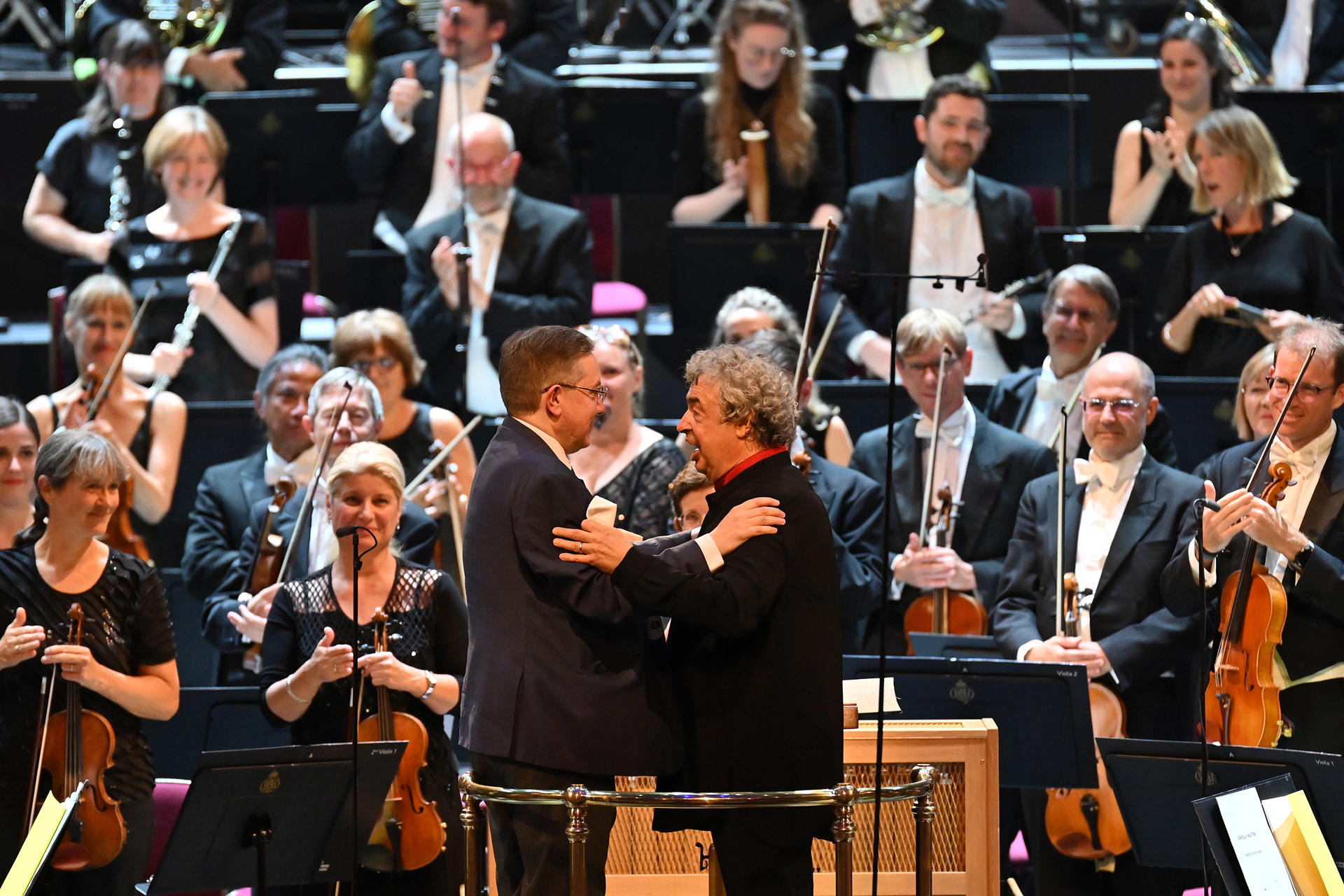
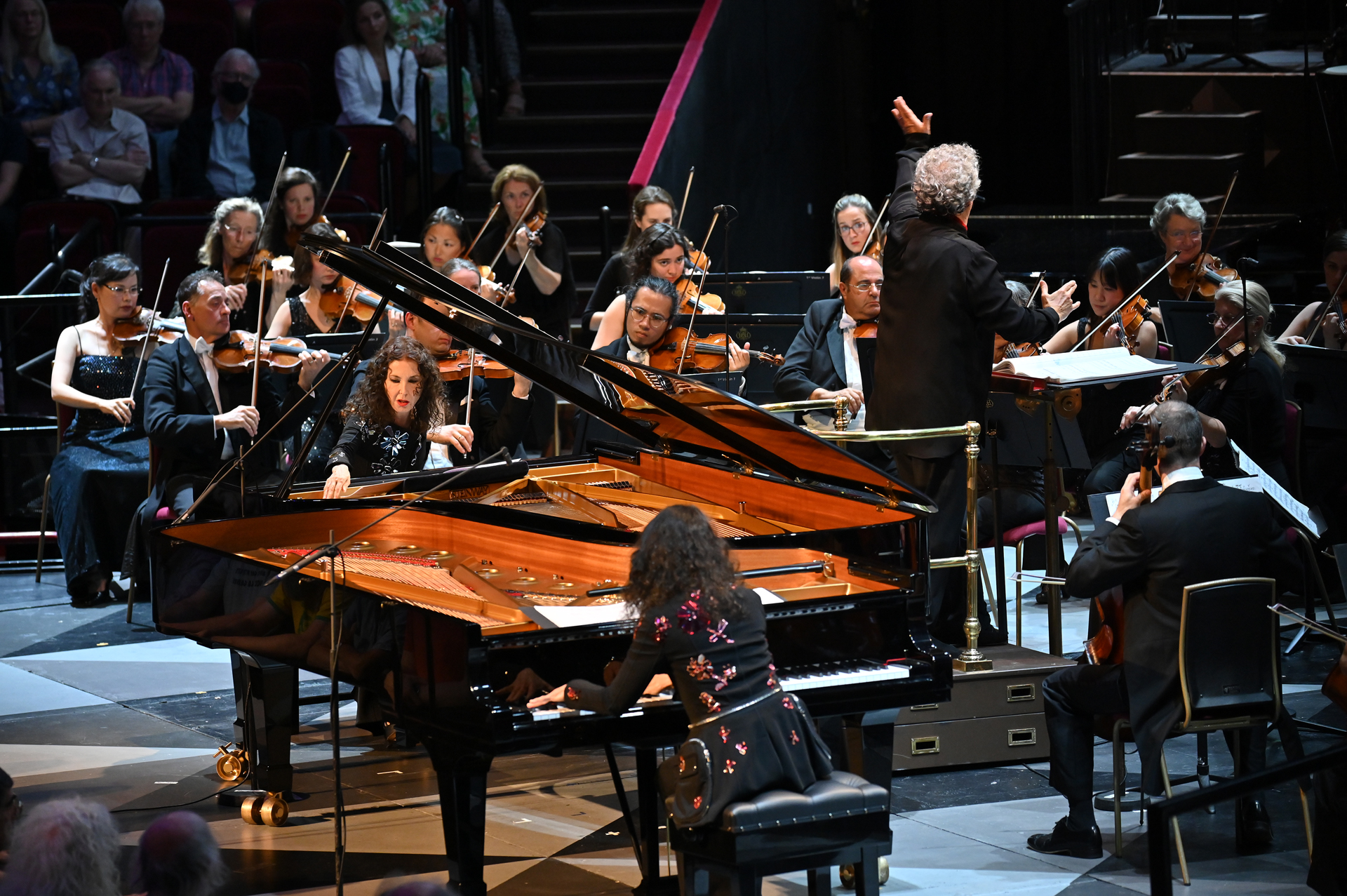
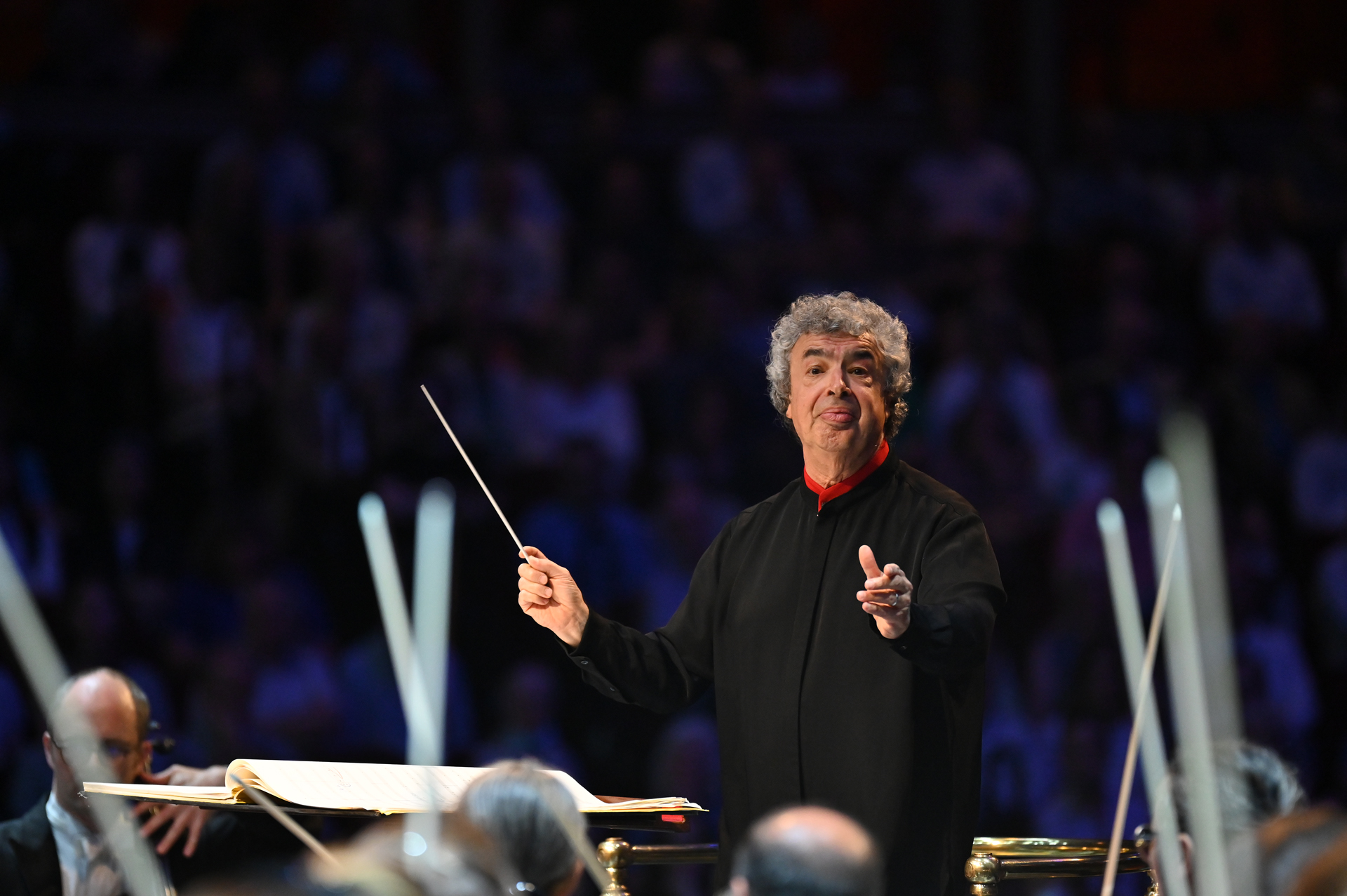
Prom 26 – Katia and Marielle Labèque (pianos), BBC Symphony Orchestra / Semyon Bychkov (above)

Anderson Symphony No. 2 ‘Prague Panoramas’ (2020-22) (BBC co-commission: World premiere of complete work)
Martinů Concerto for Two Pianos and Orchestra H292 (1943)
Rachmaninoff Symphonic Dances Op.45 (1940)

Royal Albert Hall, London
Friday 5 August 2022

Reviewed by Richard Whitehouse Photo (c) Chris Christodoulou

An unusually well-assembled concert this evening with what might be termed a programme of ‘three-by-threes’ – each of these three works having three movements which, in each case, results in a broadly symmetrical design, not least the Second Symphony by Julian Anderson (with the conductor, below).

Inspired by Josef Sudek’s photographs of Prague while utilizing two medieval Czech hymns, Prague Panoramas (might Prague Pictures be even more apposite?) is typical in its fusing evocativeness with precision. Not least the preludial opening movement, its stark alternation of quick-fire chords and silence evolving into aspiring melodic lines as build to a tumultuous if quickly curtailed climax, though this linear aspect comes to dominate the nocturnal central movement with its expressive intensifications then fades against a backdrop of bell resonance and luminously modal polyphony. The finale is a deftly organized rondo – its energetic main material, inspired by Josef Lada’s almost Rabelaisian depictions of pub brawls, interspersed with more lyrical ideas through to the heady peroration later subsiding into a calm postlude.

Although its first two movements had been heard in Munich and Prague, this was the work’s first complete performance and found the BBC Symphony at its collective best – not least the lambently interweaving woodwind and strings, the visceral impact of brass and a substantial array of percussion whose contribution was pervasive. Semyon Bychkov (under-appreciated as an exponent of contemporary music) duly brought out that unity-within-diversity such as gave this work an underlying focus across the 32 minutes of its eventful yet cohesive course.

From Prague-inspired music by a British composer to that by a Czech composer in America – Martinů’s Concerto for Two Pianos may never have gained the plaudits of his earlier Double Concerto but it typifies this composer’s exile in a tried-and-tested interplay of folk-inflected melodicism with a harmonic acerbity recalling Prokofiev and rhythmic dexterity redolent of Stravinsky. Its undoubted highlight is a central Adagio whose almost ‘harmonie’ woodwind writing and circling piano figuration (had the composer come across the gamelan-influenced music of Colin McPhee?) feels mesmeric and affecting. Neither outer movement comes close in their audibly contrived amalgam of the rumbustious and lyrical, but this is music in which Katia and Marielle Labèque excel and tonight’s performance could rarely have been equalled.

Nor was there any doubting Bychkov’s authority in Rachmaninoff’s Symphonic Dances that followed the interval. Admittedly this now regularly played while technically exacting piece needed more rehearsal than the BBCSO was able to give it on this occasion, though the outer sections of the first dance had just the right ominous incisiveness and its middle part featured winsome alto saxophone from Martin Robertson. The second dance had irony and angularity aplenty, as was slightly offset by the strings’ less than unanimous response towards the close.

Its sombre ambivalence and intricate textures give the central span of the final dance a quality unique in this composer: if Bychkov might have endowed it with even greater intensity, there was no doubting his identity with this music here or on the way to its resplendent apotheosis.

For more information, click on the names of composer Julian Anderson – and for more on the artists, click on the names of Katia and Marielle Labèque, Semyon Bychkov and the BBC Symphony Orchestra. For more on this year’s BBC Proms as it continues, head to the Proms website

For more information, click on the names of composers Kalevi Aho and Kaija Saariaho – and for more on the artists, click on the names of Carolina Eyck, John Storgårds and the BBC Philharmonic Orchestra

In concert – Nicola Benedetti, BBC Symphony Orchestra / Sakari Oramo: Romantics in Exile – Korngold & Langgaard

BBC SO/Oramo & Benedetti - Romantics in Exile

Korngold Violin Concerto in D major Op.35 (1945)
Langgaard
Symphony no.1 in B minor BVN32, ‘Mountain Pastorals’ (1908-11)

Nicola Benedetti (violin, below), BBC Symphony Orchestra / Sakari Oramo

Barbican Hall, London
Friday 8 April 2022

Written by Richard Whitehouse. Concert photos by James Watkins / BBC

Sakari Oramo has certainly blazed a trail for tackling little-known symphonic works during his tenure at the BBC Symphony Orchestra – witness his recent revival of the Symphony by Dora Pejačević and now that of the First Symphony from Danish anti-hero Rued Langgaard.

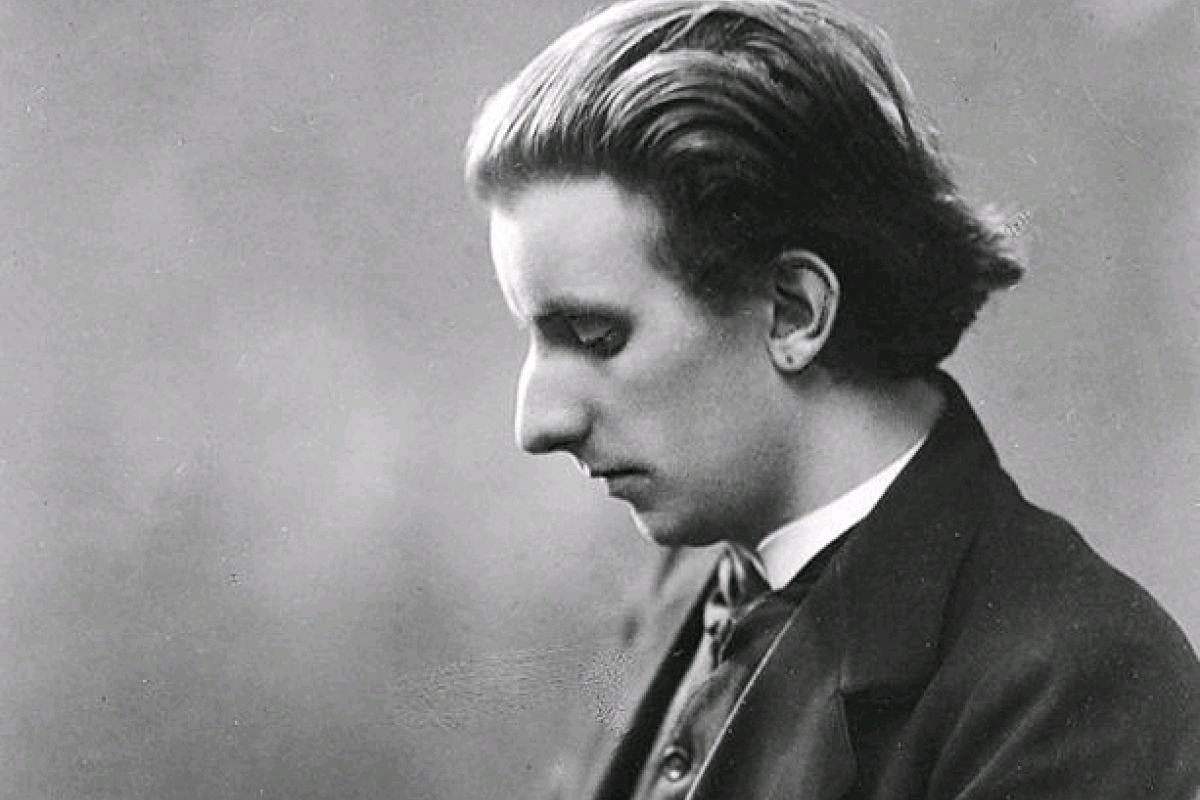
One who frequently snatched defeat from the jaws of victory, Langgaard (below) could not have had a better start to his career than its premiere with the Berlin Philharmonic and Max Fiedler on 10th April 1913, just before his 20th birthday. Its enthusiastic reception was never repeated in his remaining four decades, the composer traversing various stylistic phases while fighting a psychological battle with the Danish musical establishment. With its inspiration in Sweden’s Kullaberg peninsula, this work remains testament to the vaunting ambition of his younger self.

Steering a cohesive course across this almost hour-long piece whose sizable forces (not least four Wagner tubas) is no easy task, but Oramo succeeded more convincingly than on any of the three commercial recordings. Not least in a first movement, Surf and Glimpses of Sun, whose elongated sonata design and increasingly histrionic climaxes could so easily veer into overkill, rather than yielding a recklessly if purposefully cumulative momentum. Mountain Flowers is a slow movement of no mean eloquence, not least with Oramo encouraging the strings to relish the limelight over its opening and closing stages then towards its expressive apex. The undoubted highlight is Legend, less an intermezzo than a dark-hued formal crux whose ominous atmosphere looks on toward those anguished confessionals which lay ahead.

More conventional is Mountain Ascent, a lively and often playful scherzo whose impetus finds ready contrast with the wistful trio at its centre. Rendered here with suitable deftness, this made an admirable foil to Courage – an expansive finale not without its longueurs yet whose development affords some strikingly evocative orchestration, then an apotheosis for which Oramo not only prepared judiciously, but that the BBCSO kept within focus even as the addition of off-stage brass threatened to send those closing pages spinning out of orbit.

An experience, then, such as only a live performance can provide, and which demonstrably played to the strengths of this partnership. Might one hope that Oramo and the BBCSO give Langgaard’s Sixth, arguably his symphonic masterpiece, at a Proms concert in due course?

A thought occurred that had the Danish film industry maintained its promise prior to the First World War, Langgaard might have found as productive an outlet for his abilities as Korngold had for his during the golden age of Hollywood. The latter’s Violin Concerto was not always the familiar item it has now become, and Nicola Benedetti’s rendering assuredly conveyed its essence. Pointing up the discreet contrast between the themes of its opening Moderato, with a trenchant account of its cadenza, she gave a finely shaped if overly generalized account of its central Romance, then projected the final Allegro’s incisiveness and high-flown melodrama with relish. Nor did she undersell the suavity of Jacob Gade’s tango Jalousie – a piece which, 97 years on, confirms what is possible if a composer does not entirely eschew popular appeal.

For further information on the BBC Symphony Orchestra’s 2021/22 season, click here For more on Erich Korngold and Rued Langgaard, click on the composer names – and click on the artist names for more information on Nicola Benedetti and Sakari Oramo

In concert – Vilde Frang, BBC Symphony Orchestra / Sakari Oramo: Beethoven Violin Concerto & Dora Pejačević Symphony

Sakari Oramo

Beethoven Violin Concerto in D major Op.61 (1806)
Pejačević
Symphony in F# minor Op.41 (1916-17, rev. 20)

Vilde Frang (violin, below), BBC Symphony Orchestra / Sakari Oramo

Barbican Hall, London
Friday 26 November 2021

Written by Richard Whitehouse. Pictures (c) Mark Allan

The latter-day uncovering of music from the past two centuries by female composers has not always been determined by its intrinsic quality yet, on the basis of this evening’s account by the BBC Symphony Orchestra, the Symphony by Dora Pejačević was certainly worth revival.

Born in Budapest and growing up within the Croatian nobility, Pejačević (1885-1923) early on evolved an idiom whose pivoting on the cusp between late-Romanticism and Modernism was well suited to those large-scale instrumental and, latterly, orchestral works that dominate an output curtailed by her death – from kidney failure – at just 37. Certainly, there is nothing at all cautious about her Symphony in F sharp minor, composed during the later stages of the First World War and a piece audibly indebted to though never merely beholden to its times.

The BBC Symphony Orchestra conducted by Sakari Oramo with Vilde Frang on violin perform Ludwig van Beethoven’s Violin Concerto and Dora Peja?evi?: Symphony in F-sharp minor, op. 4 in the Barbican Hall on Friday 26 Nov. 2021. Photo by Mark Allan

Surprisingly, the opening movement is in most respects the weakest – its main Allegro failing to sustain the impact of its impressive slow introduction (Brahms’s First Symphony the likely precursor), in terms of questing harmonic trajectory or purposeful momentum, once the lyrical if rather flaccid second theme has taken hold. The development relies more on rhetoric than motivic ingenuity over its too brief course, followed by an awkwardly modified reprise then a coda whose glowering intensity reveals an intermittent tendency to overscore for the brass.

Such failings are largely absent from what follows. Centred on a soulful melody given to cor anglais, the Andante builds methodically while irresistibly to its pathos-laden climax before subsiding into the lower reaches of the woodwind; while the Scherzo (better placed second in context) utilizes tuned percussion to underpin a progress whose rhythmic vitality is unusual in symphonies from this era. The final Allegro revisits the first movement’s emotional angst, but its relative succinctness on the way to an ultimately cathartic peroration feels securely judged.

Such, at any rate, was the impression left by this performance – the BBCSO responding with alacrity to Sakari Oramo’s belief in music scored, for the most part, with no little imagination for forces including triple woodwind, six horns and four trumpets. If not the masterpiece some might like to believe, Pejačević’s Symphony is evidently worth revival as frequently as, say, that by Korngold – a potent of what this composer would surely have gone on to create. That she enjoyed only a short-lived maturity need not detract from extent of her legacy as it stands.

The BBC Symphony Orchestra conducted by Sakari Oramo with Vilde Frang on violin perform Ludwig van Beethoven’s Violin Concerto and Dora Peja?evi?: Symphony in F-sharp minor, op. 4 in the Barbican Hall on Friday 26 Nov. 2021. Photo by Mark Allan

Despite sustaining a hand injury, Vilde Frang took the stage in the first half for a reading of Beethoven’s Violin Concerto (replacing that by Stravinsky) as brought the genial and restive aspects of its expansive first movement into effortless accord; after which, the variations of the Larghetto were exquisitely delineated then the humour of the final Rondo shot-through with an incisiveness through to the emphatic close. Among the most astute of accompanists, Oramo drew felicitous playing from the BBCSO’s woodwind and a reduced string-section.

As encore, Frang gave an eloquent take on Gott erhalte Franz den Kaiser, Haydn’s theme for the variations in his ‘Emperor’ Quartet. Hopefully those still trying to reconcile the movement-headings of the Pejačević as given erroneously for the Beethoven were not unduly distracted.

For the repertoire in this concert, listen to the Spotify playlist below:

For further information on the concert, click here For more on Dora Pejačević, click here – and for more on soloist Vilde Frang, here