New music – Caroline Shaw: Leonardo da Vinci (Original Score) (Nonesuch)

published by Ben Hogwood, with text appropriated from the press release

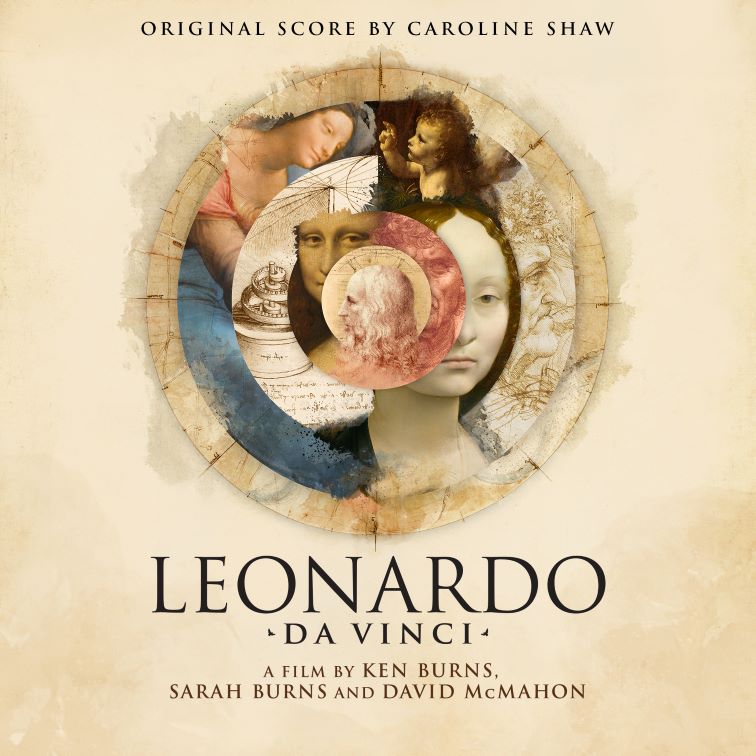
The original score for Ken Burns’s new two-part documentary, LEONARDO da VINCI, with new compositions by Caroline Shaw, is available via Nonesuch Records on 25 October. The album features performances by the composer’s long time collaborators Attacca Quartet, Sō Percussion, and Roomful of Teeth as well as John Patitucci. Shaw wrote and recorded new music for LEONARDO da VINCI, marking the first time a Ken Burns film has featured an entirely original score. The video for Intentions of the Mind, from the album, can be viewed here:

LEONARDO da VINCI is directed by Ken Burns, Sarah Burns, and David McMahon. The film, which explores the life and work of the fifteenth century polymath Leonardo da Vinci, is Burns’s first non-American subject. It also marks a significant change in the team’s filmmaking style, which includes using split screens with images, video, and sound from different periods to further contextualize Leonardo’s art and scientific explorations. LEONARDO da VINCI looks at how the artist influenced and inspired future generations, and it finds in his soaring imagination and profound intellect the foundation for a conversation we are still having today: what is our relationship with nature and what does it mean to be human?

“No single person can speak to our collective effort to understand the world and ourselves,” said Ken Burns. “But Leonardo had a unique genius for inquiry, aided by his extraordinary skills as an artist and scientist, that helps us better understand the natural world that we are part of and to appreciate more fully what it means to be alive and human.”

“To help give depth and dimension to Leonardo’s inner life, and to carry our viewers on his personal journey, we enlisted the composer Caroline Shaw,” McMahon says in the album’s liner note. “Caroline’s existing body of music—joyful, daring, at times transcendent, and wholly unique—seemed to speak directly to Leonardo, a seeking soul who, 500 years after his death, can come across as strikingly modern. A fully original score, we believed, would add crucial connective tissue to areas where the record of Leonardo’s life is thin and it’s possible to briefly lose his trail. The music Caroline created is dynamic, enthralling and filled with wonder.

“This soundtrack is a testament to the inspired efforts of Jennifer Dunnington, who marshaled it into being, the brilliant musicians and vocalists who, with the help of Alex Venguer, Neal Shaw, Colton Dodd and Tim Marchiafava, made it soar, and most of all Caroline Shaw, who might be Leonardo’s soulmate from across time,” he continues. “With her help, the Leonardo who emerges is no wizard shrouded in mystery, but a prideful, obsessive, at times lonely or flustered, occasionally ecstatic, and, in the end, content man who is in ways both modern and thoroughly of his time.”

“As we set out to explore Leonardo’s life, we realized that while he was very much a man of his time, he was also interested in something more universal,” said Sarah Burns. “Leonardo was uniquely focused on finding connections throughout nature, something that strikes us as very modern today, but which of course has a long history.”

You can read more about Caroline Shaw at her website – and also more about Nonesuch here

Published post no.2,242 – Wednesday 17 July 2024

In concert – CBSO Chorus & Orchestra / Joshua Weilerstein: Haas, Bernstein, Shaw & Dvořak

Michael Mulroy (treble), CBSO Chorus, City of Birmingham Symphony Orchestra / Joshua Weilerstein

Haas Study for Strings (1943)
Bernstein Chichester Psalms (1965)
Shaw Music in Common Time (2014)
Dvořak Symphony no.9 in E minor Op.95 ‘From the New World’ (1893)

Symphony Hall, Birmingham
Wednesday 15 May 2024

Reviewed by Richard Whitehouse Picture (c) Yuri Pires Tavares

In recent seasons, Joshua Weilerstein has presided over several of the City of Birmingham Symphony Orchestra’s most thought-provoking concerts and tonight’s programme was no exception in its potent mix of the recent and unfamiliar, alongside a symphonic evergreen.

It was thanks to the conductor and Auschwitz survivor Karel Ančerl that Study for Strings by Pavel Haas survived its immediate context, as propaganda for a Nazi documentary on cultural activity at the Theresienstadt transit-camp, to become one of this composer’s defining works. Felicitously combining Czech folk music with traditional Jewish inflections and (in its central section) more expressionist undertones, alongside a compact and quasi-symphonic design, it is a potent indication as to where post-war Czech music might conceivably have been headed.

It duly brought a vivid and energetic response from the CBSO strings, who were then joined by brass and percussion in Bernstein’s Chichester Psalms. Commissioned by the Dean of the city’s cathedral, it enabled the composer to pull together a number of earlier or aborted ideas in three Psalm-settings given focus by being heard in Hebrew translation with an authentic (if impractical as regards the percussion) scoring. Weilerstein drew the requisite verve from its initial setting, and if Michael Mulroy seemed tentative in its successor (discreet amplification might have helped), the contrast between his plaintiveness and edginess of the male-chorus interludes was pertinently drawn. Its anguished prelude for strings powerfully rendered, the final setting had an affecting eloquence through to the serene unaccompanied closing chorus.

After the interval, the CBSO Chorus was heard in rather more restrained guise with Music in Common Time by Caroline Shaw. Its brief and oblique text might have come from a late song by Talk Talk, but it yet provides the framework for a cannily unfolding fantasia in which the eddying textures of John Adams frame a speculative section with its string writing more than a little redolent of early Penderecki. Throughout, voices and instruments were finely melded in a composition that certainly suggests a plausible way out of any post-minimalist impasse.

What to say about the New World Symphony? Firstly, that it fitted judiciously into the overall programme as to conception; secondly, that it brought out the best in this partnership. Right from its evocative introduction, Weilerstein was alive to those many expressive ambiguities in the initial Allegro (a pity, though, that he omitted the exposition repeat as this undermines the formal balance overall), then drew a rapt and often searching response from the CBSO in the Largo – Rachel Pankhurst making the most of its indelible cor anglais melody. Nor was there any lack of bite or (in its trio section) gracefulness in the scherzo; such incisiveness of ensemble consistent throughout the finale, whose rhythmic impetus ensured the coda was not merely decisive but crowned the whole work in an apotheosis as conclusive as it was joyous. In his thoughtful initial remarks, Weilerstein spoke of this programme as being defined by its complexity, nuance and confrontation: qualities not always evident in present-day music, or in present-day discourse, but whose absence is our loss – as this concert eloquently confirmed.

Click on the link to read more on the current CBSO concert season, and on this link to read about the CBSO’s 2024/25 season. Click on the names for more on conductor Joshua Weilerstein, the CBSO Chorus and composer Caroline Shaw

Published post no.2,181 – Friday 17 May 2024

Screen Grab: The music of Marriage – new BBC drama brings composer Caroline Shaw to the fore

This week the BBC have started showing the intriguing drama Marriage, which has superstar quality from its two lead characters, Sean Bean and Nicola Walker.

The series has split opinion in its accurate portrayal of every life in a marriage lasting 27 years – largely played out in real time. As the series has developed the many subtleties have combined to a plot that is gathering substance and meaning as time goes on, rather like life itself.

One of the most striking elements of the drama is its bold choice of signature tune, which again has divided opinion sharply. The chosen music is by composer Caroline Shaw (above) – the first couple of minutes of her Partita for unaccompanied choir, specifically the first movement Allemande.

Initially the voices sound like an extra part of Marriage, especially as the plot continues to play out, but as the voices come together in a firm pitch so too do the images, and the end credits roll.

You can listen to the full movement, which lasts six minutes, below – and enjoy Shaw’s wonderful layering of the voices, with spicy harmonic clashes and some vibrant writing for the small choir:

The Partita continues with three further movements, each based on an old dance form. The Sarabande is initially soothing and enchanting, before really letting rip with primal power halfway through. The Courante, the most substantial of the four movements, has a number of hypnotic effects and fresh faced harmonies, especially halfway through as it soars to unexpected heights.

Finally the Passacaglia has a lilting base to its music, and a spoken word commentary resumes as it did at the start of the piece, before the voices end powerfully in unison.

Here is a live performance, given by the dedicatees Roomful of Teeth – with whom the composer sings:

Aside from this high profile appearance, Shaw has been making quite a name for herself in recent years. In 2021, Nonesuch released the album Let The Soil Play Its Simple Part, written and performed with Sō Percussion:

Meanwhile the choral piece And the Swallow lingers particularly long in the memory:

You can discover more of Caroline’s music at her website

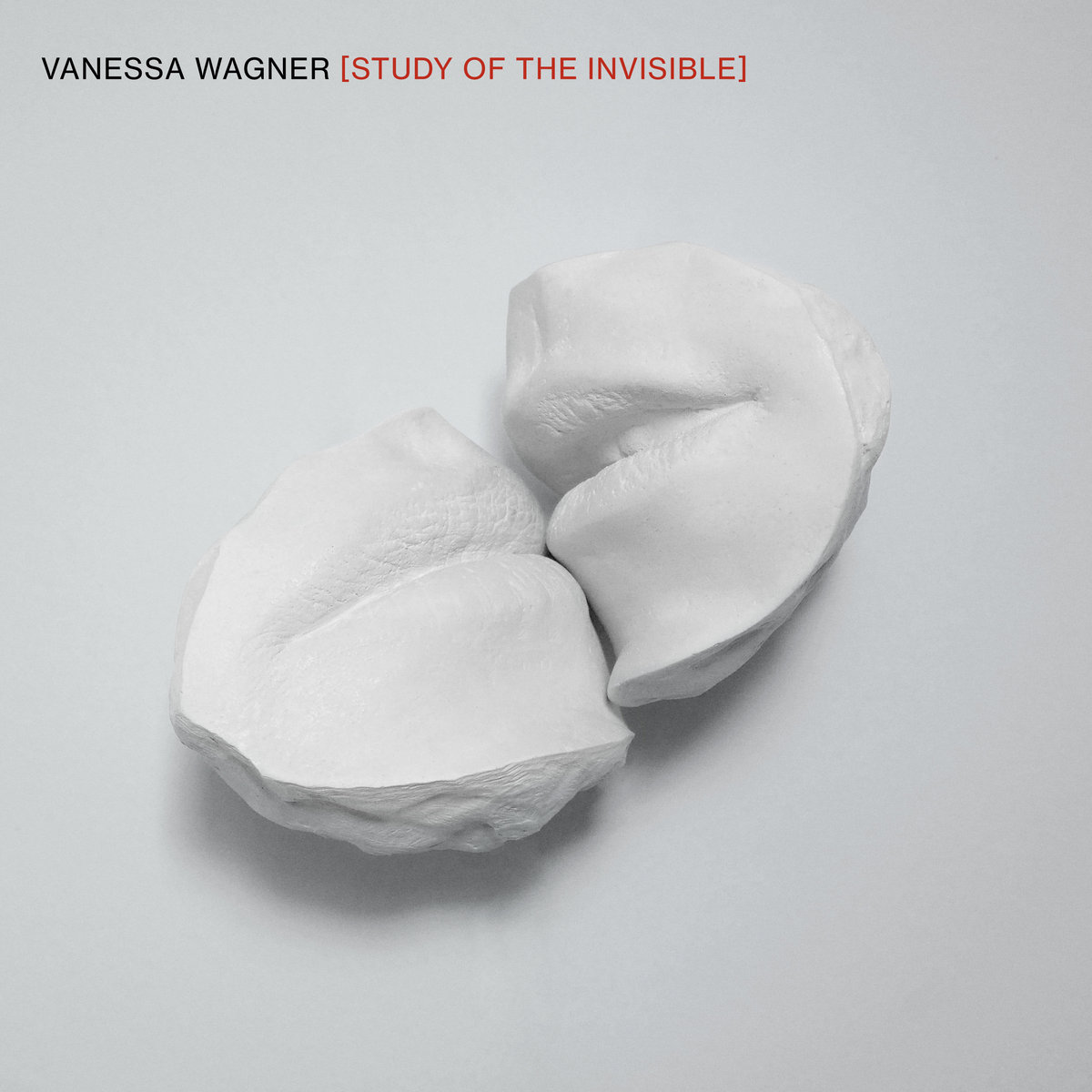
On Record – Vanessa Wagner: Study Of The Invisible (InFiné Music)

vanessa-wagner-2

written by Ben Hogwood

What’s the story?

Vanessa Wagner returns with a thoughtfully compiled album bringing together a selection of modern piano music that might be described as ‘minimal’. Her concept is to show how new music can still explore the instrument afresh, using the barest of melodic or harmonic material as its stimulus but finding something substantial within.

The selection here includes works by 14 composers, many of them rare and unpublished.

What’s the music like?

This is a really inspired compilation, logically ordered and with a natural rise and fall. In the process of the anthology, Vanessa Wagner shows off a wide range of approaches to the piano, from flowing, watery pieces to more percussive interludes. The music might be predominantly slow but Wagner finds its pressure points and releases its emotional energy in full, showcasing some fine compositions in the process.

The rippling surfaces of Suzanne Ciani’s Rain, first in the collection, are a kind of homage to a Debussy Arabesque. Harold Budd’s La Casa Bruja has a slower, more reflective beauty, as does the Brian and Roger Eno collaboration Celeste. Contrast these with the gently twinkling ivories of Bryce Dessner’s Lullaby (Song for Octave), and the thicker brush strokes of David Lang’s Spartan Arcs.

The two Philip Glass selections range from a sombre, deeply felt Etude no.16 to a staccato Etude no.6 that sounds a bit more like a fly buzzing against the insides of a jam jar. Wagner really gets Glass’s phrasing, and the powerful refrain that the piece returns to is forcefully and brilliantly played. Even more dazzling is the following Etude no.3, ‘Running’, by Nico Muhly, its thrilling discourse brilliantly distilled.

Elsewhere Moondog’s flowing Prelude no.1 in A minor casts its eyes towards the past, while Julia Wolfe’s Earring finds striking sounds in the piano’s upper register. Ezio Bosso’s Before 6 complements the activity of the Glass and Muhly Etudes with almost complete stillness, the effect both meditative and moving.

The most striking of the compositions, however, is the album’s centrepiece. Caroline Shaw’s Gustave Le Grey, based on a Chopin Mazurka, starts with clumps of chords and a solemn, slow bass. From these beginnings the piece progresses to contemplation, lost in thought in its centre before a searing expression of feeling, the piano cutting through in Wagner’s intense interpretation. A sense of pathos is evident at the end, a satisfying resolution.

Does it all work?

Yes, on many levels. What this compilation also does is somehow highlight the importance of the music of Erik Satie, without including any. Much of the music here is both minimal, interesting and emotional, mirroring the older composer’s achievements in his Gnossiennes and Gymnopédies. Wagner plays this music with great feeling and panache.

Is it recommended?

Without hesitation. This is a fine creative project, brilliantly scoped and realised. If you want to discover new piano music, here is a whole album’s worth on which to reflect and enjoy.

Stream

Buy

In concert – Hockley Social Club & the CBSO present: Symphonic Sessions

CBSO_2021.10_Symphonic Sessions_cr-Hannah Fathers-33

Symphonic Sessions

Hockley Social Club, Birmingham
Thursday 21 October 2021

Written by Richard Whitehouse Photos courtesy of Hannah Fathers

The City of Birmingham Symphony Orchestra’s ‘Out & About’ schedule has seen musicians playing at venues from railway stations to suburban pubs, but tonight’s Symphonic Sessions, billed as ‘‘the perfect evening for the musically curious’’, was a more ambitious undertaking.

The venue was Hockley Social Club – located closer to Newtown and an area which, with its rundown warehouses next to remnants of faded civic planning, is ripe for redevelopment of a kind encountered on the other side of Great Hampton Street. Such urban realism aside, it was an ideal setting for an event designed to appeal to the young professionals living or working in this area, and the capacity (300 or so) attendance was gratifying to club and orchestra alike. Assorted street food and designer cocktails were some of the attractions available on the night.

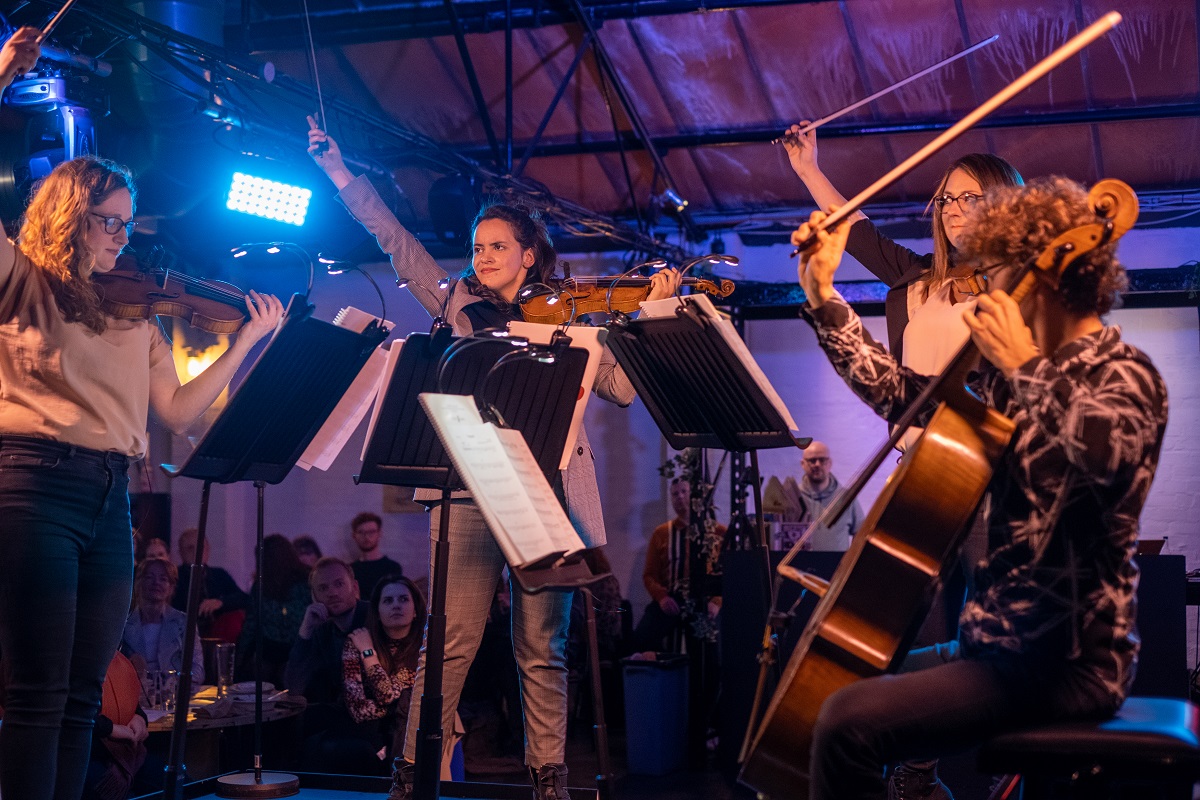
The live element consisted of two half-hour sets played by a quartet drawn from the CBSO, situated on a raised central platform, and amplified so neither visibility nor audibility was an issue. The first set enjoyed a lively start with Year of the Boar from Sufjan Stevens’s zodiacal electronica Enjoy Your Rabbit, popularized in Michael Atkinson’s arrangement for the Osso Quartet. One of the most arresting younger American composers, Caroline Shaw has written widely for quartet but, while Entr’acte provided a showcase for the musicians’ dexterity – not least cellist Arthur Boutillier – its fractured continuity tried the patience of numerous punters. Not so those teasingly ironic excerpts from Anna Meredith’s Songs for the M8 – with Sigur Rós’s evergreen Hoppípolla, as reimagined by the Vitamin Quartet, a delightful signing-off.

The inward fervency of Stevens’s Year of our Lord began a second set that touched on more Classical fare with a visceral take on the second movement of Shostakovich’s Eighth Quartet, then a lucid First Contrapunctus from Bach’s The Art of Fugue that only gained in eloquence on restarting after violinist Colette Overdijk had lost her battle with a dislodged microphone. The undoubted highlight was Bryce Dessner’s Aheym (Homeward) – a commission from the Kronos Quartet for the guitarist of The National, this is music whose propulsive energy and tensile interplay were to the fore in a performance which brooked no compromise. Violinist Kirstie Lovie and violist Amy Thomas then came into their own in excerpts from the Danish String Quartet’s folk-song anthology Wood Works, which made for a scintillating conclusion.

Either side of and in between the live music, low-key DJ sets (at least until the half-hour prior to closing) from ‘local tastemaker’ Pritt Kalsi did much to enhance the atmosphere for what throughout was a lively and appreciative audience. What proportion can be persuaded to make CBSO concerts at Symphony Hall a regular part of its fixture-list remains to be seen, though feedback on the ground was encouraging. Whatever else, the future of live events looks to be one in which listening across the spectrum of musical styles and genres has become the norm.

Good news, therefore, that Symphonic Sessions is destined not to be a one-off experiment, with the follow-up having been set for Thursday 2nd December. Whatever the line-up of musicians and music, it would seem certain that ‘‘A splendid time is guaranteed for all’’.

Further information on Symphonic Sesions can be found here. Further listening on the featured music can be enjoyed through the Spotify albums below:

Stevens:

Shaw:

Meredith:

Sigur Rós:

Shostakovich:

Bach:

Dessner:

Danish SQ:

cbso-symphonic-sessions