
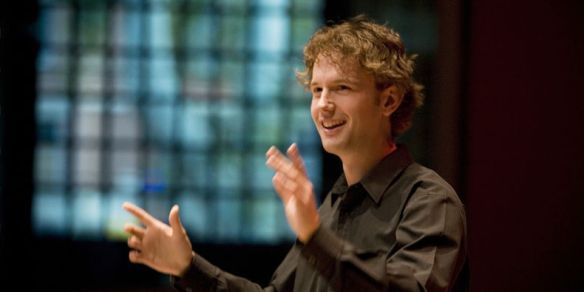
Yvonne Howard (mezzo-soprano, Sāvitri), Robert Murray (tenor, Satyavān), James Rutherford (baritone, Death), CBSO Youth Chorus, City of Birmingham Symphony Orchestra / Nicholas Collon (above)
Symphony Hall, Birmingham. Wednesday 8th February, 2017
Holst Sāvitri, H96 (1909); The Planets, H125 (1916)
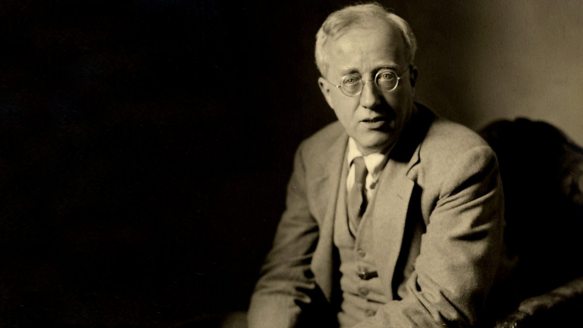
Gustav Holst (1874-1934)
Written by Richard Whitehouse
Cheltenham-born Gustav Holst enjoyed a close relationship with the City of Birmingham Symphony right from its inception, so it was good to see a concert being devoted to his music as part of The Spirit of England series running through to the orchestra’s centenary in 2020.
The elapsing of 108 years has not dulled the innovative qualities of Sāvitri, Holst’s one-act opera with which he made a decisive move from the Wagnerian opulence of his earlier music (not least the three-act opera Sita, still awaiting complete performance), towards the lean and often introspective expression of his maturity. Just over half-an-hour in length, it explores the time-honoured operatic themes of love and redemption as a means of transcending death – all rendered from a curious amalgam of Vedic teaching and Socialist thinking wholly of its time yet no less influential for being so. In addition, the scoring for just three woodwinds and nine strings, along with (wordless) offstage female voices, blazed the trail for later generations of British opera. No Sāvitri = no Britten chamber-operas and no Maxwell Davies music-theatre.
First heard in Birmingham 63 years ago, Sāvitri was given by the CBSO in 2004 and 2008. Then, as now, James Rutherford took the role of Death – his forceful yet ultimately humane assumption complementing the title-role, in which Yvonne Howard (replacing an indisposed Sarah Connolly) responded with fearlessness but also compassion; Robert Murray likewise conveying the heroic vulnerability of Satyavān as he succumbs to then escapes death via the intercession of Sāvitri. Choral and instrumental forces responded ably to Nicholas Collon’s direction, using the spatial possibilities of Symphony Hall’s acoustic to telling effect, but it was a pity that dimmed house-lights made it impossible to follow the succinct yet detailed libretto which was otherwise not always audible. Maybe surtitles could have been provided?
It would be an unlikely all-Holst concert as did not feature The Planets, which duly followed the interval. Collon presided over a performance which, while it offered few revelations, still did justice to the power and originality of this music. Mars evinced a brooding implacability through to those seismic closing bars, then Venus brought eloquence without sentimentality and a solace that was never cloying. Mercury was nimble and quick-witted, not least in the hectic approach to its close, and the only partial disappointment (as so often in this work) was Jupiter, whose outer sections were a shade unsubtle rhythmically, the indelible melody at its centre haltingly paced.
Saturn went much better – Collon alive to the gaunt solemnity of its opening pages and the monumental climax, the final section effortlessly combining radiance and resignation. Nor was there any lack of impetuousity in the goings-on of Uranus, the martial episode reaching a heady culmination (its organ glissando finely integrated into the texture) and wrathful final climax not pre-empting the stillness around it.
Following-on without pause, Neptune rounded-off this reading with a fitting evocation of the ethereal – the CBSO Youth Chorus now placed high in the Symphony Hall auditorium so its role was wholly audible yet, in keeping with Holst’s conception, poised on the intangible.
For more information on future CBSO concerts head to their website


 Arcana.fm