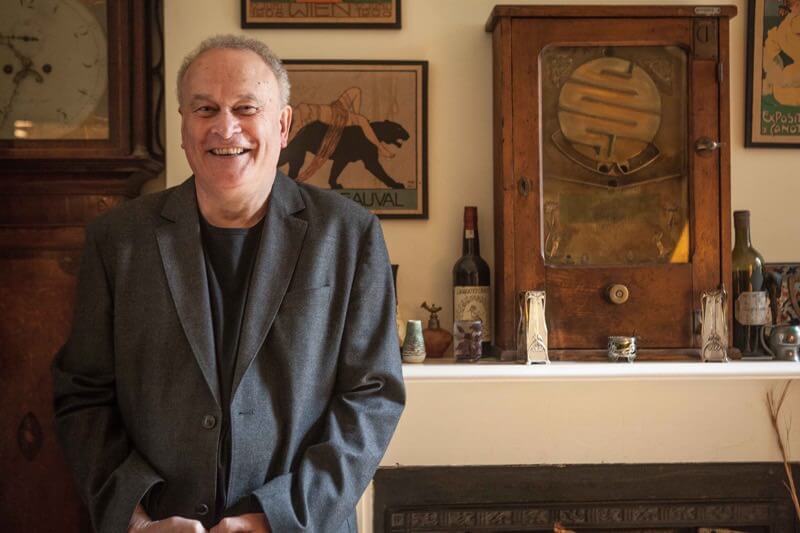
Talking Heads – Helen Grime

by Ben Hogwood

Helen Grime

In the classical music calendar, summer effectively begins with the start of the Aldeburgh Festival. This year’s model – the 76th running of the Suffolk festival – comes prefaced by a line from Shelley:

And, hark! Their sweet sad voices! ‘t is despair
Mingled with love and then dissolved in sound.

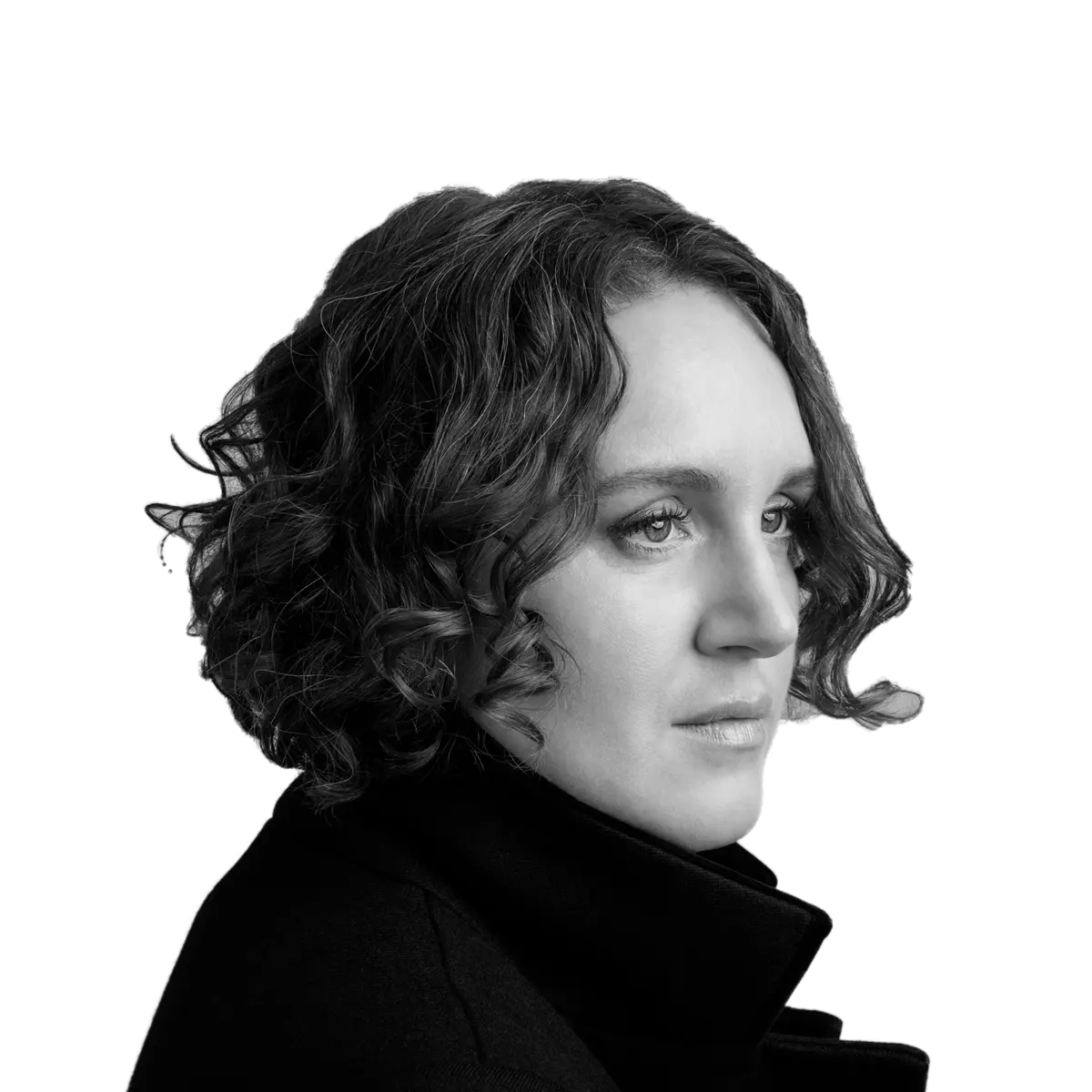
At the heart of this year’s festival are four featured artists – tenor Allan Clayton, violinist Leila Josefowicz and composers Daniel Kidane and Helen Grime. Scottish composer Grime, currently living in London, joined Arcana for a chat to talk about the range of her compositions in the festival this year, and the close link she enjoys with its audience and organisers.

Her first experiences of the festival date back to 2005, when she was on the Britten Pears Advanced Composition course. “I was studying on that and Colin Matthews was there, and I went back in 2006 to hear the performance of the piece I wrote while I was there. I also played in the chamber orchestra for the War Requiem on a course, and I played in Britten’s Nocturne as well, which was amazing. Those were the first experiences, and I also went to an opera writing course as a composer, which would probably have been 2006. Then in 2009 I wrote a piece called A Cold Spring, for chamber ensemble. It was a joint commission with Aldeburgh Music, the Birmingham Contemporary Music Group and the Sue Knussen Trust. The piece was in the same program as an Elliott Carter premiere (On Conversing With Paradise). He was there, and it was an amazing time.”

Carter is a composer Grime has always admired, and she had met him the previous year. “I was a fellow in the Tanglewood Music Center, and it was his 100th birthday year. They have a festival of contemporary music every year, and that year it was completely devoted to Elliot Carter’s music. As composers we had the opportunity to go to all the rehearsals and concerts, and it was a chance to immerse yourself in a composer’s work – lots of his chamber music but also the orchestral works. This was the time that I really dived into his music and were able to meet him and ask him questions. It was an incredible point in history to think back to really, and he had so many amazing things to say. He was able to go back in time and talk about his time studying in Paris with Nadia Boulanger, and moments in jazz bars, little things that maybe you haven’t read in a book. Hearing that directly from the composer is a fantastic experience!”

Helen lived in Edinburgh initially but moved to London for studying, and has stayed. Her music still carries parallels to her Scottish roots – and these are evident in Folk, premiered by soprano Claire Booth with the BBC Scottish Symphony Orchestra under Ryan Wigglesworth in Glasgow. “Scotland still feels like home”, she says, “and I’m so fond of that orchestra. I’ve worked with them a fair bit over the years, and it was wonderful to be able to work with them on the premier of Folk, with Ryan Wigglesworth, and of course, Claire.”

The piece will receive a second performance at the Aldeburgh Festival, with the Knussen Chamber Orchestra conducted by Wigglesworth. “I’m excited now for Ryan to do it again with a different with a different group. The piece is rooted in lots of folklore traditions. Zoe Gilbert, who wrote the libretto, is particularly influenced by Manx folklore, but the stories are rooted in different storytelling traditions from different places. She based the libretto on the stories in her book, Folk, so when you read them, you feel the resonance with stories we already know and have known since childhood. She’s subverted lots of roles, but there’s definitely that kind of connection with Scotland and folklore, so I wanted to have that connection in the music as well.”
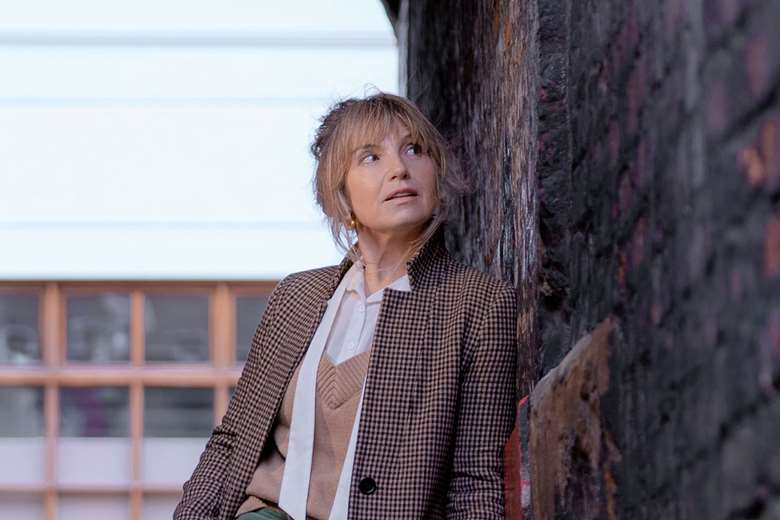
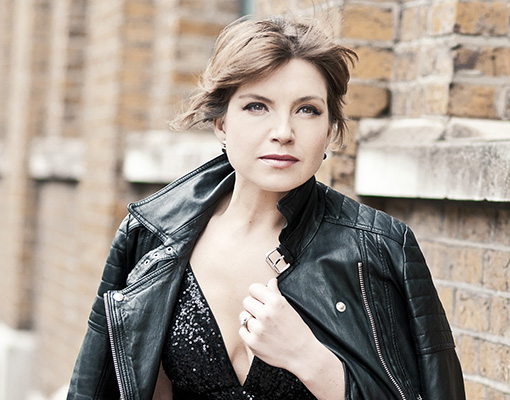
Arcana was fortunate to interview Claire Booth (above) just before the premiere of Folk, and Grime speaks warmly of her dedicatee. “She is a ball of energy! We’re very different in that way, but we get on very well. She is incredibly talented but also interested in many things. She found the book, and we both loved it, and so she approached Zoe. Obviously, I’ve known her work and singing for years. but we haven’t been working together until last year – although this project was brewing before Covid and then took a while to get it together. I don’t think it’s going to be the last time we work together, so I’m really excited about that. She’s an incredible talent but she brings such a personality to the piece, and she can just do anything. It’s very virtuosic, vocally. In Aldeburgh it will be with a small orchestra, so it will be interesting to hear that, in the Snape hall – but also with the surroundings, it’s made for that. When you’re there, and you’re amongst the reeds, it’s a magical place. You can see so far there, and whenever I’m there it always seems to be really clear skies. That time of dusk is particularly amazing.”

As a featured composer, Grime is presenting a varied body of work for the festival. “It is very satisfying. I’ve written a fair bit of music now, and I’m really happy with, for example, my Missa Brevis happening on the first Sunday. I’m really excited to hear that, as couldn’t go to the premiere in Edinburgh. To have these pieces happening in different locations around Aldeburgh is really special, with chamber music as well as bigger pieces. There is also another premiere, a piece I wrote during lockdown called Prayer which I wrote a while ago, which, again, I haven’t seen in a live performance. The Britten Pears Contemporary Ensemble are going to do that, a piece that I wrote during lockdown. It was recorded but not performed live, with the performers doing their bits separately, and Dame Sarah Connolly singing her bit. It’ll be great to be at an actual performance of that as well.”

Both of Grime’s string quartets will be performed in one recital, from the Heath and Fibonacci Quartets. They hold great personal significance for her. “It’s actually quite strange with the string quartets, because I wrote both of them partly while being pregnant. The first one was written in 2013, which was when I had my first son, so it’s weird that I then was writing another string quartet when I was pregnant with my second son! I was writing it at the beginning of lockdown, when we didn’t really know if things were going to be cancelled that summer. I was stressed out because I still had to meet the deadline, which was probably never going to actually happen – and it didn’t in the end, but I still needed to write the piece. For a lot of people that time they had lots of time to compose, but because everything was cancelled and you had a child who was then not at school, you suddenly didn’t have any time to work either, and there was no childcare of course. It was very intense, and I think the music is very intense, apart from the last movement, which is not intense in the same way and is much more of a release.”

Does it bring back vivid memories when she hears it? “Yeah, I can sort of remember how I felt, but it’s really difficult be in that moment. The Heath Quartet, who premiered and recorded that piece, I just love to hear them play, they made a brilliant recording of it and gave the most amazing premiere. So I can’t wait to hear them play it again, and to hear the other quartet with the Fibonacci Quartet, who I haven’t heard play before. It will be really exciting to hear the two pieces together and on the same program. They are sat between Beethoven and Britten, which I’m so happy about – hopefully they’ll somehow hold their own in amongst all of that! That concert is in Orford Church, so again a different venue which is so nice.”

It may seem an obvious question, but does Britten continue to be a constant presence at the festival? “Yes, and I think that’s the way it should be. I was in Aldeburgh last year, and Claire was there too, because she was coaching the young artists course. I paid my respects to Britten and Pears, at their graves. That line of history is so moving for me, and it’s something I hold close. I love Britten’s music, and it’s always going to be important to me, and that kind of continuation and line of British music is a beautiful thing. Having the opportunity to be a featured composer and to be surrounded by that is it’s a huge privilege.”
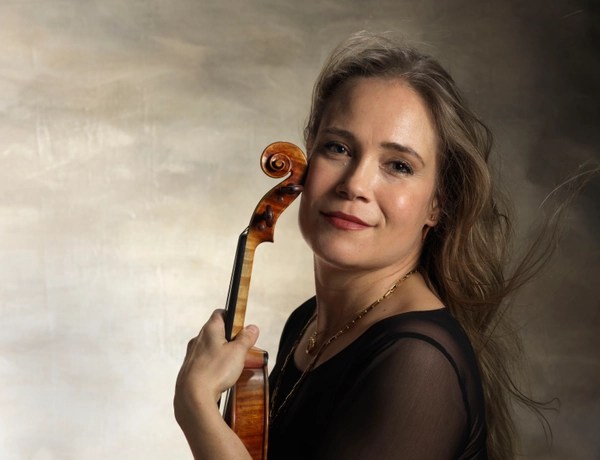
The featured artists and composers are chosen with typical care, placing Grime alongside violinist Leila Josefowicz (above), soloist in the composer’s Violin Concerto with the BBC Symphony Orchestra. “I’ve waited a long, long time for the UK premiere of concerto”, she says. “I wrote it for Malin Broman, an amazing Swedish violinist who used to be based in London and who premiered it in 2016, and then Leila took the piece on. She was supposed to be doing the UK premiere in 2020, but she’s played it a lot – in Amsterdam and in Finland. This does feel like the perfect moment, though, because Leila has that real connection with with Oliver Knussen. It’s kind of perfect that the premiere is happening in Aldeburgh. She’s an incredible artist, so the fact that we’re both featured artists is brilliant. I’m really, really excited about hearing Allan Clayton singing, and also Daniel Kidane’s pieces. We have quite a few shared concerts.”

Mention of Knussen leads us to talk about another highly influential composer, a clear influence on Grime both personally and professionally. “I have loved his music since the first time I heard it”, she says. “The first piece I heard was Ophelia Dances. My teacher at the time was Julian Anderson, and he introduced me to his music at the Royal College of Music. Every note is the right note, it’s just so beautifully crafted and exciting and powerful and enchanted.”

I was meant to meet him at the Britten Pears composer’s course, but when I was a fellow in Tanglewood he was out conducting, and he gave some masterclasses. He heard my music, and we got on well. Shortly after that, he conducted a short orchestral peace of mine called Virga, which I wrote as part of the London Symphony Orchestra scheme Sound Adventures, which is now known as the Panufnik Legacies. He was a real supporter of my music. I wrote Night Songs, which is also being done at Aldeburgh, for his 60th birthday celebrations in 2012. I really hold that dear, and I still listen to his music most weeks and days. A brilliant musician, composer, and supporter – and I think many musicians and composers feel the same way. My path would not have been the same at all without meeting Ollie.”

Looking ahead a little, Grime has an album of chamber works due for release on the Delphian label in August, a fascinating collection of works performed by The Hebrides Ensemble. “It’s coincidental to Aldeburgh, but great. The Hebrides Ensemble are one of those amazing groups who’ve been so supportive of me over the years, and they’ve given different performances. To have this portrait CD is fantastic, with a string sextet Into the Faded Air from 2007 right through to Braid Hills, a horn duo I wrote for St Mary’s Music School to celebrate their anniversary in 2022. I can’t wait for it to come out.”

Grime also acknowledges the passion and commitment of Delphian to composer albums such as this. “It’s really difficult to get these projects off the ground today, and very expensive, obviously. The commitment to new music in Delphian is absolutely brilliant, there was a wonderful CD the Hebrides Ensemble did a few years ago on Stuart MacRae, and there was a great collection of Judith Weir.”

With these projects coming to fruition, it is great to report Grime’s composition continues apace. “I’m coming to the end of my teaching turn at the moment, which means we get a bit of time for some holidays to compose. I’m writing a horn concerto at the moment, for Alec Frank-Gemmill and the Gothenburg Symphony Orchestra, so I’m completely immersed in all things horn at the moment! It’s a big piece, a big project, but I like that. I like to get my teeth into something. There are lots of various things on the horizon, too, but that’s the main thing. I’m more of a one piece at a time kind of person. Directly before this, I wrote a song cycle, Bright Travellers, which was premiered at the Leeds Lieder Festival earlier this year by Louise Alder and Joseph Middleton. I’ve been working with a lot of texts, and it’s been great in the last couple of years to work with living writers, that’s quite a new direction for me which is exciting!”

For more information on Helen Grime’s music at the Aldeburgh Festival, head to the Britten Pears Arts website
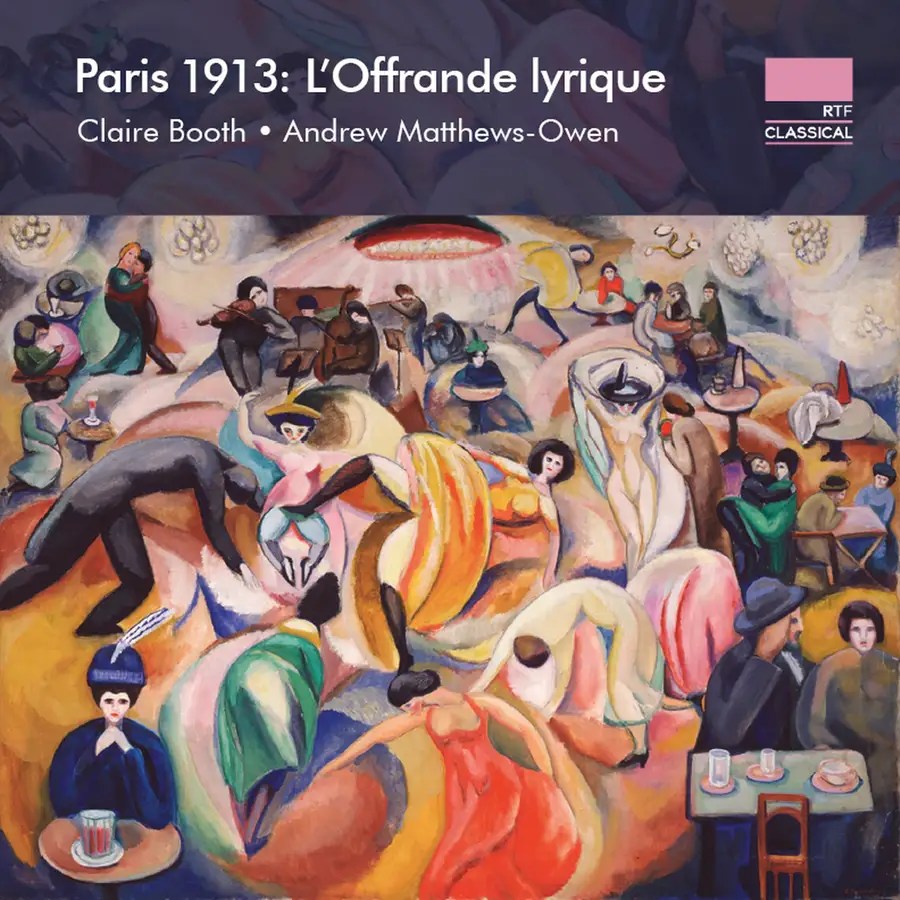
On Record – Claire Booth & Andrew Matthews-Owen: Paris 1913: L’offrande lyrique (Nimbus)

Caplet En regardant ces belles fleurs
Milhaud L’innocence Op. 10/3
Hahn À Chloris
Ravel arr. Stravinsky Trois poèmes de Stéphane Mallarmé M64
Auric Trois Interludes: Le pouf.
Ropartz La Route
Durey L’Offrande lyrique Op. 4
Saint-Saëns Petit main Op.146/9
Fauré Il m’est cher, Amour, le bandeau, Op. 106/7
Chaminade Je voudrais être une fleur
Debussy Trois poèmes de Stéphane Mallarmé L127
Satie ed. Dearden Trois Poèmes d’Amour
Lili Boulanger Clairières dans le Ciel: Vous m’avez regardé avec votre âme
Grovlez Guitares et mandolines

Claire Booth (soprano), Andrew Matthews-Owen (piano)

Nimbus RTF Classical NI6455 [66’23”] French texts included
Producer & Engineer Raphaël Mouterde

Recorded 11/12 March, 4-6 September 2023 at Wyastone Concert Hall, Monmouth

Reviewed by Richard Whitehouse

What’s the story?

Another enterprising song recital from Claire Booth and Andrew Matthews-Owen, this one focussing on songs that were either conceived, composed or premiered in Paris during 1913 and resulting in an absorbing collection best heard as a diverse while unpredictable totality.

What’s the music like?

Interleaving standalone songs and song-cycles, this recital opens with André Caplet’s take on Charles d’Orléans, its limpid modality highly appealing, then continues with an early song by Darius Milhaud as already demonstrates his distinctive and amusing approach to word-setting, while that by Reynaldo Hahn typifies the teasing charm familiar from his vocal music overall. Maurice Ravel’s triptych to texts by Mallarmé is performed in a version by Stravinsky with its accompanying nonet reduced to piano which, in preserving and maybe even accentuating the music’s questing introspection, represents no mean fete of transcription. Still relatively little known, this certainly deserves to be heard as at least an occasional alternative to the original.

Remembered best as a prolific writer of film scores, Georges Auric had shown a precocious talent for song as is evident in his sensuous setting of René Chalupt. A composer who often wrote on a symphonic scale, Guy Ropartz is heard in a setting of his own verse that amounts to a ‘scena’ in its wide expressive ambit. Interest understandably centres on the eponymous cycle by Louis Durey, a member of Les Six whose increasingly far-left conviction tended to marginalize his creativity yet, as these lucid and empathetic settings of Rabindranath Tagore (as translated by André Gide) confirm, had emerged as a protean talent by his mid-twenties. Hopefully these artists will be encouraged to investigate other of his songs from this period. By contrast, a late song by Camille Saint-Saëns exudes a touching poignancy, while that by Gabriel Fauré typifies the elusiveness of those in his last decade. As is evident here, Cécile Chaminade was a songwriter of style and elegance, then the Mallarmé triptych by Debussy (its first two texts identical to those of Ravel) finds this composer probing the inscrutability of these poems while drawing back from any more explicit intervention. The inscrutability conveyed by Erik Satie’s aphoristic settings (edited by Nathan James Dearden) of his own texts is altogether more playful – after which, the recital continues with a pensive offering by Lili Boulanger, with Gabriel Grovlez’s sultrily evocative setting of Saint-Saëns to finish.

Does it all work?

Yes, given the fascination of this collection taken as a whole and, moreover, the quality of these renditions. Booth is not a singer willing to take the easy option in her interpretations, and so it proves here with singing as fastidious as it is refined, while Matthews-Owen duly instils often deceptively spare accompaniments with understated insight. They contribute a succinctly informative note, but the booklet includes only the French texts with the English translations available at https://rtfn.eu/paris1913/: might it have best the other way round?

Is it recommended?

Very much so. There is much to fascinate even those who consider themselves afficionados of the ‘chanson’, and those who are unfamiliar with much of this repertoire could not have a better means of acquainting themselves with certain of its treasures – hidden or otherwise.

Listen & Buy

For purchase options, you can visit the Ulysees Arts website. For information on the performers, click on the names to read more about Claire Booth and Andrew Matthews-Owen

Published post no.2,466 – Friday 7 March 2025

Talking Heads: Claire Booth

The leading British soprano talks to Ben Hogwood about her duo of new albums celebrating the music of Schoenberg, as well as a fascinating career that touches on Mussorgsky and her meaningful friendship with Oliver Knussen. Photos (c) Sven Arnstein (above), Mark Allan (Oliver Knussen)

It is no understatement to state that Claire Booth is a national singing treasure. She would be too gracious to admit this, but the British soprano has played a leading role in classical music on these shores, particularly in league with composer and conductor Oliver Knussen as a leading exponent of new compositions.

Yet Booth’s pioneering spirit extends to music of the classical canon, and after Knussen’s sad death in 2018 her work has continued apace. In 2024 she has included a special emphasis on the music of Arnold Schoenberg, 150 years on from the composer’s birth. His music remains a challenge today – but as Booth revealed in an enjoyably candid chat, it is a challenge well worth accepting for the performer and ultimately the listener.

Before we discuss Booth’s new Pierrot Portraits album on Onyx Classics, where she is joined by Ensemble 360 to put Schoenberg’s melodrama Pierrot Lunaire in the context of composers inspired by the Pierrot, I ask her if she can remember her first encounter with Schoenberg’s music. It turns out to be a milestone she will never forget. “The first time I did Pierrot Lunaire, which was the first piece of Schoenberg that I did, was with Pierre Boulez at the Lucerne Festival. I was a young artist on the inaugural Festival Academy. The first year that they did that was just the Ensemble Intercontemporain and Pierre Boulez. Every instrumentalist had one student, so there was basically a student ensemble, the Ensemble Intercontemporain, Pierre Boulez and Hilary Summers, who was effectively the singing consultant. I was the student singer, so Pierre Boulez basically taught me Pierrot Lunaire! I sort of went, bowed at his feet and said, “Sprechtgesang – how do you do it?”, thinking this is the master of 20th century composition, I’ll get this incredible insight – and he must have been about 70, I suppose, and he just looked at me and said, “You sing a bit, you speak a bit. That’s it.” And actually, he’s so right – because you just learn it like any other piece of music, and you do sing a bit and speak a bit! How you do that is up to you. Like a lot of very, very good musicians, they’re very keen to leave it up to the performer. He wasn’t a micromanager,  and when you’re working with really good people they assume you’re as good as them – I mean, the nice ones do. So he just let me get on with it, and those were the parameters.”

Does the straightforward approach remove a temptation to micromanage Pierrot Lunaire itself? “That’s interesting, because you definitely need to put a lot of time in, and by that, you might think, “Gosh, I’m micromanaging this”. But I can think of any Mozart aria that actually, if you pull it apart, you are micromanaging how you are working. There is a certain sense of micromanagement, but there’s quite a negative connotation with that phrase. With Schoenberg’s music people often get stuck in the realm of thinking very carefully and complexly, but ultimately we do that with all repertoire. After that, we free ourselves up and employ our musicality and our professionalism. Once you get to that stage with Pierrot, then it does feel very innate and characterful, you just have to have done the groundwork.”

Booth has worked with one of Pierrot’s legendary interpreters. “I remember Jane Manning told me, in the way that only Jane could, that she had given the most accurate rendition of the piece ever. She’s absolutely right that there is no excuse not to be accurate pitch-wise, but if you listen to someone like Erwin Schrott do Don Giovanni, when he’s singing the recitatives, he’s not caring about the individual notes – but there’s no way he doesn’t know the notes. He’s inhabiting it completely, and it’s such a wonderful way of listening to the freedom of it. You don’t want to get bogged down in the micromanagement of accuracy. You have to be accurate, but then you get to the next level.”

Schoenberg’s detail of colour in the score reaches descriptive heights with the voice and ensemble, colours that present themselves afresh with each listen. “Absolutely. Obviously there were other vocal pieces before Pierrot Lunaire that employed instruments, but I think Schoenberg really did break up the rule book in how he uses the instrumentalists and voice as one. You’ve got five instrumentalists playing eight instruments, and the singer playing three characters and the narrator in a myriad of different emotional states. The palette is so deft that if the performer understands the text in us, it’s a complete gift. The orchestration is so brilliantly witty, clever, charming and poignant – you know, there are echoes of Bach, Mozart, and elegiac and even aggressive qualities to it. Like all the best music there are no extraneous notes, and his decision to play the note in a certain way is just consummate to me. When people come to this new as an audience member, you might be thinking, “What have I let myself in for?” Within five minutes, though, you are in this sound world, and audiences delight in the sheer virtuosity of the world. As a performer you just have to dive right in, and if you really believe in what is written, it’s just mind blowing!”

Booth has also been recording Schoenberg’s early songs with pianist Christopher Glynn, in a compelling Expressionist Music album released earlier this year on Orchid Classics. It reveals the remarkable breadth to their compositional style. “When you listen to pop music you have the Coldplay sound, the U2 sound, and it’s their thing. But one of the reviews of the Expressionist Music disc said it sounds a bit like Mahler or Brahms. Well, what’s wrong with that? These were people in the musical, historical pedigree that he loved and revered. Why wouldn’t his sound world sound like that? I think one reviewer was almost disappointed that it didn’t all sound like Schoenberg. And you’re like, “What is Schoenberg? Is it a kind of construct that we’ve decided is difficult, atonal?” I think an audience’s appreciation of tonality and atonality now is different than it would have been 40 years ago. We’ve all listened to a lot more music, we don’t hear the jarring qualities that atonality maybe heralded within us. My granny might still think it sounds a little bit risque, but, I think we’re much more open to his world anyway.”

She adds some context. “It’s so important, I think, for everyone to recognize that Schoenberg was a product of his time. He didn’t just parachute in with a pistol aiming to blow a hole in everything. He was absolutely continuing as he felt the tradition, but in the way that the expressionist movement, was going he was continuing a movement by forward motion, taking things on a step. You’ve got folk songs, cabaret songs, love songs – he clearly was a man fascinated by a lot of different aspects of life, you know? He had enormous depth and breadth, and that comes across in his vocal music, in terms of his poetry choices. It also comes through in knowing the man – he was friends with Kandinsky and a tennis partner with Gershwin. The guy was a hoot!”

Booth has been working with the Arnold Schoenberg Center in Vienna – a fascinating resource and museum dedicated to the composer, where it is possible to witness a full scale mock-up of Schonberg’s Hollywood apartment. “I’ve been in touch with them over the last year”, she says, “and we’re going to sing there in December and stay in the apartment. We’re really delighted to have that sort of immersion. Even when you go on the website, with the amount of archival material, you can really geek out on it! I think it’s a shame that he’s been so synonymous with all that is difficult and complex about music when there are composers that have come since Schoenberg that have been far more impenetrable. He’s maintained this aura of unapproachability, which you see in the reticence of festivals and promoters to put on his music, even in this 150th anniversary year, which I just don’t think is justified. So it’s wonderful to get opportunities to be reminded of kind of the breadth of his interests, and how he was a complete part of the kind of wider artistic movement in the 20th century. He’s such a towering figure!”

Booth has explored a vast amount of new music in her performing career to date. Is there the same thrill of discovering new music as there was with Schoenberg? A prime example is Helen Grime’s Folk, a setting of verse by Zoe Gilbert for soprano and orchestra which she is preparing for performance as we talk. “I think that’s what’s so great about music. I am so on the back foot – in my first lesson at college, I heard this piece of music, and I lent to the next person and said, “This is the theme music to Trading Places!” And she said, “No, it’s the Overture to The Marriage of Figaro!” I know so little about music that I am still discovering so much now – the joy of discovering new music that’s in the canon, together with new music that’s being written now.” If what your question is leading to is the same kind of craft in new music as in Schoenberg then Helen (above) is a wonderful affirmation of that.

You can listen to Helen Grime’s Folk, performed by Booth with the BBC Scottish Symphony Orchestra under Ryan Wigglesworth, on BBC Sounds

Booth elaborates on Grime’s qualities. She’s such a craftswoman, and such a great orchestrator. Not for nothing was Oliver Knussen such a big champion of her in her early days, and that’s one of the reasons we got to know each other. It feels special to be kind of continuing Ollie’s work with the composers he loved and rated, because he was such a meaningful figure to me. I wouldn’t want to speak too broadly about compositional trends in general. I think I’m very fortunate that I get to sing an awful lot of music by people that I particularly love. It’s easier to believe in music that you have an immediate connection to, and I’m lucky to have that. As a singer I’ve still got so much to learn, repertoire wise, and I’m still so curious in that.”

She cites her exploration of the songs of Mussorgsky, in league with her regular pianist Christopher Glynn. “I’d heard a couple of songs, but what an absolute deep dive. You wouldn’t think of him as a song composer! We know Songs And Dances of Death, but, that’s a group of five – and he wrote 60-70 songs! There are some absolute beauties in there, and no extraneous notes. His brilliant use of pace and orchestration – with only the piano – and the wonderful opportunities for female protagonists in his songs, which doesn’t come through so clearly in his operas. As a curious artist, that’s just brilliant. Five years ago I didn’t know any of that, and now I’m a bit of a guru. I think my love of music has maintained my curiosity for the repertoire that’s already out there, and hopefully that’s a way of marrying the two.”

Booth is struck by Mussorgsky’s originality. “When you listen to this writing, you think it’s Mahler or Wolf, and this guy was writing these songs in the 1840s-1850s. He really was ahead of his time. Ollie always did the Stokowski orchestration of Pictures at an Exhibition, with lots of bells! I think purists would say it’s less sophisticated than the Ravel, but there’s an earthiness and a gravitas to it, a sort of ridiculous element which he doesn’t shy away from. The piece is such a smorgasbord, and that’s the word I’ve tried to use with a lot of these retrospectives, and with Schoenberg too. It’s wonderful to be able to advocate for a composer’s breadth, because I think people have one or two pieces by somebody that they like, and that’s great, but that can lead to other things.”

With that in mind, the Pierrot Lunaire album places Schoenberg’s work in the context of a number of different and fascinating responses to the central character. “When you look at versions of Pierrot Lunaire, it’s always intriguing as to what people put it with. Usually it’s with another Second Viennese School composer, and I definitely didn’t want that. It did seem the figure of Pierrot himself is such a magnet for creatives. Schoenberg wasn’t even the only one to set the Hartleben translation.”

Joseph Marx went in a completely different musical direction to Schoenberg. Kowalski, another Jewish composer of the early 20th century, was actually a lawyer who advocated for Schoenberg when he was having a problem with one of his publishers. He’s done 12 settings of those heart labor poems, but they’re not the same as the ones Schoenberg did. So even with Pierrot Lunaire, we think of it as this seminal work, and it’s wonderful to see how other people have set it. It’s nice to give people a taste of what other composers thought – and even with the Korngold aria, it is this beautifully elegiac piece and so haunting. It’s the ability of the Pierrot character to be so permeable. It’s called Portraits for a reason I suppose, we wanted to present as many different angles as possible.”

We move on to the demands Schoenberg makes on the voice itself. With such a wide range of dynamics and pitches, does the voice need special preparation? “I’ve always done quite a lot of different repertoire concurrently, and I do remember a performance of Pierrot Lunaire where I performed some Handel arias two days later, and I definitely suffered. I remember thinking I would have to schedule these things a bit better. As I’ve gone on in my career, without blowing my own trumpet, I find increasingly that it doesn’t seem to cost any more than singing anything else. I mean, I did some Mozart concert arias in Prague recently, 20 minutes of singing, and I was bloody knackered! If you can get past the complexity of the score and be quite a seasoned interpreter, there is a freedom that comes with knowing something incredibly well, which then allows you to give just the right amount. I’m doing various ‘Pierrots’ this season, and some of them will be next door to singing Debussy, Marx, these other vocal styles – and obviously you need to be ready for both, otherwise you’re short changing the audience.”

Talk turns again to the much-loved Oliver Knussen. What sort of legacy has he left with Claire, and more widely, with British music? “Happily, I’m part of a large family of people who spent time with Ollie and who he was a massive influence on. When I think about Ollie, and his music making, I think of incredible standards and incredible kindness – which extended to nurturing, sponsorship and facilitating of others’ work. He always put his own compositions second, and he really wanted to facilitate others music. He got to know Harrison Birtwistle, reasonably late in his life, but part of that was because I think he felt really second best to Harry, and he was a bit embarrassed. I heard him say he felt his music wasn’t well crafted enough.”

Humility was one of Knussen’s standout qualities. “He was incredibly modest. I was the recipient of so much of his listening, and I suppose the legacy is that I would like to achieve those same exacting standards in my work, the absolute knowledge about and love of the music, and musicality of a properly high standard. As a professional creative, it matters to me, and it mattered to him hugely. The commission with Helen Grime and also Zoe Martlew, this year, who was also an incredibly close friend of Ollie’s, means a lot. When I am involved I do try to remember kind of that Ollie was so generous in his time to advocate for others work. I like to think that he’d be pretty chuffed that I was working with Helen and Zoe in this way. I think he’ll be having a chuckle when Helen’s piece comes to life!”

She goes into more detail. “Ollie worked with quite a small number of musicians over and over, and the rehearsal process was very positive and open and facilitory. I’ve worked with plenty of eminent musicians where the room is not necessarily positive and quite dictatorial and exacting, and now my job is to deliver when somebody wants to be exacting. I really appreciated Ollie’s understanding that if you have booked the right people, they’re going to be good. Treating people with respect and confidence begets that, and having a positive vibe in the room might sound like an obvious thing, but it’s amazing how often that doesn’t happen. In today’s world there’s a lot of talk about this stuff, but I wouldn’t say that people have nailed how to do it. With Ollie, with his potentially intimidating presence, both physically and musically, he was always incredibly respectful and facilitating off of the artists that he worked with. So I hope that if I could generate half of the vibe that he did, I think I’m going the right direction.”

You can explore purchase options by clicking on the links for Pierrot Portraits and Expressionist Music. Claire will perform Pierrot Lunaire twice in November – click for ticket options for Pierrot in the Moonlight on Saturday 2 November at the Classhouse International Centre for Music, and on Thursday 21 November at the Royal Welsh College of Music and Drama, and also for her multi-composer Wigmore Hall recital with pianist Jâms Coleman on Friday 29 November.

In concert – Nash Ensemble @ Wigmore Hall: Side by Side & Nash Inventions

Side by Side

Royal Academy of Music Students [Christopher Vettraino (oboe), Silvia Bettoli, Johan Stone (horns), Magdalena Riedl (violin), Gordon Cervoni (viola)], Members of the Nash Ensemble – Adrian Brendel (cello), Alasdair Beatson (piano)

Colin Matthews Time Stands Still (2004)
Balency-Bearn Entre-Deux (2022)
Alberga No-Man’s-Land Lullaby (1996)
Keting before we were ocean (2021)
Colin Matthews Dual (2021)
Abrahamsen Congratulations Greeting (2022)

Nash Inventions

Claire Booth (soprano), Mark Padmore (tenor), Nash Ensemble [(Philippa Davies (flute), Gareth Hulse (oboe), Richard Hosford, Marie Lloyd (clarinets), Richard Watkins (horn), Sally Pryce (harp), Benjamin Nabarro, Michael Gurevich (violins), Lars Anders Tomter, Jennifer Stumm (violas), Adrian Brendel (cello), Graham Mitchell (double bass), Alasdair Beatson (piano)] / Martyn Brabbins

Casken Misted Land (2017)
Colin Matthews Seascapes (2021)
Anderson Van Gough Blue (2015); Three Songs (2018-22) [World Premiere of THUS]
Benjamin Viola, Viola (1997)
Turnage A Constant Obsession (2007)

Wigmore Hall, London
Tuesday 28 March 2023 (5pm and 7.30pm)

Reviewed by Richard Whitehouse

It has become such a fixture on the London calendar that Nash Inventions, given annually by the Nash Ensemble at Wigmore Hall, could easily be taken for granted. As tonight’s concert proved, however, the range and quality of those works performed is anything but predictable.

His long-time drawing inspiration from the landscape of the North-East might suggest Misted Land as a ready-made title for John Casken. Yet this quintet for clarinet and strings focusses on emotion as much, if not more than evocation by unfolding from the intangible impressions of its initial movement, via impulsive contrasts of its intermezzo, to a finale whose visceral progress is curtailed by a timely return to the initial equivocation. Richard Hosford made the most of his alternately insinuating and forceful writing in a piece that well deserved revival.

Although settings by Michael Tippett early on confirmed the musicality of his verse, Sidney Keyes (1922-43) has been relatively little set – making this selection by Colin Matthews in Seascapes the more welcome. From the unforced rhetoric of The Island City, it takes in the fleeting sensations of From : North Sea and the tense rumination of Night Estuary; a brief Interlude leading to the heartfelt expression of Seascape – one of Keyes’s greatest poems, in which Claire Booth’s commanding eloquence (above) more than vindicated the cycle as a whole.

Last in an informal trilogy centred on the colour, Van Gough Blue sees Julian Anderson pay tribute to this artist in a sequence traversing dawn to night. A speculative emergence of sound and texture in l’Aube, soleil naissant precedes the heady rhythmic and melodic interplay of Les Vignobles then mounting animation of Les Alpilles. Nothing, though, prepares for the inward rapture of Eygalières or the dance toward destruction of la nuit, peindre les étoiles: pieces wholly characteristic of this composer and as finely realized as anything he has written.

Further music by Anderson followed the interval – three in an ongoing series for soprano and ensemble identical to, but very different in usage from, that of Schoenberg’s Pierrot Lunaire. The viscerally sensual overload of Mallarmé’s Le Tombeau d’Edgar Poe (here made a tribute to Debussy in the centenary of his death) contrasted with the disarming sincerity of le 3 Mai – an email by composer Ahmed Essyad written during the pandemic, then lines by Longfellow in THUS – Claire Booth here enacting what is less a setting than a musical riposte to its text.

Writing what had become a tribute to Takemitsu 18 months after his death, George Benjamin turned what might have reflected the viola’s innate introspection into an intensive exploration by two of these instruments of how they might discover rhythmic then melodic and harmonic accord. Music diverse in content and logical in its unfolding, its technical challenges remain considerable – making this performance by Jennifer Stumm (having replaced Timothy Ridout at short notice) and Lars Anders Tomter the more engaging through its audible conviction.

It might come a fair way back in his sizable output, but the song-cycle A Constant Obsession remains among Mark-Anthony Turnage’s finest vocal works. This reflection on ‘love’ – what it might be, what it becomes and what it could have been – is articulated across five settings of Keats, Hardy, Edward Thomas, Graves and Tennyson; its course predicted in a ‘Prologue’ and encapsulated in the bleakly humorous final poem. Mark Padmore (above) conveyed its measure now as 14 years before, as did Martyn Brabbins (below) with his attentive and unobtrusive direction.

The early evening slot brought together players from the Nash and Royal Academy of Music. Entre-Deux saw Andrea Balency-Béarn opening out the timbral and harmonic space between pitches with discreet elegance, and No-Man’s-Land Lullaby found Eleanor Alberga working toward a totemic melody with combative fervency. Sun Keting contributed music laced with nostalgia but also indignation in before we were ocean while, in Congratulations Greeting, Hans Abrahamsen commemorated the RAM’s bicentenary in lively and resourceful terms.

Colin Matthews provided a more quixotic take on that event in the subtle contrasted sections of Dual, with his music also opening and concluding this selection. Time Stands Still marked Simon Rattle’s 50th birthday in (surprisingly?) inward and even inscrutable terms, while 23 Frames marked the 30th anniversary of the Nash through that number of miniatures whose character felt as distinctive as their order was random. The outcome found this composer as his most entertaining, with no complaints if several ‘frames’ exceeded their 30-second remit.

A lengthy evening, then, and an impressive showcase for the Nash in term of marking those achievements past or present. Now is hardly the time for any complacency regarding events such as this, which remains a template for what is possible in matters of artistic excellence.

Click here for the Nash Ensemble website, and here for the Royal Academy of Music

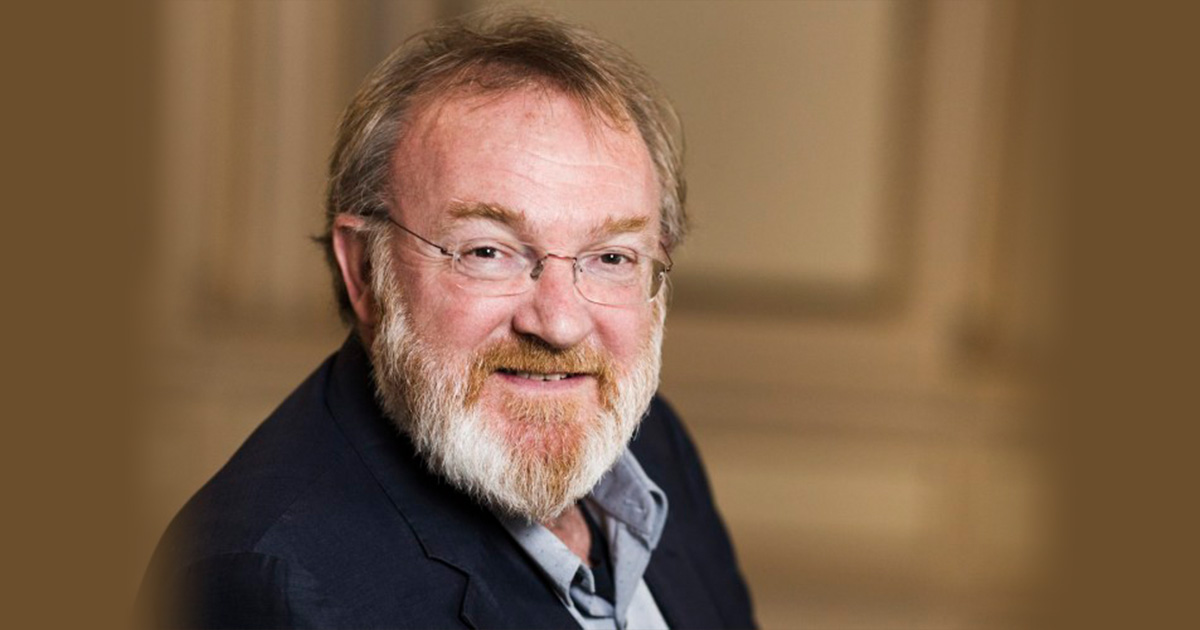
Talking Heads: Colin Matthews

colin-matthews

Interview by Ben Hogwood

The Aldeburgh Festival may not be with us in name this year, but its spirit burns brightly in the form of Summer at Snape, a series of safely distanced concerts to be given over every weekend in June.

As with the festival, these concerts feature imaginative programming, with contemporary music to the fore. Composer Colin Matthews has an illustrious history at Snape and Aldeburgh stretching back to his time as assistant to Benjamin Britten late in the composer’s life. He will be close at hand, with two new works receiving their premiere live performances. Firstly, the Nash Ensemble will feature in the first performance with an audience of Seascapes, setting poetry by Sidney Keyes. Conducted by Martyn Brabbins, the verses will be sung by soprano and dedicatee Claire Booth.

The next day will give audiences a chance to enjoy a new arrangement for string orchestra of the Double Concerto by Britten himself, a work completed at the age of 18 when the composer was still a student. Matthews arranged the original for full orchestra but has now reduced his forces, and the Royal Academy of Music Strings under John Wilson will reveal the new version with soloists Thomas Zehetmair (violin) and Ruth Killius (viola).

Matthews is a generous interviewee, taking time to consider questions from Arcana around both works and the return of live music – not to mention the problem of finding inspiration as a composer during the pandemic. First, however, we started by asking him about the poetry of Sidney Keyes, whose verse forms the bedrock of Seascapes.

“As far as I remember I first came across Sidney Keyes through Tippett’s The Heart’s Assurance”, Matthews recalls, “and I wrote a song cycle to Keyes’ words as long ago as 1968, long since withdrawn. Re-reading Keyes’ complete poems a few years back made me want to make a (hopefully better!) attempt to set him, and one of the poems (Night Estuary) was one I set more than 50 years ago – although I can’t recall it at all. The complexity of his thought doesn’t make for easy setting, but the words have a lyricism and power which calls for music.”

The work was first performed at London’s Wigmore Hall on 30 April, part of a Nash Ensemble program including works by Sir Harrison Birtwistle, Mark-Anthony Turnage, Julian Anderson and Simon Holt (which you can watch above).

What was it like seeing the work finally performed live? “Rather remarkable – only my third experience of live music in about 14 months, and an unusual experience to hear a work for the first time more than a year after it was completed.”

Claire Booth is the ideal singer for this work, and Matthews wrote the vocal line especially with her in mind. “Absolutely. I’ve known Claire since she took part in the Aldeburgh Composition Course in (I think) 2000, and this is the third piece that I’ve written for her. I chose a small ensemble whose colours are relatively subdued: a lot of the music is introspective in mood and is designed very much for the soloist to float over it.”

Moving on to the Britten, we consider the Double Concerto for violin, viola and orchestra, written at the age of 18 – and which Matthews has now reduced to the accompaniment of strings only. Does he detect is a lineage back to Mozart’s Sinfonia Concertante, a work for the same instrumental combination? “Obviously he (Britten) knew the Sinfonia Concertante, and he mentions a performance (with Lionel Tertis) in his 1931 diary, a few months before he started on the Concerto. It was one of the last pieces I heard him conduct. But there’s no influence from Mozart other than the soloists: instead, it follows very much the three-movement form of his Sinfonietta Op.1 which he had just completed, but on a larger scale.”

How much work was required between the 1997 version, made from the fully catalogued work (above), and the version we will hear at Snape? “A great deal! Making the 1997 version was comparatively simple, as Britten had made very detailed indications of instrumentation in his short score. Reducing it to strings alone – which was Thomas Zehetmair’s idea – meant a lot of rethinking and reworking. For instance, there is an important timpani part in the finale which took a lot of work to transfer satisfactorily to the double basses.”

We move on to talk about Britten’s writing for strings, and Matthews pinpoints several passages in his writing that have left a lasting admiration. “This work of course predates the most important of his string pieces, the 1936 Variations on a theme of Frank Bridge, whose string writing is a model of flair and virtuosity. The string writing for the original version of the Concerto is rarely as adventurous, so I was to some extent constrained by what was already there, as well of course as having to adapt music that was written for wind and brass. In many respects it had been easier to emulate Britten’s string writing in my orchestration of the Temporal Variations, originally for oboe and piano, and so starting from scratch.

We move on to discuss the last year, and how it has been for Matthews as a composer. Has he had plenty of material for new works or has it been hard to find inspiration at times? “At first there was a sense of freedom in not writing to commission or deadline”, he says, “and I wrote a fairly large-scale orchestral piece in the summer of last year. Subsequently I’ve been finding it a bit difficult to focus on projects other than small or solo pieces, and this is one of several arrangements I’ve made for the smaller forces that are necessary in these difficult times, which has been a good way to keep up momentum.”

The last question requires the simplest of answers to confirm just how valuable Summer at Snape promises to be. What does it mean to Colin to be part of live music making at Snape once again? “Very special.”

Summer at Snape runs from Friday 4 June until Saturday 11 July. For full details on all the live events, visit the Snape Maltings website. For more on Colin Matthews, you can visit the composer’s website here
.