On Record – Crispin Lewis & Raymond Lewis: Herbert Murrill: The Rediscovered Songs (First Hand Records)

Herbert Murrill
Four Elizabethan Songs (1927-30)
Three Carols (1929)
Self-Portrait (1929)
Trois Poèmes (1930)
Four Pastorals (1936)
The Months of the Year (c1936)
Two Herrick Songs (1938)
In Youth is Pleasure (1942)
Sonatina for Piano (1952) – Andantino

Crispin Lewis (baritone); Raymond Lewis (piano) with Rachel Broadbent (oboe, carols)

First Hand Records FHR161 [55’48’’] All world premiere recordings
English/French texts and English translations included
Producer Emily Baines Engineer John Croft

Recorded 19 & 20 April 2024 at Rosslyn Hill Chapel, Hampstead, London

Reviewed by Richard Whitehouse

What’s the story?

First Hand Records issues this first release devoted to the songs of Herbert Murrill (1909-52), now a largely forgotten though once influential figure on music circles in London and further afield; his pedagogical and administrative skills held in high esteem by a younger generation.

What’s the music like?

Murrill’s death at only 43 brought to its premature end a career which, in addition to a sizable output, involved working at the BBC – latterly as its Head of Music – and, in the earlier war years, intelligence work at Bletchley Park. An unassuming figure who operated within if at a conscious remove from the music establishment of his day, Murrill was widely respected for his professionalism – as is borne out by his own music with its lightness of touch and its deft handling of traits stemming from Stravinsky, Poulenc and neo-Classicism between the wars.

It made sense to open this recital with My Youth is Pleasure, its airy setting of Robert Wever highlighting that acute yet unforced nostalgia such as pervades so many of these songs. The lengthy The Months of the Year sustains itself ably, then a wittily engaging quartet of songs to Elizabethan texts almost inevitably recalls the influence of Peter Warlock. Four Pastorals find Murrill indulging his more lyrical tendencies to appealing effect, notably in a setting of the anonymous text Phillada Flouts Me that unerringly catches its deadpan anguish. Nor is he unwilling to tackle more contemporary writers, witness his Satie-esque response to verse by Jacques Prévert and Robert Desnos; though whether those changes to the former’s poems were considered improvements or just unintentional anomalies is now impossible to decide.

A trio of carols with oboe accompaniment (including a Medieval Scottish translation of verse by Martin Luther) would be a welcome addition to a medium which features little other than Vaughan Williams’s masterly Blake settings. After which, the wryly elegant Arioso from a Piano Sonatina makes one wish the surrounding movements could have been included (there was certainly room in terms of playing time). The brace of songs to texts by Robert Herrick summons a more sustained and eloquent response, as to suggest that Murrill’s music might have explored deeper emotions had he lived. This anthology concludes with Self-Portrait – four settings of his contemporary Geoffrey Dunn which anticipate Betjeman in their dry wit and self-deprecating humour – a very English take, indeed, on matters of existential import.

Does it all work?

Yes, albeit for the most part within its narrowly while precisely defined limits. As a composer, Murrill was clearly not out to change the world but rather to offer a discreet commentary from the margins, which he does with admirable skill and not a little affectingly. He has a devoted advocate in Crispin Lewis, for whom this project was doubtless a labour of love, and who is sensitively accompanied by Raymond Lewis or, in the Three Carols, Rachel Broadbent. He also contributes informative and well-researched notes about the life of this singular figure.

Is it recommended?

It is, and there is enough of interest musically to make one curious to hear such as Murrill’s jazz-opera Man in Cage, written to a libretto by Dunn and that enjoyed an eight-week run in London in 1930 before vanishing without trace. For now, this collection ably fulfils its remit.

Listen & Buy

Click on the artist names to read more on Crispin Lewis, Richard Lewis and Rachel Broadbent

Published post no.2,509 – Saturday 19 April 2025

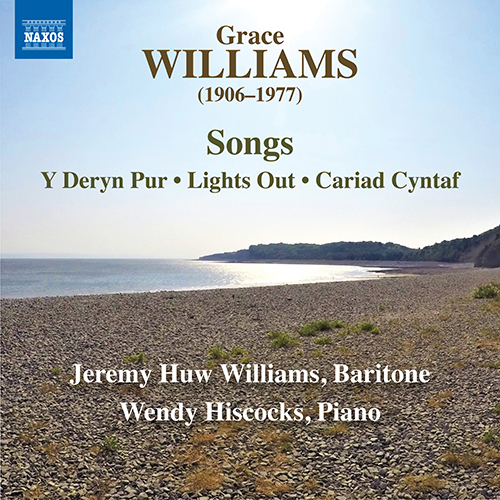
On Record – Jeremy Huw Williams & Wendy Hiscocks: Grace Williams: Songs (Naxos)

Grace Williams
Slow, slow, fresh fount (c1925); I had a little nut tree (c1930); Green Rain (1933); Stand forth, Seithenin (1935, rev; 1951); Ffarwel i langyfelach (?1920s); Llangynwyd (?1920s); The Song of Mary (1939, rev; 1945); Shepherds watched their flocks by night (1948); Fairground (1949); Flight (1949, rev; 1954); À Lauterbach (c1950); Le Chevalier du guet (1949); Four Folk Songs (1950-51); When thou dost dance (1951); Three Yugoslav Folk Songs (1952); Y Deryn Pur (1958); Y Fwyalchen (1958); Cariad Cyntaf (c1960); Ow, Ow, Tlysau (1964); Dwfn yw’r Môr (c1940); Lights Out (1965); Fear no more the heat o’ the sun (1967)

Jeremy Huw Williams (baritone), Wendy Hiscocks (piano)

Naxos 8.571384 [77’47”]
Producer Wendy Hiscocks Engineer Alastair Goolden

Recorded 28-30 September 2022 at Cooper Hall, Selwood Manner, Frome

Reviewed by Richard Whitehouse

What’s the story?

Naxos continues its long-running series of releases sponsored by the British Music Society with an album of songs by Grace Williams (1906-77), all of which are recorded here for the first time and, between them, extend chronologically over the greater part of her composing.

What’s the music like?

Even more than others of her generation, Williams has benefitted from the upsurge of interest in women composers this past decade with recordings of major works on Lyrita and Resonus. Songs may not have the primary place in her output, but they afford a viable overview of her stylistic evolution with individual instances among her most characteristic statements. Most are in English or Welsh though there also settings of French texts, while her own translations of several from the former Yugoslavia further underline the breadth of her literary concerns.

Early settings of Ben Johnson along with traditional English and Welsh poems find Williams, barely out of her teens, tackling verse with audible appreciation of this genre’s lineage within the Victorian and Edwardian eras. That of Mary Webb’s Green Rain is audibly more personal for its wistful ambivalence, while The Song of Mary brings due sensitivity to bear upon some familiar lines from St Luke. The most extended item, Fairground is a setting of Sam Harrison that captures the sights and sounds of said environment with an immediacy never descending into kitsch, while that of Flight matches the sentiments in Laurence Whistler’s poem and has a piano part testing in its intricacy. Her setting of the Jacobean-era When thou dost dance is, by comparison, slighter though no less attuned to the limpid elegance of its anonymous text.

Arrangements of traditional verse had early featured in this composer’s output, and this is not the customary text for her attractive treatment of a traditional Czech carol Shepherds watched their flocks by night. The period around 1950 saw a number of such arrangements and mainly of French texts, but with her take on the Northumbrian Bonny at Morn appreciably different from the more familiar one by Tippett. The end of that decade brought forth a trio of eloquent Welsh settings, while that of the Medieval text Oh, Oh, Treasures may be pastiche yet it has a fervency which feels not a little unsettling. The final two songs see a return to more familiar verse: that of Edward Thomas’s Lights Out evinces a subdued and even fatalistic acceptance, while that of Shakespeare’s Fear no more the heat o’ the sun captures its aura of resignation.

Does it all work?

Yes, allowing for inevitable unevenness in what is a conspectus over four decades. At least a half-dozen of these songs ranks with the best of those by British composers from this period and well warrant investigation by more inquiring singers. Jeremy Huw Williams clearly has no doubts as to their quality and, though his tone as recorded here is not always flattering, it captures his intensity of response. Nor could he have had a more committed or a perceptive accompanist than Wendy Hiscocks, who teases out myriad subtleties from the piano writing.

Is it recommended?

Indeed, and there ought to be enough remaining vocal items for a follow-up release at some stage. Graeme Cotterill pens informative notes, and while it is a pity that several texts could not be printed for copyright reasons, the clarity of Williams’s diction seems fair recompense.

Listen & Buy

Click on the artist names to read more on Jeremy Huw Williams, Wendy Hiscocks, composer Grace Williams and the British Music Society

Published post no.2,506 – Wednesday 16 April 2025

In concert – CBSO / Kazuki Yamada: Mahler Symphony no.9 & Takemitsu

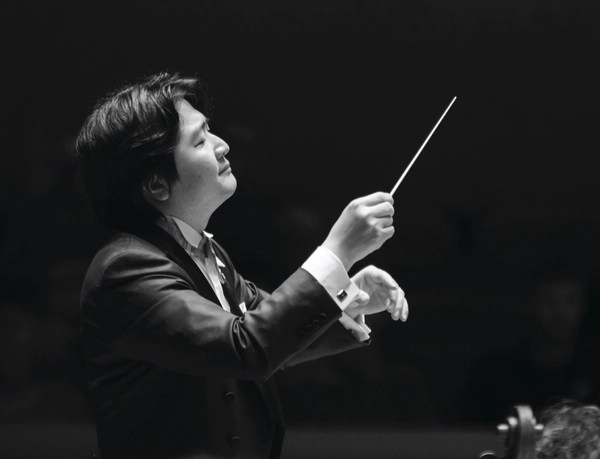
City of Birmingham Symphony Orchestra / Kazuki Yamada (above)

Takemitsu Requiem (1957)
Mahler Symphony no.9 in D major (1908-09)

Symphony Hall, Birmingham
Thursday 10 April 2025

Reviewed by Richard Whitehouse Picture of Kazuki Yamada (c) Hannah Fathers

Ninth Symphonies have been a recurrent feature of this season from the City of Birmingham Symphony Orchestra and Kazuki Yamada. Tonight’s concert brought this to a culmination of sorts with that by Mahler and which naturally occupied almost the whole of the programme.

Whatever else, it was a performance whose scope matched the music’s ambition and not least in an opening Andante as lays claim to being its composer’s greatest achievement. Admittedly this took a few minutes to find focus, those initial bars not so much speculative as halting, but an overall sense of the movement unfolding seamlessly across its strategic peaks and troughs was undeniable, and Yamada was mindful to underline Mahler’s holding back of its expected culmination so the closing minutes mused eloquently if uncertainly on what might have been.

The middle movements can often emerge as incidental to the formal scheme, and Yamada’s take on the Ländler gave some pause for thought. Each of its constituents was vividly shaped and articulated, but a stop-start discontinuity arguably denied it that innocence to experience trajectory which, in turn, makes tangible the fatalistic humour at its end. The Rondo-Burleske was the undoubted highlight – its abrasiveness spilling over into violence towards the close, but not before Yamada had summoned the requisite anguish from its yearning trio section.

It might have been better to continue directly into the Adagio. As it was, a relatively lengthy pause left this finale sounding less a direct reaction to what had gone before than a delayed avoidance of the issues raised. Yamada’s overall handling of this movement was fine if not exceptionally so. Such as the twilit episode prior to the main climax was lucidity itself, but the conductor having already slowed to near-stasis then made it difficult to reduce the tempo further, so that the closing bars risked feeling emotionally gratuitous rather than inevitable.

What could hardly be gainsaid was the commitment of the CBSO’s response over what, for all its latter-day familiarity, remains a testing challenge whether individually or collectively. Wisely, Yamada has resisted any temptation to fashion a self-consciously virtuoso orchestra; emphasis seems to be instead on encouraging flexibility and sensitivity of response in terms of the music at hand – a more circumspect though productive approach which suggests he is happy to stay the course in terms of a partnership which is still in its relatively early stages.

Not a few performances of Mahler Nine opt for a scene-setting piece rather than first half as such. Yamada did so with Takemitsu’s Requiem – if not this composer’s first or even earliest acknowledged work, then certainly the one that established his wider reputation. The CBSO strings did justice to its subtle interplay of expressive threnody and more angular elements in a reading that fulfilled its purpose ideally. Hopefully the coming seasons will revive some of the more innovative pieces to have languished in the three decades since Takemitsu’s death.

This was the latest in what is becoming a tradition and rightly so – a page in the programme listing those ‘‘friends, members and colleagues’’ whom the CBSO Remembers with no little gratitude. From this perspective, tonight’s programme could hardly have been more fitting.

For details on the 2024-25 season A Season of Joy, head to the City of Birmingham Symphony Orchestra website. Click on the name to read more about conductor Kazuki Yamada

Published post no.2,502 – Monday 14 April 2025

On Record – Naresh Sohal: Complete Piano Music (Konstantinos Destounis) (Toccata Classics)

Naresh Sohal
A Mirage (1974)
Chakra (1979)
Prayer (2006)
Tsunami (2007)
Piano Trio (1988)

Konstantinos Destounis (piano); Cristina Anghelescu (violin), Adrian Mantu (cello), Mark Troop (piano) (Piano Trio)

Toccata Classics TOCC0689 [56’30”]
Producers and Engineers Konstantinos Destounis and Bobby Blazoudakis, Peter Waygood (Piano Trio)

Recorded 18 January 2022 at Dmitris Mitropoulos Hall, Athens; 1-3 June 2001 at Gateway Studio, Kingston-upon-Thames

Reviewed by Richard Whitehouse

What’s the story?

Toccata Classics issues the first of a likely series devoted to chamber and instrumental music by Naresh Sohal, featuring all those acknowledged pieces for solo piano along with his Piano Trio, on a release that also continues the posthumous rehabilitation of this significant figure.

What’s the music like?

Although he composed sparingly for the medium, the piano pieces Sohal did write afford an overview of how his music evolved across three decades. Primarily this involved an active as well as frequently confrontational exploration of more radical tendencies in post-war music, resulting in a distinctive while personal synthesis which the composer duly refined and made more pliable with what came after. Those later pieces are not necessarily simpler technically or expressively, yet they convey their essential concerns with greater clarity and immediacy.

At the time of A Mirage, Sohal was still preoccupied with aspects of a European avant-garde he encountered on arrival in the UK some 12 years earlier. Hence the influence of Xenakis in its tendency toward registral extremes and stratified figuration which coalesce more through gestural force than motivic logic. This is already changing in Chakra, which likewise unfolds as an arch but now with a tangible sense of resolution at its apex – though little prepares one for the sudden upsurge at its close after a definite subsiding of tension across the latter stages.

Moving on almost 30 years and Prayer demonstrates a more methodical amalgam of formal means towards expressive ends, though there is nothing at all reactionary about the outcome – whether in the unforced eloquence of its initial Adagio or the fluid interplay of its ensuing Allegretto as it pursues an increasingly intricate and eventful course. A piece titled Tsunami might lead one to expect a headlong discourse, but Sohal’s study is far more controlled and understated by evoking this natural phenomenon in all its awesome and destructive majesty.

Although it comes nearer chronologically to the former group of pieces, the Piano Trio might well be the latest work here as regards overall elaboration. Thus, its three continuous if well-defined sections outline an active process of thesis, antithesis then synthesis which is audible at every stage, though here the evolution is one of a constantly increasing velocity towards a violent or even tragic denouement. Immersed in Indian philosophy as he was, Sohal was only too aware of those darker and negatory forces which are to be found at all levels of existence.

Does it all work?

Yes, in that Sohal’s is a powerful and flexible musical idiom that predicates communication of emotion over theoretical consistency. A quality always to the fore in these accounts of the piano pieces – Konstantinos Destounis searching out their imaginative reserves without ever falling short of their frequently considerable technical demands. Neither is there any lack of insight or commitment in that of the Piano Trio which, in terms of compactness and overall immediacy, is an ideal way into this composer’s language at its most characteristic or potent.

Is it recommended?

Indeed. The sound accorded Destounis is almost ideal in its clarity and definition, though the Piano Trio is rendered at a slightly oblique perspective. Informative notes on life and music, and good news that a follow-up release of Sohal’s string quartets should soon be available..

Listen & Buy

For purchase options, you can visit the Toccata Classics website. Click on the names to read more about pianist Konstantinos Destounis and composer Naresh Sohal.

Published post no.2,500 – Thursday 10 April 2025

On Record – William Wordsworth: Complete Piano Music (Christopher Guild) (Toccata Classics)

William Wordsworth
Piano Sonata in D minor Op.13 (1938-9)
Three Pieces (1932-4)
Cheesecombe Suite Op.27 (1945)
Ballade Op.41 (1949)
Eight Pieces (all publ. 1952)
Valediction Op.82 (1967)

Christopher Guild (piano)

Toccata Classics TOCC0697 [81’08”]
Producer and Engineer Adaq Khan

Recorded 13 April, 29 May 2022 at Old Granary Studios, Beccles, 2 April 2023, Wyastone Hall, Monmouthshire (Three Pieces)

Reviewed by Richard Whitehouse

What’s the story?

Toccata Classics intersperses its continuing survey of William Wordsworth’s orchestral music with a release devoted to that for solo piano, including several works not otherwise recorded and all ably performed by Christopher Guild, who already features prominently on this label.

What’s the music like?

Although not a large part of his catalogue, piano music features prominently in Wordsworth’s earlier output – notably a Piano Sonata that ranks among the finest of the inter-war period. Its first movement is introduced by a Maestoso whose baleful tone informs the impetuous while expressively volatile Allegro. The central Largamente probes more equivocal and ambivalent emotion before leading into the final Allegro, its declamatory and martial character offset by the plangent recall of earlier material prior to a denouement of surging and inexorable power.

His status as conscientious objector found Wordsworth engaged in farm-work in wartime, the experience duly being commemorated in his Cheesecombe Suite whose pensive Prelude and dextrous Fughetta frame a quizzical Scherzo then a Nocturne of affecting pathos. Written for Clifford Curzon, Ballade is a methodical study in contrasts which makes an ideal encore; as, too, might Valediction – though here the emotions run deeper and more obliquely, as befits this inward memorial to a lifelong friend from comparatively late in its composer’s creativity.

This release rounds out our knowledge of Wordsworth’s piano music with two collections not previously recorded. Among his earliest surviving works, the Three Pieces comprise a taciturn Prelude, fleeting Scherzo then soulful Rhapsody which between them find the composer trying out whole-tone figuration with resourcefulness but also a self-consciousness that might have decided him against publishing. Published by Alfred Lengnick as part of its five-volume educational series Five by Ten, the eight miniatures wear their didactic intention lightly; only one of these exceeding two minutes, yet all evince a technical skill that is never facile along with a pertinent sense of evocation that should commend them to amateurs and professionals alike. Here, as often elsewhere, Wordsworth proves a ‘less is more’ composer of distinction.

Does it all work?

Very much so and Christopher Guild, with admirable surveys of Ronald Stevenson (Toccata) and Bernard Van Dieren (Piano Classics) to his credit, is a natural interpreter of often elusive yet always rewarding music. His charged and often impetuous take on the Sonata has more in common with the pioneering account by Margaret Kitchin (Lyrita) than the overtly rhetorical one by Richard Deering (Heritage). Similarly, his approach to the Cheesecombe Suite and the Ballade draws out their depths if occasionally at the expense of their expressive immediacy. Interestingly, Valediction is played from a copy by Stevenson that alters aspects of keyboard layout or pedalling if not the notes themselves; resulting in a greater emotional ambivalence and textural intricacy which Wordsworth, had he heard it, would most likely have endorsed.

Is it recommended?

Indeed, not least when the sound of both Steinway D’s are so faithfully conveyed and Guild’s annotations are so perceptive. Those who have the Deering release should consider acquiring this one also, while those new to this music need not hesitate in making this their first choice.

Listen & Buy

For purchase options, you can visit the Toccata Classics website. Click on the names to read more about pianist Christopher Guild and composer William Wordsworth.

Published post no.2,500 – Thursday 10 April 2025