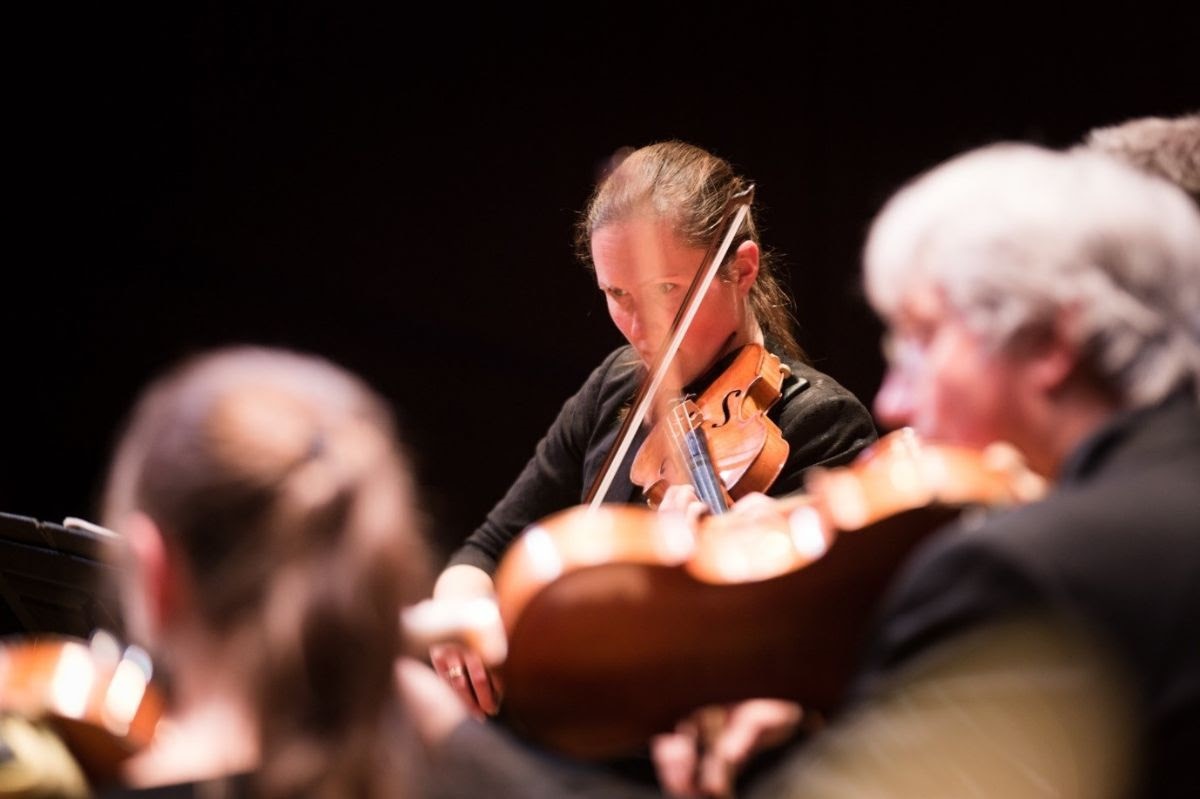
reposted by Ben Hogwood Photo Zoe Beyers leading the English Symphony Orchestra (c) Michael Whitefoot
The renowned English Symphony Orchestra (ESO), under their principal conductor Kenneth Woods, is to make a highly anticipated return to Malvern Theatres, Worcestershire on Wednesday 12 November at 7:30pm with a programme celebrating the adventurous spirit and playful energy of the 1920s, as part of their Autumn-Winter Residency.
LIVELY SPIRIT OF THE ROARING TWENTIES
The evening will feature works by composers who captured the era’s lively spirit, including Erwin Schulhoff’s Suite for Chamber Orchestra, Darius Milhaud’s The Ox on the Roof’ and Kurt Weill’s raucous cabaret songs, to be performed by the ESO’s first affiliate artist, soprano April Fredrick. The programme opens with the music of Joseph Haydn and a performance of his Symphony No. 60 entitled The Absent-Minded Gentleman, delighting in the composer’s celebrated wit and humour.
Kenneth Woods, Artistic Director and Principal Conductor of the ESO, introduces the programme: “Erwin Schulhoff’s suave Suite for Chamber Orchestra takes listeners on a guided tour of 20s dance crazes, from the shimmy to the tango. Milhaud’s zany ballet score The Ox on the Roof was inspired by the comedy of Charlie Chaplin and the dance music of Brazil, while Kurt Weill’s songs reflect life in and around the cabaret scene in all its humour and sensuality. The programme opens with Haydn’s Symphony No.60, The Absent-Minded Gentleman, quite possibly the funniest and most surreal symphony ever composed.”
ENGLISH SYMPHONY ORCHESTRA – MALVERN RESIDENCY
Wednesday 12 November 2025, 7.30pm Malvern Theatres Grange Road, Malvern, Worcs. WR14 3HB English Symphony Orchestra: The Joker’s Wild – Mischief in Music Haydn Symphony No. 60 (‘Il Distratto’) in C Weill Cabaret Songs Schulhoff Suite for Chamber Orchestra Milhaud The Ox on the Roof
April Fredrick (soprano), English Symphony Orchestra / Kenneth Woods
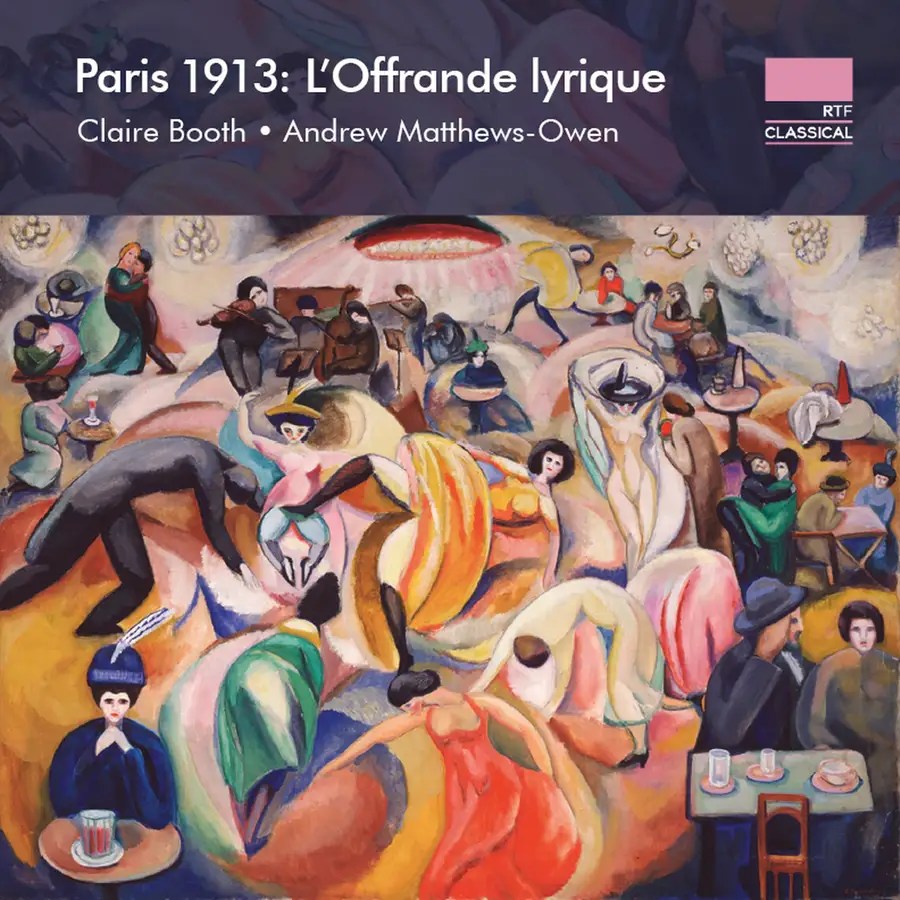
Caplet En regardant ces belles fleurs Milhaud L’innocence Op. 10/3 Hahn À Chloris Ravel arr. Stravinsky Trois poèmes de Stéphane Mallarmé M64 Auric Trois Interludes: Le pouf. Ropartz La Route Durey L’Offrande lyrique Op. 4 Saint-Saëns Petit main Op.146/9 Fauré Il m’est cher, Amour, le bandeau, Op. 106/7 Chaminade Je voudrais être une fleur Debussy Trois poèmes de Stéphane Mallarmé L127 Satie ed. Dearden Trois Poèmes d’Amour Lili Boulanger Clairières dans le Ciel: Vous m’avez regardé avec votre âme Grovlez Guitares et mandolines
Claire Booth (soprano), Andrew Matthews-Owen (piano)
Nimbus RTF Classical NI6455 [66’23”] French texts included Producer & Engineer Raphaël Mouterde
Recorded 11/12 March, 4-6 September 2023 at Wyastone Concert Hall, Monmouth
Reviewed by Richard Whitehouse
What’s the story?
Another enterprising song recital from Claire Booth and Andrew Matthews-Owen, this one focussing on songs that were either conceived, composed or premiered in Paris during 1913 and resulting in an absorbing collection best heard as a diverse while unpredictable totality.
What’s the music like?
Interleaving standalone songs and song-cycles, this recital opens with André Caplet’s take on Charles d’Orléans, its limpid modality highly appealing, then continues with an early song by Darius Milhaud as already demonstrates his distinctive and amusing approach to word-setting, while that by Reynaldo Hahn typifies the teasing charm familiar from his vocal music overall. Maurice Ravel’s triptych to texts by Mallarmé is performed in a version by Stravinsky with its accompanying nonet reduced to piano which, in preserving and maybe even accentuating the music’s questing introspection, represents no mean fete of transcription. Still relatively little known, this certainly deserves to be heard as at least an occasional alternative to the original.
Remembered best as a prolific writer of film scores, Georges Auric had shown a precocious talent for song as is evident in his sensuous setting of René Chalupt. A composer who often wrote on a symphonic scale, Guy Ropartz is heard in a setting of his own verse that amounts to a ‘scena’ in its wide expressive ambit. Interest understandably centres on the eponymous cycle by Louis Durey, a member of Les Six whose increasingly far-left conviction tended to marginalize his creativity yet, as these lucid and empathetic settings of Rabindranath Tagore (as translated by André Gide) confirm, had emerged as a protean talent by his mid-twenties. Hopefully these artists will be encouraged to investigate other of his songs from this period. By contrast, a late song by Camille Saint-Saëns exudes a touching poignancy, while that by Gabriel Fauré typifies the elusiveness of those in his last decade. As is evident here, Cécile Chaminade was a songwriter of style and elegance, then the Mallarmé triptych by Debussy (its first two texts identical to those of Ravel) finds this composer probing the inscrutability of these poems while drawing back from any more explicit intervention. The inscrutability conveyed by Erik Satie’s aphoristic settings (edited by Nathan James Dearden) of his own texts is altogether more playful – after which, the recital continues with a pensive offering by Lili Boulanger, with Gabriel Grovlez’s sultrily evocative setting of Saint-Saëns to finish.
Does it all work?
Yes, given the fascination of this collection taken as a whole and, moreover, the quality of these renditions. Booth is not a singer willing to take the easy option in her interpretations, and so it proves here with singing as fastidious as it is refined, while Matthews-Owen duly instils often deceptively spare accompaniments with understated insight. They contribute a succinctly informative note, but the booklet includes only the French texts with the English translations available at https://rtfn.eu/paris1913/: might it have best the other way round?
Is it recommended?
Very much so. There is much to fascinate even those who consider themselves afficionados of the ‘chanson’, and those who are unfamiliar with much of this repertoire could not have a better means of acquainting themselves with certain of its treasures – hidden or otherwise.
As this is our first post of the year, let me take the opportunity to wish all readers of Arcana a very Happy New Year! Thanks for taking the time to visit the site, I hope you will find much of interest.
In a musical sense, 2024 promises much – and offers a great opportunity to celebrate the music of some classical composers whose anniversaries fall this year. Keep visiting for more on Gustav Holst (above, his statue in Cheltenham), Gabriel Fauré, Darius Milhaud and Nick Drake – as well as the continuation of our Beethoven 200 series, which will pick up the composer’s work where we left off, with the opera Lenore. There will also be the usual reviews of concerts and new music, playlists and interviews. The aim is to add a post each day, so if you come back to the site on a daily basis you should find something new to read – and something new to listen to.
We aim to do what Manfred Mann’s Earth Band did to Holst – and bring some joy to our readers. Wishing you a wonderful 2024!
On this day, 22 June 1974, your editor arrived in the world…but I have just discovered for the first time that on the same day we lost the composer Darius Milhaud.
With Milhaud’s 50th anniversary falling next year it would seem to be a good time to reappraise his output, for he has dropped off the radar rather when it comes to concert programming. This is a shame – because if you listen to one of his most popular works, La Création du Monde, you will see just how well he integrates jazz into his style, and how full of melody his writing is. Listen and enjoy!
Jess Gillam (saxophones, above), City of Birmingham Symphony Orchestra / Jaume Santoja Espinós (below)
Symphony Hall, Birmingham Wednesday 20 October 2021
Written by Richard Whitehouse
This evening’s concert by the City of Birmingham Symphony Orchestra took a break from ‘standard’ repertoire to focus on music by composers either American or with an American focus, in a programme which rung the changes to often vibrant and always appealing effect.
A familiar radio presence, Jess Gillam has already encouraged renewed interest in the music for classical saxophone, as her contributions amply demonstrated. Little heard in his lifetime, the Fantasia by Villa-Lobos is among those more modest creations of a composer known for his (over-reaching) ambition – its three short movements drawing animated and ruminative responses from the soloist enhanced by a restrained orchestration. Swapping soprano for the alto instrument, Gillam returned for Milhaud’s Scaramouche which was no less engaging in this arrangement than the original for two pianos; whether in its incisive opening movement, soulful central interlude or its final Brazileira which could hardly fail to provoke a response from orchestra and audience – the latter evidently appreciative of such an infectious display.
The CBSO captured the spirit of both pieces, thanks not least to former assistant conductor Jaume Santoja Espinós, who had opened the concert with Gershwin’s Cuban Overture – the percussion-clad exuberance of its outer sections a telling foil to the haunting pathos of those canonic textures at its centre. Copland’s Danzón Cubano can seem irritating in its rhythmic over-insistence, but Espinós brought an unsuspected wit and subtlety to this amalgam of coy nonchalance with an orchestration recalling Stravinsky’s forays into ‘crossover’ at this time.
Latin-American traits made way for those of a Europeanized East Coast after the interval, Espinós directing the suite from Copland’s Appalachian Spring with a cohesion as brought out expressive contrasts between the various sections without these becoming too episodic. The idealization inherent in this ‘Ballet for Martha’ can hardly be gainsaid, yet the chaste eloquence of its musical content came through no less affectingly – not least as the familiar ‘Variations on a Shaker Hymn’ subsided into the serene inevitability of the final evocation.
The highlight was a welcome revival for Barber’s First Symphony, whose continuous design marries Sibelian formal precision with that unabashed emotionalism closer to Russian music from this period, with a cumulative impact to its four-in-one trajectory which was palpably in evidence. From the stark foreboding with which it begins, through the relentless impetus of its ‘scherzo’ and consoling poise of its ‘slow movement’ (felicitous oboe playing by Emmet Byrne), to the inexorable force of its closing passacaglia, this was a performance to savour.
An eventful evening, then, and was more to come with a post-concert informal performance from the quintet El Ultimo Tango, familiar from its several recordings and here providing a 30-minute overview of Astor Piazzolla for what was a – necessarily – belated tribute in the year of his centenary. Those wanting a longer selection can hear this group at CBSO Centre next February, while the CBSO returns next week for a programme of mainly French music from conductor Kevin John Edusei with Kirill Gerstein in both of Ravel’s piano concertos.
Further information on the CBSO’s current season can be found at the orchestra’swebsite. For more on Jess Gillam, clickhere – and for more on El Ultimo Tango, here. For more information on Jaume Santoja Espinós, head to the conductor’s website