
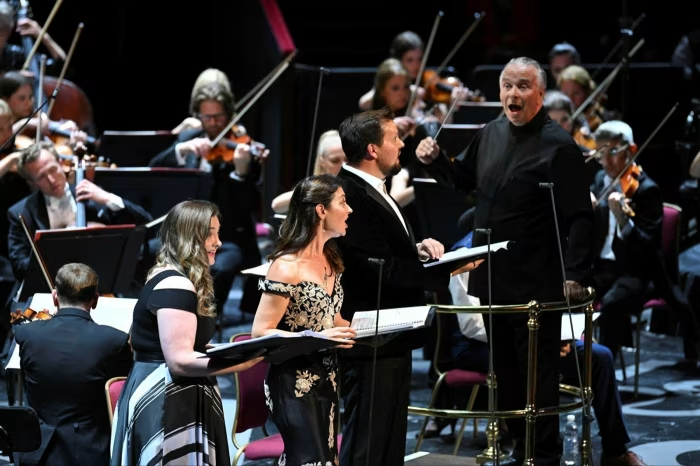
In concert – Soloists, London Philharmonic Choir, BBC Symphony Chorus & Orchestra / Sir Mark Elder @ BBC Proms: Delius: A Mass of Life

Jennifer Davis (soprano), Claudia Huckle (mezzo-soprano), David Butt Philip (tenor), Roderick Williams (baritone), BBC Symphony Chorus, London Philharmonic Choir, BBC Symphony Orchestra / Sir Mark Elder

Delius Eine Messe des Lebens (A Mass of Life) (1898; 1904-05)

Royal Albert Hall, London
Monday 18 August 2025

Reviewed by Richard Whitehouse Photos (c) BBC / Chris Christodoulou

There could be few venues better suited to Delius’s A Mass of Life, in its conceptual ambition and emotional opulence, than the Royal Albert Hall and this evening’s performance, only the third at these concerts and the first in 37 years, undoubtedly made the most of these qualities.

Despite the tragedy of his ultimate breakdown and ensuing incapacitation, Friedrich Nietzsche was considered a liberator in terms of a guiding philosophy with its emphasis on free will and rejection of conventional mores. Such appeal could hardly have been greater than on Frederick Delius, his largest concert work setting substantial extracts from Also sprach Zarathustra in a way that feels never judgemental and is only rarely overreaching. Much of the time its music has a detached and meditative aura whose inward intensity needs to be sustained accordingly.

That this account did so was owing to Sir Mark Elder, his advocacy already manifest in the finest modern recording (LAWO) as came across just as strongly and often more so here. Certainly, the longest sections were effortlessly paced – whether that beguiling interplay of longing and anticipation in In dein Auge which becomes the still (while never static) centre of Part One, or that extended sequence of Part Two taking in the scenic evocation as is Lasst vom Tanzen ab then the pantheist contemplation of Heisser Mittag schläft which is surely the expressive highpoint. Not that the dramatic openings of each part were under-characterized – the driving energy of O du mein Wille! setting the course for one as vividly as did the rousing Herauf! Nun herauf, with its orchestral prelude Auf den Bergen meltingly rendered, for the other.
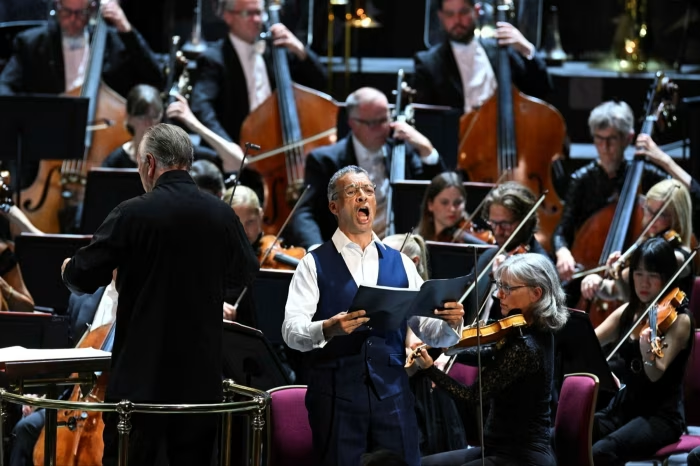
This may be regarded mainly as a choral work, but the importance of its vocal parts is never to be gainsaid. Above all, that of the baritone who assumes the role of Zarathustra in his gradual incline to enlightenment and in which Roderick Williams (above) was consistently at his best – hence the infectious Erhebt eure Herzen and assertive Wehe mir! then, subsequently, the alluring eloquence of Süsse Leier! and will to action of Gottes Weh ist tiefer. If this is the solo role as brings focus or unity to the whole, the others afford textural and expressive enhancements aplenty – Jennifer Davis as capricious and Claudia Huckle as confiding as David Butt Philip was assertive in their respective contributions. All three singers brought out the youthfulness or naivety which are crucial to this work’s underlying journey from innocence to experience.
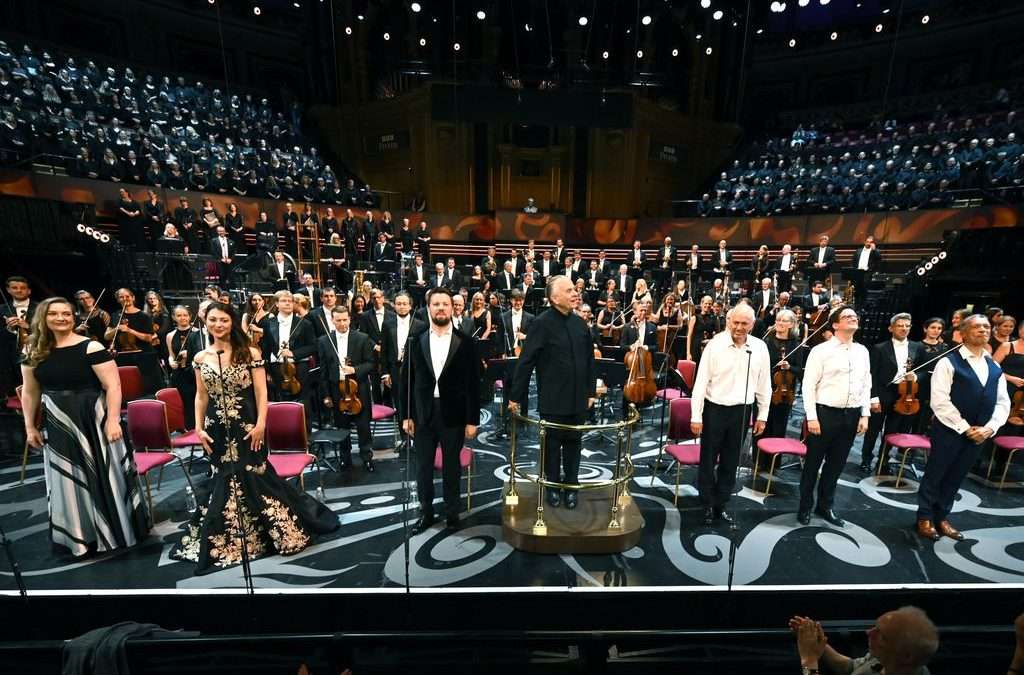
Any doubt a relative disparity in numbers of female and male singers would be detrimental to choral balance was groundless – Elder drawing a vividness but also delicacy of response from those combined BBC Symphony and London Philharmonic forces, while the BBC Symphony Orchestra was rarely less than galvanized whether in complex tuttis or the artless writing for solo woodwind that informs the latter stages. Delius’s orchestration rarely ‘plays itself’ but it conveys a lustre and translucency which could not be mistaken for that of another composer.

A near-capacity audience seemed as attentive to this as it was affected by the final Kommt! Lasst uns jetzt wandeln!, with its build-up to an ecstatic apotheosis then swift dispersal into silence: setting the seal on a memorable interpretation of this all-encompassing masterpiece.

You can listen back to this Prom concert on BBC Sounds until Sunday 12 October – or listen to the recent recording from Sir Mark Elder, with soloists, the Collegium Musicum Choir, Edvard Grieg Kor, Bergen Philharmonic Choir and Orchestra on Tidal below:

Click on the artist names to read more about soloists Jennifer Davis, Claude Huckle, David Butt Philip and Roderick Williams, the London Philharmonic Choir, BBC Symphony Chorus and BBC Symphony Orchestra, and conductor Sir Mark Elder. Click also for more on the Delius Society and the BBC Proms

Published post no.2,632 – Wednesday 20 August 2025

On record: Elizabeth Watts, BBC Symphony Orchestra / Martyn Brabbins – Vaughan Williams: A Pastoral Symphony & Symphony no.4

Elizabeth Watts (soprano)*, David Butt Philip (tenor)**, BBC Symphony Chorus & Orchestra / Martyn Brabbins

Vaughan Williams
A Pastoral Symphony (Symphony no.3)* (1921)
Symphony no.4 in F minor** (1931-4)
Saraband, ‘Helen’ (1913-4)

Hyperion CDA68280 [80’57”]
English text included
Producer Andrew Keener
Engineer Simon Eadon

Recorded 26 & 27 November (Symphonies), 2 December 2018 (Helen), Watford Colosseum, UK

Reviewed by Richard Whitehouse

What’s the story?

Martyn Brabbins and the BBC Symphony Orchestra continue their cycle of the symphonies by Vaughan Williams with the Third and Fourth, two ostensibly very different pieces whose equally equivocal reception at their premieres now seems testament to their expressive reach.

What’s the music like?

No longer the relative rarity it once was, A Pastoral Symphony remains the most elusive of this cycle – its arcadian rapture shot-through with imagery of war and transience.

Brabbins sets a well-nigh ideal tempo for the opening movement, its deceptively passive interplay of landscape and evocation informed by eddying agitation made more explicit in its successor – whose distanced solos for horn and (offstage) trumpet afford concrete recollections of VW’s wartime experience, made the more poignant by being sensed on the edge of consciousness. For all its greater physicality, the third movement is no conventional scherzo in its eliding between moods with an agility finely conveyed here through Brabbins’s judicious pacing – not least that eerily flitting coda which forms an unerring transition to the finale. Its remote outer sections enhanced by Elizabeth Watts‘s yearning vocalise, this unfolds as a necessary culmination; the composer bringing to the fore emotions earlier half-glimpsed on the way to a powerfully wrought climax, leaving in its wake a catharsis more potent for its intangibility.

From here to the seismic eruption of the Fourth Symphony is to set forth on a very different journey, one of absolute expression in combat with force of circumstance. Brabbins keeps a firm yet flexible grip on the initial Allegro, its violent opening balanced by the fugitive calm into which it withdraws. He then finds the right ‘walking’ tempo for the Andante, this sombre if never featureless landscape underpinned by angular harmonic progressions that twice break out in ominous outbursts prior to the flute’s lamenting soliloquy towards its close. Perhaps the Scherzo’s outer sections could have evinced greater sardonic humour, though the overbearing pomposity of its trio is as finely judged as is the pulsating transition into the finale. Brabbins duly brings out its martial swagger and if tension during the earlier stages could be even more acute, the ghostly throwback at its centre yields a wan rapture and how persuasively he draws the thematic elements together in the epilogo fugato for a stretto of mounting tension whose denouement is a return to the work’s fateful opening gesture and a four-letter clinching chord.

As makeweight, Saraband ‘Helen’ proves an enticing discovery. Left unfinished towards the outbreak of the First World War, this setting of lines from Marlowe’s Doctor Faustus may be off-balance in its utilizing tenor and chorus for what surely needed to become a larger entity, though both David Butt Philip and the BBC Symphony Chorus acquit themselves ably, while Brabbins secures playing of real elegance and finesse in orchestral writing that inadvertently yields what emerged as the main theme of Serenade to Music almost a quarter-century later.

Does it all work?

Almost entirely. Those who have acquired the earlier releases in this series (A Sea Symphony and A London Symphony) will be aware of the qualities which Brabbins brings to VW, and so it proves here with what is among the finest recent accounts of the Pastoral. Others have evinced a more visceral response in the Fourth, but there is no lack of impact – allied to a methodical sense of purpose that pays dividends in those densely contrapuntal passages over which the composer laboured before ultimately getting them right.

Is it recommended?

Indeed. Sound has the sense of perspective but also immediacy necessary in this music, with Robert Matthew-Walker once again contributing a detailed and informative note. Hopefully the next instalment, featuring the Fifth (and Sixth?) Symphony, will not be long in coming.

For further information on this release, visit the Hyperion website, or the BBC Symphony Orchestra. You can also read Arcana’s interview with the conductor here