
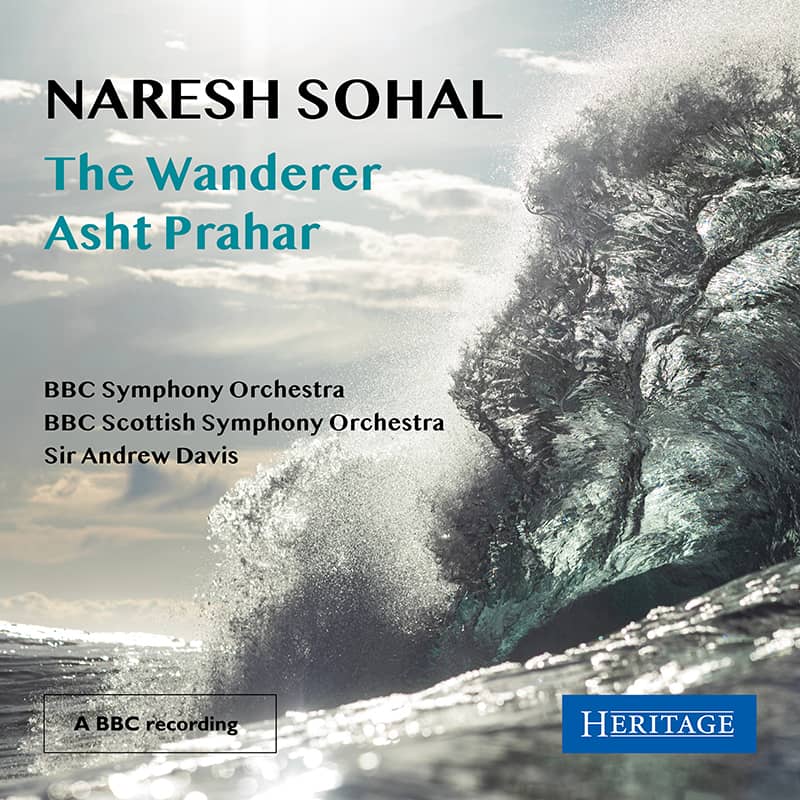
On Record – BBC SSO & BBC SO / Sir Andrew Davis – Naresh Sohal: The Wanderer & Asht Prahar (Heritage)

Naresh Sohal
Asht Pradar (1965)
The Wanderer (1982)

Jane Manning (soprano), BBC Scottish Symphony Orchestra (Asht Pradar), David Wilson-Johnson (baritone), BBC Symphony Chorus and Orchestra (The Wanderer) / Sir Andrew Davis

Heritage HTGCD135 [77’36”] English text included
Remastering Engineer Paul Arden-Taylor

Broadcast performance from BBC Studios, Glasgow on 6 January 1973 (Asht Pradar); live performance from Royal Albert Hall, London on 23 August 1982 (The Wanderer)

Reviewed by Richard Whitehouse

What’s the story?

Heritage issues what will evidently be an ongoing series of archival releases devoted to the music of Naresh Sohal, taken from BBC sources and featuring performers who championed his work over a career whose achievement is not reflected in the availability of recordings.

What’s the music like?

Although he came belatedly to the UK, Sohal (1939-2018) rapidly made up for any lost time when arriving in London in 1962 (further biographical detail can be found in the booklet note for this release and on the composer’s website). Within three years, he had produced his first major (and latterly his first acknowledged) work. Asht Prahar then had to wait until 1970 for its premiere (at the Royal Festival Hall conducted by Norman Del Mar), but it attracted much favourable attention and led to another hearing three years on – the performance featured here.

Taking its cue from the Indian sub-division of the day into eight temporal units (four each for day and night), Asht Prahar unfolds its eight sections as an unbroken continuity. The sizable forces are, for the most part, used sparingly yet resourcefully; as too the deployment of such devices as quarter-tones, along with influences of Ravel and Stravinsky, in music that makes a virtue of its pivoting between East and West. Cyclical if not necessarily cumulative, its final and longest ‘prahar’ brings wordless soprano and orchestra into tangible and haunting accord.

By the time that The Wanderer received its premiere, Sohal had a number of major works to his credit and rationalized his musical idiom accordingly. Setting an anonymous Anglo-Saxon poem in which the male protagonist speaks movingly and often despairingly of his isolation – both physical and spiritual – after the death of his lord, the work divides into two large parts that expand on the narrative’s emotional import. Such ‘‘existential bleakness’’ is intensified by omission of the poem’s last lines with their invoking a specifically Christian consolation. Despite its more than 50-minute duration, there is nothing discursive or unfocussed about The Wanderer’s content. Much of its text is understandably allotted to the baritone, whose austere character is complemented by darkly rhetorical choral passages while offset by an orchestral component with much soloistic writing (notably for flute) in a texture the more involving for its restraint and its strategic use of colour to define specific incidents or emotional responses. Nor is this an opera-manqué, the work succeeding admirably on its inherently abstract terms.

Does it all work?

It does, allowing for the fact that Sohal is not seeking any overt fusion between Occident and Orient, but rather attempting to forge a personal idiom influenced by both while beholden to neither. Both these performances bear out his convictions, Jane Manning adding her ethereal presence to Asht Prahar and David Wilson-Johnson bringing evident compassion to his more substantial role in The Wanderer. Both works benefit from the insightful presence of the late Sir Andrew Davis, whom one regrets never had an opportunity to record them commercially.

Is it recommended?

It is. The sound of these broadcasts has come up decently in remastering, lacking only the last degree of clarity or definition, and Suddhaseel Sen contributes informative annotations. Those looking for a way into Sohal’s distinctive and alluring sound-world need no further incentive.

Listen & Buy

For purchase options, you can visit the Heritage Records website

Published post no.2,451 – Thursday 20 February 2025

On Record – Helen Field, David Wilson-Johnson, soloists, Millennium Sinfonia / James Kelleher: Havergal Brian: The Cenci (Toccata Classics)

Brian
The Cenci (1951-2)

Helen Field (soprano) Beatrice Cenci
David Wilson-Johnson (baritone) Count Cenci
Ingveldur Ýr Jónsdóttir (contralto) Lucretia
Stuart Kale (tenor) Cardinal Camillo/An Officer
Justin Lavender (tenor) Orsino/Bernardo
Jeffrey Carl (baritone) Giacomo/Savella/First Judge/Second Judge
Nicholas Buxton (tenor) Marzio/Third Guest/A Cardinal
Devon Harrison (bass) Olimpio/Colonna/Third Guest
Serena Kay (soprano) First Guest/Second Guest
The Millennium Sinfonia / James Kelleher

Toccata Classics TOCC0094 [two discs, 101’32’’]
Producer & Engineer Geoff Miles Remastering Adeq Khan
Live performance, 12 December 1997 at the Queen Elizabeth Hall, Southbank Centre, London

Reviewed by Richard Whitehouse

What’s the story?

Toccata Classics fills a major gap in the Havergal Brian discography with this release of his opera The Cenci, given its first hearing 27 years ago by a notable roster of soloists with The Millennium Sinfonia conducted by James Kelleher, and accorded finely refurbished sound.

What’s the music like?

The third among the five operas which Brian completed, The Cenci emerged as the second of its composer’s seminal works inspired by Percy Bysshe Shelley (1792-1822). While his ‘lyric drama’ on the first two books of Prometheus Unbound (1937-44) had set its text almost word for word, Brian was ruthless in adapting his ‘tragedy in five acts’ – the outcome being a rapid traversal of a drama whose themes of incest and parricide made it publicly unstageable in the UK until 1922, some 103 years after publication in Livorno where it had partly been written.

Two further operatic treatments emerged either side of that by Brian. Berthold Goldschmidt’s Beatrice Cenci (1949-50) won first prize in the Festival of Britain opera competition in 1951 but itself went unheard 1988 (ironically enough, in a concert performance at Queen Elizabeth Hall), and Alberto Ginastera’s Beatrix Cenci (1970-71) went unstaged in his native Argentina until as recently as 2015. Whereas both these operas centres on the heroine of Shelley’s play, Brian’s focusses more on its ensemble as to content with the emphasis shifting from father to daughter as it unfolds. Compared to the poised yet rather self-conscious lyricism favoured by Goldschmidt or the full-on expressionism of Ginastera, moreover, its often circumspect and sometimes oblique emotional demeanour renders Shelley’s drama from an intriguing remove.

Not its least fascination is the Preludio Tragico that, at 14 minutes, is less an overture than an overview of what ensues – akin to Beethoven’s Leonora No. 2 in its motivic intricacy and expressive substance – which would most likely warrant a balletic or cinematic treatment in the context of a staging. Perfectly feasible as a standalone item, this received its first hearing in 1976 and was recorded by Toccata Classics in 2009 (TOCC0113). Ably negotiated by his players, Kelleher’s lithely impulsive account accordingly sets the scene in unequivocal terms.

What follows are eight scenes which encapsulate this drama to compelling if at times reckless effect. The initial three scenes correspond to Shelley’s first act and culminate with the gauntly resplendent Banquet Scene, but Brian’s fourth scene goes straight to the play’s fourth act with the despairing exchanges of Beatrice and Lucrecia. The fifth scene finds daughter and mother in a plot to murder Count Cenci that soon unravels, then the last three scenes take in Shelley’s fifth act as fate intervenes with Beatrice, Lucretia and stepbrother Giacomo facing execution. Save for a crucial passage where the Papal Legate arrives to arrest Cenci, omission of which jarringly undermines continuity in the fifth scene, Brian’s handling of dramatic pacing leaves little to be desired – the one proviso being the excessive rapidity with which certain passages, notably several of Cenci’s, need to be sung that would have benefitted from a slight easing of tempo. Musically, this is typical of mature Brian in its quixotic interplay of moods within that context of fatalism mingled with defiance as few other composers have conveyed so tangibly.

Does it all work?

Very largely, owing to as fine a cast as could have been assembled. Helen Field is unfailingly eloquent and empathetic as Beatrice, with such as her remonstrations at the close of the fifth scene and spoken acceptance at that of the eighth among the highpoints of mid-20th century opera. David Wilson-Johnson brings the requisite cruelty but also a sadistic humour to Count Cenci, and Ingveldur Ýr Jónsdóttir is movingly uncomprehending as Lucretia. The secondary roles are expertly allotted, notably Justin Lavender’s scheming Orsino and stricken Bernardo. The Millennium Sinfonia responds to Brian’s powerful if often abrasive writing with alacrity under the assured guidance of James Kelleher, and if the sound does not make full use of the QEH’s ambience, its clarity and immediacy tease unexpected nuance from the orchestration.

This set comes with two booklets. One features the libretto devised by Brian, duly annotated to indicate omissions or amendments (yet a number of anomalies in this performance remain unaccounted for). The other features Shelley’s own preface to the first edition, with articles by Brian afficionados including John Pickard’s informative overview of the music and Kelleher’s thoughts on its performance. Charles Nicholl’s speculations as to the ‘real’ Beatrice Cenci are more suited to activities on a culture cruise than to Brian’s opera but are entertaining even so.

Is it recommended?

It is indeed. The Cenci is unlikely to receive further performances (let alone staging) any time soon, so this reading gives a persuasive account of its manifest strengths and relative failings. Kelleher is ‘‘formulating plans to return to conducting’’ and ought to be encouraged to do so.

Listen & Buy

You can listen to samples and explore purchase options on the Toccata Classics website Click on the names for more on conductor James Kelleher and to read more about the opera at the Havergal Brian Society website

Published post no.2,298 – Wednesday 11 September 2024