cfJane Manning (soprano); hMargaret Cable, jElizabeth Turnball, hSarah Walker (mezzo-sopranos); fAlan Hacker, fEdward Pillinger (clarinets); hkRohan de Saram (cello); fPeter Seymour (perc); kAnanda Surkalan (piano); aLondon Sinfonietta, dAmbrosian Singers, gEnglish Chamber Orchestra / Sir Andrew Davis; iSingcircle / Gregory Rose; eLondon Contemporary Players / Elgar Howarth; cNash Ensemble / Justin Connolly; jNew Music Concerts / Robert Aitken; bNorthern Brass Ensemble / Lionel Friend
Naresh Sohal
Aalaykhyam Ia; Chiaroscuro Ib; Kavita Ic; Surya (all 1970)d; Hexade; Night’s Poet (both 1971)f; Aalaykhyam II (1972)g; Poems of Tagore II (1976)h; Inscape (1979)I; The Unsung Song (1993)j; Foray (2006)k
Heritage Records HTGCD122-3 [2 discs, 151’36”] English texts included
Remastering Engineer Paul Arden-Taylor
Live performances and broadcasts (London unless stated): d20 April 1971, St John’s Smith Square e13 July 1971, Goldsmiths College; c1 February 1972, Queen’s College, Birmingham; g 1 May 1973 and a 25 September 1974, Queen Elizabeth Hall, b 5 January 1977, BBC Studios, Manchester; h 22 August 1977, Purcell Room; f 8 February 1978, Wigmore Hall; i 18 November 1979, The Round House; j 28 November 1993, Du Maurier Theatre, Toronto; k 16 June 2006, Wilton’s Music Hall
Reviewed by Richard Whitehouse
What’s the story?
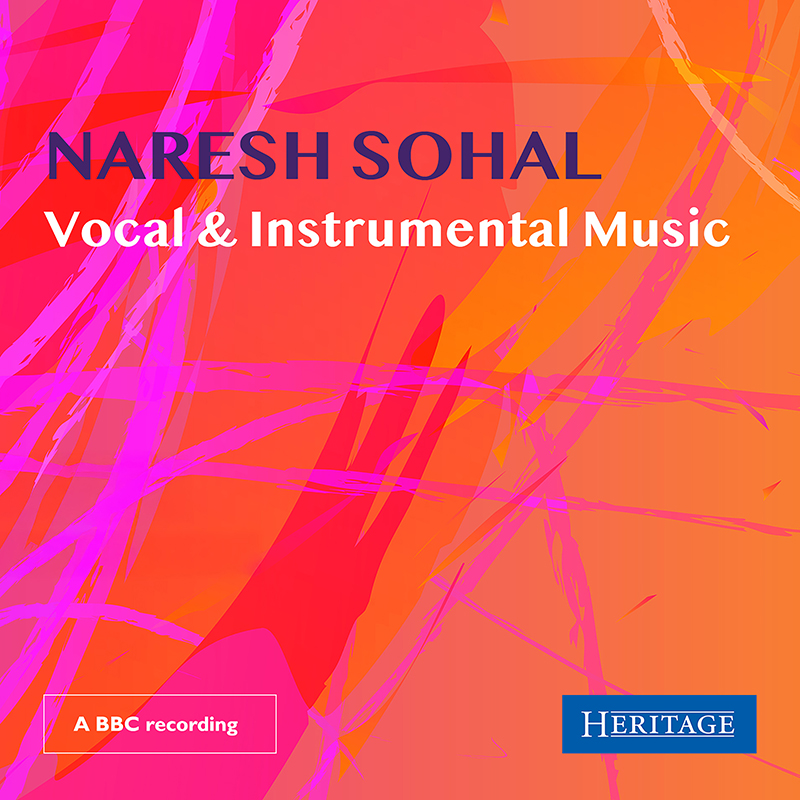
Heritage continues the extensive series of archival recordings of Naresh Sohal (1939-2018) with this double album featuring vocal and instrumental works, most heard in their premiere performances by a roster of artists synonymous with contemporary music during this period.
What’s the music like?
Although previous issues on this label have tended to focus on those large-scale pieces which established or consolidated Sohal’s reputation, his output abounds in works with more modest dimensions or forces. This release collates various of these in parallel vocal and instrumental sequences as amount to a representative overview of their composer’s career. These underline the continual evolution of his idiom, whatever its stylistic changes, while also making the case – if such were needed – for their revival in what has now become a very different music scene.
To a poem from Tagore’s The Gardner (set a half-century before by Zemlinsky as the opening movement of his Lyric Symphony), Kavita I allows Sohal’s aural imagination free-rein with its fraught instrumental movements leading into the eloquent vocal setting. Surya sets texts from the Shakuntalam and Rig Veda in music dense and evocative, charged and incantatory. Night’s Poet draws on Tagore’s The Fugitive as it veers from the speculative to the ecstatic before an alluring close; Poems of Tagore II also draws on that collection in sensuous music with cello as much a vocal element as the two mezzos. Inscape has recourse to Tagore’s Lover’s Gifts in its hieratic aura with fastidiously variegated choral textures, then The Unsung Song draws on Tagore’s Gitanjali in an ethereal exploration of the beyond necessarily remaining unresolved.
As to the instrumental selection, Aalaykhyam I proceeds in starkly contrasted episodes and a disjunction eschewed in Aalaykhyam II with its subtle but never anodyne evolution of motifs that evoke a more inviting ‘abode’. Coming between these chronologically, Hexad favours a methodical yet cumulative unfolding across six movements such that the furtive anticipation of the first meets the assertive fulfilment of the sixth; while Chiaroscuro I turns brass quintet into a succession of overlapping, often conflicting gestures that merge into a vibrant if short-lived recessional. From here to Foray is to jump ahead some 35 years with music of greater expressive focus, distilled into an Adagio then Allegro as might equate to ‘song’ and ‘dance’ were it not for a shifting of ideas and moods across what amounts to a most unlikely diptych.
Does it all work?
Pretty much throughout. Part of the fascination with Sohal’s output are the ways he tackles – and almost always solves – different considerations in successive works, taking the solutions through to the next project so that a consistency of method becomes evident alongside those of form or expression. The performances lack for little in conviction and have been expertly remastered to make them sound more than adequate. More than this, however, it extends the discography of musicians whose contributions to the cause of new music cannot be gainsaid.
Is it recommended?
Indeed it is. The booklet features insightful (if occasionally contentious) notes on each piece by Utsyo Chakraborty along with a detailed biographical overview by Janet Swinney. What has already proved an invaluable series hopefully has several further instalments still to run.
Listen / Buy
You can explore purchase options at the Heritage Records website. Click on the name to read more about composer Naresh Sohal
Published post no.2,898 – Tuesday 26 May 2026