Two days ago we noted the first performance of Aaron Copland’s ballet Rodeo in 1942. Now we look at the first performance of his Symphony no.3, which took place on this day in 1946. The Third is Copland’s flagship symphony, an impressive and powerful work that reaches its apex with music that you will no doubt recognise as the Fanfare for the Common Man, written in 1942. Here is a fine performance of the whole work from the New York Philharmonic and Leonard Bernstein, recorded for DG in 1986:
As with Rodeo, Emerson, Lake & Palmer were not far away, and their adaptation of the Fanfare for the Common Man became their biggest hit in 1977:
Published post no.2,691 – Saturday 18 October 2025
On this day in 1942, at the Metropolitan Opera House in New York City, the premiere of Aaron Copland’s ballet Rodeo took place. It was a wildly successful event, with no less than 22 curtain calls for a work that was to become one of Copland’s best-loved.
Often the Four Dance Episodes are performed as an extract for orchestra, and these contain two famous scenes in Buckaroo Holiday and the popular Hoe-Down, which you can enjoy below in a brilliant recording from the San Francisco Symphony and Michael Tilson Thomas:
Thirty years after Rodeo’s premiere, progressive rock trio Emerson, Lake & Palmer put their own inimitable stamp on the Hoe-Down, with a virtuosic tour de force that stays faithful to the original but showcases the trio’s daredevil virtuosity, especially in this concert from Milan:
Published post no.2,689 – Thursday 16 October 2025
The first movement of the Sinfonietta, by Leoš Janáček (born on this day in 1854):
The Sinfonietta is a thrilling orchestral work, begun with a powerful brass fanfare but containing five incident-packed movements.
How does it work?
The main melody of the first movement Fanfare is the basis for Emerson, Lake & Palmer’s song, but in his keyboard part Keith Emerson refers to other parts of the work.
Then, on his solo from 2’40”, Emerson departs from Janáček’s blueprint with a characteristically incisive solo, backed by a virtuosic drum track. From 3’25” the style broadens to include explicit references to J.S. Bach, the Allemande of his French Suite no.1 in D minor:
What else is new?
You can hear the whole of the Sinfonietta below, in a thrilling performance from the Vienna Philharmonic Orchestra under Sir Charles Mackerras, in a recording made in 1980:
First of all, a very happy new year to you all. Hope 2017 has been good to you so far!
Here at Arcana we are dipping our toes back in the water after an extended break, gradually getting back into the swing of the day job – and planning some exciting things for the site in 2017. The idea is to use the enjoyment and power of music to bring some much-needed sunshine to the current climate. Not just us though – if there is anything you want to see after reading this, please get in touch (editor@arcana.fm), so we can be as inclusive as possible!
So far, with the site almost two years old, it is fair to say the focus has been too heavily on classical music. That might seem an odd thing to say, but it’s time Arcana went back to first principles and delivered on its promise of looking at the intersection between pop and classical, and how we can make the latter much more approachable.
With that in mind, we will be looking a lot more at music from composers who work well on both sides. Philip Glass is 80 this year, John Adams 70 – and a lot of artists and composers inspired by them are expected to be busy.
We will once again be taking friends to classical concerts for the first time, an idea trialed with great success at the 2016 BBC Proms, so if you’re interested in that then please let us know! The Wigmore Hall Monday lunchtime concerts will still be covered too – the only website to offer reviews of these hour-long treats.
We plan to honour the music of Emerson, Lake & Palmer, paying tribute to last year’s sadly departed Keith Emerson and Greg Lake as we look at their treatment of classical music.
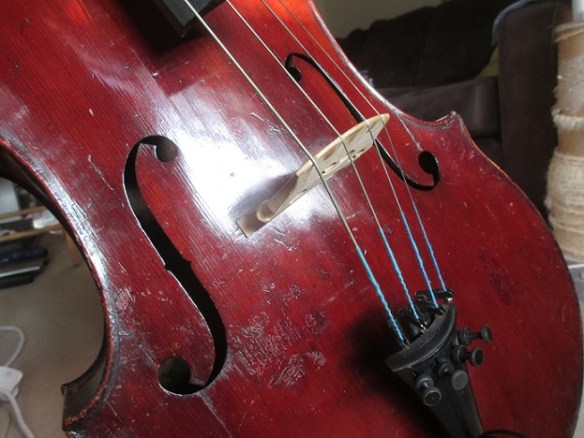
We will also celebrate the unrivalled career of cellist Mstislav Rostropovich, who would have been 90 this year, by taking an extended look at the pieces he commissioned from some of the greatest composers of the twentieth century, and celebrate his instrument, the cello.
Rostropovich singlehandedly changed the reputation of the instrument, and we’ll be looking at how he did that while also enjoying concerts such as the Kings Place cello festival.
As you’ll see then, plenty to get our teeth into as the New Year gets in to gear. Hope you enjoy the ride!
The Dance of the Knights from Sergei Prokofiev’s ballet Romeo and Juliet.
Arguably Prokofiev’s most famous piece of music, Romeo and Juliet has some fantastic music and tunes – and the Dance of the Knights is one of its most impressive calling cards. It has recently gained extra exposure as the opening titles for the BBC programme The Apprentice.
How does it work?
Williams uses the two heavy bass notes from the start to power the chorus:
A bigger sample gets used for the first chorus:
Then some snippets from later in the dance are incorporated:
The Prokofiev material appears to be replayed throughout, and Robbie adds a big male chorus for some bits, but unfortunately the bluster of verse and chorus, plus some really clunky rhyming (Russian – concussion!), mean the song itself is relatively unmemorable. The posturing in the video takes away from the music – of which Prokofiev’s contribution is arguably the most memorable.
What else is new?
Williams made far more effective use of a sample in his UK no.1 hit from 1998 Millennium, where a loop of John Barry’s You Only Live Twice tied together with a beat and a much more memorable chorus:
Prokofiev is no stranger to pop music, and has been used by Emerson, Lake and Palmer on a number of occasions. Here is their slightly foursquare take on the Dance of the Knights:
A much more effective Prokofiev transcription can be found with their transcription of the Scythian Suite – its second movement, The Enemy God Dances with the Black Spirits:
Where can I hear more Prokofiev?
The playlist below gives an introduction to Prokofiev’s symphonies and includes his Classical Symphony and Symphony no.5 – with brilliant tunes at every turn:
The second album is music for the stage, a brilliant collection under Claudio Abbado that includes Alexander Nevsky, Lieutenant Kije (with the brilliant Sleigh Ride as used by Greg Lake!) and the Scythian Suite:
Let’s also not forget Peter and the Wolf…here voiced by none other than Alice Cooper in a new version!


 First of all, a very happy new year to you all. Hope 2017 has been good to you so far!
 Arcana.fm