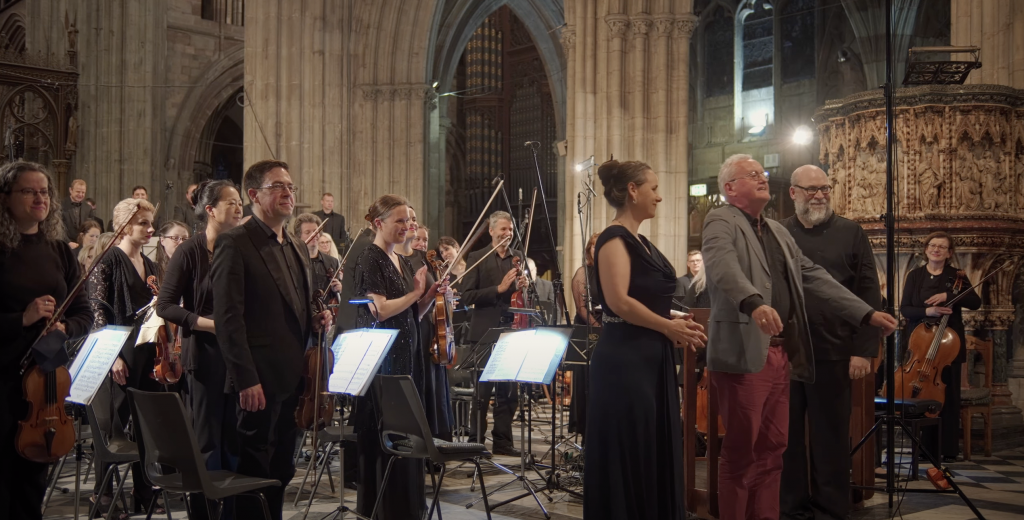
In concert – English Symphony Orchestra / Kenneth Woods @ Kings Place: Elgar, Truscott, Fribbins, Weinberg & Shostakovich

Laura Jellicoe (flute), Rosemary Cow (bassoon), Rosalind Ventris (viola), English Symphony Orchestra / Kenneth Woods

Elgar Romance in D minor Op.62 (1910)
Truscott Elegy in E flat major (1944) [London premiere]
Fribbins Folk Songs (2022) [London premiere]
Weinberg Flute Concerto no.1 in D minor Op.75 (1961)
Shostakovich arr. Barshai Chamber Symphony in A flat major Op.118a (1964, arr. 1971)

Kings Place, London
Sunday 23 March 2025

Reviewed by Richard Whitehouse

What has become the English Symphony Orchestra’s annual appearance in London Chamber Music Society’s season saw an appealing programme of (relatively) familiar and (relatively) unfamiliar British and Soviet-era music as wide ranging as it had been carefully assembled.

It cannot often have begun a concert, but the Romance that Elgar wrote for bassoonist Edwin James made an attractive entrée – its pathos and eloquence fully conveyed by ESO principal Rosamary Cow, always heard to advantage against the strings’ warmly ruminative backdrop.

Harold Truscott finished only three works for orchestra, his Elegy for strings the undoubted masterpiece – eliding intuitively between the already burgeoning British lineage with that of Central Europe (Dvořák’s crepuscular Nocturne, heard at last year’s ESO concert, affords an interesting precedent). Despite its major-key grounding, this is music of intense while often anguished emotion – Truscott bearing his soul to a degree he was rarely, if ever, to do again. As in Worcester four seasons ago, Kenneth Woods searched out its every expressive nuance.

Concertante pieces have featured prominently in Peter Fribbins’s output, with Folk Songs the most recent example. Those traditional tunes range widely geographically and expressively – the Prelude drawing on Welsh melody Bugail Yr Hafod (When I was a Shepherd) in soulful restraint, the Fugue on Serbian tune Ajde Jano (C’mon Jana) in animated dexterity, then the Fantasia on Hungarian song Azt gondoltam eső esik (I thought it rains) in elegant profundity. Superbly played by Rosalind Ventris, it makes a welcome addition to a still-limited repertoire.

Hardly less valuable in its own context is the First Flute Concerto by Mieczysław Weinberg. Written for Alexander Korneyev, its modest proportions fairly belie its substance – whether the energetic interplay of its opening Allegro, the deftly understated threnody of its Adagio, or the whimsical humour of an Allegro anticipating numerous Weinberg finales. It was also the ideal showcase for ESO principal Laura Jellicoe to demonstrate her solo prowess, with ESO strings responding ably to what must be among its composer’s most performed pieces.

Dedicated to Weinberg and written over just 11 days, Shostakovich’s Tenth String Quartet is something of a standalone in the composer’s cycle – coming between four innately personal quartets and four dedicated to each member of the Beethoven Quartet. Yet it is music no less focussed in intent and Rudolf Barshai’s arrangement for string orchestra defines its character more markedly – not least the winsome ambivalence of its initial Andante or visceral force of its ‘furioso’ scherzo, the ESO players tackling those fearsome rhythmic unisons head on. The cellos came into their own with the emotionally restrained variations of the Adagio before, its link seamlessly effected, the final Allegretto built methodically if inexorably to a heightened restatement of the passacaglia’s theme before tentatively retracing its steps to a wistful close.

An impressive demonstration overall of the ESO’s prowess and, moreover, the ideal way to close 17 seasons of LCMS recitals at Kings Place. September finds this series relocating to the newly refurbished St John’s Church at Waterloo, ready for a new chapter in its existence.

Visit the English Symphony Orchestra website to read more about the orchestra, and click on the artist names to read more about flautist Laura Jellicoe, bassoonist Rosemary Cow, viola player Rosalind Ventris and conductor Kenneth Woods. Click also to read more on composers Peter Fribbins and Harold Truscott

Published post no.2,483 – Monday 24 March 2025

Online concert – ESO Digital: Steve Elcock – Wreck

The latest addition to ESO Digital, the online concert arm of the English Symphony Orchestra, is the world premiere performance of Wreck, the orchestral piece by Steve Elcock.

This is the concert Arcana’s Richard Whitehouse saw at the 2022 Elgar Festival, at the Malvern Theatres in Great Malvern. You can read his review here.

Described by its composer as ‘‘a message of salvation beyond despair, of consolation beyond grief’’, Wreck is performed by mezzo-soprano Kathryn Rudge, with the English Symphony Orchestra conducted by Kenneth Woods. Click here to go to the ESO website and watch the performance.

Published post no.2,416 – Monday 18 January 2025

Online concert – English Symphony Orchestra / Kenneth Woods: Elgar Festival 2023 – Symphony no.1

Elgar Symphony no.1 in A flat major Op.55 (1907-08)

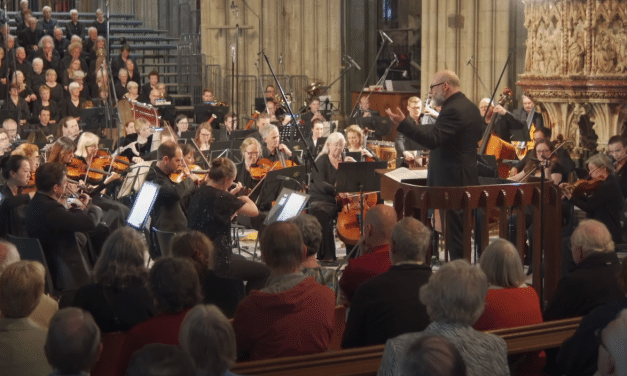
English Symphony Orchestra (leader Zoë Beyers) / Kenneth Woods

Filmed at Worcester Cathedral, Saturday 3 June 2023

Recording, editing and video direction by Tim Burton

Reviewed by Richard Whitehouse

The revival these past four years of the Elgar Festival has provided a boost to music-making in the Midlands, with the present account of that composer’s First Symphony a reminder of the English Symphony Orchestra’s prowess right across the spectrum of symphonic writing.

It may not have had the usual number of strings to complement the triple woodwind or brass, but the resonance of Worcester Cathedral ensured any such disparity was not evident in terms of internal balance. Not least an opening movement whose motto-theme was thoughtful while never indulgent, setting the tone for a main Allegro where expressive variety was never at the expense of its formal focus. Especially felicitous was a hushed transition into the reprise, and a coda which ably distilled the equivocal mood overall as it subsided into a ruminative calm.

Kenneth Woods was mindful to invest the scherzo and its trio with a consistency of pulse so, if the former felt a little reined-in at its return, the latter unfolded with an ideal blend of poise and wistfulness. Nor was that lengthy transition into the slow movement other than seamless as a harbinger of this Adagio’s understated if undeniable profundity, Woods duly negotiating its interplay of soulful main theme and wistful asides with unerring rightness through to the artless closing bars where the music seems not so much to cease as recede beyond earshot.

If the finale represents a falling-off of inspiration, it was not apparent here. Sombre yet shot through with expectancy, its introduction launched an Allegro whose alternating incisiveness and suavity held good during an impulsive development, then a transformation of the codetta whose pathos returned for an apotheosis where the motto-theme carried all before it. Not that these closing pages felt at all bombastic or even grandiloquent in import; rather, they set the seal on a work whose affirmation is the greater for its having been so purposefully attained.

An impressive performance as must have seemed even more so in the context of this concert, not that anyone hearing it via ESO Digital is likely to feel short-changed in emotional terms. Hopefully more performances from the Elgar Festival will be made available at this platform.

This concert could be accessed free until 3 September 2024 at the English Symphony Orchestra website, but remains available through ESO Digital by way of a subscription. Meanwhile click on the names for more on the English Symphony Orchestra and Kenneth Woods

Published post no.2,305 – 19 September 2024

On Record – English Symphony Orchestra, English String Orchestra, Kenneth Woods – Robert Saxton: Scenes from the Epic of Gilgamesh & The Resurrection of the Soldiers (Nimbus)

English Symphony Orchestra, English String Orchestra (The Resurrection) / Kenneth Woods

Robert Saxton
Scenes from the Epic of Gilgamesh (2023)
The Resurrection of the Soldiers (2016)

Nimbus Alliance NI6447 [47’17’’]
Co-Producers Phil Rowlands and Tim Burton
Recorded 7 April 2021 (The Resurrection) and 7 March 2023 (Scenes) at Wyastone Concert Hall, Monmouth

Reviewed by Richard Whitehouse

What’s the story?

The English Symphony Orchestra and Kenneth Woods continue their 21st Symphony Project with this major work from Robert Saxton, here coupled with one of his earlier pieces in what is a welcome and valuable addition to the discographies of composer, conductor and orchestra.

What’s the music like?

His output now as extensive as it is diverse, Saxton had written little purely orchestral music for several decades and few works that might be called ‘symphonic’, but listeners with longer memories may recall the Dante-inspired ‘chamber symphony’ The Circles of Light (1986) or taut incisiveness of the sinfonietta-like Elijah’s Violin (1988). Speaking only recently, Saxton stated a reluctance to call Scenes from the Epic of Gilgamesh a symphony and yet the piece, a result of many years’ thought about the musical treatment right for one of the oldest surviving written texts, has a formal cohesion and expressive unity which are demonstrably symphonic. Scored for pairs of woodwind, horns and trumpets with timpani and strings, its textural clarity imbues any illustrative aspect with an abstract focus amply sustained over its five movements.

Amounting to a continuous narrative, these head from the fluid motion of ‘Prologue’ to ‘The Journey to the Forest of Cedar’, whose passacaglia-like unfolding finds this composer at his most harmonically alluring, then on to ‘From dawn to dusk’ in a scherzo as animated as it is evocative. ‘Lament’ distils a tangible emotional impact from its gradual if inexorable build-up, moving into ‘Apotheosis’ which expands upon the melodic potential of earlier ideas and sees a powerful culmination with the ‘hero’ forced to seek immortality through other means.

Saxton’s approaching the issue of religious belief indirectly, or even obliquely, is as central to this piece as to the earlier The Resurrection of the Soldiers. Inspired by Stanley Spencer’s series of paintings which depict soldiers emerging from their graves on Judgement Day, this might be described as ‘prelude, fugue and threnody’ – the sombre introduction soon reaching an expressive apex, from where the intricate yet cumulative middle phase builds inexorably to a plangent climax; the ensuing slow section gradually ascends linearly or texturally to an ending whose affirmation feels pervaded by anguish. Both these works have the concept of redemption as their focal-point – albeit one which cannot be gained without effort and, even then, should never be taken as read. Tonality, indeed, as the corollary to travelling in hope.

Does it all work?

It does. Four decades on from those flamboyant pieces which established his name, Saxton here evinces an orchestral mastery which will hopefully find an outlet in further such pieces – whether, or not, ‘symphonic’. More overtly tonal it might have become, his music still poses considerable challenges whether technical or interpretative. Suffice to add these are met with finesse and conviction by Woods and the ESO, who are fully conversant with its elusive but always accessible idiom. The composer could hardly have wished for a more tangible QED.

Is it recommended?

It is, not least as enhanced by the composer’s succinct introductory notes and the conductor’s pertinent thoughts on ‘Conducting Saxton’. It reinforces, moreover, that the 21SP is not about retrenchment – rather, the enrichment of this most archetypal of genres is what really matters.

Listen & Buy

This album is released on Friday 5 July, but you can listen to samples and explore purchase options on the Presto website. Click on the names for more on conductor Kenneth Woods, the English Symphony Orchestra and composer Robert Saxton

Published post no.2,220 – Tuesday 25 June 2024

On Record – Zoë Beyers, English Symphony Orchestra / Kenneth Woods: Elcock: Violin Concerto, Symphony no.8 (Nimbus)

Zoë Beyers (violin), English Symphony Orchestra / Kenneth Woods

Elcock
Violin Concerto Op.13 (1996-2003, rev. 2020)
Symphony no.8 Op.37 (1981/2021)

Nimbus NI6446 [56’24’’]
Producer and Engineer Phil Rowlands
Recorded 28 July 2021 (Symphony), 26 May 2022 (Violin Concerto) at Wyastone Concert Hall, Monmouth

Reviewed by Richard Whitehouse

What’s the story?

The English Symphony Orchestra and Kenneth Woods add to their much lauded 21st Century Symphony Project with this release devoted to Steve Elcock (b.1957), juxtaposing two major works which confirm his standing among the leading European symphonists of his generation.

What’s the music like?

Both works heard here only gradually assumed their definitive form. Composed at stages over almost a decade, the Violin Concerto marks something of a transition between less ambitious pieces for local musicians and those symphonic works which have come to dominate Elcock’s output. Its initial Allegro vivo is a tensile sonata design whose rhythmic energy is maintained throughout, with enough expressive leeway for its second theme to assume greater emotional emphasis in the reprise. There follows a Molto tranquillo whose haunting main theme, at first unfolded by the soloist over undulating upper strings in a texture pervaded by change-ringing techniques, is a potent inspiration. A pavane-like idea soon comes into focus while the closing stage, reaching an eloquent plateau before it evanesces into silence, stays long in the memory. The short but eventful finale is a Passacaglia whose theme (audibly related to previous ideas) accelerates across five variations from Andante to Presto, before culminating in a heightened cadenza-like passage on violin and timpani then a peremptory yet decisive orchestral pay-off.

The Eighth Symphony has its antecedents even further back, having begun as a string quartet in the early 1980s, though it continues those processes of evolution and integration central to the seven such works which precede it. It reflects the impact of the Sixth Symphony by Allan Pettersson (still awaiting its UK premiere after 58 years), but whereas that epic work centres on fateful arrival, Elcock’s single movement is more about striving towards a destination that remains tantalizingly beyond reach. Numerous pithy motifs are stated in the formative stages, as the music alternates between relative stasis and dynamism before being thrown into relief by the emergence (just before the mid-point) of a trumpet melody that goes on to determine the course of this piece as it builds inexorably towards a sustained climax then subsides into a searching postlude. Overt resolution may have been eschewed, yet the overriding sense of cohesion and inevitability duly outweighs that mood described by the composer as ‘‘one of desperation in the teeth of impending catastrophe’’ which, in itself, becomes an affirmation.

Does it all work?

Certainly, given both works receive well prepared and finely realized performances – notable for the way Elcock’s demanding yet idiomatic string writing is realized with real conviction. The concerto is a tough challenge for any soloist and one Zoë Beyers meets with assurance – its close-knit interplay of soloist and orchestra brought off with admirable precision, and its occasional modal subtleties rendered as enrichments of the tonal trajectory. Elcock has been fortunate in his recorded exponents, and this new ESO release is emphatically no exception.

Is it recommended?

Indeed, and good to hear that, as the ESO’s current John McCabe Composer-in-Association, Elcock will feature on a follow-up issue of his pieces Wreck and Concerto Grosso, along with the recent Fermeture. For now, this latest release warrants the strongest of recommendations.

Listen & Buy

You can listen to sample tracks and purchase on the Naxos Direct website. For further information on the artists, click on the names for more on Zoë Beyers, the English Symphony Orchestra and their conductor Kenneth Woods. Click on the name for more on composer Steve Elcock

Published post no.2,182 – Saturday 18 May 2024