In concert – Augustin Hadelich, BBC SO / Sakari Oramo @ BBC Proms: Stravinsky, Mendelssohn, Anthony Davis & Richard Strauss

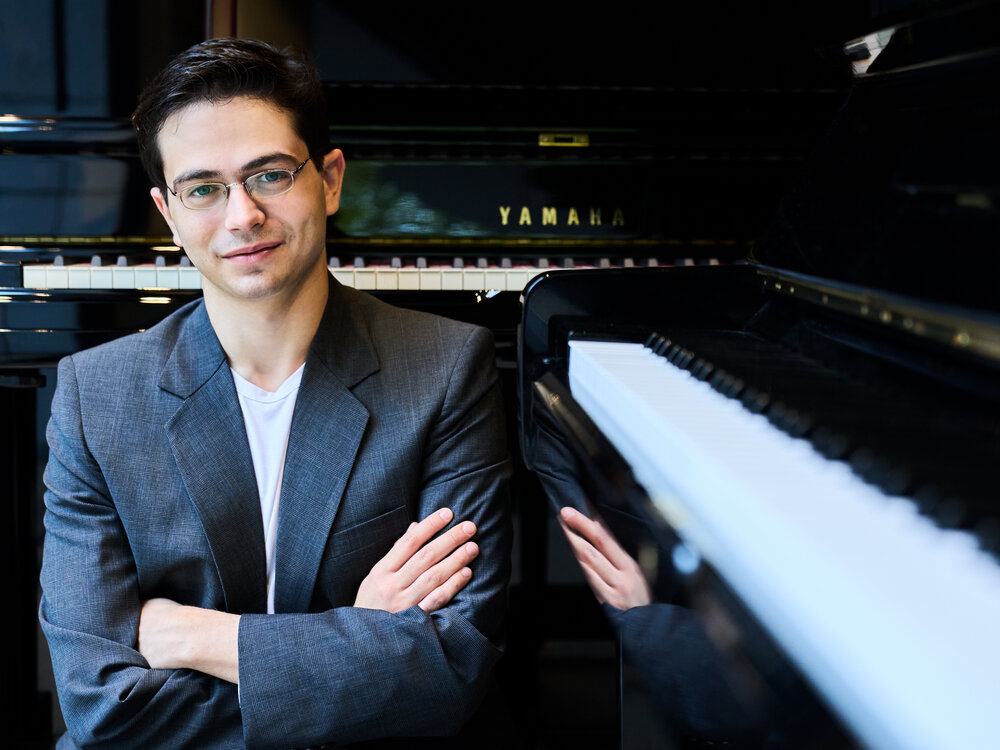
Augustin Hadelich (violin), BBC Symphony Orchestra / Sakari Oramo

Stravinsky Le chant du rossignol (1914/17)
Mendelssohn Violin Concerto in E minor, Op. 64 (1838-44)
Anthony Davis Tales (Tails) of the Signifying Monkey (1997) [European premiere]
Richard Strauss Till Eulenspiegels lustige Streiche, Op. 28 (1894-5)

Royal Albert Hall, London
Thursday 24 July 2025

Reviewed by Richard Whitehouse Photos (c) BBC / Mark Allan

Now in his second decade as chief conductor of the BBC Symphony Orchestra, Sakari Oramo can be relied on for innovative Proms programmes; tonight’s framing a staple of the concerto repertoire and an unfamiliar orchestral work with influential symphonic poems. In the case of The Song of the Nightingale, Stravinsky recycled sections from the latter two acts of his opera Le Rossignol into an illustrative sequence no less successful when heard in abstract terms. As exhilarating as are those earlier stages with their depiction of the bustling Chinese court, it is what follows – arrival of the mechanical nightingale, illness of the emperor then return of the real nightingale to restore his health – that proves most memorable. Above all, that plaintive song of the fisherman – heard on solo trumpet and rendered with due pathos by Niall Keatley.

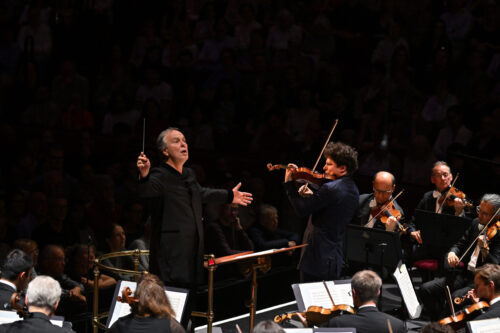
Oramo has worked with Augustin Hadelich on numerous occasions and this evening’s account of Mendelssohn’s Violin Concerto confirmed their rapport right from the outset. Not its least attraction was the deftness of orchestral response in music as wears its Romanticism with the lightest of touches, with Hadelich’s handling of the first movement’s central cadenza no less assured than Oramo’s ushering in of its reprise. The slow movement had no lack of eloquence, nor the finale of that genial humour wholly typical of its era as it headed toward its engaging close. Hadelich responded to the (rightly) enthusiastic applause with his own arrangement of Por una Cabeza – originally a song penned by Carlos Gardel and Alfredo Le Pera, and which has latterly become a favourite addition to film-scores whenever a tango element is called for.

Although he is best known for his operas, notably X: The Life and Times of Malcolm X which has enjoyed several revivals since its Philadelphia premiere four decades ago, Anthony Davis has written numerous concertos and orchestral works with Tales of the Signifying Monkey the final part of a triptych that can be played together or separately. Inspired by an African fable about how the monkey uses its innate guile to keep lions and other predatory animals at bay, this proceeds as a stealthily cumulative entity in which elements of jazz and even swing, are prominent within the stylistic mix. An aura of anticipation, frequently with an ominous tinge, is always apparent and if the outcome is at all anti-climactic, it could well another take on the maxim of travelling in hope. Certainly, the BBCSO seemed to enjoy making its acquaintance.

Usually encountered at the beginning of a concert, Richard Strauss’s Till Eulenspiegel’s Merry Pranks is no less effective (and perhaps even more so) when heard at the close. So it proved tonight with a performance which, while eschewing the uproarious humour often instilled into these increasingly scatological events, was always adept in its conveying of the music’s capricious demeanour. Composed in the wake of his ill-received first opera Guntram, the present work was a ready incentive for that orchestral virtuosity which was Strauss’s metier – above all, its climactic confrontation between its protagonist and the judiciary that results in the former’s execution. The real Till likely survived to old age, only to expire during the Black Death, but his fictional self is doubtless more appealing when characterized so judiciously as it was here.

You can listen back to this Prom concert on BBC Sounds until Sunday 12 October.

Click on the artist names to read more about Augustin Hadelich, the BBC Symphony Orchestra and their chief conductor Sakari Oramo – as well as composer Anthony Davis. Click also for more on the BBC Proms

Published post no.2,609 – Monday 28 July 2025

Summer music – Mendelssohn: A Midsummer Night’s Dream

It’s a hot summer evening here in the UK – and thoughts have turned to the wonderful score Mendelssohn completed as incidental music to Shakespeare’s play.

Here it is, with Walter Weller conducting the Royal Scottish National Orchestra:

In concert – Mao Fujita, Philharmonia Orchestra / Osmo Vänskä: Missy Mazoli, Mozart & Mendelssohn

Mao Fujita (piano), Philharmonia Orchestra / Osmo Vänskä

Missy Mazzoli These Worlds In Us (2006)
Mozart Piano Concerto no.25 in C major K503 (1786)
Mendelssohn Symphony no.5 in D minor Op.107, ‘Reformation’ (1830)

Royal Festival Hall, London
Thursday 20 March 2025

Reviewed by Ben Hogwood Picture (c) Marc Gascoigne

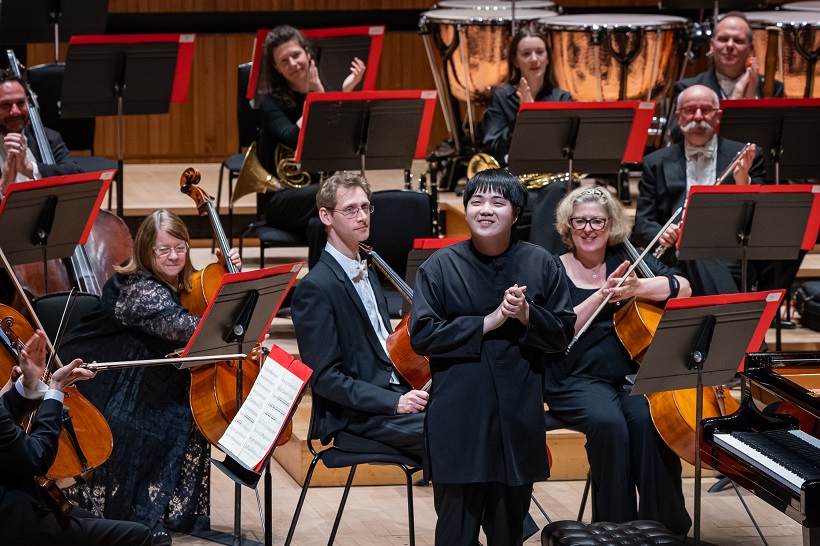
Japanese pianist Mao Fujita has shown his impressive Mozart credentials in highly praised recordings of the composer’s complete piano sonatas. More recently his focus has shifted to the piano concertos.

Here he was partnered by the Philharmonia Orchestra and the visiting Osmo Vänskä in the substantial Piano Concerto no.25 in C major K503, a ceremonial work with fulsome orchestral accompaniment. Yet less is often more in Mozart performance, and that was certainly the case with Fujita as his fingers spun a magical web of notes. The piano’s magical first entry, after the pomp and circumstance of the introduction, was notable for its lightness of touch, Fujita listening closely to the Philharmonia wind players.

With so much to enjoy in this performance, Fujita exuded technical brilliance but also commendable restraint, always with affectionate shaping of the melodic line. That is, until the unattributed first movement cadenza. Here the rulebook was torn asunder, and a flow of unpredictable counterpoint broke loose, revealing links back to Bach but notably forward towards Beethoven.

Back under control, Fujita made the piano sing in the operatic slow movement, aided again by the quality of the wind section under Vänskä, who secured typically detailed, transparent clarity. The first violins began the finale with their touch as light as a feather, after which Fujita put the pedal to the metal once again, taking great pleasure in Mozart’s sparky dialogue with the orchestra. His encore, the first movement of Mozart’s Piano Sonata in C major K545, featured a delightful ‘wrong’ chord near the end, affectionately given and rounding off a truly memorable performance.

Prior to this we heard Missy Mazzoli’s These Worlds In Us, dedicated to her father, who was a soldier in the Vietnam War. Her imaginative orchestration extended to the use of wheezy melodicas in the outer section, adding a dreaminess and heightening the link with the music of Bali. The sighing violin theme was profound, but most telling of all was the soft rat-a-tat of the snare drum, a quiet but ominous reminder of war amidst the otherwise bright scoring. Mazzoli’s music has deeply human qualities that came alive in this performance.

For the second half, Vänskä led a dramatic account of Mendelssohn’s Symphony no.5, the Reformation. Second in order of composition, it was the last of his symphonies to be properly published, on account of its troublesome reception in 1832. In more recent years however the work has enjoyed greater exposure, rewarding its portrayal of triumph in turbulent times.

The magical hush from the strings of the Dresden Amen, quoted by the composer in the first movement, drew the audience in before Vänskä powered through a turbulent Allegro. The second movement danced like a late Haydn minuet, brisk and with a charming trio, while the Andante looked inwards, initially beyond comfort but ultimately softening to the touch. Mendelssohn’s quotation of the Lutheran chorale Ein feste Burg came to the rescue, sweetly intoned by flautist Samuel Coles, before the orchestra enjoyed Mendelssohn’s exuberant finale, and its parallels to Handel’s Messiah. As is his wont, Vänskä revealed previously hidden orchestral detail, giving a fully convincing account of a symphony whose cumulative power is all the more remarkable given Mendelssohn was 21 at the time of composition. Youth and experience were ideal foils here.

For details on the their 2024-25 season, head to the Philharmonia Orchestra website

Published post no.2,481 – Saturday 22 March 2025

In concert – Benjamin Grosvenor, CBSO / Robert Treviño: Mozart ‘Prague’ Symphony, Mendelssohn Piano Concerto no.1 & Brahms Symphony no.1

Benjamin Grosvenor (piano, below), City of Birmingham Symphony Orchestra / Robert Treviño (above)

Mozart Symphony no.38 in D major K504 ‘Prague’ (1786)
Mendelssohn Piano Concerto no.1 in G minor Op.25 (1830-31)
Brahms Symphony no.1 in C minor Op.68 (1868-76)

Symphony Hall, Birmingham
Thursday 23 January 2025 (2.15pm)

Reviewed by Richard Whitehouse Picture of Benjamin Grosvenor (c) Jenny Bestwick

Having worked with the City of Birmingham Symphony Orchestra on numerous occasions, Robert Treviño was well placed to take on a programme which was pretty demanding for all that its constituents were hardly unfamiliar – its two symphonies repertoire works to the core.

His cycle of Beethoven symphonies (Ondine) among the best of recent years, it was perhaps surprising to find Treviño boxing himself in interpretively with Mozart’s Prague symphony. If the first movement’s Adagio introduction was imposingly wrought, the main Allegro was taken at too consistently headlong a tempo for its intricacy of textures and its range of expression fully to register, though the CBSO admirably stayed the course. Nor was the central Andante wholly successful, the pervasiveness of its five-note motif not matched by the diversity of emotional responses to which this is put, with the development sounding harried rather than impetuous. Best was a final Presto that was a sizable-enough counterpart (first- and second-half repeats taken) to what went before, and its élan maintained through to the effervescent closing bars.

Fresh from having taken on Busoni’s epic Piano Concerto (most notably at last year’s Proms), Benjamin Grosvenor (above) met the very different challenge of Mendelssohn’s First Piano Concerto with comparable conviction. Written quickly but with nothing left to chance, this takes up the precedent of Weber’s Konzertstück (which, completed barely a decade earlier, had featured at Mendelssohn’s public debut) by eliding its individual movements into a succinct and cohesive whole. Vividly as Grosvenor projected its opening Molto allegro – no lack of ‘con fuoco’ – he came into his own with an Andante whose dialogue of piano and lower strings was meltingly rendered, then a final Presto both dextrous and exhilarating. The CBSO made a fine recording with Stephen Hough a quarter-century ago (Hyperion) and this was at the very least its equal.

Even so, it was Brahms’s First Symphony as proved the highlight of this afternoon’s concert. Whereas his Mozart had felt unduly beholden to ‘authentic’ concepts, Treviño was entirely his own man here – not least the opening movement whose implacable introduction linked effortlessly into an Allegro trenchantly characterized and with a cumulative impetus such as carried over into the fatalistic coda. Its eloquence never laboured, the Andante featured some felicitous woodwind and a poised contribution from guest leader Nathaniel Anderson-Frank.

Having had the measure of what feels more intermezzo than scherzo, pensive and playful by turns, Treviño steered a secure and always purposeful course through the lengthy finale. Its introductory Adagio preparing stealthily for a fervent if not over-bearing take on its majestic ‘alpine’ melody, the main Allegro was unerringly paced so that its formal elaboration never risked being discursive. Nor was the CBSO found wanting in a peroration that endowed the main motivic ideas with a resolution the more powerful for having been so acutely gauged.

There can be few seasons when Brahms’s First Symphony does not feature in this orchestra’s schedule, but Treviño’s was surely among the most impressive in recent memory; confirming demonstrable rapport between him and the CBSO one hopes will be renewed before too long.

For details on the 2024-25 season A Season of Joy, head to the City of Birmingham Symphony Orchestra website. Click on the names to read more about pianist Benjamin Grosvenor and conductor Robert Treviño

Published post no.2,423 – Sunday 26 January 2025

In concert – Esther Abrami, English Symphony Orchestra / Kenneth Woods – Robert Saxton, Bruch & Mendelssohn

Avie, London 15 Feb 2011

Esther Abrami (violin), English String Orchestra / Kenneth Woods

Saxton Scenes from the Epic of Gilgamesh (2022-3) [World Premiere]
Bruch Scottish Fantasy in E flat (1880)
Mendelssohn Symphony no.3 in A minor Op.56 ‘Scottish’ (1841-2)

Sheldonian Theatre, Oxford
Friday 10 March 2022

Reviewed by Richard Whitehouse

There cannot be any more historic or atmospheric performance venues than the Sheldonian Theatre in Oxford, which is still going strong after over 350 years and the setting for this latest contribution to the English Symphony Orchestra’s ‘21st-Century Symphony Project’.

Speaking only recently, Robert Saxton stated a reluctance to call his Scenes from the Epic of Gilgamesh a symphony and yet the piece, a result of many years’ thinking about the musical treatment right for one of the oldest written texts, has a formal cohesion and expressive unity comparable to previous instalments in the ESO’s project. Scored for late Classical forces of pairs of woodwind, horns and trumpets with timpani and strings, its textural clarity serves to imbue any illustrative aspect with an abstract focus duly sustained across the five movements.

Charting a deft course over its narrative, the work heads from the fluid motion of a Prologue to The Journey to the Forest of Cedar, whose passacaglia-like evolution finds this composer at its most harmonically alluring, then to From dawn to dusk and a scherzo as tensile as it is evocative. Lament distils a tangible emotional force into its gradual yet inexorable build-up, moving straight into an Apotheosis which opens out the melodic content of earlier ideas and so brings a powerful culmination as the hero is forced to seek his immortality by other means.

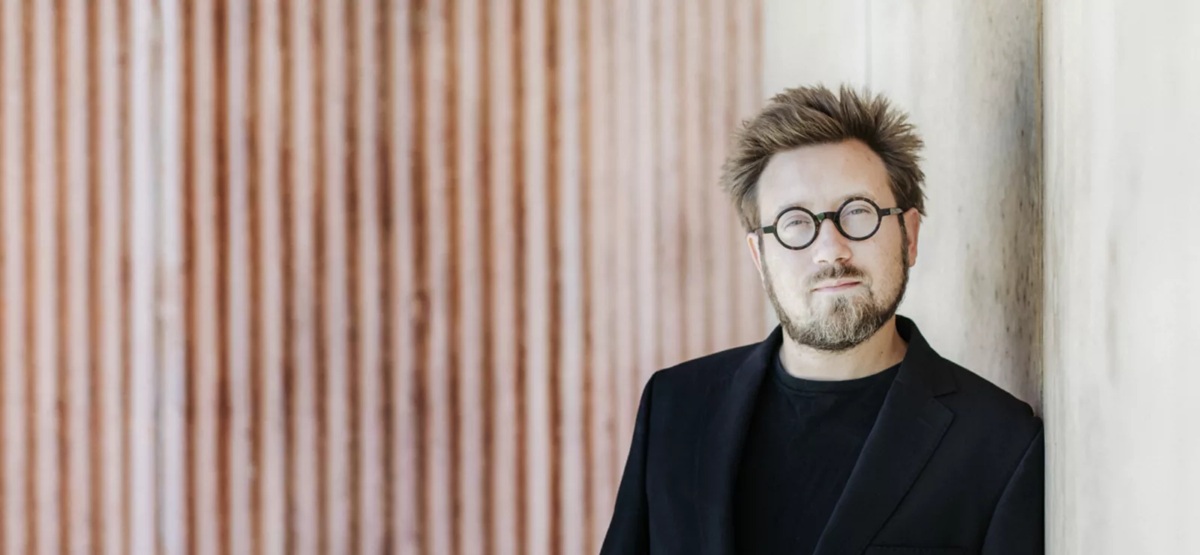
More overtly tonal it may have become, Saxton’s music still presents considerable challenges technical and interpretive. Suffice to add these were met with finesse and no little conviction by Kenneth Woods (above) and the ESO who, having previously recorded this work for future release, were fully conversant with its elusive while always approachable idiom. Almost four decades on from the flamboyant pieces which helped establish his name, Saxton revealed an orchestral mastery that will hopefully find an outlet in further such pieces – whether or not ‘symphonic’.

Tonight’s concert was also notable for featuring the ESO’s new Creative Partner and Artist in Residence – violinist Esther Abrami (above), her presence on social media enhanced by the release of her eponymous debut album for Sony. Stylishly attired (with an image that, for older readers, might recall Audrey Hepburn), she gave an account of Bruch’s Scottish Fantasy at its best in the transition from sombreness to eloquence of its Introduction and high-flown sentiments of an Andante in which the composer’s recourse to folk melodies is at its most felicitous. Before it, the Scherzo ideally needed more incisiveness for its engaging humour fully to register, with the final Allegro (given in abbreviated form) rather less than ‘warlike’ – though its mellifluous second theme enabled Abrami to conjure a tonal warmth which was never less than appealing.

After the interval, the ESO came fully into its own with an impressive take on Mendelssohn’s ‘Scottish’ Symphony. Whatever its genesis in his tour of that country when just 20, the work is demonstrably that of a composer who, having reached a creative mid-point, surveys his many successes but also failings. Hence the fatalistic aura such as informs the opening movement’s introduction or the tense agitation of its main Allegro – both of which were palpably brought out by Woods, who then gave the brief if scintillating scherzo its head. The highlight was an Adagio whose constant pivoting between pathos and anguish was graphically stated – aided by an orchestral discipline no less evident in the final Allegro, its martial overtones carrying through to a pause in which the decision to opt for tragedy or triumph is held in the balance.

That the work closes in triumph has often been felt its downfall but, as conveyed by Woods at a swift if not inflexible tempo, such an apotheosis is one of determination or even defiance in the face of whatever is to come. It certainly brought this concert to a memorable conclusion.

For more information on the artists in this concert, click on the links to read about Esther Abrami, Kenneth Woods and the English Symphony Orchestra. Click on the name to read more about composer Robert Saxton – who also has a page from his publisher here