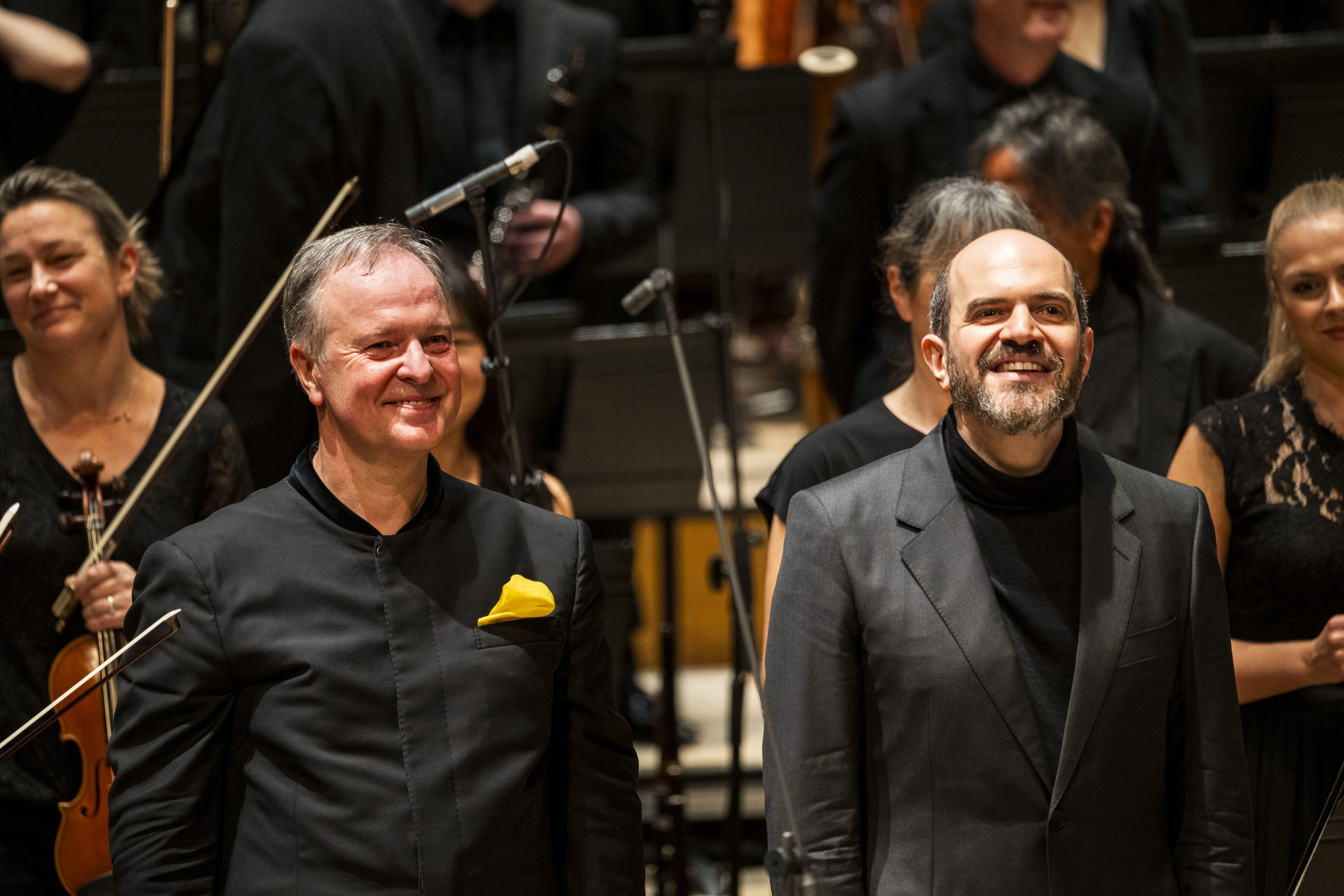
In concert – Kirill Gerstein, BBCSO / Sakari Oramo: Bacewicz & Busoni @ Barbican Hall

Kirill Gerstein (piano), BBC Symphony Chorus (lower voices), BBC Symphony Orchestra / Sakari Oramo

Bacewicz Symphony no.2 (1951)
Busoni Piano Concerto in C major Op. 39 (1901-04)

Barbican Hall, London
Friday 1 November 2024

Reviewed by Richard Whitehouse Pictures (c) BBC / Sarah-Louise Bennett

Wait years for a performance of Busoni’s Piano Concerto then (at least) two come (almost) at once. As 2024 sees the centenary of the composer’s death and it is much his largest work for the concert hall, this was doubtless to be expected though a welcome occurrence all the same.

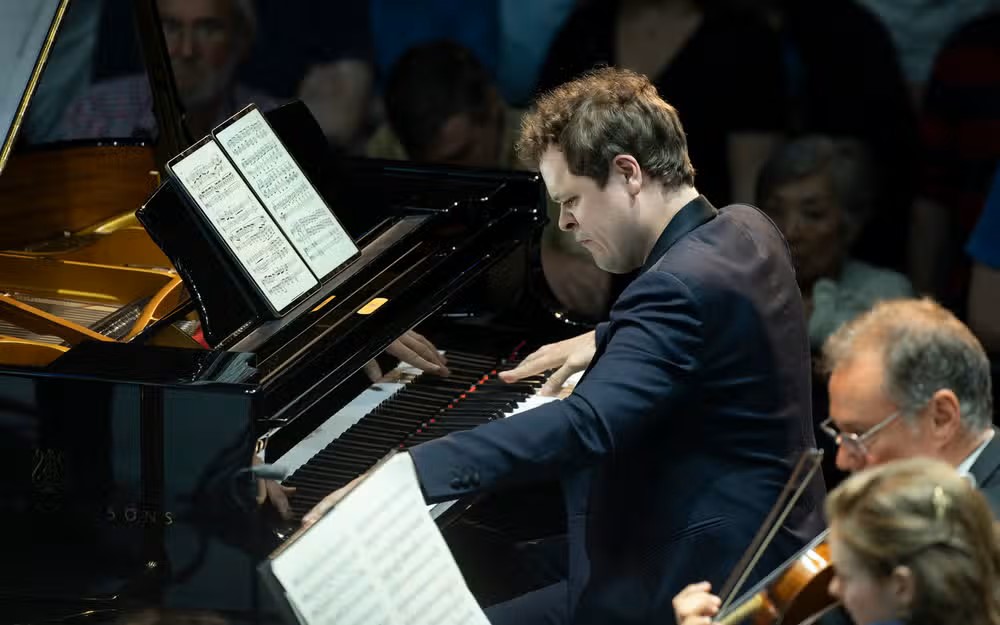
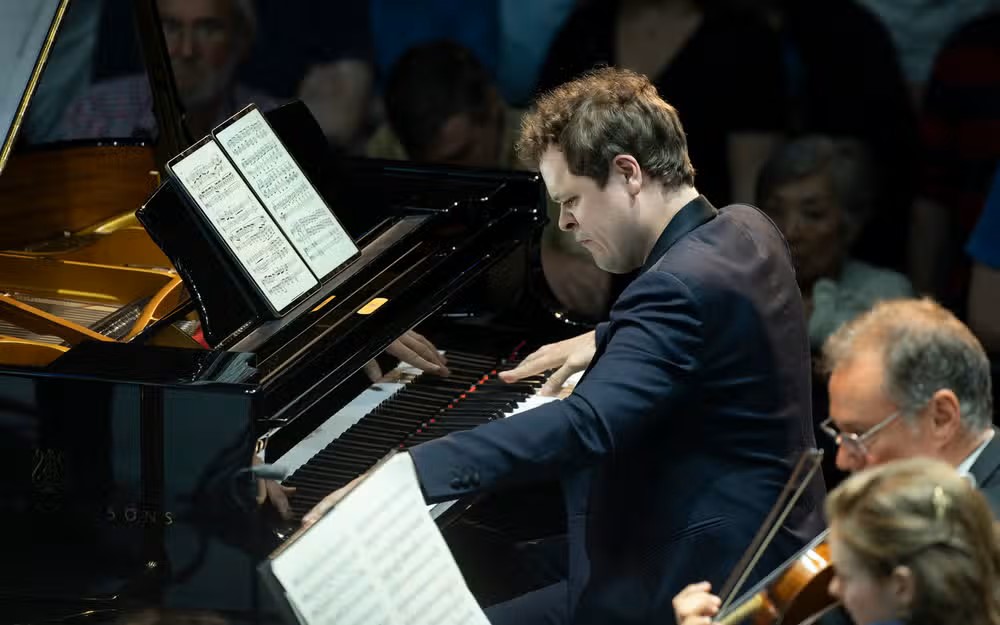
Having first played it in Boston seven years ago (later released on Myrios), Kirill Gerstein (below) and Sakari Oramo were intent on utilizing an experience unusual in the context of this work. This was evident at the outset of its Prologo e introito – the long orchestral introduction having a cumulative impetus that carried into the soloist’s imposing entry, with this physicality finding contrast in the delicacy of passagework and the sensitivity of dialogue later in this movement. Nor was there any lack of capriciousness in a Pezzo giocoso whose more ambivalent asides pointedly underlined, and its more populist elements always integrated into the ongoing flow.
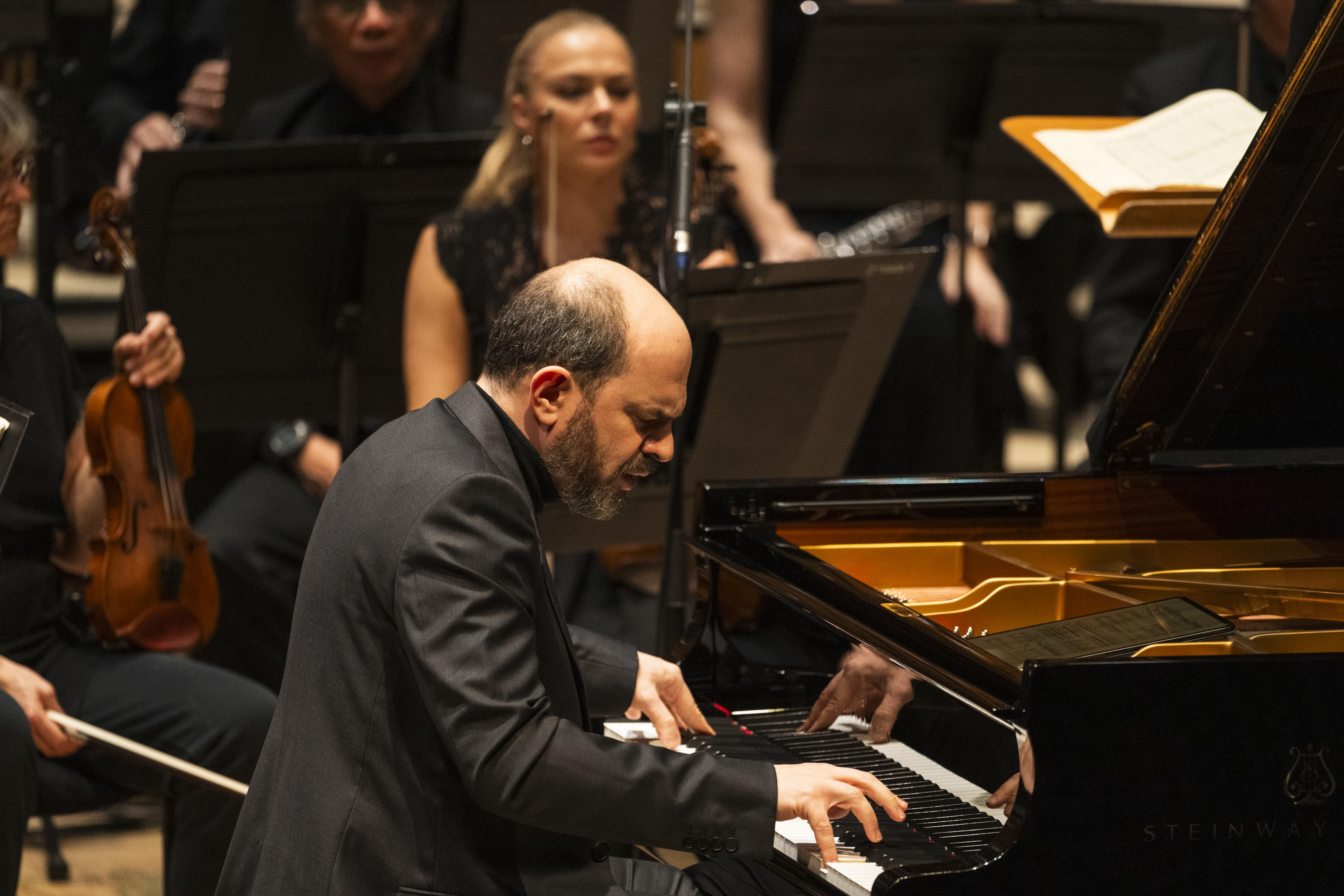
Centrepiece in every respect, Pezzo serioso made a memorable impression. The sombreness of its introduction complemented by the undulating poise of Gerstein’s playing in the ensuing barcarolle section, before a remorseless build up of intensity towards its central climax found piano and orchestra in true accord; the re-emergence of earlier themes of a pathos abetted by a conclusion whose gently insistent rhythmic undertow led to an ending of exquisite finesse.

Rarely can the All’italiana have conveyed such scintillating appeal at this headlong a tempo, making for a tarantella of infectious wit but one whose ever more daring flights of fancy never threatened to lose focus – the BBC Symphony Orchestra responded with unfailing conviction, while the climactic cadenza made for a seamless link into the Cantico. Here male voices, placed at the rear of the platform instead of offstage, assumed the musical foreground as this finale built in a rising arc of tension to an apotheosis of a triumph the more cathartic for its sense of release.

How Busoni’s epic work comes over in performance is in part determined by what has been heard earlier in the programme. Tonight’s concert got it just right with a rare hearing (at least in the UK) for the Second Symphony from Polish composer and violinist Grażyna Bacewicz.
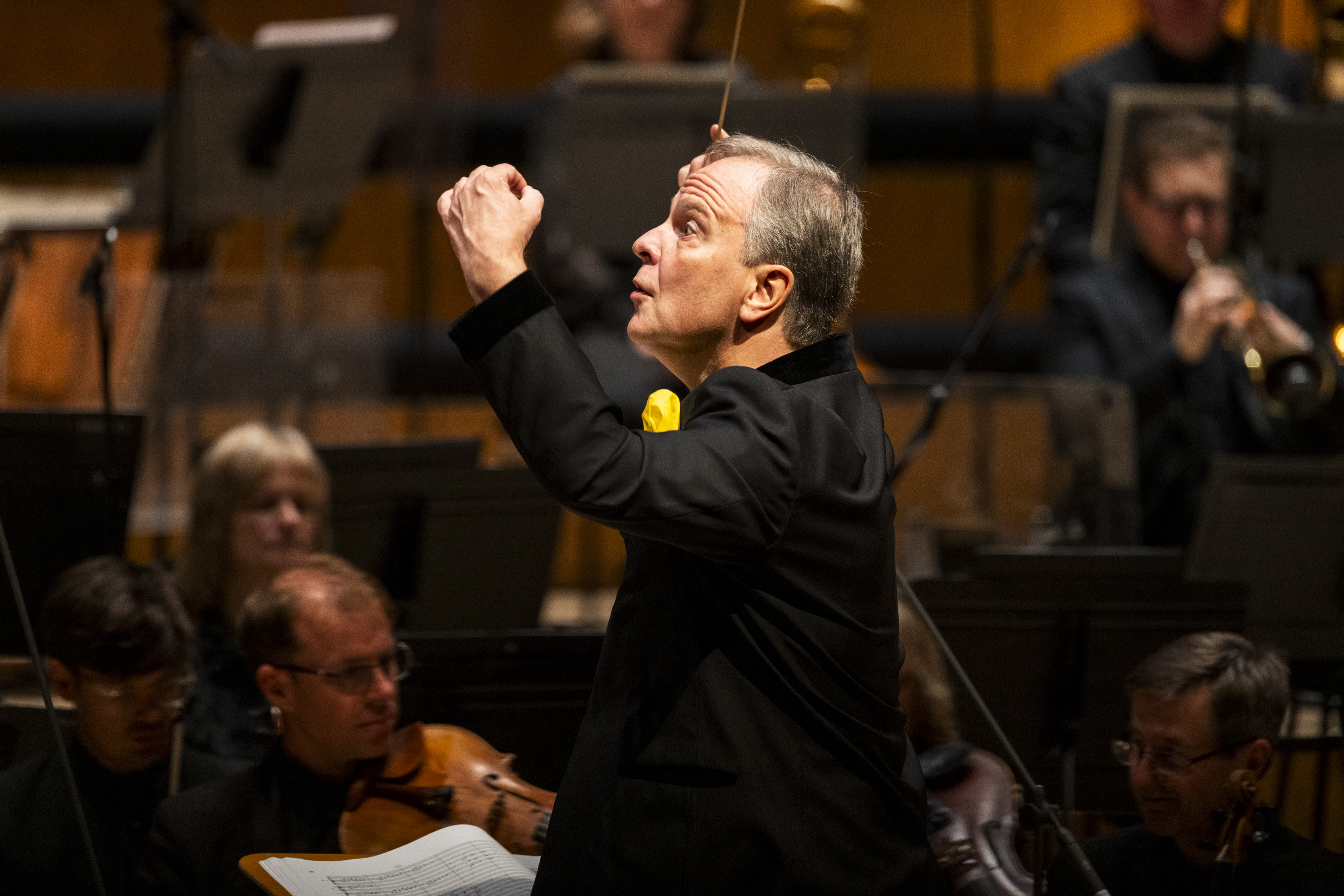
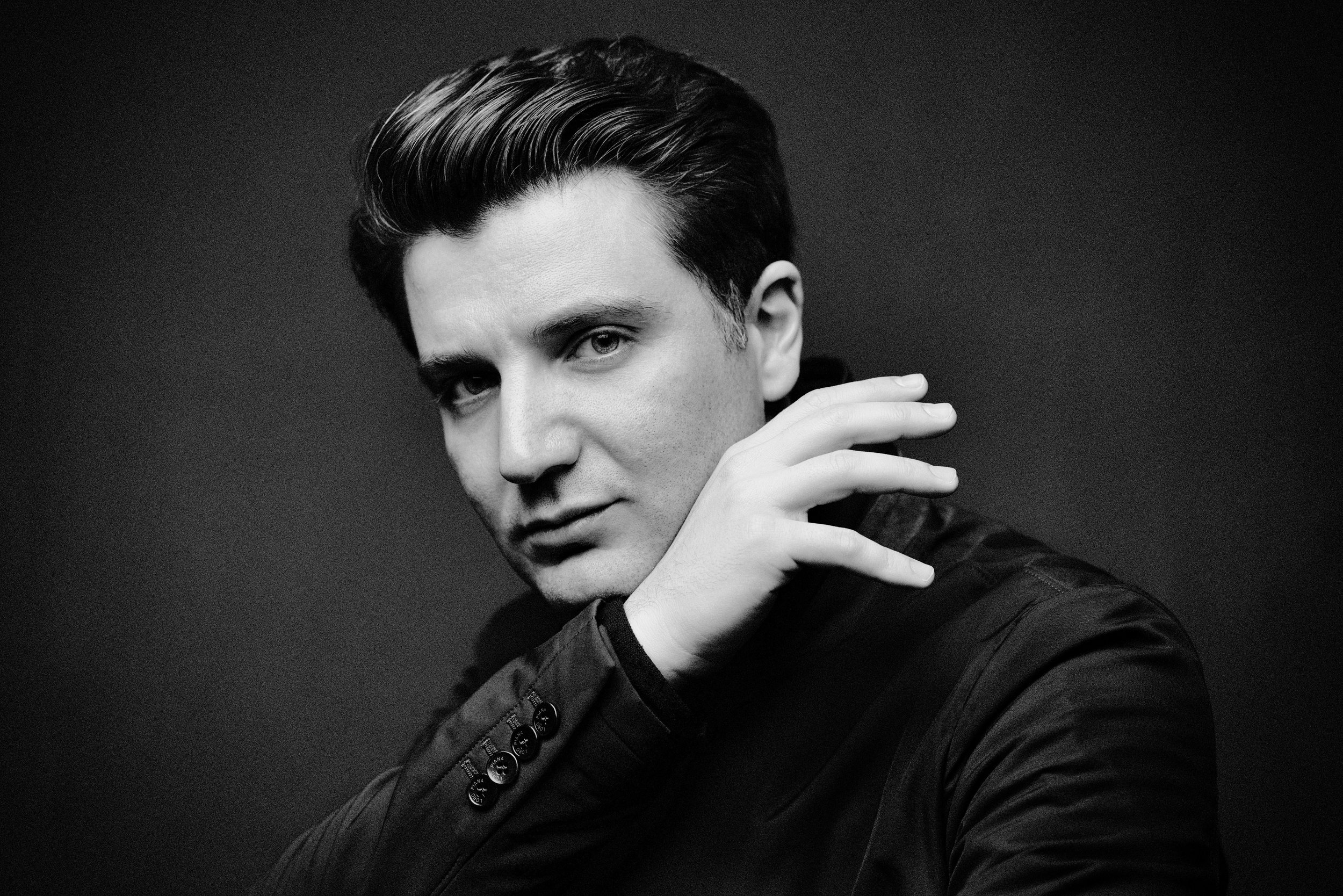
Oramo (above) had previously given notice of his sympathy for her music via recordings of the Third and Fourth Symphonies (Chandos), and this performance did not disappoint. Playing for just over 20 minutes, the Second has a variety of incident and overall impact out of all proportion to its length – whether in the opening movement as this alternates between equivocation and resolve, the eloquence of a Lento in which Bacewicz’s orchestration is at its most resourceful, a Scherzo whose poetic asides never threatened to offset its prevailing vivacity, then a Finale that (as with Roussel’s Fourth Symphony which may have provided the model) ended almost too soon yet whose incisiveness always felt apposite to the whole. Throughout, Bacewicz was conscious of the implications of Socialist Realism while steering clear decisively of its values.

Hopefully this and Bacewicz’s First Symphony will be appearing in due course as a follow-up volume. For now, it gave ready enhancement to a concert whose enterprise and conviction are further proof, is such were needed, of that continued rapport between Oramo and the BBCSO.

For details on their 2024-25 season, head to the BBC Symphony Orchestra website. Click on the names to read more about pianist Kirill Gerstein, conductor Sakari Oramo and composer Grażyna Bacewicz

Published post no.2,351 – Sunday 3 November 2024

Arcana at the Proms – Prom 23: Benjamin Grosvenor, Rodolfus Choir, London Philharmonic Chorus & Orchestra / Edward Gardner – Busoni & Rachmaninoff

Rachmaninoff Symphonic Dances Op.45 (1940)
Busoni Piano Concerto in C major Op. XXXIX (1902-4)

Benjamin Grosvenor (piano), The Rodolfus Choir (men’s voices), London Philharmonic Choir (men’s voices), London Philharmonic Orchestra / Edward Gardner

Royal Albert Hall, London
Monday 5 August 2024

reviewed by Richard Whitehouse Photos (c) Andy Paradise

This centenary of Busoni’s death has not thus far seen a great deal of activity in the UK, so it was gratifying to find the Proms scheduling his most (in)famous work – the Piano Concerto tonight receiving its second performance at these concerts, 36 years to the day after its previous outing.

Back then, the first half featured Beethoven’s Fourth Symphony and a more apposite coupling than Rachmaninoff’s Symphonic Dances. Now firmly ensconced in the orchestral repertoire, it remains a stern test the London Philharmonic Orchestra did not quite meet on this occasion – despite such felicities as Martin Robertson’s eloquent alto sax in the first movement and Edward Gardner’s conjuring of a tangible malevolence in its successor. Impulsive but erratic in its outer sections, the finale’s evocative central span had a superficial quality typical of this performance overall.

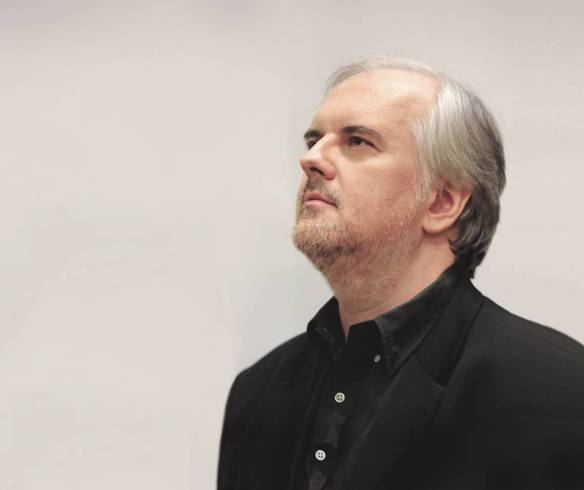
This was not the case in the Busoni. Benjamin Grosvenor (above) might not the first name who comes to mind for this concerto but, having already given performances in Reykjavik and Berlin, he was audibly attuned to an idiom not as elusive as often supposed in its canny amalgam of the Germanic and Italianate, while his playing was fully equal to its technical demands. That he is not a pianist looking to confront the orchestra head on ensured a more than usually close-knit coordination with players and conductor, which was almost always to the benefit of this piece.

Not least in Prologo e Introito, its orchestral introduction enticingly shaded by Gardner with Grosvenor integrating his unequivocal entry into what are essentially variations on the theme at the outset. Few pianists have weighted Busoni’s complex chords or his intricate harmonies with such translucency, not least the end of this movement where piano and orchestra melded to spellbinding effect. Straight into Pezzo giocoso, its capricious outer sections framing one of stealthy ambivalence as perceptively rendered as was that spectral angularity near its close.

Grosvenor managed the rare trick of making Pezzo serioso simultaneously cumulative and cohesive. He duly channelled the slow-burning momentum of its introduction into the rolled chords of its barcarolle-like first part – Gardner sustaining impetus across its successor to an imperious climax, during which the soloist never risked being obliterated. The lead-in to its third part had a poise equal to that at the end, where subtle rhythmic contrasts between piano and timpani against undulating strings had an enfolding calm to diffuse any lingering tension.

A general pause for retuning, then All’italiana burst forth – the underlying tarantella rhythm a springboard for its motley succession of vernacular elements initially humorous and latterly uproarious, held in check by the scintillating give-and-take of soloist and orchestra. Grosvenor almost topped these shenanigans with his electrifying cadenza – after which, Gardner prepared admirably for Cantico in which male voices (above) hymned Allah’s praises with mounting fervour; Grosvenor a largely passive observer until he belatedly returned for the headlong signing-off.

Quite a performance, then, that will hopefully be released commercially. Did Busoni offer an encore at that Berlin premiere? It could not have been more suitable than J.S. Bach’s Prelude in E minor BWV855, transposed and arranged by Alexander Siloti – three minutes of balm bringing us gently down to earth.

For more on this year’s festival, visit the BBC Proms website – and to read more on the artists involved, click on the names: Benjamin Grosvenor, Edward Gardner, The Rodolfus Choir, London Philharmonic Choir and the London Philharmonic Orchestra

Published post no.2,264 – Thursday 5 August 2024

Arcana at the Proms – Prom 23: Thoughts on Busoni’s Piano Concerto

Benjamin Grosvenor (piano), The Rodolfus Choir, London Philharmonic Choir, London Philharmonic Orchestra / Edward Gardner

Royal Albert Hall, London
Monday 5 August 2024

by Ben Hogwood Photo (c) Andy Paradise

A full review of Prom 23 will follow from Richard Whitehouse, but I wanted to register some thoughts on my first live encounter with one of the most extraordinary piano concertos you could ever hope to hear.

In the last few months pianist Benjamin Grosvenor has taken Ferruccio Busoni’s Piano Concerto on something of a concert tour, and has written of his love and admiration for the piece in a Guardian article, which proves a helpful guide for anyone not fully attuned to the piece.

The centenary of Busoni’s death falls this year, hence the first appearance of this piece at the Proms in 36 years, since a memorable occasion when Peter Donohoe squared up to the solo part in the company of the BBC Symphony Orchestra and Mark Elder. Oh, and the BBC Singers – for this work, unbelievably, has a male chorus in the finale, singing “Lift up your hearts to the Power Eternal”, a hymn to Allah from Adam Oehlenschläger’s Aladdin. Busoni’s quote in the score at this point is that “The Pillars of Rock begin to make soft and gentle music.”

Yet even before we got to that fifth movement the extraordinary power and individuality of Busoni’s music was shining through. The London Philharmonic Orchestra under Edward Gardner had a big part to play here, setting the scene in the Prologo e introito as though we were standing in a cathedral, awestruck at the architecture but still taking in a new sight with each about turn.

Grosvenor’s interpretation of his part was balletic, and the music really danced – swooping down from the heights or bubbling up from the depths, the pianist finding remarkable clarity in even the most complex passagework. Busoni, a formidable concert pianist himself, really tests his soloist, but retains a well-judged balance between piano and orchestra. Grosvenor and Gardner somehow found this equilibrium in the notoriously tricky acoustics of the Royal Albert Hall, where from the arena you could hear the clear communication of Busoni’s ideas. The orchestra were superb here – percussion ideally balanced, strings and wind interacting with the piano cleanly and the brass sensitively placing their chorale interventions. The clarinet and viola solos in the second movement had all the room they needed, while the orchestral colour that appears so unexpectedly and vividly in this work was richly shaded.

And what of the piece itself? In many ways it was like listening to a progressive rock album from the 1970s, which in itself is extraordinary when you think the Piano Concerto was completed in 1904. The sheer scope of Busoni’s imagination knew no bounds, then – taking on board more obvious influences from Bach, Beethoven, Chopin and Liszt, while using harmonic techniques to remind us that we were now in the age of Sibelius, Elgar and even Schoenberg.

The fourth movement was perhaps the most remarkable in this performance. With the gargantuan third completed, a kind of meditation in four parts, Busoni summons even greater invention for a Tarantella of remarkable energy, the solo part whirling round in a circle and brilliantly played here by Grosvenor. Just as it seemed all possibilities had been exhausted, the appearance of the male chorus was a masterstroke, their sonorous tones floating above much of the audience in the Royal Albert Hall. They leant a whole new dimension to the work, meaning that even those who might have been struggling 55 minutes into a piece found the new impetus and energy in Busoni’s exultation.

If you have not yet encountered this extraordinary piece I encourage you to without delay – but don’t stop there, for Busoni’s solo piano output, while very different, has many riches to impart in a fraction of the time. First, though, you have to try the Piano Concerto. It will knock your socks off!

You can listen to this concert on BBC Sounds – with the Busoni Piano Concerto beginning at 1:03:55. For more on this year’s festival, visit the BBC Proms website

Published post no.2,263 – Wednesday 7 August 2024

Online Concert: Francesca Dego & Alessio Bax @ Wigmore Hall – Mozart & Brahms

Francesca Dego (violin, above), Alessio Bax (piano, below)

Mozart Sonata for piano and violin in B flat major K454 Den første sommerfugl (1784)
Brahms Violin Sonata no.1 in G major Op.78 (1878-9)

Wigmore Hall, Monday 20 March 1pm

by Ben Hogwood

This was the first time violinist Francesca Dego and pianist Alessio Bax had performed together in public – but had that fact not been given to us by BBC Radio 3 announcer Andrew McGregor, the unsuspecting audience would have assumed they had been playing together for years. Both demonstrated an innate understanding of the music in this attractive programme, which had equal portions of light and shade.

Much of the light was found in the Mozart, his K454 violin sonata written during a phase where he was especially preoccupied with the key of B flat major. Around the violin sonata, regarded as one of the three crowning masterpieces in the form, sit the string quartet nicknamed the Hunt (K458) and the Piano Concerto no.18 (K456), the B flat neighbours evidence of a period where Mozart seems to have been especially fertile.

His stimulus on this occasion was the Italian violinist Regina Strinasacchi, a figure with whom the Italian Dego – a Mozart specialist herself – possibly felt an affinity. In detailing her affection for the work in the concert notes, Dego noted how Strinasacchi had studied at the Ospedale della Pietà, where Vivaldi once taught, before meeting Mozart in Vienna.

The piece made a winsome impression here, Dego showing how, in Mozart performance, less can so often be more. The pair enjoyed a poised introduction, Dego lingering on the last note before a sparkling Allegro moderato opened up ahead. There was definitely an air of spring to this movement, with burbling piano figures and bright violin melodies ideally balanced by the two.

The slow movement took time for thought, enjoying the space afforded to an operatic violin line, though never lingered unnecessarily. Dego’s tone was especially enjoyable here. The finale was very nicely done, with breezy humour and opportunity for virtuoso display for both instruments, tastefully taken.

Alessio Bax Pianist Photo: Marco Borggreve

As with several of his first forays into a new musical form, Brahms took several attempts before he was happy to publish his Violin Sonata no.1, which was completed just after the Violin Concerto. It is an attractive work with memorable themes, but a shadow fell over its composition due to the fate of Felix, the son of Clara Schumann and Brahms’s godson, who contracted tuberculosis, from which he died.

Dego and Bax brought this melancholy to the slow movement, the music turning hollow at the extremes of the piano register, Bax’s shaping of the low phrases especially expressive. The soft coda was bittersweet, a mood which carried over into the slow movement. Whereas the first movement had plenty of room given to its attractive melody, the finale pushed forward, Brahms looking to blossom into an exultant major but ultimately remaining troubled by the frequent reappearance of the minor key. There was however a good deal of energy and ultimately the sonata ended positively, the light and shade of this performance having given it a deeper perspective.

Dego introduced a bold encore choice, the second movement Tarantella of Busoni’s Violin Sonata no.2 – a work that should be heard in the concert hall far more often. On this evidence, a recording would be most welcome, given the musicality the two performers brought to this fine recital.

For more livestreamed concerts from the Wigmore Hall, click here

Wigmore Mondays – Nicolas Angelich plays Bach / Busoni, Brahms & Beethoven

Nicolas Angelich (piano)

Wigmore Hall, Monday 9 December 2019 (lunchtime)

You can listen to this concert on the BBC Sounds app here (opens in a new window)

Review and guide by Ben Hogwood

A concert of the three ‘B’s, all of them greats of keyboard literature – with a fourth, Busoni, added for good measure.

J.S. Bach and Busoni make a winning combination, the Italian 20th century composer having discovered a strong affinity with his ‘ancestor’s’ work in transcribing his organ and harpsichord works for piano. These were always done in a reverent way, and the famous Advent chorale prelude Nun komm, der Heiden Heiland (Now come, Saviour of the heathens) is no exception. Nicolas Angelich ensured all was still before beginning this account, and once started he left plenty of room for musical thought and variation of tempo and phrasing. Although at times it was a little too mannered, it was a nicely gauged start to the concert.

Angelich continued without a break into Brahms 7 Fantasien, hailed by Clara Schumann as ‘a true source of enjoyment, everything, poetry, passion, rapture, intimacy, full of the most marvellous effects’. The seven pieces work well as a whole, with three Capriccios placed 1, 3 and 7 in the group, interspersed with four Intermezzi. The relatively ambiguous labels mean Brahms has plenty of freedom for expression, and beyond the Capriccios being faster and stormy, and the Intermezzi slower, intimate and experimental, there is little to confine his work.

The performances here were well-informed, Angelich having recorded these works for Virgin Classics back in 2006. The first Capriccio in D minor (9:51) exhibits power and authority, with the composer’s beloved triplet rhythms in evidence, and is complemented by the first Intermezzo in A minor (12:11), one of several moments where Brahms’ thoughts turn wholly inwards – apart from the slightly sunnier middle section. The third piece, a Capriccio in G minor (16:23) has arpeggios tumbling downwards, and has a central section anticipating the tonal area (E) of the three Intermezzi to come. These are the fourth piece in E major (19:23), full of subtle but noticeable questioning in its melody, and the longest piece of the set. It is followed by the thoughtful fifth piece in E minor (23:59) and a sixth, mostly chordal piece back in E major (26:56) which quickly moves away from its harmonic base. Finally the power and passion returns for the seventh piece, a Capriccio in D minor (30:21). Brahms again is in his favourite two-against-three rhythmic figuration, and this signs off the set in the major key with some aplomb in Angelich’s performance.

Fantasy is also a theme for Beethoven’s most famous piano work, his Moonlight Sonata. In truth this piece sits between a fantasy and a sonata (hence the composer’s subtitle, Sonata quasi fantasia), and the first movement, though static in the profile of its arpeggios, is pure and magical imagery, Beethoven intentionally or not evoking moonlight over Lake Lucerne as perceived by his friend, the poet Ludwig Rellstab.

Angelich brought the stillness of the moment to the Wigmore Hall (35:30), reflective and deep in a reverie, only rousing slightly for a Scherzo of relatively downbeat thoughts (41:35). Those sentiments were well and truly blown away by the Finale (44:12), the only one of the three movements written in true ‘sonata form’ by Beethoven. This was a terrifically played account, carefully thought through and played with feeling rather than a need for technical prowess – though that was present too.

Angelich returned to late Brahms for his encore, the Intermezzo in E flat major Op.117/1 (54:02) Another late work, this one is based on an old Scottish ballad, Lady Anne Bothwell’s Lament – and brought the mood and chronology of the concert full circle.

Repertoire

This concert contained the following music (with timings on the BBC Sounds broadcast in brackets):

J.S. Bach arr. Busoni Nun komm, der Heiden Heiland BWV 659 (c1748, arr.1898) (4:36)
Brahms 7 Fantasien Op.116 (1892) (9:51)
Beethoven Piano Sonata no.14 in C sharp minor Op.27/2 ‘Moonlight’ (1802) (35:30)
Encore: Brahms Intermezzo in E flat major Op.117/1 (1892) (54:02)

Further listening

The music from this concert can be heard in leading available versions on Spotify below. These include Angelich’s recording of the Brahms pieces, with Murray Perahia playing the Bach / Busoni and Beethoven:

Angelich can be heard in a double album of late Brahms that includes the composer’s piano pieces published as Op.117-119. They hold a unique place in the piano repertoire, written by Brahms in the knowledge that his compositional career was nearly over and looking forward to innovations by composers such as Mahler, Berg and Schoenberg:

Busoni’s transcriptions of Bach organ works repay further exploration, especially at this time of year. This album from Kun-Woo Paik brings together some of the more famous examples, including the Toccata, Adagio and Fugue:

Beethoven’s 32 Piano Sonatas remain one of the wonders of his output, but even a listen to the four published after the Moonlight sonata reveal a composer striking out for new shores. The Piano Sonata no.15 in D major Op.28, known as the Pastoral, is similarly magical – before the group of three works published as Op.31 reveal humour in the first, stormy Romanticism in the second (nicknamed The Tempest) and an openness of expression in the beautiful third. The playlist below brings together leading recordings from Emil Gilels: