On record: Poulenc – Works for piano and orchestra

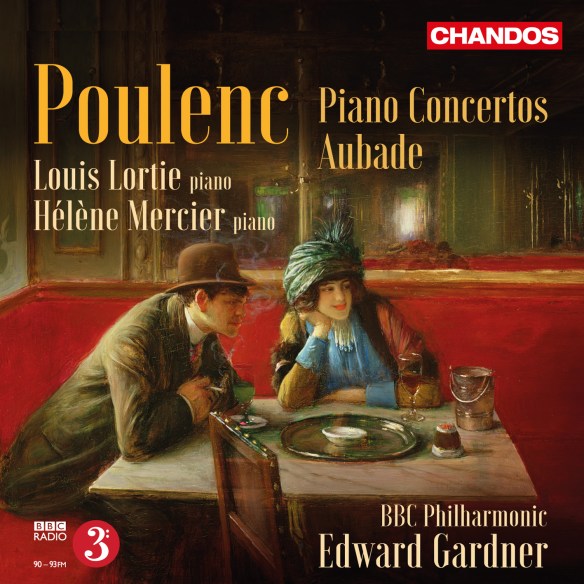
Featured recording: Poulenc – Works for piano and orchestra (Chandos)
poulenc-lortie

Louis Lortie, a French-Canadian pianist, teams up with conductor Ed Gardner and the BBC Philharmonic Orchestra for a disc presenting Poulenc’s complete music for piano and orchestra, as well as some of his works for two pianos. Here he is joined by regular duet partner Hélène Mercier.

What’s the music like?

Poulenc is well-loved among 20th century composers, often for his gift of writing bittersweet melodies that make the listener smile – such as the oboe theme that dominates the Rondeau section of the Aubade for piano and orchestra, the second work on this disc.

Poulenc is a cheeky composer, thumbing his nose behind your back in a sense, and as with most French composers the imaginative and colourful orchestrations bring the music to life. Every so often Poulenc throws in a turn of musical phrase that makes the listener smile, with an exaggerated gesture here or a knowing chord progression there.

This new collection from Chandos brings together an impressive range of writing. The Piano Concerto is perhaps not as popular as it might be, for it often sparkles in this performance, and that label certainly applies to the entertaining and multi-faceted Aubade from 1929. This work, Roger Nichols informs us in his authoritative booklet note, was written in one of the composer’s depressive bouts, and it tells the story of how the huntress Diana is driven to suicide by her own ‘love that the gods forbid’.

The brief works for two pianos included here are greatly affecting – the doleful Élégie and the free-spirited L’Embarquement pour Cythère especially – while the concise Sonata packs an energetic punch. When writing for two pianos and orchestra in the Concerto Poulenc must have had great fun, for this is full of frolics – but with the customary cautionary notes just beneath the surface.

Does it all work?

Yes. This collection is consistently entertaining, played with great enthusiasm and affection and recorded in such a way that the light and shade of the composer’s writing is fully revealed.

The Aubade is at times po-faced but has an almost ever present glint in the eye, as though it can’t resist cracking a joke amongst the downward thoughts. In the double concerto, Mercier and Lortie enjoy sparkling and spiky exchanges between pianos and orchestra, and in the finale there is what sounds like a clockwork mechanism towards the end.

The tender second movement of the Sonata for two pianos is beautifully done, before the finale scurries away.

Is it recommended?

Yes. Poulenc is a charmer on record, and can be enjoyably brash too. The performers here do him proud.

Listen on Spotify

This particular recording is not on the streaming service, but samples from each track can be heard here

Wigmore Mondays – Anna Caterina Antonacci & Donald Sulzen

antonacci

Anna Caterina Antonacci (soprano), Donald Sulzen (piano) perform Poulenc melodramas

Wigmore Hall, London, live on BBC Radio 3, 14 September 2015

Listening link (open in a new window):

http://www.bbc.co.uk/programmes/b069x6kh

on the iPlayer until 13 October

Spotify

In case you cannot hear the broadcast, here is a Spotify playlist of the music in this concert – none of which Anna Caterina Antonacci or Donald Sulzen have yet recorded. Poulenc wrote these pieces either for voice and piano or voice and orchestra, and the playlist opts for the latter as Felicity Lott is the vocalist.

https://open.spotify.com/user/arcana.fm/playlist/2Xn85iACUoZurViTV2qiFs

A voice and piano version can be heard from Denia Mazzola Gavazzeni and Eric Hull here:

https://open.spotify.com/album/0CM2nBzQxiGys75arYMAki

What’s the music?

Poulenc: La dame de Monte Carlo (1961) (7 minutes)

Poulenc: La voix humaine (1958) (36 minutes)

What about the music?

poulenc-cocteau

A brave program to start the Wigmore Hall’s new lunchtime season! Francis Poulenc (left picture above) is a composer loved for his humour and witty tunes, but these two melodramas bring out his darker side. The humour remains at a much-reduced level, as does the melodic interest which tends to be assigned more to the piano.

La dame de Monte Carlo, written to words by Jean Cocteau (right picture above), describes a suicidal woman who goes to the principality for a bout of gambling before ending her life in the Mediterranean.

La voix humaine is a much more substantial piece, written three years earlier. It was found by Poulenc and Cocteau to mimic their own lives, and Poulenc identified himself with the subject, a woman whose lover of five years is about to get married. We don’t meet the lover but the study of the woman, carried out in the form of a telephone call, builds a picture of both parties from her perspective. The woman is starting to come to terms with her lot, and has herself taken an overdose the previous night. Over the course of nearly 40 minutes Poulenc and Cocteau explore a wide range of feelings from earlier in the relationship, but above all they bring out the insecurities and terror of starting again alone without a loved one.

Their innovative script – telephones not being that widespread in 1958 – is well ahead of its time, still very relevant to the present day, and Poulenc portrays the phone ringing with uncanny accuracy through the piano. Not only that, he uses the piano to set the mood, describing not just the woman’s movements but also anticipating what is said on the other end of the line. It is an often uncomfortable but mesmerising experience.

Performance verdict

Anna Caterina Antonacci and Donald Sulzen were superb in this performance of both works, allowing a more light-hearted approach in La dame de Monte Carlo but getting right to the heart of the matter in La voix humaine, which turned into a harrowing experience as Antonacci walked restlessly up and down the stage.

Her text was especially clear, which proved to be a real asset when following the quick moving thoughts of the woman. Donald Sulzen was similarly profound in his communication of the piano part, even taking some elements from Poulenc’s orchestral arrangement to bolster his depiction of the unravelling emotions on stage. It all made for a powerful and unsettling concert – a bold season opener!

What should I listen out for?

La dame de Monte Carlo

Words are here, part of a massive Hyperion set of the complete Poulenc songs. The words can be found on Page 126

Described by the composer as ‘the lamentable story of an old, abandoned, miserable floozy who, instead of suicide, tries her luck at Monte Carlo and finally throws herself into the Mediterranean’.

2:16 – a gentle if quite sorrowful introduction from the piano, followed by the soprano with a downbeat assessment of life. Here Poulenc is describing sadness, and the different verses follow with descriptions of pride (from 4:24), lyricism (5:28), violence (6:37) and finally sarcasm (7:18). The sorrowful tale ends with the subject throwing herself into the sea – described impishly by the piano with a chord that sounds like a small ‘plop’!

La voix humaine

Words are here (no English translation available)

Antonacci played the role with a telephone either in her hand or on the table next to her, walking distractedly around the stage as the part demanded.

12:48 – the piano sets the rather fraught scene as the subject waits for the phone to ring – which it finally does (13:45). However it’s a wrong number, so the tension grows further until…

14:55 – the phone rings for a third time, and finally to her relief it is the woman’s lover. The conversation can begin. Initially she is strong but by 18:00 the façade is beginning to crack, as the husk in Antonacci’s voice shows. The speech is more faltering.

21:30 – the woman begins to panic, and then, as the two are momentarily disconnected at 22:15, her distress gets ever closer to the surface. Her lover does not sound the same – and then comes the confession, from 24:30, that ‘J’évite de me regarder’ (‘I no longer look at my face’)

26:06 – the quality of the line deteriorates, the piano becomes discordant and the operator has to intervene. The tension goes up another couple of notches!

29:37 – now the woman begins her confession, that she is close to ruin and took an overdose the previous night. She becomes agitated and starts to move around the stage, which you can hear as the perspective of the singer changes. The piano matches her mood.

32:22 – the music now reflects the sadness and emptiness of the subject, as the woman details the details of her overdose the previous night. Whenever the phone comes close to dying she becomes nearly hysterical.

35:43 – a tender moment as the woman recalls time with her lover, but the reverie is broken as the piano plays jazzy music, which she can hear over the phone.

38:39 – ‘I love to hear you speaking’, the woman confesses – and then she looks back on the five years they have spent together. Again this bout of nostalgia is rudely interrupted by an interloper on the line (39:31). Gradually the woman begins to imagine them making up – before around 42:00 declaring that ‘a telephone is cold, what we had is lost for ever’.

43:52 – the two become disconnected, and the woman feverishly wishes for her subject to call back. Her very life seems to depend on it.

44:51 – now the woman becomes gradually more resigned to the lovers’ fate, and the drama ends with a final declaration of love at 48:40. Here the waltz theme Poulenc has worked into the piano part returns in a poignant gesture, before a final piano chord.

Further listening

Normally Arcana would recommend a piece or two by the same composer, but in this case a strong recommendation is put forward for a live recording of Antonacci and Sulzen at the Wigmore Hall a few years back, performing a recital including French and Italian songs by Hahn, Tosti, Cilea and Respighi:

https://open.spotify.com/album/4MTzyat9ZtmmgHozyaUFwu

Ailish Tynan and James Baillieu – French Song at the Wigmore Hall

French Song at the Wigmore Hall

ailish-tynan

Ailish Tynan (soprano), James Baillieu (piano) – Wigmore Hall, London, live on BBC Radio 3, 22 June 2015

Listening link (opens in a new window):

http://www.bbc.co.uk/programmes/b05zh7pr

on the iPlayer until 21 July

Spotify

In case you cannot hear the broadcast, I have put together a Spotify playlist of most of the music in this concert, including recordings the artists have made where possible. The playlist can be found below:

What’s the music?

Hahn: Fêtes galantes; En sourdine; A Chloris (various) (9 minutes)

Poulenc: La courte paille (1960) (11 minutes)

Poulenc: Trois poèmes de Louise de Vilmorin (1937) (7 minutes)

Hahn: Venezia – Chansons en dialecte vénitien (1901) (16 minutes)

What about the music?

There is something rather special about a recital of French songs, and this intriguing program brings together one of its best exponents – the soprano Ailish Tynan – and one of the best up and coming accompanists, pianist James Baillieu. Of course to call him an ‘accompanist’ recognises just how important that role is, setting the tone and providing the colour.

The two composers here are well matched, despite their very different styles of writing. Reynaldo Hahn, born in Venezuela but moving to Paris when three years old, is best known for his songs, especially settings of Victor Hugo and Paul Verlaine. The BBC Radio 3 announcer Sara Mohr-Pietsch sums up the songs in the first trio as ‘a group of young men serenading their beloveds, the piano imitating a mandolin’ (Fêtes galantes), ‘a muted nocturnal love song’ (En sourdine) and ‘a love poem set with a loving nod to Bach (A Chloris). In contrast the cycle of five songs Venezia glorifies the gondoliers in the city, setting it as ‘the elegant playground of the rich and famous’, in Graham Johnson’s words.

Francis Poulenc, meanwhile, is completely different, writing with economy but also with an appealing brashness and humour that mean he gets away with some pretty outrageous settings. There are touching moments too, though, and in his last song cycle La coute paille (The short straw) he sets seven nonsense rhymes, a present for realised in music for the singer Denise Duval, so that she could sing them to her young boy. The simplicity of Poulenc’s musical language is perfectly suited to the text.

Complementing this is a short mini-cycle of poems set in 1937 to the poetry of another good friend, Louise de Vilmorin.

Performance verdict

Ailish Tynan is in her element in this sort of program, and the combination of Poulenc with Hahn is not one to miss. Poulenc can never resist humour in his songs and Tynan makes it her mission to seek it out, from the zany and oddball moments of La coute paille to the heady eroticism of his three de Vilmorin settings.

The performance of Venezia is glorious, and even listening on the radio you can tell just how much fun she gets from Che pecà. Before then however there are the heady heights of La barcheta, Tynan’s voice both flexible and incredibly well controlled.

James Baillieu’s setting of each scene is also carefully managed and vividly painted.

What should I listen out for?

Hahn

1:11 – Fêtes galantes A lively song, begun by the clang of the piano in the upper register, and a playful interplay between him and the singer, who has quite an unusual contour to the melodic line.

3:05 – En sourdine (Softly) A slower and much more languorous affair this, and it’s easy to imagine a hot and sultry evening where nobody is able to sleep. Verlaine’s text has something else in mind, reflected by Tynan’s wonderful higher note at 6’12” or thereabouts.

6:42 – À Chloris (To Chloris) the tread of the bass line and the profile are indeed similar to Bach, a kind of equivalent to his Sleepers Awake. Baillieu introduces the song with an admirable calm, before the rapturous entry of the singer. This rather wonderful song finishes softly at 10:08.

Poulenc

La courte paille (The short straw) – with words here

11:37 – Le sommeiil (Sleep) A light and graceful song to start the cycle – though there is a dark underside to it, as ‘sleep is on vacation’ and the mother is frustrated.

13:35 – Quelle aventure! (What an adventure!) This song trips along with outbursts in the higher register of the voice, reflecting the nonsense text of the flea pulling an elephant in a carriage. A surreal dream!

14:46 – La reine de cœur (The Queen of Hearts) This sleepy song depicts the enchantment of the queen, beckoning the listener into her castle.

16:40 – Ba, be, bi, bo, bu The nonsense is evident in the spiky piano part – depicting the cat who has put his boots on! – and in Tynan’s shrieks and whoops, brilliantly stage managed. It’s all over in a flash!

17:16 – Les anges musiciens (The musician angels) A more sombre and graceful affair, again suggesting the onset of sleep as the angels play Mozart on their harps

18:42 – Le carafon (The baby carafe) The alternation in the vocal part between swoops and gliding notes gives an indication of the surreal nature of the text.

20:01 – Lune d’Avril (April moon) Initially lost in thought, this final song of the cycle builds to an impressive climax

Trois poèmes de Louise de Vilmorin

23:45 – Le garçon de Liège (The boy of Liège) A fast moving and breathless song with plenty of ‘wrong’ notes in the piano part.

25:16 – Au-delà A colourful piano introduction alternating between two chords as the singer goes on a breathless voyage of self-examination.

26:43 – Aux officiers de la Garde Blanche (To the officers of the White Guard) A thoughtful mood runs through this song, which Graham Johnson notes to be unusual in Poulenc’s output for its contemplation.

Hahn

Ailish Tynan introduces this cycle as a portrayal of ‘sultry, steamy, sensual Venice – where young men lure you into gondolas’!

32:18 – Sopra l’acqua indormenzada (Asleep on the water) This song is notable for its high and clear sound from the soprano, as she entreats her subject to join her in the boat. As part of this she stylishly glides between notes, occasionally sliding between them (a technique known as ‘portamento’)

36:01 – La barcheta (The little boat) The boat itself is home to simmering passion in a minor key. There is a really nice ornamentation to the melody, then a vocalise on the word ‘Ah’ at the end of each verse.

39:26 – L’avertimento (The warning) An urgent song warning the lads off ‘the lovely Nana’, who ‘has the heart of a tiger’. There is an impressive outburst at the end.

41:02 – La biondina in gondoleta (The blonde girl in the gondola) A slower and longer song, describing the raptures of an encounter with the blonde girl. Heady music, with a breathless final verse!

45:35 – Che pecà! (What a shame) Described by Tynan as ‘one of my favourite songs of all time’, this is a stuttering march, perhaps suggesting the rickety man of the text. Tynan’s voice rings out on the high notes, before the ‘Che pecà’ response, a distinctive reply, falls lower down the scale to comedic effect.

Encores

48:59 The boy From… by Mary Rogers, with words by Stephen Sondheim. A send-up of The Girl from Ipanema. You may be able to hear Ailish dedicating the song to the Director of Wigmore Hall, John Gilhooly, before vividly illustrating her comic powers!

52:41 – Extase by the French composer Henri Duparc (1848-1933) The other side of the singer in a carefully controlled but poignant account.

Further listening

If you enjoyed this recital then the next recommendation can only be for more Ailish Tynan, for she is wonderful in French song. Here she is in a disc of Fauré, with the pianist Iain Burnside. Well worth hearing for the composer’s open-air writing style!

For more concerts click here