
The Danish String Quartet play works by Haydn and Shostakovich at Wigmore Hall
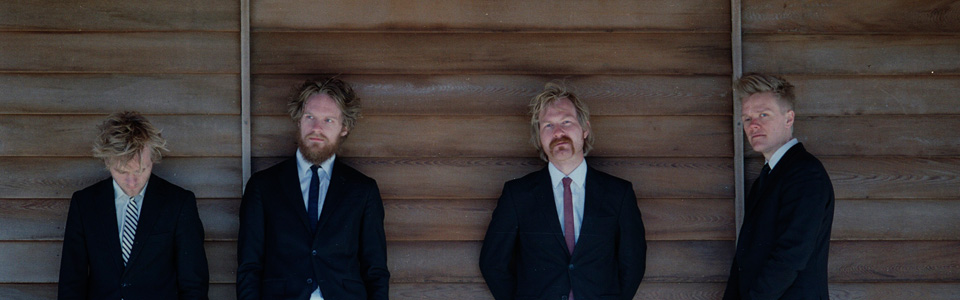
Danish String Quartet (Frederik Øland, Rune Tonsgaard Sørensen (violins), Asbjørn Nørgaard (viola), Fredrik Sjølin (cello)) – Wigmore Hall, live on BBC Radio 3, 23 March 2015.
Listening link (opens in a new window):
http://www.bbc.co.uk/programmes/b05mqmkv
on the iPlayer until 22 April
Spotify
The Danish Quartet are yet to record either of these pieces, so for listeners unable to hear the BBC audio here is a Spotify playlist of the same works from the Lindsay Quartet (Haydn) and the Aviv Quartet (Shostakovich) – two fine versions:
What’s the music?
Haydn – String Quartet in C major Op.54/2 (1788) (20 minutes)
Shostakovich – String Quartet no.9 (1964) (25 minutes)
What about the music?
[PIC]
As my concert-going companion remarked, Haydn string quartets are always used as curtain openers, which can be something of a shame, as they are always performed when the quartet is at its ‘coldest’. This particular work, seemingly written for the violinist Johann Tost in 1788, can not be allowed to fall into that category, for the first violinist has a lot of demands made on him right from the start.
As with many Haydn works this quartet is deceptive, for it has the routine layout – yet tinkers with the overall design of a conventional string quartet. The first movement is a lot faster than it would be normally, while the second movement (the slow movement here) runs straight into the third (a minuet), a tactic very seldom witnessed. Not only that, the last of the four movements is predominantly slow.
Shostakovich’s most private thoughts went into his string quartets, which often convey the intense fear and claustrophobia he felt with the authorities seemingly poised to knock on his door in the middle of the night, ready to remove him forever for his supposedly rebellious musical tendencies. Ultimately he found ways of expressing himself in a private musical code, and the string quartets were especially vivid at using that.
Yet his ninth published string quartet is much more positive in mood than most, seemingly gathering itself to renounce the fear and stand confidently on two feet. As the Wigmore Hall program note states, this may have been due to the composer’s recent marriage – his third – and the slight ‘thaw’ in relations that was allowing him to revive the previously out-of-bounds opera Lady Macbet of the Mtsensk District.
Performance verdict
How refreshing to hear Haydn played with the energy the Danish String Quartet gave it in this performance. All too often these quartets sound too polite, but this account was a good reminder of Haydn’s innovations in the form, and in the way he makes this piece sound a bit like a miniature violin concerto. First violinist Frederik Øland was up to the job.
The Shostakovich was even better, given a depth of feeling and range of colour that suited the piece perfectly. Whereas some of the composer’s quartets are very closed in this felt like a positive, outgoing experience, standing tall in the face of the horrors of the time. Particularly effective was the Rossini-like polka that danced manically, while the slower sections – and in particular the quotes from Musorgsky’s Boris Godunov – were beautifully handled.
The quartet’s ensemble playing was superb, and their togetherness and positivity were two standout features of a superb concert.
What should I listen out for?
Haydn
1:49 – the first movement, unusual in the composer’s output for being marked Vivace (lively). The Danish Quartet enjoy its contours – particularly first violinist Frederik Øland, who has a challenging part!
8:14 – the mood turns sombre (and the key changes from C major to C minor) for the slow movement. Again the first violin starts to take the lead but sounds a bit absentminded against the long, slow chords from the other three instruments. This moves straight into…
11:27 – the Menuetto, an injection of pace and poise, with a typically upbeat theme from the composer. This is in direct contrast to the Trio section, from 13:03, with its discords. The texture is surprisingly full here for four instruments. The Menuetto reappears to put things right at 14:01, as though nothing had happened!
15:06 – a solemn introductory theme, which turns into a thoughtful and deeply felt Adagio. Very unusual for a slow movement to appear last in a typical four-movement quartet structure in the eighteenth century…and yet there is fast music to come, from 19:54 as the music scampers away…only to return to its previous slow tempo, on which it ends at 22:12.
Shostakovich
This quartet runs continuously but is in five distinct sections / movements:
24:48 – an airy beginning, with hints of unease from the inner and lower parts. The second violin is playing a theme associated with Pimen in Musorgsky’s opera Boris Godunov. A light dance is played out and an air of tranquillity takes over. Yet even here, as the upper parts circle, nervy thoughts lurk in the shadows. Then we move to the second ‘movement’…
…at 29:05. A romance in all but name with happier thoughts, possibly inspired by the composer’s recent marriage (his third). The harmonies are lush here, and after some thought the tempo begins to increase…
..to 33:24, where a polka starts up, and the rat-a-tat rat-a-tat rhythm – a quotation from Rossini’s William Tell Overture – begins to obsessively take hold. A furious energy is unleashed, brilliantly captured by the Danish Quartet, who keep an appealing roughness around the edges when the music is most fractious. The instruments converse with some of these melodic figures.
37:13 – the music takes on a mood of deep thought, but is wrenched from its reverie by violent pizzicato (38:09), a tactic used several times to unsettle the listener, before a piercing and unnerving violin cadenza briefly takes centre stage.
40:38 – the substantial final movement starts with a jolt, the music thrown forwards like a car starting suddenly. Having started this mad push forwards Shostakovich has to keep it going, and does to with some emphatic and blustery unison passages for two or more instruments of the quartet. Powerful lines on the cello are compromised by what can only be described as ‘scrubbing’ from the persistent second violin. Shostakovich’s sardonic humour makes itself known through ‘glissandi’ (where a note slides in pitch, mostly upwards in this case!), before an emphatic finish.
Encore – Nielsen – Mit hjerte altid vanker arranged by the Danish String Quartet second violinist Rune Tonsgaard Sørensen
52:40 – Chosen to celebrate 150 years since the Danish composer’s birth, this is a short but sweetly voiced chorale lasting just under two minutes.
Want to hear more?
As the Danish Quartet mentioned, their compatriot Carl Nielsen is in an anniversary year, born 150 years ago – and the foursome have recorded his complete string quartets, not often heard but here on this album on Spotify:
For more concerts click here


