
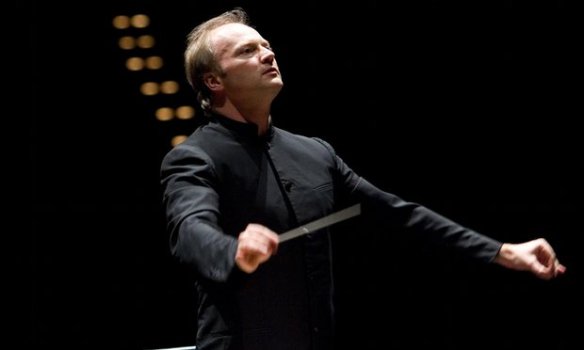
Friendly Fire – Shakespeare 400: London Symphony Orchestra / Gianandrea Noseda

gianandrea-nosedaFriendly Fire – Simon Trpčeski, London Symphony Orchestra / Gianandrea Noseda (above)

Barbican Hall, London; Thursday 25 February 2016

Welcome to Arcana’s new ‘alternative’ reviews slot! It is an ‘ask the audience’ feature – where I (Ben Hogwood) take a friend / colleague to a classical concert and get them to review it in the bar afterwards. Our second ‘reviewer’ in the series is John Earls, a family man from Harrow & Wealdstone who works as Head of Research at Unite. He shares his thoughts on a program of music inspired by ‘Shakespeare 400’ – with works by Smetana (Richard III), Tchaikovsky (Romeo and Juliet), Richard Strauss (Macbeth) and the seemingly unconnected Piano Concerto no.2 by Liszt. The artists are pianist Simon Trpceski and the London Symphony Orchestra under newly announced guest conductor Gianandrea Noseda.

john-earls

Arcana: How did you prepare for this concert?

John: I didn’t do that much in the way of preparation, other than see what the four pieces in the concert were, and whether I was familiar with them. At the time the only one I thought I was familiar with was the Tchaikovsky, but you reminded me I had heard the Liszt before.

What was your musical upbringing?

As a young child, pretty limited. Most of the music I heard from my parents would have been Irish music, then as I went through school I was more exposed to bits of classical music, as I learned the clarinet. In my teens I got more into contemporary music, rock music, new wave – I played in my own band – and became more interested in jazz and classical music as I got older and attended more concerts and read more about those particular types of music. Jazz and classical are the forms of music I listen to most now.

Name three musical acts you love and why:

(almost without hesitation): Miles Davis was a trailblazer and an innovator who has done some very different things throughout his career. He also struck me as a great leader of bands and ensembles, because he was a great talent spotter who pulled some phenomenal musicians together, and it always struck me that anybody who played with him was better for the experience. They tended to be either better musicians or composersafter having gone through the Miles Davis experience, and also his ensembles tended to be greater than the sum of their parts.

I would also go for Christy Moore, who in many ways would be the soundtrack to my development and my life. I think he has a huge amount of integrity, and if you listen to him sing he comes across as somebody who really means it. If you see him performing live you see a gifted songwriter but also somebody who has a mission to transmit the songs he knows. He has a great deal of songs he hasn’t written but he is able to communicate and pass them on.

I should pick a band really…Wire. I saw them last year for the first time in around 30 years, at the Lexington near Kings Cross. They were influential in my formative days in the late 1970s / early 1980s. They were innovative and straddled the artistic side with the punk sensibility, but had the credibility of doing what they wanted to do. To release an album like they did last year nearly 40 years after they first started, and to think they can still do it, was a phenomenal achievement. They are still great live and the songs incredibly well crafted.

Have you been to classical music concerts before, and if so what has been your experience?

I’m not sure I fit your criteria of ‘someone who doesn’t normally attend a classical concert’. I’m actually a regular classical concert goer – all forms and types. Living in London I’ve been able to see some of the finest musicians and orchestras in the world. Many of my most treasured musical moments have been at ‘classical music’ concerts – Mitsuko Uchida playing Schubert’s late piano sonatas, Rattle and the Berlin Phil doing Mahler’s Resurrection Symphony, Steve Reich’s Music for 18 Musicians with Reich himself playing. I also think some pieces are best experienced live – Messiaen’s Turangalila, for example. Had a few disappointments too! But live music is really important to me. 

What did you think of the Smetana?

I thought it was OK – I could see why they had used it as a piece with which to start. Would I have got the Shakespeare connection? Probably not, but having known it I could see there were bits that sounded regal. Some bits reminded me of a royal hunt, with lots of trumpet. Some of it was like a fanfare but there was solo trumpet that was quite ‘angsty’ and personal. I suppose the trumpet has royal connections. Those things came into my mind while I was listening but I’m not sure, as a piece of music, I would be in a huge hurry to listen to it again.

What about the Liszt?

I hadn’t remembered that I had heard it before. I quite enjoyed it, but there were parts where the pianist seemed a bit stroppy and belligerent, reminiscent of Jerry Lee Lewis! I enjoyed it a bit less than I thought I was going to but the thing that did stick out for me was the cello (Rebecca Gilliver’s solo in the third movement – ed). The sound was absolutely beautiful.

What about the Tchaikovsky?

I was more familiar and knew what to expect. I wasn’t used to being that close to the orchestra! If you heard those four pieces of music and was told there was a Shakespeare link to be honest I probably couldn’t have noticed it, but the one that would be most likely would be that one – and you would probably think Romeo and Juliet because of the tragedy, the romance and the action. You almost feel like you’re in a Bond movie! It’s got everything in it, around 16 minutes, it packs it all in, and it’s Tchaikovsky, who I love.

Finally, what about the Richard Strauss?

I thought that was a good piece to finish on. It had a range of things. I don’t think I would have thought Shakespeare but it was more personal in that it was not necessarily a narrative story – you’re inside somebody’s head. I’ve got ‘magisterial’ written down here, and I felt there was a real tension in it. The offstage snare drum was great, I always like that use of the space, and I’ve not heard the percussion played like that before (the tam tam I think! – ed)

It was more psychological I think, and it was only in that piece that I noticed Noseda’s score was tiny, I’ve never seen one so small! I enjoyed the music, and would go back to listen to it again. I didn’t realise Strauss was 24, that’s quite a phenomenal achievement – not only to put all the instrumentation together but to get the psychological elements at that stage, you would think only an older composer would manage that.

What about the environment and setting of the concert, and how it was promoted?

The only PR I’ve seen was the Shakespeare-related things, and I couldn’t see the link with the Liszt, but I like the idea of linking things in. Sometimes it can be a bit contrived but I think if it’s used as a technique to expose you to different bits of music then that’s fine – like Romeo and Juliet – and it worked for me in the case of the Strauss but not the Smetana.

I think they got the range and order of the pieces right. I’ve been to the Barbican as a venue, and I do like the way it works with an instrument offstage, like they did with the Strauss. I’ve seen that done with vocal and choral pieces and it can work. I think the conductor was quite energetic, not necessarily in a flowing way – quite staccato would be your terminology! There seemed a good rapport between him and the orchestra, the sense they really respect him.

If you could give it a mark out of 10 what would you give?

Probably a 7, but that would be an average. The Tchaikovsky and the Strauss would be an 8 or 9, and the Smetana would drag it down a bit. But it was certainly worth going to!

Arcana’s brief thoughts on the concert:

The connections between classical music and Shakespeare are many, but the London Symphony Orchestra did really well to present a variety of nineteenth century settings. All fall into the ‘Romantic’ period, where composers were getting to grips with the idea of the orchestra being a storyteller in what was known the ‘symphonic poem’.

Smetana’s Richard III was an ideal curtain opener, though like its subject it had an uneven walk – brilliantly portrayed but still with a sense of a portrait not quite fully fledged.

Tchaikovsky’s Romeo and Juliet was different. This was the London Symphony Orchestra on white hot form, Gianandrea Noseda conducting like a man wholly affected by the tragedy. This music surged forward with passion and drama in equal measure, and the hair stood up with the volley of brass and percussion, and the intensity of the love theme on the strings.

Richard Strauss’s Macbeth was equally intense, though even more effective in exploring the minds of the two main protagonists of the story. The lower strings had a steely effectiveness, the double basses brilliantly marshalled, while the drama above unfolded in compelling fashion.

Though Liszt’s Piano Concerto no.2 had no Shakespearian connection it was a relatively sound choice, for he is a composer unable to resist the temptation of telling a story! This one had its moments of drama, albeit fleeting in comparison to the warhorses of the second half.

Wigmore Mondays – Denis Kozhukhin – Out of Doors

denis-kozhukhin
Denis Kozhukhin (piano)

Wigmore Hall, London

Monday, 22 February 2016

Audio (open in a new window)

http://www.bbc.co.uk/programmes/b071774c

Available until 24 March

What’s the music?

Haydn – Piano Sonata in D major, HXVI:24 (1773) (10 minutes)

Brahms – Theme and Variations in D minor (1860) (10 minutes)

Liszt – Benediction du Dieu dans la solitude (1847) (16 minutes)

Bartók – Out of Doors (1926) (14 minutes)

Spotify

Denis Kozhukhin has recorded the Haydn sonata but not any of the other works in this repertoire. In case you are unable to hear the radio broadcast the below playlist contains legendary recordings of the Brahms (Radu Lupu), the Liszt (Claudio Arrau) and Andreas Haefliger’s account of the Bartók:

About the music

Haydn is acknowledged as the godfather of so many forms that became the norm in classical music from the late 1700s onwards. As well as the symphony and the string quartet, he left a great body of piano sonatas that are fresh, original and ground breaking. Later examples from Beethoven and Schubert would surely not have been written were it not for works such as the D major example here.

The Brahms Theme and Variations is actually an arrangement of the second movement of his String Sextet no.1 – and transcribes for piano effortlessly, so much so that the listener would think it was a piano original. This was in order for it to be played by Clara Schumann, who received the score as a forty-first birthday present in 1860.

Liszt wrote his Benediction as part of a cycle of ten pieces for piano called Harmonies poétiques et religeuses in 1847. It is a relatively long, single span of contemplation, and in it the composer writes music that could be seen as an early pointer towards the so-called ‘impressionism’ of Debussy and Ravel. So often known for writing barnstorming piano pieces, Liszt takes his foot off that particular pedal for once.

Liszt’s fellow Hungarian Béla Bartók wrote his short set of five pieces, Out of Doors, in 1926. As its name suggests it is a celebration of the Hungarian countryside, by raucous day – pipes, drums and chases – and by atmospheric night, where the sounds of amphibious creatures can be heard in some of his exquisite nocturnal picture painting.

Performance verdict

From this concert it is very clear that Denis Kozhukhin is a special talent. The well-designed hour of music moved almost seamlessly from the simplicity of Haydn to the brazen antics of the Bartók with almost no join.

Kozhukin’s Haydn was lovely, the D major sonata receiving an airy performance with plenty of rubato – which means a stylish way of letting the music breathe – so that the rhythms were not too rigid.

The Brahms was similarly magical in the quieter passages, allowing Kozhukhin to use an imposing tone when the music returned to the minor key. This was a performance flying in the face of the obvious technical difficulties presented by the composer – and the same could be said for the Liszt, reaching moments of hypnotic beauty in its outer sections.

Kozhukhin took his time here, creating and maintaining the mood of contemplation, holding the atmosphere while easily managing the fiendishly difficult writing for the right hand. In the Bartók he found a good balance between percussive power and the primitive, folksy material that the composer brings to the surface. As a result Out of Doors felt like a celebration, entertaining and energetic, but with an added chill to the night pieces.

What should I listen out for?

Haydn

1:10 – the piece starts with a flourish in the right hand, one that recalls the sonatas of Scarlatti – as BBC Radio 3 announcer Fiona Talkington points out. It is a fresh tune that twinkles with the accompaniment that Haydn chooses, with very little bass. As is customary the first section is repeated (2:14) before at 3:20 Haydn starts to develop his main idea, moving it around harmonically. This is brief – as at 4:25 we hear the main idea again.

5:47 – the slow movement, which is immediately quite sombre and preoccupied. It is in the style of an aria, as though an imaginary singer were taking the line Haydn gives to the right hand. It is a brief but poignant movement, lost in thought towards the end. Haydn emerges from the quiet mood, leading straight into…

8:54 – the last movement, a short structure bright in tone and with an amicable tune. The end is rather nicely done.

Brahms

11:44 – Brahms begins with a grand statement. The first statement of the tune is given to the right hand, while the left plays arpeggiated chords. It is a big tune – and the first of six variations starts at 13:09, still in the minor key. By 15:38 the music is worked up and full of darkly coloured passion, but then Brahms slips effortlessly into the major key and a lighter outlook (16:54), from where Kozhukhin leads to a radiant variation. At 20:04 the austere minor key returns, but Brahms still finished in the major key, settling the strife experienced earlier.

Liszt

22:35 – Benediction du Dieu dans la solitude (God’s blessing of solitude) is a radiant performance of a piece that begins with a very long melodic phrase. It is quite unusual for Liszt in having very few moments of fire and brimstone, and instead achieves a kind of ecstasy of contemplation. The key – F sharp major – is key to this, the black keys somehow much more mystical than the white on this occasion! There are two central sections – both calming influences (28:39 and 30:58) before the original material returns (32:28). We hear all three tunes before the piece closes softly.

Bartók

39:03 – With Drums and Pipes – an exuberant if heavy start, low on the piano. This is almost an early precedent of rock music with its pounding rhythms!

40:40 – Barcarolla – a slower dance that flows nicely but which sounds uneasy, as though the direction of the boat on the water is uncertain.

43:10 – Musettes – this is rustic, dance-based material, where a lot of the tunes sound as though they are packed with wrong notes (they aren’t!) It makes them strangely charming.

46:05 – The Night’s Music – a classic example of a Bartók night setting. The music closes in on itself, and in the distance some animal / insect noises can be heard, disturbing the night’s piece when they get closer or make sudden noises, such as when Kozhukhin slams the upper end of the piano. It is an atmospheric and highly descriptive piece of music, and more than a little eerie as the sounds persist, seemingly stopping any chance of sleep.

51:11 – The Chase – a bruising encounter with the hands seemingly all over the place on the keyboard. The rhythms are deliberately inconsistent as the music hurries along, with great dissonance and surprises in both parts.

Encore

54:35 – the first encore is a sonata from Domenico Scarlatti – a relatively slow one that makes much of a trill in the right hand. It was published as Kk247 and lasts four minutes…after which point (at 59:01) we hear another sonata, this time from the Spanish composer Antonio Soler – a brighter example in D major – just the two minutes.

Further listening

At the bottom of the playlist you can hear the original Brahms Theme and Variations, written as the second movement in his String Sextet no.1. You can then hear another set of variations – on a theme of Haydn – as well as trying to second guess where Liszt was heading, in the direction of Ravel’s Jeux d’eau! Finally some more Bartók – his three movement Piano Sonata, just as raucous and unhinged as Out of Doors. Listen below:

Wigmore Mondays – Elizabeth Watts and Julius Drake

Elizabeth Watts, Photo : Marco Borggreve

Elizabeth Watts, Photo : Marco Borggreve

Elizabeth Watts (soprano), Julius Drake (piano) – Wigmore Hall, London, live on BBC Radio 3, 26 October 2015

Listening link (open in a new window):

http://www.bbc.co.uk/programmes/b06kb0f0

on the iPlayer until 25 November

Spotify

In case you cannot hear the broadcast, here is a Spotify playlist of the music in this concert, from available versions on Spotify (which do not include the Liszt song Quand tu chantes bercée).

What’s the music?

Liszt: 6 settings of poetry by Victor Hugo (dates are for first versions only): Enfant, si j’étais roi (1849); S’il est un charmant gazon (1844); Comment, disaient-ils (1842); La tombe et la rose (1844); Quand tu chantes bercée (c1844-45); Oh! quand je dors (1842) (21 minutes)

Debussy: Ariettes oubliées (1885-1887) (17 minutes)

Hahn: 4 Hugo settings: Rêverie (1888); Si mes vers avaient des ailes (1888); L’Incrédule (1893); Fêtes galantes (1892) (9 minutes)

What about the music?

A recital bringing together some richly varied settings of two French poets, Victor Hugo and Paul Verlaine.

It also gives us the opportunity to listen to some of the large output of Franz Liszt, who is best known for his piano music but whose songs have enjoyed greater prominence in recent years. He and the poet Victor Hugo were friends, meeting in Paris in the 1830s, and Liszt went on to set a number of his poems to music.

Debussy’s Ariettes oubliées (Forgotten Songs) is a cycle of six songs for voice and piano, based on a poem written by Paul Verlaine, who the composer knew and whose verse was a profound influence throughout the composer’s career.

We return to Victor Hugo for several settings by the Venezuelan-born French composer Reynaldo Hahn, who is best known for his song settings. This group of four includes Si mes vers avaient des ailes, the song that really brought Hahn to public attention and which, in the words of Graham Johnson, ‘has become his motto song’.

Performance verdict

A note first of all to say Arcana did not attend this concert, so the review is directly from the radio performance.

What is abundantly clear is that Elizabeth Watts is becoming a soloist of real repute, and one who has a very impressive and diverse repertoire. It was especially gratifying to hear her accounts of the Hugo settings by Liszt, not heard much in the concert hall but invested with real passion here, Watts floating effortlessly through the high notes as Julius Drake set the scene. Drake is an experienced pianist in Liszt songs, and is in the process of recording his output for Hyperion – and his ability to find the detail to point up alongside the vocal line was a real asset.

The Debussy had an essential mystique that Drake was quick to create in his piano part, Watts controlling her voice wonderfully well in the tricky melodic intervals. Meanwhile the Hahn selection sparkled, showing off this composer’s flair for word setting as well as the natural chemistry between Watts and Drake.

What should I listen out for?

Liszt

1:57 Enfant, si j’étais roi (Child, if I were king) translation here – a typically grand setting from Liszt, with a big piano part, while the soprano sings boldly above. A brave piece with which to start a recital! In the second verse the piano adopts a more threatening bass line as the soprano extols the virtue of a kiss from her lover.

5:13 S’il est un charmant gazon (If there’s a lovely grassy plot) translation here – a more gentle and loving song, this, with a similar mood to the opening of Brahms’ Violin Sonata no.2. The music flows with a mood of relative contentment.

7:41 Comment, disaient-ils (How then, asked he) translation here a nervy piano accompaniment immediately puts this song on each, though the floated higher vocal counters that somewhat. This is a short song but the high note at the end from the soprano carries a lasting impact.

9:49 La tombe et la rose (The tomb says to the rose) translation here This time we hear the soprano in a much lower range and with a fuller voice as Liszt takes on the much heavier text. There is weight in the piano part, too, though here as with a couple of the other songs it feels like Liszt has a short attention span.

13:44 Quand tu chantes bercée (When you sing in the evening) translation here This song has much softer contours, with a restful piano part and a relatively smooth vocal line for the soprano. That is not to say passion is lacking though, especially when the soprano sings ‘Chantez, ma belle’ (‘Sing, my pretty one’)

16:17 Oh! quand je dors (Oh! When I sleep) translation here As the title suggests here is a lullaby, though this one doubles as a love song. Again the soprano has to sing high, especially given the passion of Hugo’s text. The piano immediately sets the scene of rapture.

Debussy

The words for Ariettes oubliées are here

24:12 – C’est l’extase langoureuse (It is ecstasy) A heady song as you might expect from the title, which hangs on the air heavily. This whole impression is helped by Debussy’s chromatic writing, with soprano and piano right hand often in unison. The rich harmonies and melodies might sound awkward in isolation but, in a performance such as this, they are totally natural.

27:28 – Il pleure dans mon cœur…(It weeps in my heart) One of Debussy’s most celebrated early songs, delighting – or finding sorrow, rather – in the sound of the rain ‘on the ground and on the roofs’. A wide range is called for on the part of the soprano, not to mention the restless yet easily flowing piano part.

30:28 – L’ombre de arbres (The shadow of the trees) ‘The shadow of the trees, in the mist-covered river’ find the soprano beginning in a lower range, the air thick with humidity. This is a more sorrowful lament, the piano essentially standing by while the singer emotes – nowhere more so than the high note of 32:06.

33:14 – Chevaux de bois (Merry-go-round) A brilliant evocation of the fairground, the merry-go-round burling around dizzily on the piano, over which the soprano sings of the hurrying horses. Debussy’s quick moving harmonies are ideally suited to this sort of setting. The song ends quietly.

36:31 – Green A love song. The soprano has to travel quite a way in the course of this song, from low asides to higher outpourings of intense feeling. The twinkling of the piano’s right hand provides an effective counterpoint.

38:36 – Spleen A downcast song, reflecting on how ‘all my despair is reborn’. This does still take place over some exotic harmony on the part of the composer, the song moving far and wide in its melodic and harmonic reach.

Hahn

43:09 – Rêverie – translation here A halting figure on the piano feels like an offbeat waltz, accompanying the soprano as she sings, lingering on the word ‘kiss’. The song is relatively conventional in its structure.

45:11 – Si mes vers avaient des ailes (If my verses had wings) – translation here – a bright and positive love song, the singer clearly lost in thoughts of her beloved – and reaching some beautifully spun high notes along the way, with twinkling piano account. The last notes need particularly impressive control as the music slows.

47:52 L’Incrédule (The Sceptic) – translation here – a softly coloured but rather moving song, which has its conviction in the last lines, where the singer declares ‘And my faith is so deep in all that I believe in that I live for you alone’

50:11 Fêtes galantes – translation here – one of Hahn’s most endearing songs to close, the sparkling piano introduction keeping a detached feel as the singer spins higher notes above. The ‘shivering breeze’ is brilliantly evoked in the piano.

Encores

53:32 An encore of a Victor Hugo setting, L’Attente, (1840) from Richard Wagner. As Elizabeth Watts says to the audience, it’s not exactly easy – whether it’s the full bodied, high register vocal or the heavily congested piano part!


Further listening

Something completely different to complement Elizabeth Watts’ artistry, and also to show just how versatile she is. This is a recently released album of vocal works by the Baroque composer Alessandro Scarlatti, given with The English Concert and Laurence Cummings:

https://open.spotify.com/album/1Crx7DHWHCAqV7za0K80oX


Louis Schwizgebel

BBC Radio 3’s New Generation artist Louis Schwizgebel gives a live recital of piano works by Haydn, Chopin and Liszt

Louis SchwitzgebelPhoto © Caroline Doutre

Louis Schwizgebel – Wigmore Hall, live on BBC Radio 3, 23 February 2015

Listening link (opens in a new window):

http://www.bbc.co.uk/programmes/b05302mn

on the iPlayer until 24 March

For non-UK listeners, this Spotify playlist is available:

For those unable to hear the broadcast I have put together a Spotify playlist. Louis has not recorded this repertoire, so I have chosen suitable available versions:

What’s the music?

Haydn – Piano Sonata in E flat major (1789-90) (19 minutes)

Chopin – Ballade no.3 in A flat major (1841) (7 minutes)

Chopin – Étude in C# minor (1836) (5 minutes)

Chopin – Waltz in C# minor (1847) (4 minutes)

Chopin – Fantaisie-impromptu in C# minor (c1834) (4 minutes)

Liszt – Consolation no.3 in D flat major (1849-50) (4 minutes)

Liszt – Hungarian Rhapsody No. 6 in D flat major (c1863) (6 minutes)

What about the music?

This is a cleverly structured recital taking in three giants of the piano.

Schwizgebel begins with Haydn, godfather of so many musical forms – and one of the first composers to start writing what became known as the mature piano sonata, in three movements. His examples in the form – many written like this one for the palace of Esterházy in Hungary – show good humour and a delicate touch. This work, not often heard in concert, fits the bill nicely as an opening piece.

Schwizgebel’s Chopin selection is carefully structured so that the keys fit – moving from A flat major for the Ballade into C# minor for the three other works. The Ballade is a form in which Chopin made very personal expressions but which also allowed him the chance to experiment formally. The three works following are an unusually profound Etude (Study) – which sounds technical but is far from dry, shot through with characteristic Chopin melancholy. The Waltz is more playful, coming back to the same theme again and again, while the freeform Fantaisie-Impromptu makes the most of its freedom.

Liszt was a barnstorming virtuoso – the piano equivalent of Jimi Hendrix, you could say! – but he had his sensitive side too, as the Consolations show – and this one selected is a tribute to Chopin himself. It is a thoughtful example, leading to the fire and brimstone of the Hungarian Rhapsody no.6, given the natural inflections of the music of Liszt’s own country before a helter-skelter coda.

Performance verdict

Schwizgebel is a thoughtful Haydn pianist, and gives a rather touching performance of the slow movement in particular. He is commendably modest in performance, preferring not to go for the demonstrative approach, but instead letting his playing do the talking. The Chopin selection is excellent, very well played, losing a little rhythmic definition in the climax of the Étude but trumping that with a dazzling Fantaisie-impromptu.

The Liszt could perhaps have done with more of the reckless bravura you get in the Hungarian Rhapsodies, a sense of living right on the edge. That said, the closing pages are brilliantly played, the octaves written for the right hand immaculately delivered.

What should I listen out for?

Haydn

4:19 – a matter-of-fact start to the first movement, with a slightly gruff accompaniment to the tune. Yet Haydn’s easy charm is soon in evidence, despite the left hand having to work pretty hard in accompaniment!

11:14 – the second movement begins, headed by a graceful melody, as if assigned to a singer. Then, later on, it nearly stops as the right hand melody gets lost in thought before ambling to an easy close.

19:46 – a typically perky Haydn finale, nicely proportioned and sensitively played here.

Chopin

24:36 – the Ballade no.3 – beginning with an attractive introductory theme before the music assumes the profile of a waltz (from 26:27). Schwizgebel takes this slower than a lot of pianists, with a delicate approach – allowing greater contrast for then the music appears again, much more forcefully, at 27:20. At 29:35 a shadow falls over the music and it becomes more fraught as it moves into a minor key – C sharp minor, which is the key for the next three works in the recital. The Ballade’s main theme comes back at 30:57 before the closing passage.

31:52 – the Étude in C# minor, numbered 7 in the second book of studies Chopin published as his Op.25. The left hand takes the lead with a rising theme, and sets the melody throughout in what is a deeply intense piece, the longest of Chopin’s Études.

37:25 – the more playful Waltz in C# minor, published as Op.64/2, characterised by a sparkling theme high up in the piano’s register. This returns frequently to trump the underlying melancholy in the music, and the player has the chance to play around with the speed to give the music more ebb and flow. A contrasting section (38:28) brings a ray of light in the middle.

40:35 – the Fantaisie-Impromptu, a freeform piece where the floodgates just open! A torrent of notes form the main theme, wheeling up and down the keyboard, before taking the foot off the gas for a sweetly toned second theme (41:31)…which segues neatly back to the river of notes again (43:24)

Liszt

46:02 – the Consolation in D flat major, one of a set of six. Intimate and romantic, especially in this performance.

50:07 – the Hungarian Rhapsody no.6 begins with a drone and a rustic tune, very controlled in this performance, which takes some nice liberties with the tempo, holding back where necessary. There is some dazzling virtuosity as the piano then unfurls a variation on that melody before a solemn second theme (51:50) makes itself known. At 54:01 the final section starts with a melody played in octaves, which soon works to a thunderous climax (55:33).

Encore

57:36 – Moszkowski’s Étincelles (1886) – a showpiece from the Polish composer, with some brilliant runs up and down the keyboard as well as some sharply pointed notes. Schwizgebel dispatches it very impressively, with a wonderful throw-away finish!

Want to hear more?

Haydn’s humour makes for lovely music to work to – and a personal favourite is his C major sonata.
Chopin’s Ballades reward repeated listening – so after the intimate Third I would recommend the stormier Fourth – with the calm of an A minor Waltz and the famous Raindrop prelude completing a very attractive selection.

For Liszt with real depth the Vallée d’Obermann can be strongly recommended as a powerful utterance.

All these are collected on a Spotify playlist, below the repertoire played by Schwizgebel:

For more concerts click here