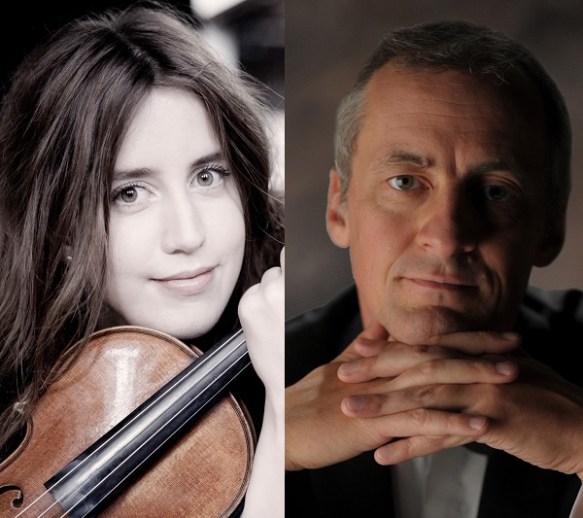
Vilde Frang (left, violin), Aleksandar Madžar (right, piano)
Bartók Violin Sonata no.1 (1921) (33 minutes)
Schubert Fantasy in C major D934 (1827) (21 minutes)
Listen to the BBC Radio 3 broadcast here, until 16 November
Arcana’s commentary
It is easy to see why Vilde Frang is held in such high regard. This contrasting program of Bartók and Schubert showed a steely side to her playing in the former, but also a purity of tone that could be easily appreciated throughout.
These qualities served her well in a powerful rendition of Bartók’s massive Violin Sonata no.1, but she could not have made this impact without Aleksandar Madžar’s superb piano playing, notable for its clarity and rhythmic precision.
Bartók and rhythm are inseparable, and the hold that folk music has on his compositions was all too clear in the syncopations and cross rhythms that Frang and Madžar exploited here. The angular tunes of the first movement (first heard at 2:07) had an assertive mood, brilliantly played.
Richard Bratby’s excellent program note reminded us how modern the music must have sounded in 1922, when Bartók himself played piano with violinist Jelly d’Aranyi, who became an important creative muse. Frang and Madžar powered through the first movement, making light of its technical difficulties, but in the second movement time stood still. Frang’s sweet but thoughtful tune, initially heard alone (from 14:26), was complemented by a solemn and mysterious chorale from Madžar (16:00), the two forces gradually aligning but still lost in a distant world.
The finale arrived with a flourish (25:15), both performers tackling it with some relish and achieving a remarkable unity of ensemble at the end (from 32:30), finishing with a terrifically spicy, bluesy chord.
Schubert’s Fantasy in C major can seem like a long piece in the wrong hands, but here it came alive. Completed in the last year of his life, it is conceived in a single span of four distinct sections, and is a very original piece of writing. Balance between the violin and piano is key, and this was spot on for the moving opening statement, where Madžar had a lot of work to do but was always responsive to Frang’s soft intonation (from 37:09)
A bracing Allegretto section (from 40:23) led to the centrepiece, a Theme & Variations (45:44) The origin of the theme, a Schubert song, was abundantly clear in this lyrical performance, while there was some sparkling playing from Madžar as the variations took hold (try 48:57) This flair and musicality continued to the return of the soft first movement theme, now shaping up in the finale (52:36), an emotional reunion in these hands before a convincing finish (from 57:40).
This was a superb concert, affirming Vilde Frang as one of the best violinists of her generation on the concert circuit, but also illustrating just what a fine pianist Aleksandar Madžar is too. Hear this if you can!
Further listening
You can hear more of Vilde Frang in an early album recorded for Warner Classics with Michail Lifits. Here she brings a sunny tone to violin sonatas by Grieg (no.1) and Richard Strauss, full of youthful exuberance, while there is more Bartók in the form of his Sonata for solo violin, a tour de force:
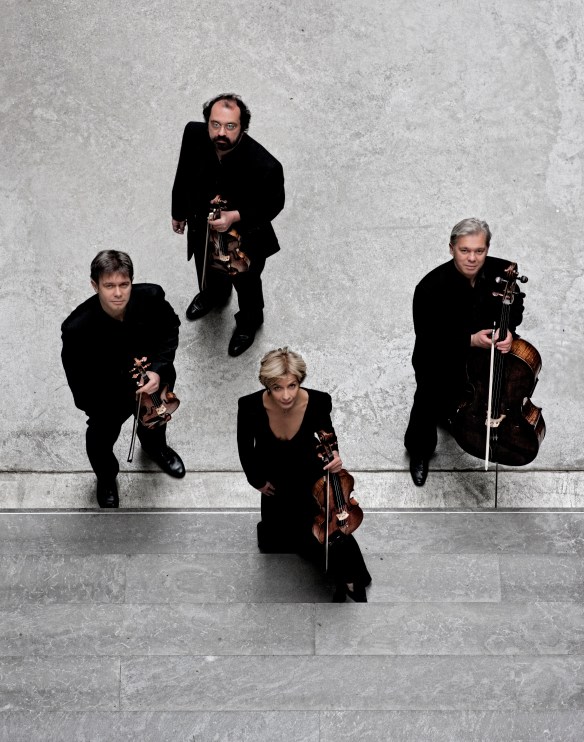
Lukas Hagen, Rainer Schmidt, Veronika Hagen, Clemens Hagen (f.l.t.r)
Hagen Quartet Photo (c) Harald Hoffmann
For this performance, Veronika Hagen had to miss out with a shoulder injury. The line-up was therefore Lukas Hagen and Rainer Schmidt (violins), Iris Hagen-Juda (viola) and Clemens Hagen (cello)
Schubert – String Quartet in G major, D887 (1826) (55 minutes)
Spotify
In case you cannot hear the broadcast, the Hagen Quartet’s recording of this work can be accessed through Spotify on the playlist below:
About the music
Schubert’s last quartet remains shrouded in secrecy. It is however another illustration of the ‘late’ Schubert’s ability to write at tremendous speed. ‘Late’ Schubert of course is the composer in his very late twenties, dogged by illness but still able to write a large string quartet such as this in a mere ten days.
He did not hear it in his lifetime, for the first performance did not take place until 1850 in Vienna – at which point the audience will no doubt have been surprised to note that the first movement, clocking in at well over 20 minutes, is the size of many Haydn quartets. It is classic late Schubert, finding its own sweet time but containing some extraordinary music of poignancy and depth.
It eclipses in size Schubert’s previous biggest quartets, known as the Rosamunde and Death and the Maiden respectively, but it goes further in exploring Schubert’s near-obsession with the conflict of major and minor mentality. The piece is listed as being in G major but often spends time in the minor, creating an exquisite tension resolved only in the final moments.
Performance verdict
Quite simply an outstanding performance from a quartet wholly inside the music. The Hagen Quartet kept extremely concentrated levels of performance throughout a gripping drama that took hold of the listener from the first moment and did not let them go.
The tension of the first movement never let up, its major-minor arguments sustained at an impressive level of intensity, but the second movement introduced more raw emotion in the form of Clemens Hagen’s yearning cello solo. The bubbling scherzo gave a little respite but in the finale the group restored Schubert’s tense arguments, never allowing one to dominate, holding the conflict firm.
They also reminded listeners of just how expansive Schubert’s quartet-writing had become, to the extent that some passages sound like a small string orchestra rather than four players. That the Hagens managed to do this without full-time viola player Veronika
What should I listen out for?
2:27 – the quartet begins and immediately sets out the idea that will give it extreme tension over the next 45 minutes. Here – and seemingly throughout – the music alternates between major (the very beginning) and minor (2:32), the listener torn between happy and sad and never quite sure which is which.
A certain amount of piece descends with the first theme proper from the violin at 3:09, given over hushed tremolos in the other three instruments.
At 6:36 the cello takes over with a beautiful theme, if somewhat hesitantly written in by Schubert. Then at 8:40 the quartet observe Schubert’s instruction to repeat the music from the beginning. From 14:58 the quartet slow the pace a little, giving the main tune a more graceful impression, but the tense movement in the other instruments takes over once again.
At 18:23 a serene home key is reached, and then the music heads into a more emphatic passage, closing out one of the longest single movements in the quartet repertoire (22 minutes)
26:17 – the second movement, marked Andante un poco moto, is a beautiful though rather sorrowful piece of music, introduced by a sparse chord and then passed over to the cello for a reflective, songful tune. This completely dominates the music, though there are two stormy interruptions (28:01 and (31:41), where Schubert feels more unhinged.
However at 34:11 the music shifts to the major, and for a brief moment all cares are forgotten as a shaft of sunlight comes through.
37:17 – the third movement is a Scherzo, and its scurrying main theme again sets the mood for the whole movement. It acts like the wind picking up stray leaves and whirling them around…before they are set down in the ‘trio’ section, beginning at 40:33, which features a charming melody from the cello which is almost suitable for the stage. This is taken up by the violins. The scherzo section returns in its entirety at 42:55.
45:25 – the last movement reinstates the conflict between major key and minor key, and holds it the whole way through til the end. It starts with the nervy tune, and the backwards and forwards continues in music of a distinctly wary energy. At 46:36 the violin introduces another prominent theme, this one more obviously happy in the major key. Then at 49:36 another melody asserts itself, this one more earthbound and like a hymn.
At 50:24 we hear the main idea of the last movement once again…through until at 55:16, when the hymn-like tune is more profound. The music then arrives at a final, massive two part cadence – completed at 57:20.
Further listening
How to follow one of the biggest works in string quartet literature? Well I’ve tried to go for a mixture of big and small in the additions to the playlist. For small-scale, you can enjoy another Schubert movement for string quartet, the brilliant, self-contained Quartettsatz, as it’s known. On a bigger scale, Schubert’s quartet is often compared and contrasted with his Symphony no.9, known as the Great – and that is noted below:
Schubert – Sonatina for violin and piano in G minor (arr. Rysanov) (1816) (20 minutes)
Leonid Desyatnikov Wie der Alte Leiermann (1997) (14 minutes)
Sergey Akhunov – Erlkönig (2015) (5 minutes)
Dobrinka Tabakova – Suite in Jazz Style (2008) (15 minutes)
Spotify
Unfortunately most of the music in this concert is not available to stream…but there is a violin version of the Schubert that you can hear on the below playlist – which also contains some recommended listening and the originals of the Schubert songs inspiring the pieces by Desyatnikov and Akhunov:
About the music
This is a concert rather cleverly themed on the music of Schubert. Maxim Rysanov, though still a relatively new performer, has already contributed much to the available repertoire for the viola – and some of these contributions are in the forms of original compositions by Brahms and Schubert.
Schubert wrote three attractive Sonatinas for violin and piano, but their titles are misleading as they were applied posthumously. They are actually quite in depth pieces deserving of a bigger audience, and as Rysanov shows the G minor work transcribes nicely for viola and piano.
Russian composer Leonid Desyatnikov works predominantly in film, but wrote Wie der Alte Leiermann, his take on a song from Schubert’s song cycle Winterreise, for viola and piano. Likewise fellow Russian Sergey Akhunov expanded on Erlkönig, one of the composer’s darkest songs, to create a minimalist spectacular.
Finally Bulgarian composer Donbrinka Tabakova, with whom Rysanov has worked closely on an arrangement of a Schubert sonata for viola and orchestra, contributes a freely formed Suite in Jazz Style, where she looks to combine classical and jazz in a way successfully achieved by the likes of Stravinsky, Milhaud and Duke Ellington to name just a few.
Performance verdict
Maxim Rysanov is without doubt one of the finest viola players around, and he cemented that reputation with a series of powerful and passionate performances at the Wigmore Hall.
He has also gained a reputation for imaginative programming, and that was also in evidence, taking the music of Schubert and projecting it into much newer music and influences. This was a more guarded success, for the piece by Desyatnikov felt too long, despite its dramatic profile, and was rather relentless in its cold and downbeat mood. This does imply it was a successful recasting of the Winterreise song, which is hardly sweetness and light itself, but a little more light amongst the shade would have been welcome.
Akhunov’s Erlkönig was more effective as it had more momentum and rhythmic interest, though this too was starting to test the ear and run thinner on inspiration by the time its five minutes came to a close.
Far more involving was Bulgarian composer Dobrinka Tabakova’s Jazz Suite, for it was more obviously fun, as well as being more immediately emotional. There were some clever syncopations and use of the viola to get some truly unusual sounds, and Rysanov clearly warmed to this, in the company of Ashley Wass’s clear but nicely swung rhythms.
The Schubert with which the two began was very well played and carried an urgent dialogue throughout, reminding us that the three pieces in this form are not trifles, as the Sonatina name implies they should be – they are actually really substantial and memorable works.
What should I listen out for?
Schubert
1:28 – a call to arms to begin (marked Allegro giusto by the composer, which becomes a bit more furtive as the piano takes the lead. This is repeated (2:51) and then developed from 4:14 – before a reprise back in the ‘home’ key at 5:12. Mostly the two instruments are equal partners, though they both become obsessed with the three-note figure that dominates Schubert’s thinking. Rysanov’s arrangement for viola lies relatively comfortably under the fingers.
6:55 – a relaxed Andante forms the slow movement, with a nice and simple theme from the viola. Schubert gives it plenty of space, and the whole movement – though relatively short – has a nice airy profile.
12:57 – the influence of Mozart can be more clearly felt in this brisk Menuetto. You would have to look pretty lively if you were dancing three in a bar! The viola is effective when Rysanov drops down an octave to exploit the lower range (e.g.13:48). A trio section (from 13:59) is nicely poised, before the main theme comes back at 14:54.
15:42 – this sounds more like one of Schubert’s songs, with an offbeat piano accompaniment to the main viola tune. There is a lively secondary tune though, which comes through to dominate – especially when Schubert brings it back in the main key at 19:05, to close what had initially been an uncertain piece in emphatic fashion…or so we thought! He then swings back to the minor key, but ultimately this tune wins through.
Desyatnikov
The inspiration for Desyatnikov’s piece is Schubert’s Der Leiermann, which can be heard here:
23:02 – the harsh tones of the viola’s opening strings evoke the hurdy-gurdy in coarse style. In response the piano line feels very cold, and the two exchange their ideas. Then there is a slow statement from the viola using harmonics () before things get very fraught between the instruments. At 28:43 a new, faster section starts with urgent sounds and a swing to the melody that sounds almost American. In the long closing section, from 33:30, the music’s frosty tone becomes almost devoid of feeling, though some outbursts (34:08) draw vivid parallels with the music of Janáček.
Akhunov
Akhunov’s inspiration is Schubert’s Erlkönig, which can be heard here:
38:48 – a twisted introduction, with plenty of discords, gives way almost immediately to an intriguing development, a pulsating tonal base from the piano and a melodic cell that grows steadily from the viola.
Tabakov
45:35 – this first movement, marked ‘Confident’, starts out with a walking bass in the piano deliberately written to imitate the sound of a plucked bass instrument. Over the top is an airy, improvisatory piece of work from the piano. The pair spar playfully until the viola literally dies away.
49:54 – the second movement is marked ‘Nocturnal’, and treats the viola as though it were a solo jazz singer. After a sultry introduction from the piano the viola comes in with a bluesy tune, moving between the major and minor keys with ease. Tabakova uses some intriguing techniques to vary the sound of the instrument.
56:12 – the third movement has a simple marking – ‘Rhythmic’. It starts almost inaudibly, scratching on the viola, but then the two instruments start trading a syncopated figure. The music has a happy disposition, and both viola and piano dance around each other, the viola becoming ever more expansive in its language. The two are restless bodies right until the end.
Further listening
There is plenty of good music for viola and piano if you look hard enough. Maxim Rysanov has recorded a fair bit of it already – and in a link with the music of this concert, here is an album begun by the Arpeggione Sonata arranged by Dobrinka Tabakova for viola and string orchestra:
Meanwhile you can watch her Suite in Old Style – again with Rysanov – below:
Mendelssohn (1809-1847): Andante and Scherzo for String Quartet, Op.81/1 & 2 (1847) (10 minutes)
Schubert (1797-1827): String Quartet in D minor D810, ‘Death and the Maiden’ (1824) (40 minutes)
Spotify
The Escher Quartet have made recordings of the music of Mendelssohn, but these are not currently available on Spotify. Instead you can hear the music played by the quartet’s unofficial mentors, the Emerson String Quartet, on the playlist below – including the off-broadcast encore of Haydn:
About the music
Schubert’s Death and the Maiden quartet is arguably the most famous in the string quartet repertoire. It is certainly one of the composer’s finest works in the form, and brings with it a steely tone and darkness that had only really been heard before in the works of Beethoven.
The reason for its nickname lies in the second movement, a set of variations on a theme from a song of the same name written by Schubert in 1817. It is the emotional heart of the work, but there is plenty elsewhere that leaves a lasting and deeply felt impression. The way the quartet leaps out of the blocks at the start is striking, as is the quick chase of the last movement.
Schubert wrote the quartet in 1824, after a serious illness – and when he realised, at the age of 27, that he was not going to recover. It carries a lot of resentment and anger, but also a deeper resolve.
Mendelssohn also wrote his Andante and Scherzo in the final year of his life. They were the start of a projected seventh string quartet, but in the event were the only two movements written. Two earlier movements were added to make a set of four that were published as his Op.81, but the four pieces are rarely heard together.
Mendelssohn was suffering at the time of composition from a series of strokes, heavily aggravated by the death of his sister Fanny. He, like Schubert, died at such a young age – 38 – but you would never know from the size and maturity of his compositional output.
Performance verdict
The Escher Quartet gave a superb account of Death and the Maiden, achieving remarkable clarity and unity of ensemble in the striking unison moments, but also reaching great emotional depths in the Theme & Variations second movement. This was the heart of their performance, but technically their fast playing in the third movement Scherzo, with its driving syncopations, and the fourth movement, with its quick fire string writing, were hugely impressive.
Despite the prevailing darkness this was a performance that offered hope in the lighter moments that come along – the sunny disposition of the third movement Trio and the brief major key excursions of the finale being two examples. The end was utterly convincing.
The Mendelssohn made an ideal contrast, the lightness of the Andante enhanced by the velvety tone of Pierre Lapointe’s viola in the first variation on the theme. In the Scherzo the quartet’s unity was again in evidence, but so was the furtive nature of much of Mendelssohn’s arguments, fading to the end with unsettling speed.
As an encore – unfortunately not heard on the radio broadcast – we heard the slow movement from Haydn’s String Quartet in F minor Op.20/5. First violinist Adam Barnett-Hart dedicated this to Haydn himself, ‘the father of the string quartet’ – without whom the form would not even exist! It was an appropriate and affectionate finish to a very fine recital.
What should I listen out for?
Mendelssohn
1:30 – an airy Andante theme, light of touch. The variations on it begin at 2:18 where the viola takes the lead, after which there is a sweet violin solo. Despite the sunny air there is a note of nervousness too, realised at 4:39 when the music switches to the minor key. The theme returns at 6:03 – and all is now well as the music finishes quietly.
7:32 – the Scherzo is also light of touch, though much quicker – and here the nervousness is right to the fore. There are moments of subtle humour, and the music is in the form of a quick dance, but it is a shadowy outline too. There is a hint of a more fluid waltz at 10:55, but the music becomes detached again, petering out at the end.
Schubert
13:39 – the start of this quartet is one of the most instantly recognisable tunes in all string quartet writing, hurled out as a unison by all four instruments. The mood is immediately fraught, and Schubert makes frequent references to two themes – the one punched out at the beginning and a second, quicker one at 14:11. These compete for space throughout the first movement.
At 16:55 the music sweetens for the first time, but by 20:18 the main theme returns. The movement ends in brooding fashion.
25:58 – this is the centrepiece of the quartet, a movement of theme and variations. The theme, a solemn and very sad tune heard from the outset, seems almost inconsolable, but as Schubert begins to work his magic it becomes more flexible in musical content and mood. The violin is sweeter, while from 30:33 the cello takes over expressively. From 32:31 the quartet are united in driving forward. The music spends some time briefly in the sunny major key, but from 36:47 is ploughed back into a mood of sombre uncertainty, and the emotional climax of the movement from 37:30.
The final minutes are plaintive but ultimately positive, falling into silence at 39:44.
40:27 – the third movement is a Scherzo – and finds us resolutely back in the quartet’s ‘home’ key of D minor. The music drives forward with grim determination, but the clouds part at 42:05 for the ‘trio’ section, where the textures are lighter and the tune much sweeter. The respite is all too brief, though, and we head back to the scherzo music at 43:31.
44:35 – the last movement is a quick dash, the four instruments chasing as a pack with a distinctive tune that seems destined never to stop. Because this is a ‘rondo’ it is written in a certain form that means the main tune recurs several times, interspersed by a grand ‘B’ section (46:16) and a ‘C’ (47:02)
Encore (not heard on the broadcast)
The slow movement from Haydn‘s String Quartet in F minor Op.20/5 – one of the composer’s ‘Sun’ quartets.
Further listening
You can watch the Escher Quartet in the slightly earlier Quartet movement (Quartettsatz) by Schubert in the clip below:
There are some very fine late works from Mendelssohn to explore, darker though they have become because of the death of the composer’s sister. The F minor string quartet, published as Op.80, is especially good, as is the late String Quintet no.2 in B flat major, Op.87. Both can be found on the Spotify playlist below:
Ben Hogwood visits the Edinburgh String Quartet on their home turf for an inventive program studying the intimacy of the string quartet
Queen’s Hall, Edinburgh, Wednesday 11 November
Schubert String Quartet in E flat major, D87 (1813)
Shostakovich String Quartet no.7 (1960)
Sibelius String Quartet in D minor, Op.56, Voces Intimae (1909)
Intimate Voices was the subtitle of this triptych from the Edinburgh String Quartet, an intriguing look at how the combination of two violins, viola and cello has become one of the main expressive forms in classical music.
To show how composers have approached the medium in different ways they presented a quartet by the teenage Schubert, a mature and compact example by Shostakovich and the only fully published example by Sibelius.
Of the three pieces it was perhaps this one – subtitled Intimate Voices – that carried the most penetrating emotional impact, played with passion and purpose by the quartet, whose dynamic control was especially impressive. The quiet moments, helped by an attentive Queen’s Hall audience, were a real window into Sibelius’ mind, and his string writing, which as the perceptive booklet note pointed out was boosted by his knowledge of stringed instruments through playing the violin, was interpreted with real style.
This piece was equalled in emotional impact by the Shostakovich, arguably the most effective of his fifteen quartets at making its mark in a very short space of time. Just twelve minutes pass in the String Quartet no.7 but in it we get deep into the thoughts of the composer. Shostakovich vividly illustrates his humour in the face of adversity but also the adversity itself, and the Edinburgh Quartet could be found warily treading forward as though worried what might be around the corner. Here again they paid exquisite attention to the quiet writing, so that when the third movement exploded out of the box it did so angrily and with maximum impact.
By complete contrast the first item in the program served notice that the sixteen year old Schubert was capable of going places. While taking obvious leads from Haydn (the second movement) and Mozart (the third) the String Quartet in E flat, published as D87 in the composer’s catalogue, is a beautifully crafted work that is by no means a copy. Schubert writes with confidence and melodic interest, the roots of his work in song already sown and making their most poignant effect in the first and third (slow) movements. The second movement was a blink-and-you-miss-it affair, with first violinist Tristan Gurney and cellist Mark Bailey helping to bring out the humour. Overall the intimacy between the players was as Gurney said in an insightful chat with the audience, essentially being a conversation between friends.
Gurney’s introduction was a key part of the enjoyment of this concert, showing that the theme Intimate Voices need not be restricted to the four players, but that the audience were included as well.
The Edinburgh String Quartet website can be accessed here