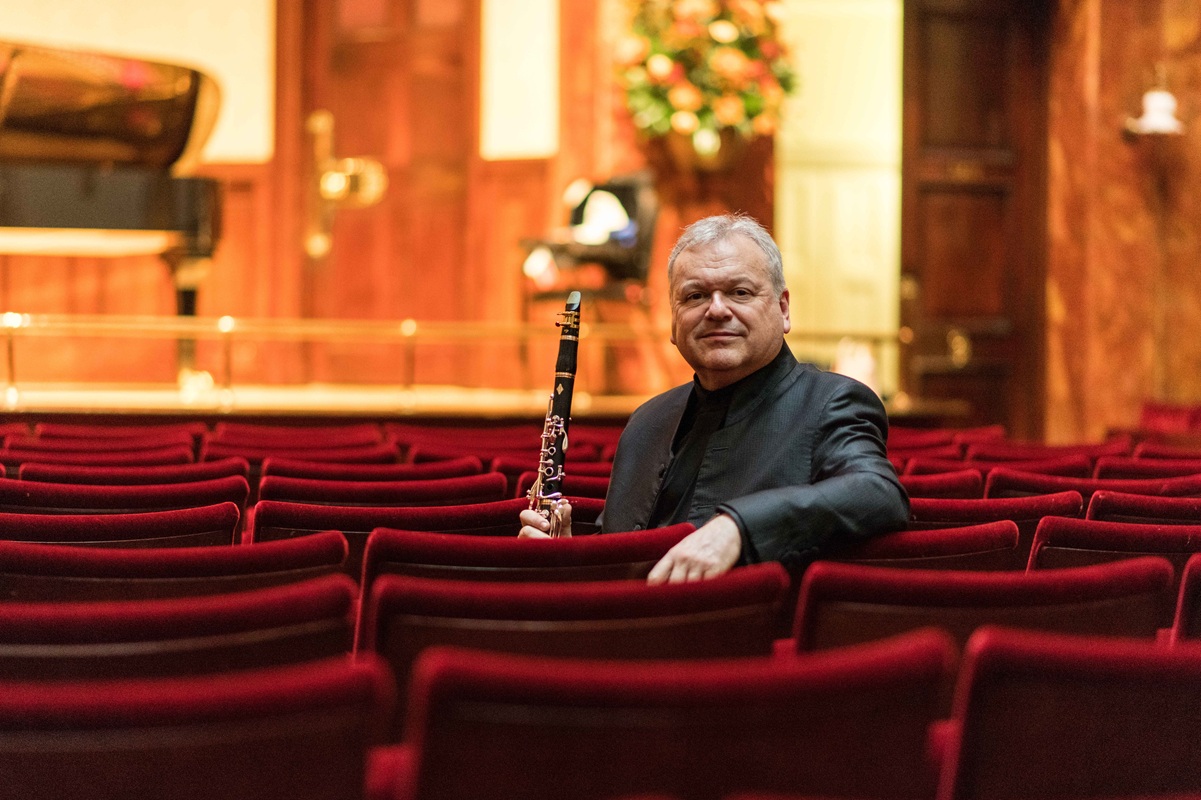
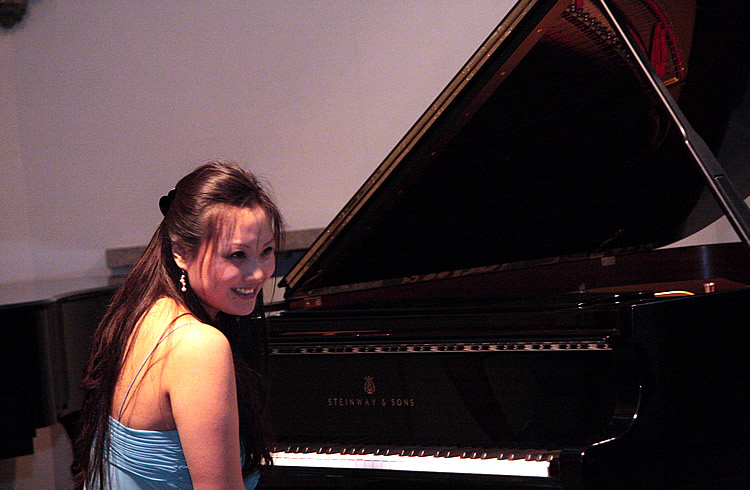
Michael Collins (clarinet, above), Wu Qian (piano, below)
Finzi 5 Bagatelles Op.23 (1920-9) Martinů Sonatina for clarinet and piano (1956) Milhaud Duo Concertante Op.351 (1956) Tailleferre Arabesque (1973) Cooke Clarinet Sonata in B flat (1959)
Wigmore Hall, London Monday 9 March, 1.05pm
Reviewed from the online broadcast by Ben Hogwood Photo of Michael Collins (c) Jack Lewis Williams
This was the first public appearance for Michael Collins and Wu Qian as a duo, yet together – on BBC Radio 3’s Lunchtime Concert at least – they displayed an easy familiarity, suggesting a partnership of a longer vintage.
They began with five much-loved miniatures from Gerald Finzi, often heard in isolation on rival radio stations. Collins and Qian enjoyed the bustling counterpoint of the outer Prelude and Fughetta movements, but the emotional heart of the set lay in the lovingly phrased Romance and Forlana, whose lilting rhythms were persuasively played, and the solemn Carol. The downbeat mood, inhabited from wartime struggles, was especially pertinent, though the Fughetta gave the music renewed energy in this performance.
Martinů’s Clarinet Sonatina is a late work, completed during a brief second stay in New York. The Czech composer was used to relocating at short notice on account of Nazi invasions of his homeland and Paris, but this brief second trip to America was an ultimately unsuccessful career move. The Sonatina inhabits the composer’s restlessness, looking longingly across the Atlantic towards Paris. This was captured by Collins and Qian in the bare piano octaves and reflective melody of the Andante, while the finale found greater conviction of feeling.
While Martinů pined for the French capital, Darius Milhaud was writing his Duo Concertant as a competition piece for his Paris Conservatoire students. Milhaud rarely outstays his welcome, and the piece was wrapped up with typical humour and a heartfelt central episode, gracefully played. Meanwhile the Arabesque of Milhaud’s fellow ‘Les Six’ member, Germaine Tailleferre, was a softly undulating dance that proved restrained yet elegant.
The English composer Arnold Cooke acquired a continental edge to his music thanks to a period of study with Paul Hindemith in the 1920s. His compositions for clarinet were written for Franz Reizenstein, also a pupil of Hindemith, and include a concerto and quintet. The airy first movement of the Clarinet Sonata in B flat – written deliberately without major or minor key labelling – was similarly elusive, its questioning line thoughtfully phrased by Collins in a satisfying balance with Qian.
The strident second movement is laced with humour which Collins was keen to bring out, before a probing slow movement with private asides from the clarinet hints at darker thoughts, particularly in its low burbling notes from the instrument near the end, suggesting a watery contemplation. The Finale swept these thoughts aside, making demands on Collins’ agility with the wide range of its thematic material, common across the work. The music dipped and weaved its way through a number of entertaining figures, plumping resoundingly for the major key in a hugely satisfying coda.
You can listen to this concert on BBC Sounds until 9th April.
On this day in 1901, the composer Gerald Finzi was born in Oxford.
Finzi’s most popular pieces tend to be in slightly shorter forms, and his unique way of writing for strings has endeared him to many lovers of British music. Here is a great example, a piece more than suitable for a summer’s evening – the Romance for String Orchestra:
Recorded 13-14 April 2024 at St Mary’s Church, St Marylebone, London
Reviewed by Richard Whitehouse
What’s the story?
Although the Taiwanese violinist Chu-Yu Yang and the American pianist Eric McElroy have found success independently, their appearances as a duo have firmly established them before the public across a wide repertoire, not least the music which is featured on this new release.
What’s the music like?
The title of this album might be thought to speak for itself, yet An English Pastoral amounts to more than an exercise in wanton nostalgia. Alongside early if not wholly uncharacteristic music by Ivor Gurney and Arthur Bliss – contemporaries whose outlooks were transformed through war service – it takes in one of Gerald Finzi’s most affectingly realized instrumental pieces and works by Ian Venables whose 70th birthday is just weeks away at time of writing. A programme, moreover, as cohesive in recorded terms as it would be heard as a live recital.
The centrepiece here is a sequence of pieces by the teenage Gurney such as demonstrates no mean assurance in this testing medium. Hence the Elgarian wistfulness of Chanson Triste or respectively poetic and bittersweet evocations as are In September and In August. A winsome Romance is the most elegantly proportioned of these eight pieces, with the elaborate Legende more discursive in its (over-) ambition. The poignant A Folk Tale and an engaging Humoreske have a succinctness to confirm that, with Gurney as with most composers, less is often more.
The players seem as emotionally attuned to this music as they are when mining the expressive subtleties of Finzi’s Elegy which, composed barely a year into the Second World War, offsets its yielding nostalgia with passages of simmering anxiety. Nor do they disappoint in the single movement that was all Bliss completed – if, indeed, he ever envisaged any successors – of his wartime Violin Sonata; its cautious if never inhibited handling of ‘phantasy’ form implying a transition from his earlier Pastoralism to the innovation of those pieces which came afterward.
Venables proves no less adept combining violin and piano, not least when adapting what was previously his Flute Sonata as to emphasize the pensive raptness of the first movement or its alternately playful and plaintive successor. Witness, moreover, the astutely judged trajectory of his Three Pieces as it moves from the blithe lyricism of its initial Pastorale, through the unforced eloquence of its central Romance, to the incisive energy of its final Dance – thus making for a sequence that could have been a ‘sonatina’ had the composer designated it thus.
Does it all work?
Pretty much always. Nothing here sounds less than idiomatic in terms of being conceived for this medium, a tribute to the skill of these players in realizing the intentions of the composers in question. For those listeners who still (rightly) attach importance to such things, the layout is viable but it might have been improved by interpolating the Gurney pieces – most of which are what might be termed ‘medium slow’ – across the release as a whole rather than grouping them all together at its centre, but this is relatively less of a consideration in streaming terms.
Is it recommended?
Indeed it is. The recorded ambience could hardly be bettered in terms of this medium, while Yang contributes detailed and informative annotations. Hopefully he and McElroy will have a chance to record further such collections, whether or not in the ‘English Pastoral’ tradition.
Listen / Buy
You can read more about this release and explore purchase options at the Somm Recordings website
Soprano Katharine Dain and pianist Sam Armstrong are on the other side of a screen, talking to Arcana from the Netherlands – where Katharine lives, and where Sam stayed during lockdown. Their musical partnership blossomed in that time, yielding the intriguing collection Regards sur l’Infini, grouping songs by Messiaen, Delbos, Debussy, Dutilleux, and Saariaho. The sequel – and principal topic of conversation here – is their new recording Forget This Night, a carefully curated selection of songs by Lili Boulanger, Karol Szymanowski, and Grażyna Bacewicz on 7 Mountain Records. Headed by Boulanger’s special cycle Clairières dans le ciel (Clearings in the sky), its subject matter is very different.
“In some ways we were worried that the music was going to be too similar, very thoughtful and intense”, says Katharine, “which the first one also was. As we went along, we realised that no – thematically and musically, it’s very, very different. It is a continuation, we hope, but not anything directly related to the first. It’s all the kind of material that we gravitate to anyway, and of course it’s helpful to be validated in our choices the first time, to realise that people really do respond to them in the same way that we do if it’s presented thoughtfully and at the best level we’re able to give. For us we had already started to think about the next music we wanted to look at, before we knew the kind of reach our first album would have. Yeah. So this Lili Boulanger cycle was really the beginning of the second project, but it’s already something that you begin to think about when you’ve spent so long on one programme. Your brain immediately starts to wander, and both ours had started to do that!”
Given the intensity of the songs chosen, and their heady, emotional content, did the music take a toll on the performers? “The Boulanger cycle is particularly intense,” agrees Sam, “and it’s great to see Boulanger getting much more exposure in concerts and also recordings. With this cycle the emotional scope doesn’t fully reveal itself unless you hear all 13 songs together. The last song is devastating, and Katharine doesn’t always make it with dry eyes. It’s a really intense cycle.”
The fact we have any music at all from Lili Boulanger is remarkable, given her story of life and death from tuberculosis at the age of 24. “I think so too”, agrees Katherine. “Before we embarked on this project, I knew her name and a few pieces, but didn’t really know a lot of her music. I had been influenced, I realised in retrospect, by this idea of her as a fragile flower who died before she could really do anything significant. I couldn’t disagree more with that now that I do, but it took some real investigation of the music itself, of what turned out to be a major work. As Sam said, you don’t know it unless you go into it completely and find out what’s there. It was a real revelation, worth all the intensity and being drained after the performances!”
Throughout Clairières dans le ciel the singer needs an unusual amount of vocal control, with some long notes to master. Katharine laughs, modestly. “That’s very true! It took a long time until I felt I was typically integrated with what she asks. The original singer who premiered it was a tenor, and that gives it a different sound of course, but it’s not easy for a tenor as it’s for a high voice that could be a soprano or tenor. There is an amazing story that I find very touching, which is that when she wrote the piece it was the beginning of World War One. Normal performances weren’t really happening in France, and she was busy with the cycle, doing her best in her first year after winning the Prix de Rome composition prize. She wrote this major piece and had to do a private ‘try out’ of the premiere, where she sang all 13 songs herself and Nadia played the piano. That was the only time she ever heard or experienced her own song cycle live, when she sang it. I thought about that so much because the songs are so challenging to sing, they’re really tough and ask a lot of you. Yet somehow Lili, not a professional singer or even a performer, managed to do it in a home for a few friends as an unofficial premiere. Something about that inspires all of us – professional or not – to try to meet the challenges of these amazing songs!”
The challenges are by no means restricted to the singer, with the pianist battling some quasi-orchestral writing to evoke a whole range of colours. Armstrong smiles. “Towards the end of the cycle it really opens out in scale, and suddenly all these changes and fragments, and the breaking apart of everything to represent what’s happening emotionally give it a bigger scale than the standard song repertoire. It’s emotionally very intense, and a lot of the transitions in the music are directly related to the psychology of the text. They are difficult to navigate and you really have to think about you do that. The counterpoint is not simple, either!”
To complement the Boulanger’s cycle there are two more of her songs and two piano pieces, along with works by Szymanowski and Bacewicz. As Polish composers, their language is a marked but welcome contrast to the French songs. “I’m so glad, if that’s how it feels to you”, says Katharine warmly. “That’s certainly how it felt to me in preparing it. Polish is a really tough language in which to sing. I had done a bit of Szymanowski in the past but not a lot, so it was a big hill to climb, but it also created different chapters in terms of my ability to assimilate the music. It really directly affects how you think about the score, the way the vocal line unfolds. Once you learn about the way sounds travel in Polish through the mouth – vowels and consonants – it’s very different from other languages, but it has the same kind of specificity as French. They both have to be really precise, the position in the mouth, the position of each of the parts of the mouth – the tongue, how the lips are shaped, what the space inside is like – all of these things are super specific, and I had great help with that. Once I began to get a handle on the Polish, not that I am singing it like a native speaker would, I began to understand the music better too. That allowed me to understand the emotional temperature of the songs as a result, so it really was an important part of the preparation. If it feels like differentiated sections on the programme then I’m very glad because that was something we were aiming for.”
The songs are an area of Szymanowski’s output that feel ‘off limits’ in recent times. “I find it so strange”, says Katharine, “as his piano and violin pieces are a lot better known, and his opera King Roger has been done in London not that long ago. It’s a stunning piece, and I think that’s how you got to know it?”, she says, turning to Sam. “Yes”, he confirms. “I’ve done the Myths for violin and piano but that really reignited my imagination for his sound world. It’s really special. “The songs are quite hard to programme though”, says Katharine. “I’ve known songs of Szymanowski for a long time, and I’ve really loved them – but I’ve sung one complete cycle of his which is the Songs of The Infatuated Muezzin, a particularly beautiful piece. Apart from that, I have never done a complete song cycle of his. When we were thinking about what to put on this disc, we loved the music and knew it would be a great pair with Boulanger, but then which cycle or chunks of songs to choose? We figured out that’s probably why we don’t hear the songs more often. Every cycle has a big challenge, a big thematic difficulty, not all of the songs are of equally high quality, or dramatically it doesn’t create the kind of story we look for in song cycles. So we decided what we would love to do is think about the developing theme of the program, which is how do we cope with things that vanish or things that disappear, and pick and choose with that?
Their approach paid dividends. “The whole world of Szymanowski opened up to us in a beautiful way and suddenly many things became possible that are not possible when thinking of his own groupings of songs. I would hope more people can start to think outside the box of just the groupings, the cycles, the opus numbers, because it’s such a rich and beautiful repertoire and you don’t have to think of it that way to make a nice programme.”
It is an easy trap to fall into with songs, thinking they should only be sung in the groups in which they were published. Is it the case of some composers randomly putting songs together but all of them being published at the same time? “That’s exactly it”, confirms Katharine, “and this is the funny thing about the song cycle, this term that we’ve come to associate with anything from 3 to 24, any number of songs. It meant different things at different times, and to different composers. There are some famous 19th century examples of pieces that were conceived complete, but for the most part they were mostly songs published at the same time for a commercial reason, which is that someone could take home a book of songs and get to know them. With Szymanowski he was such a prolific song composer, and some of the groups have a real cohesion and a reason for them being together. We found the songs don’t necessarily suffer if you sample them out of context and are stronger as a result than if you just try to stick to an opus number. For us it was an eye=-opening approach.”
The songs of Bacewicz were an unexpected find. “That was a real discovery. I found out that Bacewicz is a figure known in orchestral circles and in chamber music circles, because she was a violinist and wrote beautiful music for strings. A lot of string players and pianists I know had played her or a few of her pieces. Singers know nothing about her, because she didn’t write very much vocal music at all. She only has 11 songs, I think – a very small number. They were only recorded for the first time as a collection of her complete songs for voice and piano in the year before our recording, so it was luck that I was able to actually hear them.”
There is an intriguing historical context, too, meaning her music fits the collection hand in glove. “I had come across her name, and liked her string music once I started to listen to it, and I found this interesting biographical continuity, because Lili Boulanger and Szymanowski lived at the same time. They didn’t meet each other but they were inspired by many of the same things, writing music that was fearless, imaginative, colourful and with no ceiling on the kind of emotional intensity. There was something really common between them, but then we were hoping to find some sort of cooler composer in terms of the emotional temperature of the music, to mop up all that intensity but still be in the same world. We thought for a while about Lutoslawski, and there are some beautiful ones by him that are more known, but eventually I just bumped into Bacewicz, I came across her almost by accident. A friend mentioned the name of this composer and I said, “Wait, who’s that? That sounds Polish?” “Well, yes, she was Polish.” “Wait, she?! Who is this?!” So that that was how it began.”
Her fascination with the composer deepened. “Once I started looking into it, and found out that the songs had just been recorded, I thought they were fantastic. It turns out she was a student of Nadia Boulanger in the 1930s, so there’s something a little bit different in her influence. She was the generation after Szymanowski, so would have known Szymanowski she was studying at Warsaw when he was the head of the Conservatory. There seemed to be a continuation of the family of music that was coming as a result of all Szymanowski’s innovations and from the Boulanger sisters, but by then she was really doing her own thing. I found it very interesting, very fresh, and the music very beautiful. Although it’s also intense, it does have a different way of interacting with the emotions of the texts, than Szymanowski or Boulanger.”
One poem, Parting by Rabindranath Tagore, appears on the album in contrasting settings by Szymanowski (in German) and Bacewicz (Polish). One wonders when they encountered it in their lives and how that affected them? “I find it so interesting”, says Katharine. “In that one poem that is on the album twice, although in different languages. Szymanowski’s approach is so melancholy and so hopeless, and Bacewicz has no fear in expressing anger. I’ve thought about the pressure on women, and women composers, and then women composers of songs, what kinds of pressure they have to create things that are just very beautiful. For a long time I think that’s what people expected women to produce – songs in a domestic form, rather than a big orchestral form met for the concert hall, things that were beautiful and pleasant to listen to. Bacewicz really broke all those moulds, writing music that is rhythmic and super spiky. That setting of that song I found it very cool that the setting was completely different than Szymanowski’s and was very angry. I really liked that about it.”
Armstrong’s approach to Bacewicz’s music was similarly fresh. “Her music was new to me. Interestingly I was teaching a class of students about the Piano Sonata no.2, which is quite beautiful, and has been played quite a lot in Eastern Europe. Unfortunately there is not much music for piano by Lili Boulanger, though two of her three pieces are on the album – and then with Szymanowski I did some of the chamber music actually. Szymanowski is more familiar to me by ear than stylistically, he is very specific but also quite accessible. With Boulanger the influences are obvious in a sense, certainly Wagner and Fauré I hear in there, but the voice is really her own, especially in the song cycle, where the forms are quite unconventional. It is a question of finding your way in and the prose, the essence of the language. As Katharine was saying, in Bacewicz it’s much more paired down and concentrated, in a way that I think is more expressionist than Szymanowski.”
Dain and Armstrong worked in each other’s company through lockdown, where their creative relationship was cemented – enough for them to have plans for further collaborations. “We always have far more ideas than we can ever implement or use!” laughs Katharine. “Coming up with interesting ideas and music that I love and want to explore further is never the challenge. With this project, because we’re not Covid-locked down anymore, we’ve spent as much time on this as we did on the previous disc, probably more. The question is that in the end it’s going to require a huge investment, so what is going to light such a fire under you that you’re willing to put in the amount of time that we want to? Not everybody approaches recording in the same way, but what’s been so rewarding for us has been giving ourselves as much time as we can until the answers arrive, and you can’t force them. The Boulanger cycle we started by performing live, and did one recital, and it blew our minds how amazing it was – but that only came by performing it. We realised in rehearsal that this is a major piece, more than we realised, but only in performance did it really hit us what an impact it can have. That was already more than two years ago, since when we’ve performed it as much as we could, and every time we do we have to go back and spend another few days or a week revisiting it, uncovering new things, and trying to set aside our old ways of coping with the score’s challenges in order to get to a truer version each time, a version that’s more honest. It’s really hard but it’s also the biggest pleasure of the work.”
Looking forward, “I have an idea – one at the top of my mind – and many others lining up behind that idea! We just have to see as we begin to try music together, and that’ll be the next step. We’re always doing that for fun, thinking about future recital programmes, whether they become recording products or not, and finding out what really makes us so passionate that we have to spend the time and we have to do all that discovery.”
Turning to live performance, Katharine has Finzi’s Dies natalis on her concert schedule in the Netherlands, where they both live. Is the piece a curiosity for Dutch audiences? “It’s my first time performing it, and it’s so amazing, but Finzi is really not very well represented here. I would say in general English language – American and British – is not performed so often. I really jumped at the chance when this opportunity came along. It was going to be a Christmas concert, and the Netherlands Chamber Orchestra – a wonderful orchestra – had their programming already, but when they proposed this and I had to do it! I never get to do Finzi unless it’s on recital, and I choose it for fun with Vaughan Williams or English composers in the same period. Mostly it’s me having to advocate for them, so that was very exciting!”
Is their hope for the new album a similar aim, to bring in new listeners – as well as retaining those who enjoyed the first album? “Both of those are equally important to us”, she says, “and whether we’re thinking about people who are inside or outside of the experience of listening to art song albums already. There’s a very niche market for people who already know what they’re getting when they see this, even within people who like song. We’ve discovered that these are three composers that – although the combination might be intriguing – people really have no idea what they’re going to hear. There are several simultaneous goals. One is that for people who love song, but don’t know that there are good songs by these people, that they will listen and realise that the song repertoire is fantastic. The Boulanger is an overlooked masterpiece, and people don’t know that yet because it’s not heard very often. But then we felt equally passionately about Szymanowski and his songs. If you think you love hearing song recitals, but haven’t heard any of these composers represented on a song recital yet, you can listen on a recording at home and realise there’s really good stuff here. Let’s let’s try to get into performance!”
They have clearly considered their output, for Armstrong nods in agreement as Katharine talks. “In the end”, she says, “we also didn’t want to make something that only would be of cerebral specialist appeal. We hoped to make something that if you know nothing about any of this music at all, you could still listen from beginning to end if you chose, to feel an emotional shape and hear very beautiful songs in a very thoughtfully laid out sequence – the same way you would for anything else, like pop music. That’s why we spend all this time digging up music that people haven’t heard yet, because it turns out to be super emotionally powerful and direct and beautiful.”
She cites a recent event supporting their approach. “Last week we did a release concert for the album, and someone in the audience was a pop musician I know who had seen how passionate I was about this project, though this person had absolutely no experience listening to classical songs. They came to the show with an open mind, and they write pop albums, concept albums, single songs. At the end of the show, they loved it – and said “It’s the same as what I do, they’re songs! They each have a feeling, or series of feelings, and they go on a journey from start to end. There’s no difference in what we do except that the style is different!” To me that felt like such a happy validation, and the work that we do to build bridges. This is actually just music that you haven’t heard yet, but anyone can relate to. We feel equally strongly about these two goals for the album.”
The example adds fuel to the theory that Schubert was, in fact, one of the very first writers of the early pop song. “I completely agree!” says Katharine, “and I didn’t instantly like song when I heard it on recordings. When I was 19 years old and encountered Schubert I had no experience with it before. I liked pop songs and choir music, and that was how I got into singing, not through classical solo singing at all. When I first encountered it I found it strange and stylized, and a bit off putting, but when I heard it live and realised that it’s just about how someone is putting across a story in a different way, I found the music is really beautiful once you get a chance to experience that more easily.” How reassuring – to hear a singer’s own story behind an initial struggle to love song, for this is an area of classical music receiving less column inches than most. The next part of the process is for you, the reader, to get out there and start listening – for the same transformative experience can most definitely be yours.
Katharine Dain and Sam Armstrong present their new album Forget This Album on 7 Mountain Records. You can order the album at the 7 Mountain Records website, or listen below:
Ralph Lane (clarinet), Oberon Symphony Orchestra / Samuel Draper
St James’s, Sussex Gardens, London; Saturday 2 December 2017
Weber Oberon, J306 – Overture (1826) Finzi Clarinet Concerto, Op.31 (1949) Vaughan Williams Symphony no.4 in F minor (1934)
Reviewed by Richard Whitehouse
British music has not figured prominently on the schedule of the Oberon Symphony Orchestra thus far, so it was interesting to have two notable works from the concertante and symphonic genres juxtaposed in tonight’s concert; their contrasts in aesthetic brought unequivocally into relief.
Long the most often performed of its composer’s larger works, Finzi’s Clarinet Concerto is now firmly established in what is still a limited repertoire. Avowedly English despite (even because of?) his mixed European ancestry, Finzi cuts a somewhat ambivalent figure such as this piece pointedly confirms and which Ralph Lane duly underlined.
Whether in the starkly alternated recitative and arioso writing in the initial Allegro, the ruminative and frequently ominous poignancy of the central Adagio (its expressive eddying deftly unfolded), then the amiable but never merely blithe melodiousness of the final Rondo, this was an assured and perceptive account – enhanced by Samuel Draper’s handling of the restrained orchestration. Maybe Finzi’s shorter orchestral works will find their way onto future Oberon programmes?
As, hopefully, will other Vaughan Williams symphonies, given the success of this reading of the Fourth. Over eight decades on from its premiere, the work still divides opinion as to what its composer intended. The deteriorating political situation in Europe is often quoted as evidence, though this is not a symphony about or even anticipating war; rather the composer posits the notion whether the Beethovenian concept of adversity to triumph was sustainable in an era of cultural, specifically tonal dislocation.
The sound-world exudes an austerity and angularity not unknown in Vaughan Williams’s earlier music, though never so overt as here: worth considering in the context of Shostakovich’s (then unwritten) Fifth and Enescu’s (then unfinished) Fourth, both symphonies which have been highlights of recent Oberon concerts.
As also was this performance. Draper set a fast though never unduly headlong tempo for the opening Allegro, bringing out those contrasts between violence and eloquence on the way to a coda of rapt introspection. The ensuing Andante was similarly kept moving, its dissonant harmonies and tensile polyphony yielding an unexpected pathos confirmed in the flute-lead threnody at its close.
Rhythmically exacting, the Scherzo evinced a measure of uncertainty in ensemble, though Draper had the measure of its acerbic humour – as also the trio’s pomposity – through to an impulsive transition into the Finale. Its martial strains never descending into parody, this brought the overall conception into powerful focus; the ‘fugal epilogue’ driving onward to a fateful return of the work’s opening and an unequivocal (four-letter?) last chord.
So, an impressive take on a symphony which has lost none of its capacity to provoke, or even shock, and an admirable statement of intent from this orchestra on its fifth anniversary.
Given the occasion it was understandable when, instead of beginning with a British overture, Draper chose that which Weber wrote for his final opera Oberon. If the magical opening was a touch earthbound, the performance then hit its stride prior to an effervescent close.
On this evidence, the Oberon Symphony is set fair on the home strait towards its first decade of music-making.
Further information at on the Oberon Symphony Orchestra can be found at their website – while Samuel Draper’s website is here



 Arcana.fm