On this day – the world premiere of the Violin Concerto no.1 by Philip Glass

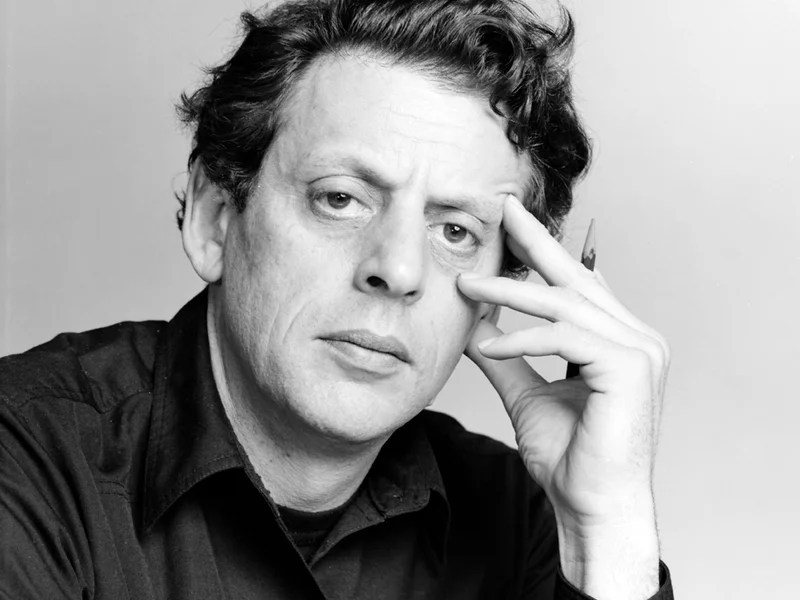
by Ben Hogwood picture (c) Jack Mitchell/Getty Images

On this day in 1987 the premiere of Philip GlassViolin Concerto no.1 took place, played by Paul Zukofsky and with the American Composers Orchestra under Dennis Russell Davies.

The piece has established itself as one of Glass’s most popular works in concert, and can be heard below in its first recording, made by Gidon Kremer for Deutsche Grammophon:

Published post no.2,495 – Saturday 5 April 2025

In concert – Alexander Roslavets, Gidon Kremer, LPO / Andrey Boreyko @ Royal Festival Hall: A Dark Century

Alexander Roslavets (narrator / bass), Gidon Kremer (violin), London Philharmonic Choir (men’s voices), London Philharmonic Orchestra / Andrey Boreyko

Schoenberg A Survivor from Warsaw Op.46 (1947)
Weinberg Violin Concerto in G minor Op.67 (1959)
Shostakovich Symphony no.13 in B flat minor Op.113 ‘Babi Yar’ (1962)

Royal Festival Hall, London
Wednesday 27 November 2024

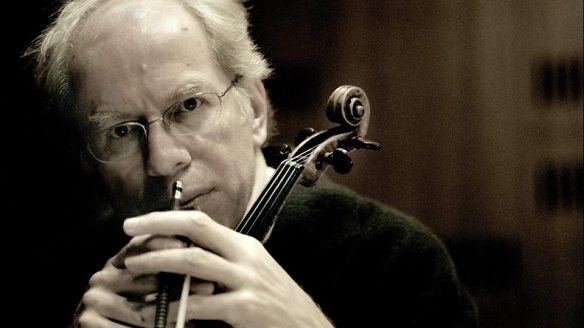
Reviewed by Richard Whitehouse Pictures (c) Richard de Stoutz (Andrey Boreyko), Angie Kremer (Gidon Kremer)

Anyone who heard one or other of these works for the first time at this concert by the London Philharmonic Orchestra could be forgiven for thinking that the twentieth century, if not a ‘dark century’ per se, was at the very least a troubled one for all that the quality of its music was undeniable.

With its elements of melodrama and cantata, Schoenberg’s A Survivor from Warsaw is one of his most original conceptions and necessarily so, given the unnerving immediacy of its text in which a speaker has to take on the roles of survivor and officer in just six minutes. Alexander Roslavets rose to this challenge, bringing out emotional contrasts as surely as he instilled his words with that ominous dread whose culmination in the prayer Shema Yisrael was intoned by the London Philharmonic Choir with the right balance between desperation and defiance.

One composer who witnessed something of such atrocities was Mieczysław Weinberg, and if his Violin Concerto demonstrably continues the ‘Romantic’ tradition, this is still an inherently personal statement. Gidon Kremer has championed the composer extensively in recent years and, while technical issues seemingly inhibited the respectively incisive and impetuous outer movements, the restless searching of its intermezzo-like Allegretto then confiding eloquence of its Adagio were abundantly in evidence. For all its outward virtuosity, the music’s essential inwardness is what prevails as the soloist remains musing when the orchestra fell silent at the close of the finale. Kremer was in his element here, as in a touching rendition of Silvestrov’s Serenade which made for an apposite encore and was dedicated to all the people of Ukraine.

Best known for giving the posthumous premiere of Gorecki’s Fourth Symphony with the LPO 10 years back, Andrey Boreyko is well established as an exponent of Shostakovich so that his take on the Thirteenth Symphony did not disappoint. At a distance of over six decades, it can be hard to recapture the provocation of that most eminent Soviet composer using verse by the most populist younger poet, as Yevgeny Yevtushenko then was, but this setting of Babi Yar retains all its expressive force through the immediacy and resourcefulness in which it relates official indifference to the Jewish massacre as that ravine outside Kyiv was transformed into landfill. Broodingly restrained, Roslavets emerged into his own with Humour – its scabrous send-up of bone-headed officialdom inspiring one of Shostakovich’s most scurrilous scherzos.

Fashioning the last three movements into a cohesive if cumulative unity, Boreyko underlined the potency of Shostakovich’s creative vision as he takes the Soviet establishment to task for various failings economic as In the Store, political as in Fears and cultural as in A Career. Implacable then volatile, these first two are rounded off by Yevtushenko’s considering of the relationship between society and the individual; framed by an undulating melody, for flutes then strings, which is one of its composer’s most evocative as well as affecting inspirations.

It duly brought this work, and this performance, to its subdued yet spellbinding close. As the relationship between East and West becomes ever more confrontational, Shostakovich’s 13th remains a testament to rationality and compassion whose denigration is to everybody’s cost.

For details on the 2024-25 season, head to the London Philharmonic Orchestra website. Click on the names to read more about soloists Alexander Roslavets and Gidon Kremer

Published post no.2,373 – Monday 25 November 2024

Weinberg 100

Today marks the centenary of the birth of the Polish-born Soviet composer Mieczysław Weinberg.

After a long period without exposure for his music we are finally starting to see the full extent of this extraordinary composer’s output. Some of it has been covered by Arcana in his centenary year, including a pioneering cycle of the 17 string quartets given by the Quatuor Danel at the University of Manchester and two concerts from the CBSO’s Weinberg weekend – from an orchestral concert from the CBSO and Mirga Grazinyte-Tyla to Gidon Kremer‘s Preludes To A Lost Time by way of Kremer and his chamber group Kremerata Baltica in a fascinating concert of putting Weinberg’s works in context.

The Cello Concerto made quite a splash at the BBC Proms this year, and you can watch Sol Gabetta playing it with the Orchestre Philharmonique de Radio France conducted by Mikko Franck below:

Meanwhile a good place to start for the uninitiated is by taking on Kremer’s two discs on ECM. The first of these comprises the four chamber symphonies and the Piano Quintet:

Meanwhile the sequel is an enticing collection of miscellaneous works from the Weinberg pen, including the Symphony no.10:

Live review – CBSO Weinberg Weekend: Symphony no.21 & Shostakovich: Symphony no.15

Freddie Jemison (treble), Maria Makeeva (soprano), Gidon Kremer (violin, above), Kremerata BalticaCity of Birmingham Symphony OrchestraMirga Grazinyte-Tyla

Symphony Hall, Birmingham
Saturday 24 November 2018, 11am

Weinberg Symphony no.21 op.152
Shostakovich Symphony no.15 in A major op.141

Written by Richard Whitehouse

The Weinberg Weekend being held in Birmingham reached its culmination tonight with this uncompromising yet rewarding symphonic double-bill. Those unfamiliar with the composer’s music may have been disconcerted by what they heard. Whereas the early Violin Concertino (heard at the previous concert) feels not so far removed from comparable works by Malcolm Arnold, the Symphony no.21 breathes an air of stark fatalism. Written at a time which witnessed the collapse of the Soviet Union and dedicated to the memory of those who died in the Warsaw Ghetto (the ‘Kaddish’ subtitle is found in his catalogue but not the actual score), it ranks among Weinberg’s deepest statements. At almost an hour it is also among his longest symphonies, so making its predominant sparseness and concentration the more remarkable.

The single movement falls into several continuous sections – an initial Largo’ introducing the plangent hymn that pervades the work then the chorale whose presence Weinberg traced back to his First Symphony, their alternation making way for the opening theme of Chopin’s First Ballade intoned somnolently on piano. An Allegro draws a theme from Weinberg’s Fourth Quartet into its reckless orbit, while a further Largo similarly utilizes one from his Double-Bass Sonata – the latter’s sepulchral tones sounding more bizarre given the ensuing klezmer-like passage with clarinet, which persists through a tensile Presto then plaintive Andantino that brings the principal climax. A final Lento unfolds with increasing introspection – violin, piano and harmonium adding their spectral sonorities until the music fades out of earshot.

The work went unheard in Weinberg’s lifetime, with its undoubted technical and emotional challenges having made revivals rare. Yet its formal cohesion and expressive consistency are undoubted – in the conveying of which, Mirga Grazinyte-Tyla took especial credit for rendering the epic structure as an inevitable yet cumulative entity whose febrile outbursts were held in check by that encroaching vastness which extends right across the whole. She was abetted by an assured response from the City of Birmingham Symphony, bolstered by members of Kremerata Baltica (Gidon Kremer taking the violin solos), and if dividing the vocalise between eloquent Maria Makeeva and plaintive Freddie Jemison slightly disrupted continuity in the closing stages, it hardly distracted from the stature of this reading overall.

Shostakovich‘s Symphony no.15 made a pertinent coupling, with Grazinyte-Tyla having its measure right from her purposeful take on the opening Allegretto. The Adagio’s ominous tread was finely sustained, its numerous solo passages having ample room to unfold prior to an anguished climax then desolate coda, while the brief scherzo fairly crackled with barbed irony. Nor was there any lack of focus in the finale, emerging from its miasma of allusions through to a spectral passacaglia whose seismic culmination never pre-empted the subdued recollection of earlier ideas or, above all, the transfigured conclusion with its evocation of ‘voices overheard’ over simmering percussion. It set the seal on an impressive performance and a memorable concert: one which certainly warrants the proposed commercial release.

Sunday morning saw a lecture in the Recital Hall at the recently-opened Royal Birmingham Conservatoire. As presented by Prof David Fanning (Manchester University) and Dr Michelle Assay (Huddersfield University), Exploring Weinberg offered a selective though consistently informative overview of the composer’s life and career: from his formative years in Warsaw, via his arrival in Moscow following periods in Minsk then Tashkent against the background of war; the dark years of the anti-formalism campaign then his incarceration during the final months of Stalin’s increasingly paranoid rule, then to the decades of growing acclaim from colleagues and public alike during the 1960s and ’70s, before a period of increasing neglect as a new generation of Soviet composers came to the fore and the Soviet Union neared its end.

The lecture was illustrated with numerous visual and musical examples, but it was archival recording of Weinberg playing and singing extracts from his opera The Passenger to the Moscow Union of Composers – in a futile attempt to secure its performance – that riveted attention. Hearing a composer’s actual voice is seldom less than revealing and so it proved here, setting the seal on an event which was certainly worth attending despite the absence of a selection of chamber works from Conservatoire students that was to have followed.

Summing up, the Weinberg Weekend fairly succeeded in terms of introducing Birmingham audiences to music by a composer whose importance continues to increase and as a prelude to what looks set to be a deluge of UK performances over the course of his centenary year.

Further information on the Weinberg Weekend can be found here

Live review – CBSO Weinberg Weekend: Gidon Kremer & Kremerata Baltica

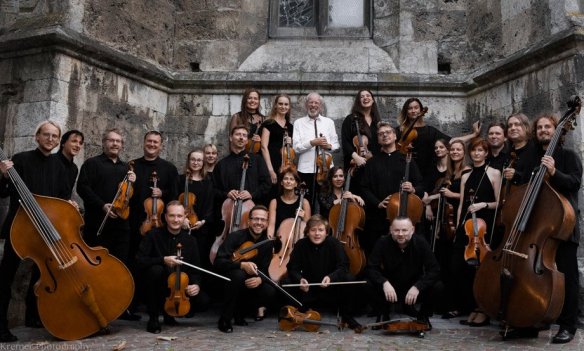
Gidon Kremer (violin), Georgijs Osokins (piano), Kremerata Baltica (above)

Town Hall, Birmingham
Saturday 24 November 2018, 11am

Bach-Busoni (arr. Kremer) Chaconne in D minor BWV1004/5 (c1720)
Weinberg Concertino for Violin and Strings in A minor op.42 (1948)
‘Schubert meets Silvestrov’:
Schubert Five Minuets and Six Trios D89 (1813) and Der Musensohn D764 (1822) interspersed with
Silvestrov Five Pieces for violin and piano (2004)

Written by Richard Whitehouse

Having launched the Weinberg Weekend with his impressive transcription of the 24 Preludes for cello, Gidon Kremer this morning bought Kremerata Baltica to Birmingham’s Town Hall for a programme that placed Weinberg within a typically stimulating and unexpected context.

Few who have heard Weinberg’s opera The Passenger could have been left unmoved by that climactic moment when the opening of Bach‘s Chaconne is intoned by unison violins as the symbol of an enduring German culture. Disappointing, then, that Kremer’s own arrangement of Busoni’s mighty piano transcription (as referenced at the opening) should have proved so underwhelming; or was it more the demands of synchronization when not conducted that led Kremerata Baltica to neuter textural and emotional contrasts in this immaculate yet unresponsive rendering.

Kremer then joined his ensemble for Weinberg’s Violin Concertino, a product of late-1940s Soviet culture when accessibility was not just desired but proscribed. While there is little in its melodic content of real memorability, the deftness and subtlety with which the composer unfolds his ideas across an ingratiating Allegretto, ruminative Adagio (whose cadenza-like introduction brings the most arresting music) then an incisive final Allegro is nothing if not resourceful. Even then, this attractive piece waited almost half a century for its first hearing.

Kremer and his ensemble made the most of these attractions, as they did in the final piece – a curious though effective dovetailing of miniatures from Schubert and Silvestrov. The former was heard in transcriptions (by Kremer?) of an early sequence of minuets and trios for string quartet, his teenage gaucheness outweighed by melodic poise and rhythmic brio. In between these, Valentin Silvestrov’s Five Pieces proved suitably elusive – Kremer and pianist Georgijs Osokins teasing myriad subtleties from a subdued elegy, wistful serenade, poetic intermezzo, limpid barcarolle and haunting nocturne. The sequence was rounded off with an arrangement (by Christoph Ehrenfellner) of Schubert’s song Der Musensohn, one of a handful of Goethe settings that mark the onset of his full maturity; here working its bewitching charms in full.

A bewitching way, indeed, to conclude a typically provocative programme by this always enterprising ensemble. Kremer’s and Kremerata Baltica will also be taking part in tonight’s concert which features a very different piece by Weinberg, his valedictory 21st Symphony.

Further information on the Weinberg Weekend can be found here