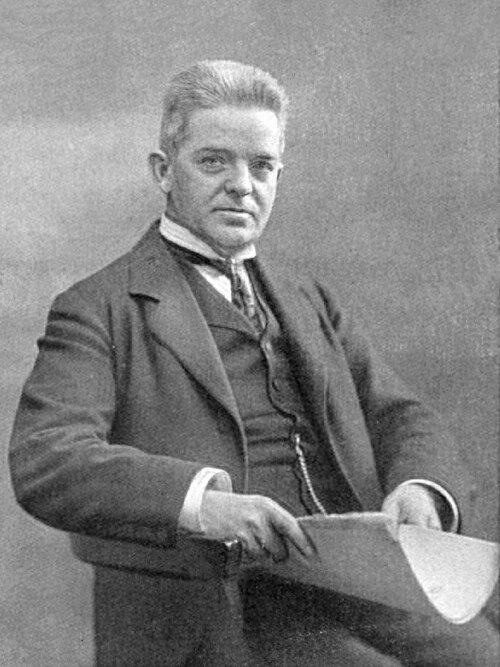
by Ben Hogwood. Image of Carl Nielsen in 1917 – unknown credit, used courtesy of Wikipedia
On this day 100 years ago – the first performance of Carl Nielsen’s Symphony no.6, the Sinfonia Semplice, took place in Copenhagen.
To mark the anniversary, Linn Records made a very intriguing release in September of a special version of the symphony. As the page for the album states, “conductor Ryan Wigglesworth joins Royal Academy of Music’s outstanding young musicians to revisit the composer’s later period. This recording showcases two works by Nielsen in two spellbinding arrangements by fellow-Dane Hans Abrahamsen. The No 6 ‘Sinfonia semplice’, written during a period of declining health, is viewed by some as a strongly ironic work. However, its lightness is also deeply sincere. With its crystalline weightlessness, Abrahamsen’s chamber arrangement reclaims both the quizzical spirit and sense of fragility in the original.
You can hear the album on Tidal by following the link below:
Jennifer France (soprano), London Philharmonic Orchestra / Edward Gardner
Abrahamsen let me tell you (2012-3) Mahler Symphony no.4 in G major (1892, 1899-1900)
Royal Festival Hall, London Friday 3 October 2025
Reviewed by Richard Whitehouse
Tonight’s London Philharmonic Orchestra concert featured the welcome revival of a 21st-century classic. Hans Abrahamsen’s recent output may be relatively sparing, but the works that have emerged represent a triumph of quality over quantity and not least let me tell you.
Set to fragmentary lines drawn by Paul Griffiths from his eponymous novel, this centres on the character of Ophelia – its seven songs falling into three larger parts whose outlining of a ‘before, now and after’ trajectory gives focus to the arching intensity of its 30-minute span. The first, fourth and sixth of these anticipate what comes to fruition during the second, fifth and seventh – the exception being the third whose speculative vocal line is underpinned by a stealthy progress in the lower registers evoking the motion, if not the form, of a passacaglia. Elsewhere the voice evinces an intricacy and translucency that effortlessly carries the word-setting as it pivots between thought of oblivion and transcendence, before eventually being subsumed into the orchestra for a conclusion among the most affecting in recent memory.
The LPO acquitted itself ably in music which is texturally complex for all its harmonic clarity, though it was Jennifer France (above) who (not unreasonably) most impressed with a rendering of the solo part as did ample justice to its high-lying melisma and airborne flights of fancy. Edward Gardner directed with an innate sense of where this music was headed, not least in those final bars with their tapering off into silence. Relatively few pieces are recognized as seminal from the outset, but let me tell you is one such and seems destined to remain so well into the future.
France then returned (or rather stole in) for the finale of Mahler’s Fourth Symphony after the interval. His setting of ‘Das himmlische Leben’ from the folk-inspired anthology Das Knaben Wunderhorn had actually been written almost a decade earlier and was once envisaged as the finale to the Third Symphony, but it makes a natural conclusion to a successor whose relative understatement is sustained right through to this movement’s intangible end: a ‘child’s vision of heaven’ whose intended innocence becomes informed with no little experience by the close.
Gardner had steered a convincing trajectory through the preceding movements – not least the opening one whose mingled whimsy and wistfulness took on a more ominous demeanour in its eventful development, before conveying unalloyed resolve in a warm-hearted reprise and beatific coda. What is among the most striking of Mahler’s scherzo’s proceeded with audible appreciation of its pivoting between the sardonic and sublime, Pieter Schoeman’s ‘mistuned’ violin being first among equals in music whose soloistic textures were thrown into relief by the homogenous stability of the Adagio. Its double variations unfolded with a fluid intensity capped by a coda whose ‘portal to heaven’ yielded thrilling resplendence as subsided into a transcendent raptness that, in other circumstances, could have made a satisfying conclusion.
That this lead so seamlessly into the vocal finale says a great deal for Mahler’s foresight, but also Gardner’s ability to fashion so cohesive a symphonic entity. As the music subsided into subterranean chords on harp, the audience was (necessarily) held spellbound a while longer.
Knussen Chamber Orchestra / Ryan Wigglesworth (above)
Knussen …upon one note – Fantasia after Purcell (1995) (from 2:15 on the broadcast link below) Birtwistle Fantasia upon all the notes (2011) (9:29) Freya Waley-Cohen Naiad (2019, world premiere) (20:14) Knussen Study for ‘Metamorphosis’ (1972, rev, 2018) (30:54) Abrahamsen Herbstlied (1992, rev. 2009) (38:58) Alastair Putt Halazuni (2012) (47:36) Knussen Songs without Voices (1991-2) (tbc)
The BBC Proms’ 800-year odyssey of music over eight weeks at the Cadogan Hall reached the present day in the company of the UK’s newest orchestra.
The Knussen Chamber Orchestra took its bow at the Aldeburgh Festival this year. Created specifically in memory and celebration of Oliver Knussen (above), it is an ensemble for commission and festival appearances, unrestricted in the repertoire it will perform – in that way very much reflecting the approach of its dedicatee. Comprising orchestral principals and budding young talent, it also reflects Knussen’s ability to communicate with musicians regardless of their standing.
Knussen is still greatly missed, a towering figure in British music in the latter part of the 20th century and the 21st until now. Tales have emerged not just of his mentoring of young composers and influence on the established writers, but of a sparkling personality and wit, a dinner companion par excellence. As a conductor he made several richly inventive programmes for the Proms with the BBC Symphony Orchestra and the Birmingham Contemporary Music Ensemble, and as a composer his small but perfectly formed catalogue is required listening for any budding contemporary composer of today. Like the composers he adored, particularly Stravinsky and Webern, his is a musical language that speaks directly through an economy of means.
That much was immediately evident in the three and a half minutes of …upon one note – Fantasia after Purcell, which used the colours of clarinet, violin, cello and piano to lasting effect. Knussen moved the omnipresent middle ‘C’ – the ‘one note’ – around the parts effortlessly, enjoying the harmonic diversions possible around it and alternating solemnity with mischief. The piece proved both a homage to Purcell and a brief spark of invention, and was ideally weighted by the soloists.
Birtwistle’s Fantasia upon all the notes has potential for mischief in its title but is in effect a typically serious piece. Written for an ensemble of seven players this was led with authority by harpist Céline Saout, who effectively drove the piece through its initial jagged outlines. The colours available to Birtwistle were exploited through music of stern countenance, its few tender asides to be cherished as the exception rather than the rule. Only at the end, with little points of pitch from solo instruments, did the mood lighten.
In a charming conversation with BBC Radio 3 host Petroc Trelawny, Freya Waley-Cohen revealed Knussen’s qualities as a tutor and a ‘wonderful person’. Naiad (20:14 on the broadcast) was a fitting tribute, fulfilling Cohen’s description of reflections from the scales of fish and dew on a spider’s web with music that cast a rarefied light, such as the sun does this time of year. The attractive melodic cells rippled with a slight chill, piercing moments of clarity from the woodwind contrasted by fuzzier asides from the strings. Although Cohen’s description of a slow piece and a fast piece rubbing up together was more difficult to follow, that did not mar in the slightest an enjoyable and meaningful piece, whose last few bars had a lilting four-note melody that hung on the air, leaving an enchanted atmosphere in its wake.
Bassoonist Jonathan Davies then stepped forward for Knussen’s highly virtuosic Study for Metamorphosis (30:54), based on Kafka. There were some extraordinary sounds here, the composer exploiting the cartoon-like persona the bassoon can elicit but also reminding us of the instrument’s versatility, its ability to paint pictures both happy and sad. Davies was superb and clearly enjoyed the experience.
Hans Abrahamsen’s Herbstlied followed (from 38:58), an extended arrangement and combination of a Danish song and two J.S. Bach subjects from The Art of Fugue. This instrumental version was unexpectedly moving, its picture painting of leaves ‘falling as from far…’ most apt for the time of year and given a vivid account by the five players. The cor anglais of Tom Blomfield added a unique sourness to the tone, and the downward motion of the melodies indicated sorrow, but there was still a sweeter melancholy here that stayed with the listener long afterwards.
We moved into Alastair Putt’s wind quintet Halazuni (47:36) without a break. This was a less affecting piece, more calculated in its depiction of a spiral (its title is the Persian word for spiral) The colours of the instruments – flute, oboe, clarinet, horn and bassoon – were frequently attractive, and while the music did on occasion feel predetermined, there was a clear end goal.
The best was saved until last in the form of Knussen’s Songs Without Voices (not yet linked to the broadcast on BBC Sounds). A group of four pieces for an ensemble of eight players, the Songs use vivid colour combinations which bring the composer’s imagery to life. The melodies, though short, are incredibly meaningful.
The first three Songs are wordless settings of texts by Walt Whitman, starting with Winter’s Foil, which was alive with bird calls and blustery winds. As elsewhere Wigglesworth secured playing of great poise and personality, led with characteristic authority by violinist Clio Gould. Prairie Sunset showed off the colours of the ensemble both separately and in combination, before the delicate outlines of First Dandelion were revealed. ‘simple and fresh and fair’.
Finally we heard Elegiac Arabesques, Knussen’s tribute to Polish-English composer Andrezj Panufnik. This wove an incredibly poignant thread, suitable in its own way as a memorial to the composer-conductor commemorated with such grace and feeling here.
Listen
The music in this concert can be heard on Spotify below:
A playlist featuring works both composed and conducted by Oliver Knussen can be heard below. It includes …upon one note from this concert, though not the Songs Without Voices – which are in fact available on the Erato label:
Tamara Stefanovich(piano), Simon Haram (saxophone), London Sinfonietta , London Sinfonietta Academy Alumni / David Atherton, George Benjamin, Vladimir Jurowski
Birtwistle The Message (2007) Stravinsky Octet (1923) Ligeti Chamber Concerto (1970) Deborah PritchardRiver Above (2018) (World premiere) Samantha Fernando Formations (2018) (World premiere) Abrahamsen Left, alone for piano (left hand) & orchestra (2015) (London premiere) Various Encore! (14 Variations on a Hornpipe by Purcell) (2018) (World premiere)
Royal Festival Hall, London; Wednesday 24 January 2018
Written by Ben Hogwood
You can listen to this concert on the BBC iPlayer by clicking here (available until 22 February 2018)
With a bold slogan Unfinished Business – We’re 50, the London Sinfonietta illustrated at their birthday concert exactly why the ensemble remains such a vital cog in the musical life of the capital and the UK.
Their relentless drive for the new, the original, and the game-changing, is coupled with a level of musicianship that remains at the very highest in all they do. This concert reminded us of those things, while a couple of tactful presentations drew attention to the inspirations behind the music, as well as highlighting those who were sadly not able to experience the half-centenary birthday.
To the music – and a short fanfare to begin in the form of The Message, written for the Sinfonietta’s 40th birthday by one of the composers to help shape the ensemble, Sir Harrison Birtwistle (from 4:43 on the broadcast link above). It began proceedings with appropriate ceremony, brilliantly played and controlled by the spotlit trio of clarinettist Mark van der Wiel, trumpeter Alistair Mackie and percussionist David Hockings.
Stravinsky’s Octet followed (from 7:43-23:19), conducted by one of the ensemble’s founders, Sir David Atherton. This was a colourful account, enjoying the outdoorsy and often playful writing for the less-than-usual combination of flute, two clarinets, two bassoons, two trumpets, trombone and bass trombone.
The short introduction ushered in the perky main theme of the first movement (from 9:12), but it was in the second movement (12:01) where the Sinfonietta really excelled, the flurries of notes brilliantly delivered by clarinets and bassoons. The third movement (12:10) enjoyed Stravinsky’s pointed interactions between the instruments, bassoons again dictating the rhythmic impetus.
The first half ended with Ligeti’s Chamber Concerto, written in 1970 and continuing to dazzle with its innovations in tone and sonority (from 27:35-47:05). Atherton worked with the composer on the score, so this ‘first hand’ performance had real authority. It was a performance of exceptional detail, the atmospheric effects hushing the audience almost in to a stage of hypnosis in the quieter moments.
By complete contrast the harsher interventions had the power to make the listener jump, meaning a return to the state of hypnosis was needed for some nerves to be kept intact! The players were terrifically alive to the changes in mood and colour, and in those loud moments (e.g. 38:54) Clive Williamson’s piano added an edge of visceral power.
If the first half was a summation of the London Sinfonietta’s expertise with established 20th century repertoire, the second reaffirmed their commitment to the very new.
Deborah Pritchard’s commission River Above, a world premiere, gave us a marked change in sonority as we turned to the solo saxophone of Simon Haram. This was a brilliantly played piece, exploring the timbre of the instrument to good effect through long-breathed phrases (1:28:00-1:36:49 on the broadcast).
This was followed by a second world premiere, Samantha Fernando’s Formations (1:40:41-1:49:17) for an ensemble of 15 players. This was much more immediate in its impact, beginning with imposing block chords before moving to a section with sharp, barbed wire edges to the texture. Throughout there were fascinating and colourful sonorities and strong tonal associations, before the piece began to move forward with greater purpose towards the end, which if anything came too soon.
Danish composer Hans Abrahamsen has enjoyed a close association with the ensemble since the late 1960s, so the inclusion – and London premiere – of Left, alone, a Concerto for piano (left hand) and orchestra (1:58:30-2:19:00), conducted by George Benjamin, was wholly appropriate. The much larger orchestra and piano required a considerable break while the heroic front of house team expanded the, but the wait was worth it – for this was an apt choice.
Starting with a real show of strength, soloist Tamara Stefanovich had terrific energy, the piano outlining a bold rhythmic profile in the lower register but then moving higher, accompanied by the large ensemble. As Abrahamsen says in the interesting interview with Sara Mohr-Pietsch on the radio broadcast, the wiry tones of the large ensemble are essential to the overall sound, preferable to the fuller symphony orchestra approach. This was clear as the piece progressed, becoming less of a battle between left hand and orchestra; more an integration of the two different sound worlds, so that when twinned with the bassoons at the end the sound palette burbled like a hot spring.
Finally there was a collaborative commission, a collage of Variations on a Hornpipe by Henry Purcell (from 2:24:31-2:42:46 on the broadcast link), conducted by Vladimir Jurowski. The variations were written by 14 composers with Sinfonietta connections, and were followed by an altered statement of the hornpipe itself written by 10 more. All contributions were woven together under the direction of John Woolrich, who composed the beginning and end.
The best advice here is to listen to the introduction on the radio, then to guess who might be the composer of each fragment as the piece proceeds! A stately, ceremonial air surrounded the piece at its start but gradually the variations moved it further from the source. Perhaps inevitably the fragmented approach led to a disjointed whole at times, with a short attention span – due to the number of composers involved rather than Woolrich’s sterling work in getting the music together.
It was however a suitable showcase for the Sinfonietta as an ensemble, proving beyond doubt once again that their virtuosity knows no bounds, and ended with a flourish – as though to say, “Here’s to another 50 years, at the very least”. And so say all of us!
A 50th anniversary tribute will follow on these pages soon.
Further listening
You can listen to an album of Hans Abrahamsen’s music made by the London Sinfonietta in 1997 on Spotify:



 Arcana.fm